
Translated material
Holy place
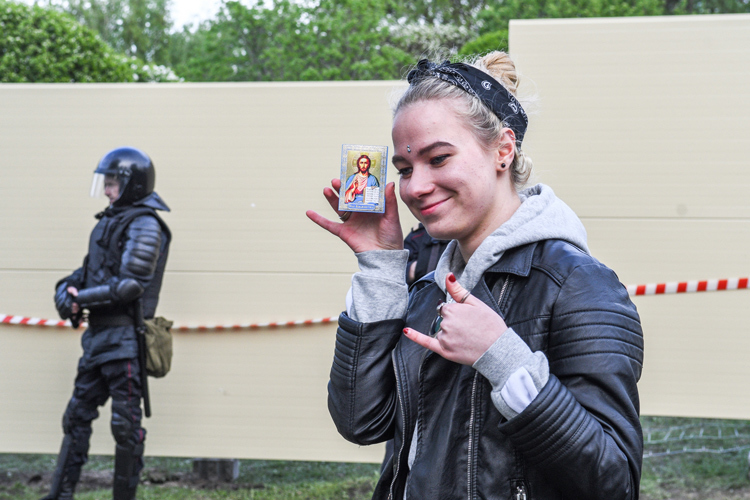
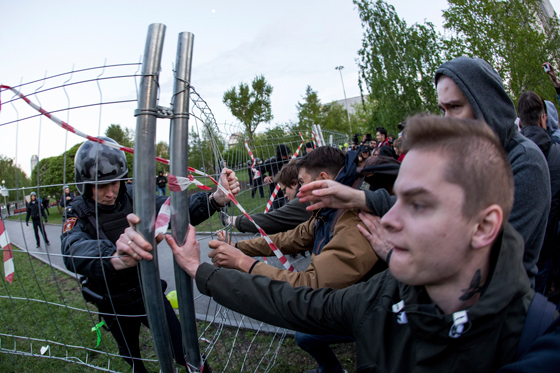
All week independent and civilian media - and we along with them - followed what was happening in Yekaterinburg, whose inhabitants are opposed to the construction of the temple and a residential complex in the square in the city center. On the air of the state radio protesting citizens was called demons . The local church leadership yesterday stated that it was "not just the fight against the temple, but an attempt to destabilize the situation in the region and the country in order to destroy the foundations of Orthodoxy and statehood." Maxim Trustlyubov testifies that the feelings of believers are far from so clear.
Today it is necessary to explain that a group of freshmen from quite urban, educated families could generally gather - by their own initiative - in order to open the temple, and not prevent its appearance. I myself were among those freshmen, and the cathedral that was then discussed, really handed over to the churches in 1991 or 1992, we could not resist there, other, serious, people came, but this is another story.
It is also necessary to explain that the church was then not attached by default either to the authorities or to development projects. Walking to festive services was not a necessary condition for a happy career in the party in power.
It also needs to explain that in those days it seemed that faith and freedom were tightly connected. Now it seems to me that people of the 70s born in the 70s (like me) may turn out to be the only generation that remembers it. The generation here is not demographic - we are more likely about people related to common, comparable experience. A significant part of this experience was the liberation from everything Soviet, and reunification with the tradition and history that were interrupted by the Soviet period. The temple was one of the most important symbols of this reunion - and this was outside the faiths. Then it was not necessary to explain, but now it is necessary, but it is not clear how.
Without the opening of the temple - I was completely convinced then - there would be no transmission of the culture that I wanted to reach, forgetting the political formation and the history of the party as a nightmare. The discovery or construction of temples then went in the same package with freedom of speech and freedom of assembly - and we just practiced them, opening the temple. That package also included the abolition of censorship, the memory of the victims of the Soviet state, the new old, non -Soviet, relationships between people, the return of dignity in relations with the state.
- The selection and production of priests is the party’s business!
The restoration of communication with the “big” world and with Russian emigration was inseparable from all this. In Soviet times, the Russian abroad was banned, and it was there that the emigrants took Russia and faith - they wrote, and we read and wanted to return it - well, or become with all this, inaccessible yesterday, one whole. We also read that Orthodoxy is universal, that it is not limited to national churches and somehow exists on top of political dividing lines. And they also thought that it - in its foreign incarnation - knows how to live in modern society. It can speak with him in an understandable language and even be a moral lamp of a secular society in the absence of coercion - any, atheistic or confessional. Metropolitan Anthony of Sourozhsky, then it seemed then, was a living proof (one can still listen to the lecture of the Protopresian John Meyendorf “Church in the modern world” ).
All this is even strange now, but it was perceived and felt then. There would be no naive expectations if we then watched the news or better understood them. The very opening of the temple at the expense of the USSR was possible, because the Soviet authorities have already prepared a legislative framework for this. We then did not overcome resistance, because it was no longer there.
 © AP / TASS
Even then, the Russian Orthodox Church was included in the sphere of politics on new grounds. In 1988, after a long throwing caused by the approach of the 1000th anniversary of the Baptism of Rus', the Soviet authorities decided to change relations with the Russian Orthodox Church, more precisely, to change the nature of the control. After conducting polls of public opinion, the authorities found that their ideological policy crashed. Citizens did not so much strive for religious faith as atheism rejected. They rejected the class values and the fundamental provisions of Marxism-Leninism about the inevitability of the transition of all societies to communism (polls, the history of the decision of Mikhail Gorbachev and his surroundings on rapprochement with the Russian Orthodox Church are described in the recent interesting book of Victoria Smolkina “Holy place does not exist in a holy place” ( “ a Sacred Space IS Never Empty : A History of SOVIT Atheism " ) ). Here you have to quote from those times:
“We have reached the greatest success in the control of religion and in suppression of its initiative among priests and bishops of the Russian Orthodox Church. At first it pleased, and now it threatens to turn into unforeseen circumstances. Despite the fact that the activities of the Russian Orthodox Church are controlled and limited and its initiative does not cause concerns (although, by the way, even the patience of the clogged, the patience is not highlighted), anxiety raises the strengthening of other faiths ... and the questions arise that the parties are more profitable - a believer in God, not a believer or a believer in both God and communism. I think that out of two evils they choose less. According to Lenin, the party should control all the spheres of the life of citizens, and since you are not getting anywhere and our history has shown that religion is seriously and for a long time, it is sincerely believing for the party that it is also easier for believers to communism. And then the task faces us: to educate a new type of priest. The selection and production of priests is the party’s business! ”
This is an excerpt from the report of Konstantin Kharchev, Chairman of the Council for Religious Affairs, at a meeting with teachers of the Higher Party School of the CPSU. He said this in 1988, when it was necessary to urgently explain to the party asset a sharp turn of the general line. Konstantin Mikhailovich was mistaken only in the sense of faith in communism, in the place of which faith quickly came to capitalism. It would be interesting to listen to today's closed performances to the students of modern incarnation of the party school - the school of governors and deputies under the presidential administration. Judging by what is happening around, the continuity with the Kharchev line is much larger there than with the line of Anthony of Sourozh or John Meyendorf. And the line of Anthony could not survive among the hierarchs, the negative selection of which the party had been engaged in decades.
The irony is that if the ROC as an institution was generally needed for something businessmen and officials gathering to earn money on this project, then just in order to ensure public consent.
The political coexistence of the church with the authorities was immediately understood as a given. The past 30 years have gone to another - in search of the best ways to coexist economic. It was a long and difficult path-from the trade of excisable goods through “charitable foundations” in the early 90s before today's examples of solid development cooperation. We see his mature fruits in today's Yekaterinburg. There is a large development project with offices and expensive housing, the construction of which is engaged in LLC “Temple of St. Catherine” . The company belongs to two large businessmen, and its name (like the idea of including the temple in the complex) is probably invented to promote the project in the labyrinths of the authorities.
The fact that the project could generally cause any opposition on the spot was probably not taken into account. The irony is that if the ROC as an institution was generally needed for something businessmen and officials gathering to earn money on this project, then just in order to ensure public consent. She is absent as an independent institution there. Now the owners of the LLC and the regional authorities invisibly participating in it are probably biting the elbows - why did they need this temple at all, they would have built it faster without it. After all, this is generally the political role of the Russian Orthodox Church - to be responsible for the audience. The church shows the presidential administration that the flock goes to services and is in lines to the relics. It is important at the same time that the care of the audience is carried out, first of all, by the service, and this is limited, because a parish life or, for example, life in the fraternities, is already beginning on the services, and this never know what will turn out.
If you reason dramatically, it will turn out that the church experienced Soviet policy, but did not survive the post -Soviet economy. But this is not so - the institutional and Soviet period did not completely survive (what is now, created in 1943), and the mystical will survive anything. Another thing is important: it is more difficult for today's young people to swim against the currents than those who dreamed of a beautiful spiritual life 30 years ago. Meanwhile, they already managed to express the desire for new relationships between people, the willingness to help their neighbor and defend their right to faith and dignity in a modern secular society. What, as it once seemed, should have been made from the inside of the church, is made on the outside and besides. Yes, the institutional church is not part of this aspiration, but a holy place is not empty.
Subscribe to the COLTA.RU channel in Yandex.Zen to miss nothing