
Translated material
So said Spinoza
Six new products deserving your attention
The sociology of children's literature in the early USSR, the novel of the best friend of Virginia Wulf, the stories of Senchin and Tolstoy, a slightly crazy coloring and a detective about the death of Roland Bart. The observer of Gorky Ivan Napapenko chose the most interesting books that were published this week. 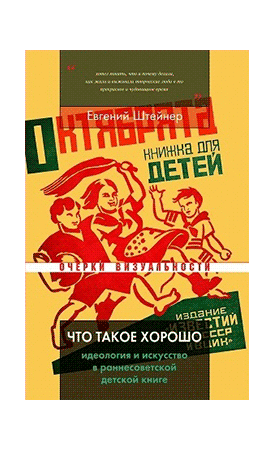 Evgeny Steiner. What is good: ideology and art in the early Soviet children's book. M.: New Literary Review, 2019
If childhood is a space where it is customary to look for master keys from an individual unconscious, then it is logical to assume that a children's book is a fertile material for finding keys to an unconscious era. Evgeny Steiner demonstrates the fruitfulness of this hypothesis, analyzing how in the Soviet children's book of the 1920s and early 1930s it took place, using the expression of Nikolai Bukharin, “processing of human material” (essentially very contradictory and far from ideological unambiguousness). The book is a significant refinement of the 2002 publication, published under the name "Avangard and the construction of a new person." The new text is a third of the total volume, the reference apparatus and illustrative material, which increased primarily due to little -known work, has grown significantly.
“It’s strange, by golly,” “Our Boil Leto-Yeti”, and suddenly “fuck! And everything flew to smithereens”. It is appropriate to recall the thesis already mentioned above again about the presence of archaic stereotypes in the avant -garde attitude and consider this problem in more detail.
It is possible to put forward an assumption, bordering on the confidence that in the Soviet, and earlier-in the pre-Soviet, Russian-intelligence, not to mention the peasant, mentality of the steam locomotive was ultimately associated with destruction and death. As you know, the railway in Russia began with a panic unwillingness of the people to use this means of movement, because of which the road had to be tested on soldiers. Even Belinsky, not without admiration, compared Pechorin with a steam locomotive, which crushes everyone who comes across his way. From stereotypical texts about a cast iron, Nekrasov is immediately recalled, who, having taken to describe the railway, first distinguishes the following:
Right road: the embankments are narrow,
Columns, rails, bridges.
And on the sides are all Russian bones ...
Russian bones turn out to be an absolutely necessary basis for the railway and progress, for they
To life, having appealed to these jungle barren,
The coffin was found here. ”
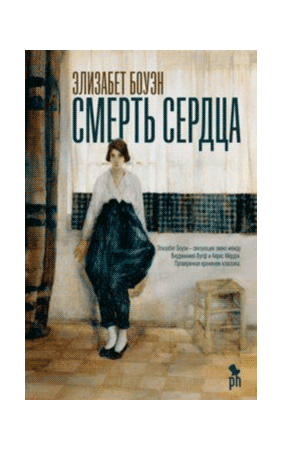 Elizabeth Bowen. The death of the heart. M.: Phantom Press, 2019. Translation from English Anastasia Zavozova
For the first time in Russian, a novel of a little -known writer from the circle of Virginia Wulf (her closest girlfriend) is released in Russian. Publishers characterize the books of Elizabeth Bowen, whose compositions are tightly built into the British classics corps, as a link between modernism of the beginning of the 20th century and the psychological novels of its second half. The result of growing up an innocent young portion, which falls into the two -faced atmosphere of secular London, can be predicted by the name of the novel. The author himself was against the “death of the heart” to be reduced to the tragedy of growing up as unanimous initiation, indicating that it was more about the tragedy of progressive wilting, in which the “adult” heroes of the book are immersed.
“Eddie with a hardened face raised the forgotten wilted Margaritas, broke their stems in half and put it straight into the paper basket. He examined the room, as if trying to understand that there was not yet in its place, then it has completely not changed, completely inhuman gaze returned to a portion and stopped on its figure.
“Now it seems to me that,” he answered.
The portion bent behind the hat. Only the tweeters of stupid chrome-based watches and non-stop ranging the phone violated the silence somewhere below while the portion put on a hat. She had to postpone the letter of Anna, which she, without realizing it, kept all this time in her hands. She got up, laid him on the table - and Eddie's invisible eyes immediately dug into him.
“Oh,” she said, “only I have no money at all.” Will you lend me five shillings?
“You do not need so much money to get home.”
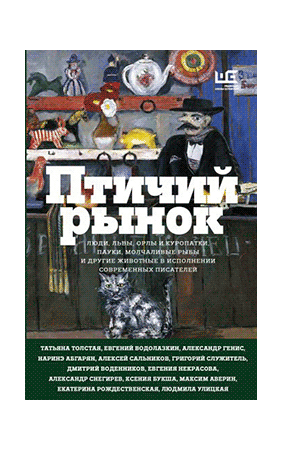 The bird market [Stories] / Compiled by E. Shubin, A. Shlykov. M.: AST Publishing House, 2019
The publication is noteworthy for at least two reasons. Firstly, this is a convenient way to quickly and in one fell swoop to get acquainted with the landscape, so to speak, relevant domestic fiction (at least in its “daytime”, mainstream part) in the range from Senchin's novel to Tolstoy. And secondly, to do this with curtsy towards the fashionable “inhuman” prospects of the narrative: a collection of thirty-seven Russian stories is published with an honest subtitle “People, Lions, Eagles and partridges, spiders, silent fish and other animals performed by modern writers”.
“Nikita was smirked, but he didn’t throw anything more in the goat. Yes, and stopped calling. And Gordey brought the goat a cookie the goat the next day, and he eagerly ate it. Then he said:
-M-me-e-e!
- Tasty?
-Mmmma-e-e!
- I'll bring it tomorrow ...
Strange, but Gordey remembered about mom less and less. No, he remembered her, but so that he wanted to cry, did not remember.
He did not tell a goat about his mother. He will tell, and maybe not what it is necessary. Only he will do it worse ... I decided: the mother will come and he will see everything herself. And something will happen. ”
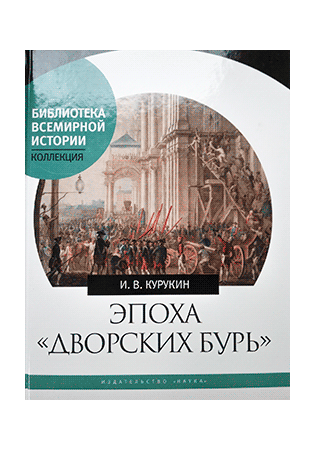 Igor Kurukin. The era of "Dvoro storms". Essays on the political history of post -Peter Russia (1725–1762). M.: Science, 2019
The reprint of the fundamental study of the era of palace coups in the Russian Empire, which first saw the light in 2003. The author in all details captures how, after the traumatic reforms of Peter I, the “Dvoro storms” were institutionalized as a specific way to build a balance between the interests of the autocracy and aristocratic elites. In a natural way, special attention is focused on power games with the participation of the first persons of the "noble corporation", that is, officers of the imperial guard.
“The emperor could save either a throw into the Kronstadt fortress, or following the advice of an experienced minik: to personally“ come to the people and guard, point out to them to their origin and right, ask about the reason for their displeasure and promise all satisfaction. ” Then, and later, the phenomenon of the monarch - such as, for example, Nicholas I in the square in front of the rebellious crowd in 1831 - could change the situation. But he was not capable of the last, and the first decided only by night. However, by that time Admiral Talyzin had already arrived in Kronstadt had already led the sailors and the garrison of the fortress to the oath of Ekaterina and gave them a “portioned cup”. After a two -time attempt to land, he sailed with his retinue, was forced to go at 3 a.m. back to Oranienbaum. ”
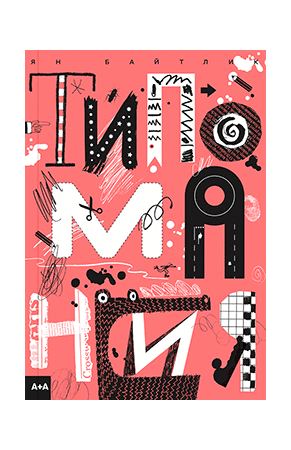 Jan Baytlik. Tipomania. M.: Ada Margin, 2019
An unusual coloring book of a Polish illustrator will interest not only and not so much those who are seriously going to go to study at a marty artist, how many children who are inclined to find funny in a serious one-that is, potentially all children in general. In addition to the entertainment load, the “Printing” is valuactive: the author helps to see letters in almost everything that surrounds us, and thus teaches the understanding that such an abstract, it would seem, the essence is rooted in the very rude life specifics.
“What a mud! Connect the blots so that the letters turn out. ”
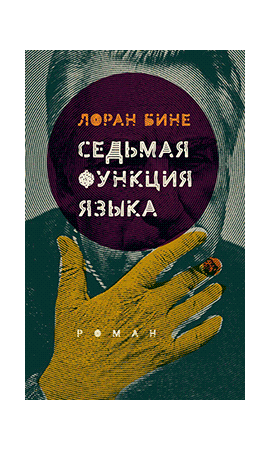 Laurent Bina. The seventh function of the language. St. Petersburg: Publishing House of Ivan Lumbach, 2019. Translation from French Anastasia Zakharevich
Lastness: after a meeting with a contender for the presidential post, Francois Mitterin, philosopher Roland Bart (as in life) is shot down by a car. The police are included in the matter - under suspicion of murder, colleagues of the deceased in the workshop, from Michel Foucault to Julia Kristeva, go. On the horizon there is a secret manuscript of Jacobson’s novel about the magical function of the language, which the killers allegedly seek. Hybridizing Dan Brown and the manual “Post -structuralism for dummies”, Laurent Bina achieves outstanding results. On the one hand, unlike Brown, he is well versed in what he writes about, and on the other, it’s ridiculous to read it (again, unlike Brown), regardless of the relationship with the epistem and the zero degree of writing.
“Kristeva sits on the grass between the two guys. And he says, affectionately, their hair is in a tender: “I love america. You are soigenous, boys”. One of these two is trying to kiss the neck of the neck. She repels him with a laugh. The second whispers in her ear: "You mean" genuine ", right?"
Kristeva quietly jumps back. And he feels how an electric trembling passes through her squirrel body. Opposite them, another student lines and storms the jamb. A pleasant smell of grass spreads in the air. After several puffs, Kristeva’s head is slightly dizzy, and she says with teaching restraint: “As Spinoza said, denial is a definition.” Three already-no-hippy-not-nu-nu-vay delight and fun: “Wow, say it again! What different spinoza say?” ”