Translated material
How Lotman became a structuralist
On the collection of little -known works by the author "Talks of Russian Culture"
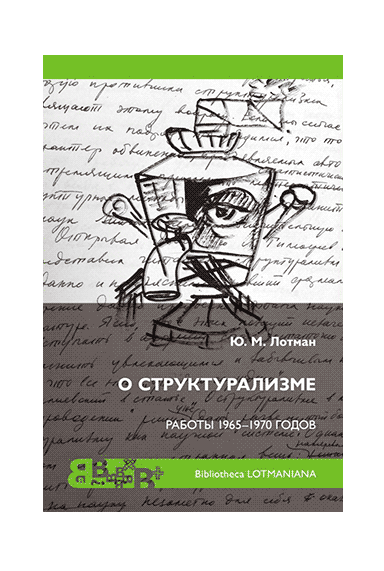
The “Publishing House of Tallinn University” published a meeting of previously not published and inaccessible works of Yuri Lotman, which allows you to better understand not only the scientific evolution of an outstanding scientist, but also the context of the formation of the entire Moscow-Tarta school. At the request of Gorky, this book is told by its editors, Mikhail Trunin and Nikolai Villagin.Yu. M. Lotman. On structuralism: works of 1965-1970 / Ed. I. A. Pilshchikova; sost., prepare. text, accompany. Art. and comment. I. A. Pilshchikova, N.V. Poselagina and M.V. Trunin. Tallinn: TLU Publishing House, 2018
Early Lotman
Structural studies occupied the central place in the scientific work of Yuri Lotman the second half of the 1960s-early 1970s. In fact, it is from his monograph “Lectures on structural poetics”, published in 1964, and held in August of the same year on the sports base of the University of Tartu in Kiaryik [the first] summer school on secondary modeling systems and the Tartu-Moscow (or Moscow-Tartuska, depending on which of its two “brain centers” to put the main emphasis) school. Further Lotman studies in the field of culture typology and semiotics became the development of ideas, first formulated in its early structuralist works.
The son of Lotman, Mikhail, recalled his father’s life: “In the late 1950s-early 1960s. Yu. M. Lotman experienced an acute creative crisis: the circle of problems, the study of which he devoted the previous years, if he did not completely lose interest to him, then, in any case, lost a significant part of his attractiveness. The initial dissatisfaction with himself, however, soon converted into the awareness of the crisis of the situation in the most domestic literary criticism. ”
In the same years, in Moscow, a circle of young linguists, united around Vyach. Sun. Ivanov and Vladimir Toporov, began to develop a structuralist approach to studying not only a natural language, but also the phenomena of culture, including fiction. In this, they relied on the concept of the founder of the linguistic structuralism of Ferdinand de Saussure, and on the work of Roman Jacobson and Claude Levi-Strass, who expanded the scope of the structuralist method. The Moscow circle preferred to call his method to semiotic (or structural-semiotic), in fact, using the concepts of “semiotics” and “structuralism” as synonyms.
Lotmann of the structural and semiotic approach was interested in several reasons. Firstly, he proposed a set of new working tools for the analysis of literary texts, alternative in that it could give official Soviet literary criticism. Secondly, he translated the installation into strict scientific, systematic and verification of the method. For Lotman, this was a way out of the crisis: philology from a set of subjective interpretations and ideological dogmas turned into a serious science, methodologically similar to accurate and natural sciences. The verified and complex terminology of Soviet semiotics also worked for the new approach to find a strictly fifty appearance. Thirdly, Lotman after Ivanov and Toporov saw the potential of the structural-semiotic method, which can be extended to the study of all human culture, and not just its individual aspects. In fact, this meant the transition from philology to the wide field of cultural anthropology, where literature, on the one hand, was interpreted as one of the parts of culture - important, but not the only and not isolated from the rest. On the other hand, the study of language and literature became an indicative and convenient model for subsequent - wider - studies. Finally, for Lotman and others, the connection of structuralism with the formal method was important, especially with the concepts of the OPOSIA, the living representative of which was Jacobson. According to Boris Uspensky, the connection and interest in this case were mutual: “[Jacobson] of the work [participants of the Tartu-Moscow school] read and appreciated, treated them very interested (we all knew his publications and studied on them). When he arrived in Tartu [to the second summer school in Kaerik in 1966 - N.P., M. T.], he played for each report, sat at meetings from morning to evening. ”
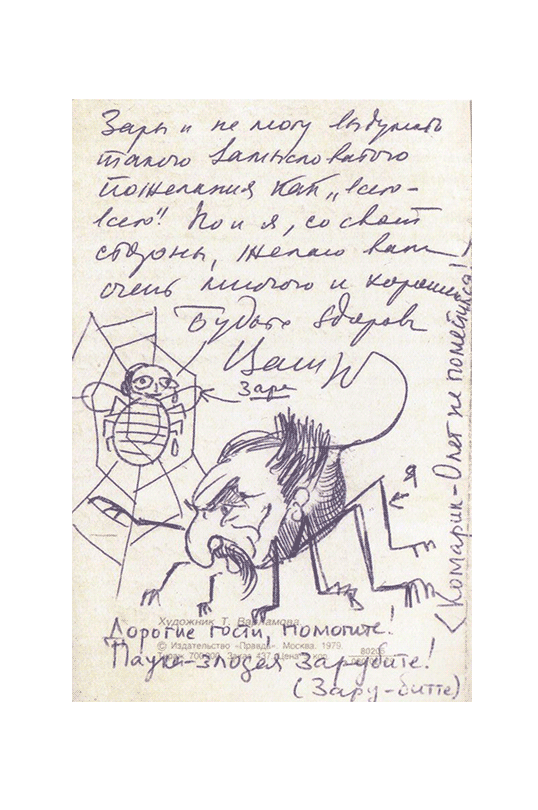 New Year's congratulatory card: “Dear guests, help! The spider-pronounced! (Zaru-bitta). " 1979.
Although the scientific evolution of Lotman, including the times of the Tartu-Moscow school, is not easy, in some places to be confused, and to trace all its features and details, the task of individual large studies, the Lotman structural and semiotic heritage can be divided into two periods: roughly speaking, structural and semiotic. The first of them lasted from the mid-1960s to the mid-1970s. At this time, Lotman was engaged in a detailed development of the method and terminology, applied structural analysis mainly to the texts of fiction and narrative forms of art (for example, cinema), and also determined the boundaries of the method of the method and criteria of structuralism. Since the second half of the 1970s, the structuralist period is gradually replaced by the semiotic: Lotman is increasingly interested in the general problems of the semiotics of culture, the reasoning of strict scientificness fades to the background before raising wide cultural and anthropological issues, and testing the method gives way to wide philosophical generalizations.
The book “On Structuralism” is facing the first period: the works of the second half of the 1960s-early 1970s are presented in it.
What the book consists of
The book contains little-known and previously unknown works by Lotman, dedicated to closely interconnected topics-the origins of literary structuralism, structural poetics and prospects for the application of structural-semiotic approach to intellectual cultural phenomena. Firstly, these are texts that are not published during the life of the author or published in an altered form. Thus, the book opens with the article “On the principles of structuralism in literary criticism”, which was written in 1965 with this name, and printed in early 1967 in reduction under the editorial heading “Literary studies should be science”. Secondly, these are articles written in Russian, but during the life of the author there were only other languages. This is the article “Some results and problems of the application of accurate methods in Soviet literary criticism”, until recently, inaccessible to the Russian-speaking reader, since it was published in 1967 in Italian translated by Vittorio Sereda. The other three articles of Lotman, included in the first section, came out only in Estonian.
The published work is grouped in three sections on chronological, genre and thematic principles. The first section consists of polemic and viewing articles of the 1960s, dedicated to the discussion of the specifics of the structural-semiotic method, its historical roots and its compliance with the criteria for strict scientific scientific in the understanding of Lotman. Since often the historical and political contexts of these reviews and polemic are no longer obvious, a detailed story about them is given in the introductory article to the book. The second and third sections are devoted to other historical and scientific plots, so each of the thematic blocks begins with a separate accompanying article.
The second section contains the materials of the border of the 1960-1970s related to the work of Lotman for the “Brief Literary Encyclopedia” and “Philosophical Encyclopedia”. The key Lotman text of this section is an article on structuralism, written for the CLE, but then never saw the light. The history of its failed publication is described in detail - publishing reviews and other internal documentation of the Soviet Encyclopedia publishing house are given. The Lotman article “Structuralism in literary criticism” is notable not only by the fact that this is a software statement about structuralism, addressed to a wide audience, but also its complex censorship history. A series of prohibitions of work and entire publishing projects begins with it. The enthusiasm of Lotman and other participants in the Tartu-Moscow school of the mid-1960s sometimes lacked to overcome all censorship obstacles.
The third section published materials related to perhaps the most famous Lotman publishing project of those that were banned-by the Russian publication of the works of one of the founders of Czech structuralism, Jan Mukarzhovsky, conceived by Lotman together with his friend, literary critic Oleg Malevich. A special archival research was conducted in the Foundation of the Arts Publishing House in RGALI, where in the same years she began to go out, but soon the book series “Semiotic Studies on the theory of Art” was banned (in fact-the first large-scale approach of the participants of the Tartu-Moskovsk school to cultural problems; only the “poetics of the composition” of the Assumption and Lotman “structure of artistic text” managed to get out of the press). It is noteworthy that the Foundation of Arts could not find any traces of the project of the publication of Mukarzhovsky, while materials about other publications of the failed series in the archive have been preserved. Apparently, the “telephone law” entered into force, which was used by one of the literary functionaries (presumably, the Czech Stalinist Ladislav Stolle, who had good connections in nomenclature Moscow). Nevertheless, the history of the preparation of the two-volume Mukarzhovsky, in the end, divided into two separate books, published only in the 1990s and in different publishers, managed to reconstruct quite in detail. And although the article by Lotman “Jan Mukarzhovsky - the theoretician of art”, written as a preface to the failed two -volume, was already printed in both of these publications, in the book “On Structuralism” it is reproduced in the previously not published author’s edition, which returns it to that scientific, historical and political context in which it was originally created.
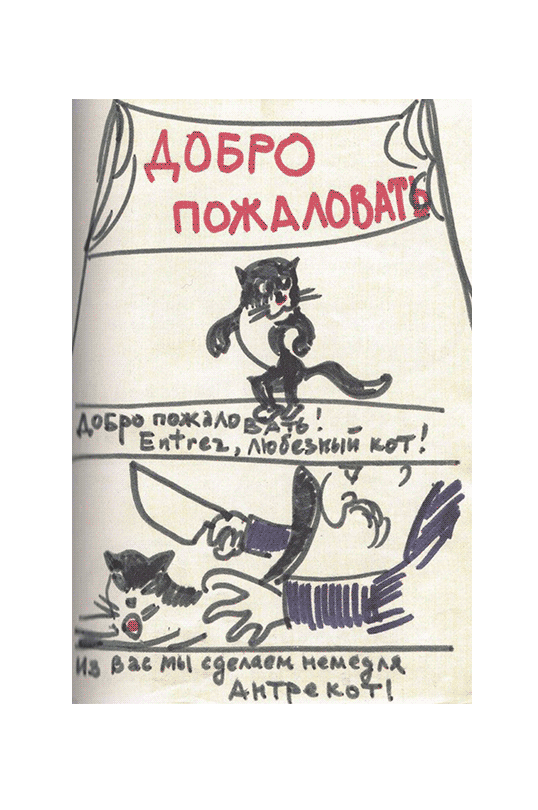 "Welcome! Entrez, my dear cat! Of you, we will make an enthrikot immediately! ” Drawing for the comic album "Kotovasia". 1976
The task of returning Lotman's work to the original contexts is one of the key for the collection “On Structuralism”. The texts collected here under one cover give a more complete, comprehensive idea of the structuralist stage of the evolution of Lotman, and through it-the entire Tartu-Moscow school. The same goal is pursued by detailed comments on each publication, often exceeding the volume of the commented articles themselves.
Although Lotman's main array of Lotman's works has been collected and repressed-primarily in the large project of the Art-SPB publishing house, divided into nine volumes (“Semiosphere”, “On Art”, “History and Typology of Russian Culture”, “Conversations of Russian Culture”, “On Poets and Poetry”, “On Russian Literature”, “Pushkin”, “Karamzin” and “Education” Souls ”), they do not give a complete idea of what scientific and philosophical evolution the thought of their author passed. The articles and monographs of different years, as a rule, are placed under one cover, reproduced inside one section, no comments are given to them (only a short introductory note to all that), and because of this it seems that Lotman wrote more or less the same, but for some reason retold the same thoughts in different ways. Such a publishing principle is useful when readers already know the history of the scientific evolution of the theoretic-classic, and now you need to “revive” it, knock it down from the canonical pedestal and make it again modern and relevant. But this story needs to be written first - and if possible without canonizing the author - and the collection “On Structuralism” is trying to fill out at least part of the gaps in it. More precisely, in its period that refers to the work of Lotman with the structuralist method and its assessments of structuralism and structuralists.
Late Lotman
Since the mid-1970s, Lotman has been increasingly interested in the cultural aspects of the semiotics, and he-without parting, of course, with literary criticism-at the same time is engaged in the development of a large theory of the semiotics of culture. The philological term “text” begins to be interpreted more broadly: from the recording of a work of artistic art (not necessarily verbal), it turns into a certain action or phenomenon endowed with the meaning, more precisely, into our result of “reading” this action or phenomenon - be it the text of literature, cinema, material culture or human domestic behavior. In the end, any action in culture and any phenomenon of culture itself in Lotman's writings turns into a kind of text that the researcher-semiic is able to “read”, understand and decipher for his readers. Since a person, from the point of view of Lotman Semiotics, always abides inside culture and can never go beyond it (because he himself is a “carrier” of culture and, therefore, the semiotic of the surrounding world, its endurance), then the semiotics in this understanding of the general theory of culture turn into a universal science of a person.
At the turn of the 1980s, the term “Semiosphere” appears in Lotman's works-a semiotic space in which all the texts of this culture are created and functioning. In practice, the semiosphere is often equated with culture (usually national, but also world). He has been engaged in the theory of the Semiosphere for the past ten years of life; However, it cannot be said that it is a complete concept with a carefully designed methodological apparatus - rather, it remained a selection of well -aimed observations and general philosophical postulates. Nevertheless, the main theoretical provisions in it are isolated well and their great scientific potential is obvious.
Lotman’s last books - “See within the thinking worlds”, “Unpredictable mechanisms of culture” and “Culture and explosion” - are devoted to the theory of the semiosphere. The fate of these publications turned out to be different. The book “inside the thinking worlds” initially, in 1990, was published in English and introduced foreign readers to Lotman's semiotics; The Russian-speaking original was published only in 1996, already after the “Culture and the Bang” (publ. 1992). The “unpredictable cultural mechanisms” came out in Italian, but the first publication in Russian took place only in 2010.
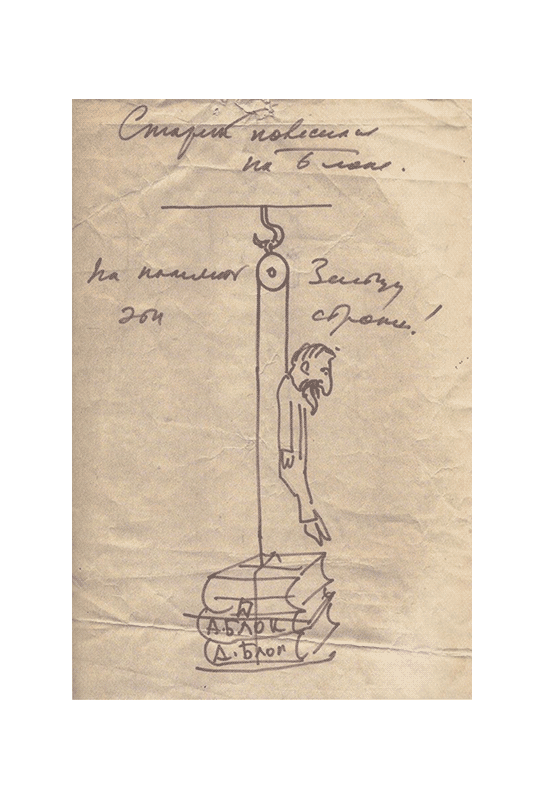 “The old man hanged himself on the block. These lines! ” Late 1970s-early 1980s
As a result, the Russian reader initially presented only the third part of this conditional trilogy, “Culture and explosion”, which is a logical continuation of the first two. She, actually torn from the context, carefully read only those who were already in advance in advance quite deeply immersed in the theoretical context of the Tartu-Moscow school. For the wide Russian humanitarianism, the semiotic of the late Lotman became something as if familiar, but poorly reflected. And Lotman himself remained primarily a literary critic, a specialist in the Pushkin era, and only then on the second roles - a structuralist and a semiotic.
Another picture has developed abroad. Since the late 1960s, Lotman’s works and other participants of the Tartu-Moscow school began to be translated into other European languages (while most of the manuscripts were sent for translations “illegally”, that is, through acquaintances or with an opportunity, in order to avoid censorships that could repair the official Soviet instances), and works of a general-the -oretical nature were selected that could give an idea of the concept of the school as a whole. The book “inside the thinking worlds”, in addition, was read against the background of other semiotic theories and in comparison with them, and this made it better to perceive its own potential. As a result, outside the Slavicism, Lotman is perceived primarily as a semiotic Theoretic, a figure of authors such as Umberto Eco, Roland Bart or Jacques Derrida. Elements of the theory of the Semiosphere are used in various fields - from the approach to the analysis of historical sources, known as “New History” (Stephen Greenblatt), to the analysis of discursive strategies for political power (Albrecht Koshorka).
On the other hand, researchers who use the theoretical tools of Lotman Semiotics often complain that his works are still poorly known to the international audience. For the most part, Lotman still remains a classic of Slavicism, the Area Studies, where his literary work is more in demand. Non-volatilers began to discover Lotman, in fact, only in the 2000-2010s (Greenblatt, who used his ideas back in the 1980s, is a rare exception). And the work of other participants in the Tartu-Moscow school is still waiting for a serious international and interdisciplinary recognition.
Видимо, ситуация может кардинально измениться только когда сами слависты начнут воспринимать наследие Лотмана — как и наследие школы в целом — в первую очередь как теоретическую концепцию, актуальную и сегодня, а не только как подборку (безусловно, высококачественных!) историко-литературных исследований. Сборник «О структурализме» — шаг в этом направлении.