
Translated material
Crisis in Kommersant
Medusa found out how the dismissal of journalists discussed inside the newspaper - and why the authors of the article about Matvienko refused to disclose their sources
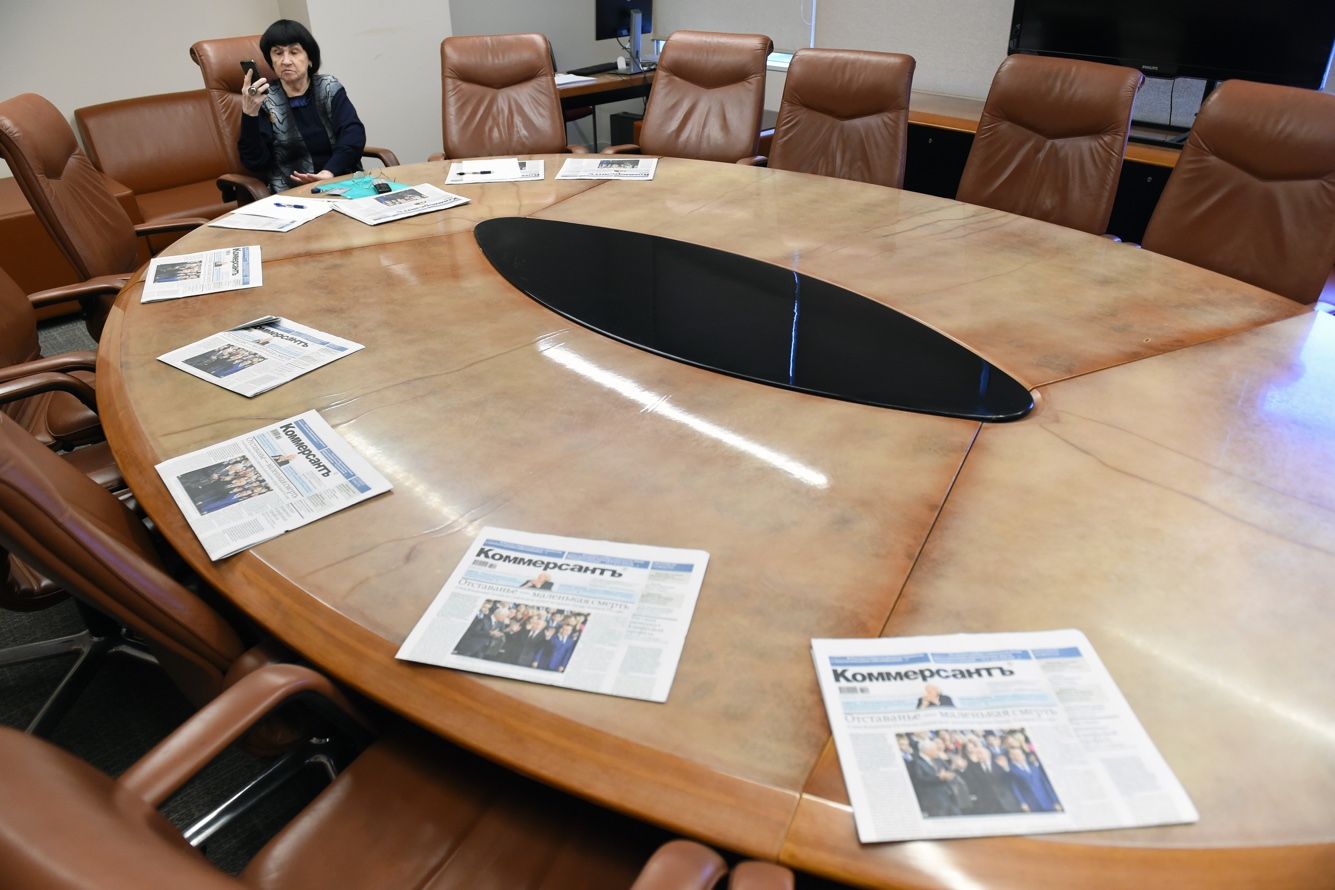
On May 20, it became known that two journalists of the publication - Special Corps Ivan Safronov and editor Maxim Ivanov were forced to leave Kommersant. The owner of Alisher Usmanov demanded their dismissal due to an article on the possible resignation of the speaker of the Federation Council Valentina Matvienko. In protest against the decision of the shareholder from Kommersant, the entire department of politics resigned. Throughout the day, the publication was rapidly immersed in a crisis: the editor -in -chief and chairman of the board of directors of Kommersant accused Safronov and Ivanov of violating editorial standards. The editorial staff issued a statement that the shareholders "right now destroy one of the best media in Russia." Medusa found out how the situation with a note on Matvienko was discussed inside the editorial office. Information about this questions the approval of the management of the publication about the violation of editorial standards.
As the leadership of Kommersant explained the dismissal of journalists
The leadership of Kommersant did not explain the editorial office why Ivan Safronov and Maxim Ivanov leave the newspaper. The first comment on this occasion, the editor -in -chief and general director of Kommersant Vladimir Zhelonkin gave Vedomosti. He refused to comment on the possible intervention of shareholders (later the editor -in -chief announced that he decided to dismiss employees himself), but explained the reasons for the departure of Safronov and Ivanov. Allegedly, in their text about Valentina Matvienko , in which the newspaper sources say that she can leave the post of the Speaker of the Federation Council, “Kommersant’s editorial standards” were violated (there are five authors, besides Safronov and Ivanov, this is Natalya Korchenkova, Anastasia Manuilova, Oleg Sapozhkov).
In a conversation with Medusa, Zhelonkin said that he saw the material before publication, but information about the violation of standards appeared after his text. What exactly the violations were, he did not explain-neither Medusa, nor Vedomosti, nor the Russian BBC service , which asked the chief editor of Kommersant similar clarifying questions. “Zhelonkin refers to certain standards of Kommersant. But if Vedomosti has the famous Dogma , then we have nothing like this, ”Medusa told Medusa one of the reporters of Kommersant (and two more confirmed).
Later, the chairman of the Board of Directors of Kommersant, the representative of the ID Alisher Usmanov Ivan Streshinsky told The Bell that the dismissal of journalists was not related to the content of the article or the pressure of power. According to him, neither Matvienko, nor the head of the foreign intelligence service, Sergei Naryshkin (his sources of Kommersant called the possible successor to Matvienko as a speaker), were not associated with the newspaper, but he “received a signal” that the article could be “custom”. The source of information does not disclose.
After the “signal”, Streshinsky, according to him, asked to figure out Zhelonkin's situation. “It is unacceptable for Kommersant to be used as a drain tank in domestic political showdowns. It was about the journalists to prove to him the good faith of his work and compliance with all journalistic standards, ”said Streshinsky.
The journalists demanded to reveal the sources of information - they refused. At the same time, Streshinsky claims that Zhelonkin would not have transmitted this information to him. Journalists themselves accused of writing a custom article rejected; The deputy chief editor Gleb Cherkasov specified that he himself issued a newspaper’s number with an article about Matvienko-he worked with the text and is “one hundred percent sure that there can be no talk of any custom-made background”.
Despite this, Streshinsky emphasized that the refusal of journalists violates the internal rules of Kommersant and Subordination. The representative of Usmanov in the ID clarified that if there was confirmation from Zhelonkin that the article was not custom -made, he would immediately cancel the decision to dismiss Ivanov and Safronov. To prove this, the editors were given for three days: “In the indicated terms, no confirmation of good faith was provided - this is a vivid evidence that either a custom article, or the scandal is more necessary for journalists. But we will not give in to blackmail. ”
After the refusal, Zhelonkin agreed with reporters on dismissal by agreement of the parties - however, after the scandal, Streshinsky plans to insist on dismissal “under the article”.
On the evening of May 20, Vladimir Zhelonkin commented on the subsequent dismissal of the policy department, saying that the journalists left "for considerations of false solidarity and in order to provide pressure on the leadership of the ID."
Little is officially known about Alisher Usmanov’s position. Usmanov’s press service “Medusa” said that the billionaire learned about the situation from the media. “The shareholder does not intervene in an editorial policy and, moreover, does not make decisions on the dismissal or hiring of journalists,” the press service added.
As the reasons for their dismissal Safronov and Ivanov explained to colleagues
The sources of Medusa in Kommersant said that on the evening of May 20, an informal meeting of the editorial office (“dump” outgoing journalists) took place, which was attended by almost all employees, including some managers; Zhelonkin was not on her. The audience asked to tell about the incident of Ivan Safronov, who noted that “this story has been going on for a month”: “In many ways, we helped to linger here a little longer than the May holidays, during which Alisher Burkhanovich Usmanov sailed on a yacht to Sardinia - but he returned from there.” Medusa has an audio recording from this meeting; Safronov, on this entry, asks the audience, so that “everything that is now saying, it would be good if it hadn’t climbed anywhere”; The Medusa editors publishes only those quotes that it considers socially significant.
According to Ivan Safronov, the position of the shareholder is clear to him “only partly”, although he realizes that “for Usmanov, Kommersant is the same asset as any of the hundreds of his assets, which he is free to dispose of, as he wants.” “There were no illusions about non -interference in editorial policy and so on. Alisher Usmanov wanted to dismiss the ordinary employee of Metalloinvest - the employee is Nafig. He wanted to fire the top manager of Megafon-the top manager of MegaFon is Nafig. He is the owner, this is his decision. There was nothing to argue about this side, ”Safronov said.
The journalist told his colleagues that the leadership of the newspaper had no complaints about the contents of the notes about Valentina Matvienko at the time of publication or the next day; Moreover, “the entire leadership of the newspaper took part in its publication” - and the authors even discharged the prize for it. “The claims appeared a week later - I had to go on a business trip with Putin either to Irkutsk ... where there were fires, in short, there were. I was returned right on the way to the airport and said that there are some difficulties; There is a conversation, ”Safronov said.
Valentina Matvienko did not like the note. “She [Matvienko], as I understand it, personally expressed these claims to our shareholder. Further, respectively, the chain, which was written by the [deputy chief editor of Kommersant] Renata [Yambaeva]: Usmanov - [Chairman of the Board of Directors of Kommersant Ivan] Streshinsky - Zhelonkin, ”said Ivan Safronov at a meeting in the editorial office (that Matvienko was unhappy, and sources of Medusa said, familiar with familiarity situation). After that, long negotiations began on who will be punished - all five authors of the note or only some of them. “[Editorial representatives] tried to save everyone; They [representatives of the shareholder] did not agree to this, ”Safronov explained.
(The interlocutor of the Medusa claimed that, initially, due to the text, they were going to dismiss the chief editor and general director of Kommersant Vladimir Zhelonkin, but he managed to agree with the owners. As a result, the shareholders decided that some authors of the article would leave. “[We] did not work for a long time to do this not,” one of the journalists who resigned as a sign of protest against protest what is happening.)
“One condition was staged before us, and [if it is completed] we remove all claims: you must disclose sources of information, names, surnames, passwords. I think Ms. Matvienko herself wanted to know this. As I understand it, this note was torn by the appointment of Valentina Ivanovna to the Pension Fund. The first version of the headline, by the way, was: “Valentina Matvienko was retired,” Safronov told his colleagues. - Max [Ivanov] and I consulted about this. I said that some people who confirmed the information about it work in power structures in big positions. And if Matvienko immediately calls their head to the minister, he will bent them, kill them, and then what will remain from them will come to me. This is a question of my safety and my family. I can’t open the source and take risks. ”
The next day, the authors talked with their sources, who said that “Valentina Ivanovna began to worry very much,” Safronov said to her colleagues. “We refused to name the names of [sources] on Wednesday. On Thursday, an agreement of the parties comes out: the payment of three -month salaries to everyone. There were two options: to agree to the condition of Gender [to dismissal by agreement of the parties] - or [they could] dismiss us for violation of the TC [Labor Code]. For example, every day we must be at work from 10 to 18. We go through magnetic cards. One fine day, when I will be at the meeting, and not in the office - everything, you can fire for violation, ”the journalist explained.
One of the employees of the publication, in turn, explained that the editorial office was silent about this pressure, and “the silence was aimed at reducing harm”: “There was hope to resolve this and agree. The whole course of today suggests that the reputation costs for those who remain are growing every half hour. ”
“Max [Ivanov] and I several times after all this garbage began, we were somehow discussing-maybe there was an opportunity to roll back that day, already knowing about the consequences. I would say that I would once again write this note. Because she was the note that could and was supposed to be released in Kommersant. If it was necessary to write it again, they probably would have written it too, ”Ivan Safronov told his colleagues.
At the end of the meeting, Kommersant's employees agreed to make a joint statement.
What is said in the final statement of the employees of Kommersant
About 20:45 employees of Kommersant began to publish a statement in their accounts on social networks. The text indicated that, despite the assurances of Alisher Usmanov that he did not intervene in the editorial policy of the publication, the dismissal of colleagues was explained precisely the requirements of the owner.
“Note [about the possible departure of Valentina Matvienko from the post of head of the Federation Council] fully met the“ Kommersant ”standards, which always relies on reliable and proven sources,” the text said. “Moreover, immediately after the publication, the authors were awarded for this material.”
Nevertheless, later the shareholder expressed displeasure of the article and demanded to reveal the identity of the sources. The application notes that, in accordance with the Law on the media and the employment contract, employees of the Kommersant ID, the disclosure of sources is impossible without a request from the court. It was after the refusal of journalists to reveal the names of the sources of the note that a decision was made to dismiss them.
“The Kommersant’s team considers itself to inform the readers that Kommersant will not be able to inform them about Russian politics for an indefinite for a long time,” the statement was stated in connection with the departure of journalists of the policy department. -Such a forced break occurs for the first time in the 30-year history of the publishing house. We apologize to our readers. ”
In the end, the team turned to readers with an appeal to “explain to shareholders” that by their decision to dismiss newspaper employees, they destroy one of the best media in Russia. Signatures under the statement were put several dozen employees of Kommersant.
Attention. After publication, edits were made to the material, since inaccuracies were found in it.
Konstantin Benyumov , Ivan Kolpakov , Pavel Merzlikin