
Translated material
Water was first discovered in asteroid dust

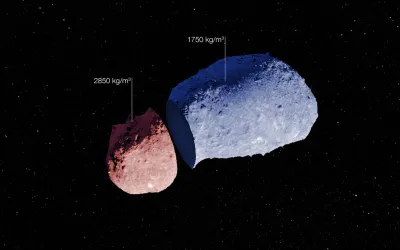
In the mineral samples collected on the surface of the asteroid, water was first discovered. This was reported by the cosmochemistes of Tszylyan Jin and the Metraye Jin, Maitrayee Bose from the University of Arizona, who studied tiny particles from the surface of the asteroid of the outcome. The substance from the results fell to Earth in 2010 - this is the main result of the Hayabus mission of the Japanese Aerospace Research Agency (JAXA). An unexpected find allowed researchers to propose their hypothesis of the appearance of water on Earth [ 1 ].
Water is not only a key condition for the appearance and existence of carbon forms of life [ 2 ], but also a substance necessary for the formation of the earth -type planets [ 3 ]. Even if it is excluded from the calculation of the hydrosphere of our planet, it is still quite rich in water. The earth's crust contains from 15 thousand to 20 thousand million shares (metro) of water, in a mantle, according to various estimates, from 380 to 2560 m. [ 4 ]. Liquid water was recently discovered under an ice layer at the south pole of Mars [ 5 ]. The results of recent studies suggest that on the moon and asteroids of the Vesta family you can also find magmatic water [ 6 ].
The origin of water in the inner region of the solar system is a constant subject of disputes [ 6 ]. Within the framework of the astronomical model of large maneuver 1, it is believed that the asteroids rich in volatile substances were inside the orbit of Jupiter no later than 10 million years after the formation of this planet and provided water for the growing planets of the earth's group. The hypothesis of late accretion suggests that the most water was in the internal solar system about 100 million years after the formation of Jupiter, and ice asteroids and comets from the external regions of the solar system became the source of this water [ 7 ]. In addition to the two main hypotheses of the appearance of water on the planets of the earthly type, there are many alternative scenarios, which in themselves seem quite reliable, but contradict each other, and great maneuver, and late accretion. As a result, astronomers are forced to recognize the uncertainty of ideas about the origin and the amount of water that fell on the planets of the Earth Group of the Solar System (from Mercury to Mars inclusive), as well as when this happened.
Information about whether its planetosimali (cosmic objects from which the planets of the solar system once formed) came from from the planets of the earth's group from the planets of the earth's group. It is assumed that the most reliable information about the chemical composition of planetosimale in our time can be given a study of S-type asteroids. These are relatively small (no more than 20 km in the diameter) space objects located at distances from 0.3 to 3 a. e. from the sun. Asteroids of this type are the most common type of asteroid zone. Astronomers suggest that they could save information about the appearance of water in the solar system and on internal planets.
In 2010, the Japanese Aerospace Research Agency received about 1,500 particles of soil collected from the surface of the S-type asteroid-asteroid of the outcome of 25143. The results are an improper space object with a maximum length of 0.3 km. He makes a complete revolution around the Sun in 18 months. Samples of soil from this asteroid fell into the earth's laboratories thanks to the Hayabus mission.
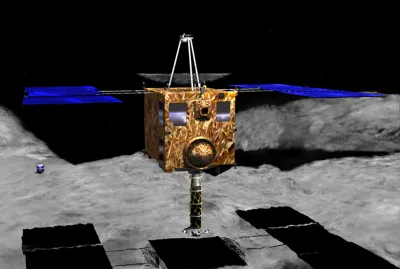
The Khayabus space probe (in Japanese this means “sappan”) was launched on May 9, 2003. It was planned that he will approach an asteroid, study its composition right on the spot, take the soil sampling, and in June 2007 he will return to the ground and drop a capsule with produced samples. This would be the first delivery to Earth from a different large celestial body after lunar expeditions.
The Hayabus mission was dramatic: its engines and solar panels worked with failures, and the failure of a special sampling mechanism forced scientists to doubt that the apparatus would be able to deliver at least some samples of substance from an asteroid to Earth. The total duration of the trip exceeded the calculated by three years. During the flight to the results, a strong solar flash violated the work of solar panels. This reduced the maneuverability of the device to a minimum. Because of this, the probe reached an asteroid only in September, and not in mid-2005, as was originally planned. In November 2005, Hayabus was supposed to carry out three short landings on the results - one trial and two regular ones. However, due to a number of failures, one landing was unsuccessful.
Having flew up to the asteroid and sitting on its surface, the Hayabus was supposed to release a microcorobot equipped with three cameras. Two synchronized cameras were designed for stereo shooting of objects located at a distance of 10 to 50 cm from the robot, including for the shooting of individual specks of dust. The third camera could observe more remote surface objects. Also, the robot was equipped with devices to study the composition of an asteroid. However, after the robot was separated, it was not possible to establish contact with him, and he was lost.
On November 26, 2005, Hayabus tried to pick up the soil of the asteroid again. Before rapprochement with the surface of the asteroid, a computer failure. The device lost its orientation, and one of the engines was damaged. Although the soil was still taken away, soon the connection with the probe was lost. By March 2006, communication with Hayabusa was restored. In June 2006, JAXA reported that the device may still be able to return to Earth.
Fortunately, on February 4, 2009, JAXA employees finally managed to restart the Ion engine and direct the apparatus to the ground. On June 13, 2010, Hayabusa entered the atmosphere of the Earth and dropped a descent capsule containing examples of an asteroid substance. The capsule has successfully landed and was discovered in the south of Australia. The device itself burned out in the dense layers of the atmosphere.
The main components of the substance are chain iron -sososilicates - olivin and pyroxen. The same silicates were previously discovered as part of a lunar substance. It is assumed that these substances were formed as a result of the condensation of the cooling protoplanetary disk, from which the solar system was formed [ 8 ]. Jin and Bose analyzed two pyroxenic grains, determining in them the water content and the ratio of deater to light hydrogen (D/H) using the method of nano-plane secondary ions-specification. One of the grains contained 970 ± 93 m. Water, and the other is 680 ± 65 m. This is a fairly high water content for formally anhydrous materials from an asteroid, in particular, considering that over millions of years of existence of the result of the breed located on its surface, it was subjected to cosmic elimination and lost water. It was also found that the isotopic composition of hydrogen in the studied particles is close to the average isotopic composition of hydrogen in the water of the world ocean. The results obtained by Jin and Bose allow us to say that the asteroids of the S-type, formed in the internal solar system, despite high temperatures, contained a large amount of water and could become a potential source for the Earth.
Based on the results obtained, Jin and Bose offer their hypothesis of water on Earth. They suggest that during the formation of the solar system, iron -winging particles, the dimensions of which were comparable to grains of substances delivered from the results, captured hydrogen due to both physical adsorption and chemical hydroxylation processes that occurred at high temperatures (up to 1200 ° C) and pressure in the protoplanetary disk. Over time, iron -sososilicat grains stuck together, forming a protoplanetary disk at first, and then planetosimali, similar to the results, most of which continued to accrecrate and turned into planets. Thus, Jin and Bose suggest that the water was already contained in the material from which the Earth and other planets of the solar system were formed.
Of course, this hypothesis also needs to be tested. There are indirect evidence of the existence of water on the asteroids of the S-type. For example, the NASA OSIRIS-REX probe spectrally discovered a gydroxil radical (he ·) on asteroid Bennu. However, the results of only spectral studies are difficult to interpret - they simply talk about the presence of water, not allowing you to unambiguously judge its origin.
It is possible that the cosmochemists will be able to get more full-fledged information by analyzing the results of the JAXA “Hayabus-2” mission, which was directed to study another S-class asteroid-1999 JU3. Its diameter is estimated at about 0.92 km - almost twice as much as that of the asteroid. Launched on December 3, 2014, on February 22, 2019, the Hayabus-2 probe sank to a relatively flat six-meter venue of 1999 JU3 and took soil samples. Currently, Hayabus-2 continues to study the asteroid 1999 JU3. If there is no emergency situations, the Hayabus-2 departure on the return path to the Earth is scheduled for December 2019, and the return to land with soil samples for December 2020.
Arkady Kuramshin,
cand. chem. Sciences, Associate Professor of the Chemical Institute of KFU