
Translated material
Tibetan Denisovets
This was supposed to happen sooner or later, and this happened.
Until now, we knew the Denisovites - representatives of the third branch of Homo sapiens (the other two are Neanderthals and Cro -Magnons, that is, we) - only on small bones from the Denisa cave in Altai: teeth, phalanx of the fingers. Fortunately, this was enough to determine the genomic sequence; As a matter of fact, according to the genome, Denisovites were allocated in a separate group [ 1 ].
The Denisovites lived in this cave for at least hundreds of thousands of years, interspersing and crossing with Neanderthals. Last sensation was the genome of a girl whose mother was Neanderthal, and dad - Denisovts [ 2 ]. But, on the other hand, fragments of Denisov origin were discovered in the genomes of the Australians (up to 5% in individual genomes), eastern and southern Asians and American Indians, and crossing has occurred repeatedly [ 3 , 4 ]. So, fragments from one group of Denisovites were found only in the genomes of modern residents of New Guinea, and according to some estimates, crossing happened only 15-30 thousand years ago (however, this dating is disputed) [ 5 ]. In any case, this means that the Denisovites lived not only in Altai and in different parts of their range met with the ancestors of modern people, leaving their mark in the genomes of many ethnic groups. However, we saw only these traces and did not see the Denisovs themselves: there were no bones anywhere, although everything indicates that they should be found not only in the Denisa cave.
Denisov variants of some genes were useful for the southern and eastern Asians [ 6 ], the Inuits of Greenland [ 7 ] and Tibetans. Almost all Tibetans have the Denisov version of the EPAS1 gene, useful for life at high altitude [ 8 ]; In general, it turned out that the higher the Tibetan lives, the more he has in the genome of Denisov and Neanderthal fragments [ 9 ].
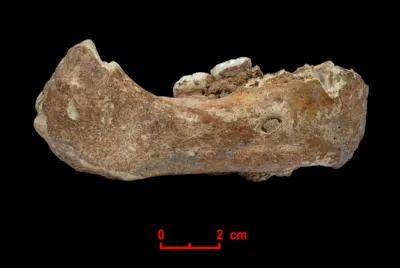
And, it seems, the first residents of the Tibetan plateau were the Denisovites [ 10 ]. As has already happened in studies of ancient DNA, the archaeological discovery was made not on excavations, but in the museum. The bone-a fragment of the jaw with several teeth-was found back in 1980 by the Buddhist monk in the karst cave of Bayshiy and transferred to the sixth living Buddha Gun-Tan, who, in turn, sent it to the University of Lanzhou [ 11 ]. Researchers from this university Fahu Chen and Dunzu Zhang passed the bone to study at the Institute of Evolutionary Anthropology of the McA Planck Society, in which Denisovites opened nine years ago [ 1 ]. DNA was not preserved, but it was possible to distinguish and explore proteins from dentin, hard tooth tissue - they found options that are characteristic of the Denisovites, and the limestone crust made it possible to determine its age, 160 thousand years, which coincides with the age of the oldest bones from the Denis cave and that earlier than the exit from Africa of the ancestors of modern Euro -Asians.
What to wait? You can hope for the Denisov bones with the preserved DNA, or in excavations, as soon as it became clear where you can look, or in museum samples. But the sensation would be the genomes of the new branches of hominids. The fact that they can find there are fragments inherited from unknown hominids in the genomes of Tibetans [ 9 ], Indians and inhabitants of the Andaman Islands [ 12 , 13 ] (however there are doubts [ 14 ]), Pigmeev of Central and South Africa [ 15 , 16 ], and the Denisovs themselves [ 13 ].
Mikhail Gelfand
- Reich d, ..., pääbo S. Genetic History of An Archaic Hominin Group from Denisova Cave in Siberia. Nature. 2010; 468 (7327): 1053–60. DOI: 10.1038/Nature09710. ncbi.nlm.nih.gov/pmc/articles/pmc4306417/
- Slon V, ..., pääbo S. The genome of the offspring of a neanderthal mother and a denisovan Father. Nature. 2018; 561 (7721): 113–116. DOI: 10.1038/S41586–018–0455-X. ncbi.nlm.nih.gov/pmc/articles/pmc6130845/
- SKOV L, ..., DURBIN R. Detecting Archaic IntrogReSSON USING An Unadmixed Outgroup. PLOS GENET. 2018; 14 (9): E1007641. Doi: 10.1371/Journal.pgen.1007641. Journals.plos.org/plosgenetics/article?id=10.1371/Journal.pgen.1007641
- Browning SR, Browning BL, Zhou Y, Tucci S, Akeyy JM. Analysis of Human Sequence Data Reveals Two Pulses of Archaic Denisovan Admixture. Cell. 2018; 173 (1): 53–61.e9. DOI: 10.1016/J.Cell 2018.02.031. scienceirect.com/science/article/pi/s0092867418301752
- Gibbons A. Moderns Said to Mate with Late-Surving Denisovans. Science. 2019; 364 (6435): 12–13. Doi: 10.1126/Science.364.6435.12. Sciencemag.org/news/2019/03/our-mysterious-cousins-denisovans-may -have-modern-hacently-15000-years-go
- Racimo F, Marnetto D, Huerta-Sánchez E. Signatures of Archaic Adaptive IntrogResion in Present-Day Human Populations. Mol Biol Evol. 2017; 34 (2): 296–317. DOI: 10.1093/molbev/MSW216. ncbi.nlm.nih.gov/pmc/articles/pmc5400396/
- Racimo F, ... Nielsen R. Archaic Adaptive IntrogRession in TBX15/Wars2. Mol Biol Evol. 2017; 34 (3): 509–524. DOI: 10.1093/molbev/MSW283.
ncbi.nlm.nih.gov/pmc/articles/pmc5430617/ - Huerta-Sánchez E, ... Nielsen R. Altightude Adaptation in Tibetans Caused by Introgression of Denisovan-Like DNA. Nature. 2014; 512 (7513): 194–7. Doi: 10.1038/Nature13408. ncbi.nlm.nih.gov/pmc/articles/pmc4134395/
- Lu d, ..., Xu S. Ancestral Origins and Genetic History of Tibetan Highlanders. Am J Hum Genet. 2016; 99 (3): 580–594. DOI: 10.1016/J.Ajhg 2016.07.002. scienceirect.com/science/article/pi/s0002929716302737?via%3DIHUB
- Chen f, ..., Hublin jj. A Late Middle Plestocene Denisovan Mandible from the Tibetan Plateau . Nature. 2019; 569 (7756): 409–412. DOI: 10.1038/S41586-019-1139-X.
- Max Planck Institute for Evolutionary Anthropology. FIRST Hominins On the Tibetan Plateau Were Denisovans. Science Daily, 05/01/2019. ScienceDaily.com/releases/2019/05/190501131405.htm
- Mondal M, ..., Bertranpetit J. Genomic Analysis of andamaneses Provides Insights Into Ancient Human Migration Into Asia and Adaptation. Nat Genet. 2016; 48 (9): 1066–70. DOI: 10.1038/NG.3621. Afanporsaber.com/wp-content/uploads/2016/08/genomic-analysis-off-andamanese-oprovides-into-anto-ancent-human.pdf
- Mondal M, Bertranpetit J, Lao O. Approximate Bayesian Computation with Deep Learning Supports a Third Archaic IntrogRonsion in Asia and Oceania. NAT Commun. 2019; 10 (1): 246. Doi: 10.1038/s41467-018-08089-7. Nature.com/articles/s41467-018-08089-7
- Skoglund p, ..., Reich D. No Evidence for Unknown Archaic Ancestry in South Asia. Nat Genet. 2018; 50 (5): 632–633. DOI: 10.1038/S41588-018-0097-9. ncbi.nlm.nih.gov/pmc/articles/pmc6433599/
- Hammer MF, Woerner AE, Mendez FL, WatKins JC, Wall JD. Genetic Evidence for Archaic Admixture in Africa. ProC Natl Acad SCI USA 2011; 108 (37): 15123–8. DOI: 10.1073/pnas.1109300108. pnas.org/content/108/37/15123.long
- Hsieh P, ..., Hammer mf. Model-Based Analyses of Whole-Genome Data Reveal a Complex Evolution History Involving Archaic IntrogReun in Central African Pygmies. Genome Res. 2016; 26 (3): 291–300. DOI: 10.1101/GR.196634.115. genome.cshlp.org/content/26/3/291.long