Date
Author
Анастасия Семенович

Preserved copy
Translated material
Naked women beat the pelvis
On the first of April 2019, the cost of washing in a public bath on the 17th line of Vasilievsky Island in St. Petersburg sharply jumped from twenty-five rubles on a preferential day to sixty. For permanent visitors, this became another symptom of a prolonged decline in the colossal sanitary and hygienic empire, built in the USSR for residents of communal services. Once upon a time, thousands of people were washed and steamed daily in public baths, and today there are almost exclusively adherents of a special city bath culture, unlike modern saunas and expensive steam rooms. At the request of Samizdat, Anastasia Semenovich’s many -year -old member of this disappearing community explores the fragments of the genuine culture of the Soviet steampunk, where the ethics of spontaneous feminism of the female steam room mixed with traces of village magic.
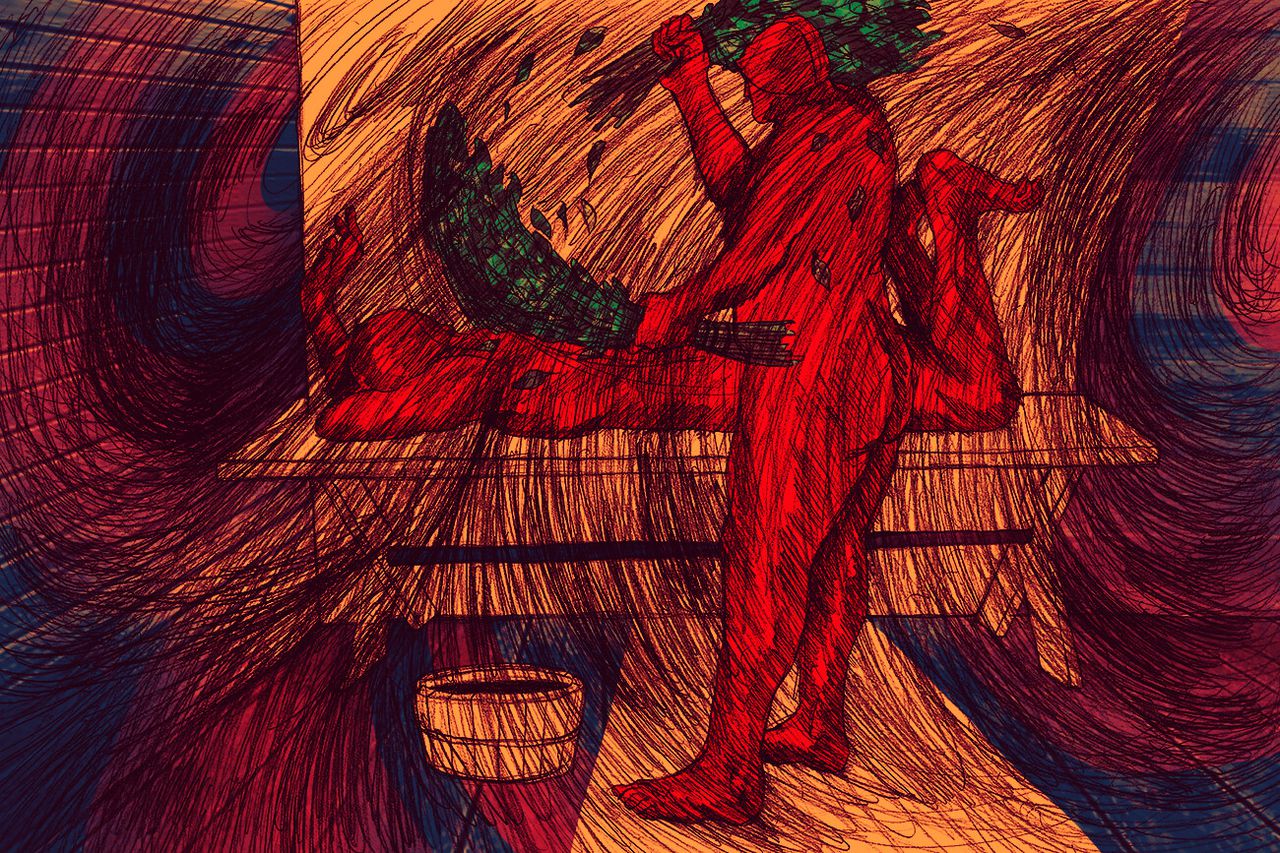
"Girls, steam!" We gain steamed brooms from the basins - birch, oak. Sweeping water from the foliage. We put on a variety of hats, take the seats, go into the spacious old steam room. In the corner there is a massive furnace, in some places rolled to brick, and in the stove behind heavy shutters - hot stones. We give in. It is necessary for a long time to wave a heavy pole with a cast-iron cup for a long time, slightly throwing hot water into the far corner, where it hisses better. The conversation is silent, after a few minutes we ask for mercy: "One, two, three - and that’s all, otherwise it is already burning!" We breathe. We are waiting for the steam to fall. Women smile. Here no one pulls his stomach, the leg sits on the leg, like in the saunas of water parks and fitness clubs-on the contrary, lounging blissfully, scraping hips, heels, armpits. We are not like pastoral swimsuits. The floor above the same stove is appealed in the male department. “The men are talking loudly. About politics, probably! " On the right, someone's eucalyptus broom smells like a vacation on Sicily, or an inhaler. I will have a nose and smile even wider. The mistress of the broom brings it on me for a couple of minutes - breathe. She specially brought these branches from vacation, then to go to the bathhouse with them. “You know, I don’t even worry with this broom, I take it for smell.” - "Yes, this is directly a bouquet!" We are soaring. Oak leaves are sticking to clean red-pink skin, the torture sound of whipping by branches is interrupted by interjections of happiness: ah, oh, oh, uh. From a steam run under a cold shower and in an ice pool. And again. And yet.
Spa for ten rubles
For ten years I have been going to my “my” public bathhouse on Vasilyevsky Island. This is not a spa-salon or “Sanduna”: no one “serves” us, we clean and ventilate the steam room, my floor, scoop up the leaves, dry, give in. We do not always know each other by names and more often we recognize by hatches, but we all love this bathhouse, from year to year every Monday we carry heat from here in the shower, lightness in the body and excellent mood.
Meanwhile, in the soul and the restroom, you can meet a cockroach here, and a cricket lived in a steam room a couple of years ago. No elegant tile and fresh, photogenic wood, but here they are not afraid to leave things in open lockers, and “washing” costs 60 rubles (until April 1, 2019 it happened 25 each, and even earlier - 10 each). But the main thing is the right, “prayed” steam room.

Every day there are dozens of women of various income and lifestyle, someone flies on vacation to the Dominican Republic, and for someone a Sunday bathhouse is too expensive, someone has a spectacular tattoo on a tanned body, and someone enters the steam room with a stick, but everyone is equal in the bathhouse. And whoever you are, it is not customary to swear in the bathhouse and be “on negative”, talk about work and family squabbles. “Washing” - a couple of hours of rest and joy. Here you can cure a cold, cough, soul. Once I saw a woman who spent an hour and a half at the soapy, looking at one point-a spectacular blonde with a black-black and green face from coffee grounds from coffee grounds.
The fragments of the giant
“In 1907, on the 17th line of the Vasilievsky Island, d. 38, a bathhouse“ for the poor ”was built. She was still hidden behind the huge backs of the houses that had been rebuilt later and continuing to perform a difficult task, which was cherished on her brick shoulders almost a hundred years ago, to serve the poor, which is also plentiful among the inhabitants of the Vasileostrovsky communalists, ”wrote Igor Bogdanov, in 2000, in the book“ Three centuries of the St. Petersburg Bani ”about our bathhouse. He notes that from a deep pre -revolutionary tradition in Leningrad, the bathhouse degenerated into a “washing” and obligation. For example, as Fyodor Chaliapin steamed in the Pushkarsky baths on the Petrograd side: “Barely entering the big dressing room, Chaliapin instantly undresses”, and then, “Clutching a large washcloth and a huge birch broom in his hands ... widely stepping with large steps of long legs, quickly went to the bathroom ... here is hot, but it was hot, but it was hot, but it was hot, but it was hot, but it was hot. And comfortable ... ”After some time, Chaliapin“ processes his body with the cruel blows of the rustling birch broom ... From the clouds of the couple, the voice of Chaliapin comes: “Venik-the main superiors are the main one! Bath is dear! ... I-uh you! I love, brothers, bathhouse!” Then, on the motive “Volga, Volga, Mother Mother” he sings “Bath, Bath, Mother” - and the rest of the companions in the bathhouse pull him up. ”
And the 30th researcher describes this: “... the baths built over the years of Soviet power were not designed for a person, but for a crowd“ carrying out the raining ”. All planned baths were supposed to have the necessary “throughput”, because in most newly erected residential houses, bathrooms were not provided, as certain apartments, individual kitchens, isolated toilets and other “luxury” were not provided.
Giant baths were built with a calculation of thousands of people a day, and the workers, according to Bogdanov, forced to go to the bathhouse (for hygiene reasons). The architect A. S. Nikolsky designed a bath with a glass dome, a pool, a solarium and a ramp, but the power rejected similar “excesses”, making a “washing” from a delicious Chaliapinsky bath. It is this calculation for the crowd that we owe the current abundance of old baths in different parts of the city. The crowd is so a crowd. There are really many of us - more than fifty cabinets. But we do not go to our old “bath for the poor” for “raining”.
Naked women beat the pelvis
The rain was wow, even the roof of Zenit-Arena flowed (although, probably, this is just not an indicator). On the street, a flood, women come with already wet brooms, dripping from the nose, boots and jeans through.
- All spring they talked about the hot summer. And about global warming. Where is it all? For 75 years, I still did not understand what it was - when it was hot. I remember it was young, we left the door open at the dacha open to the house to put it into the house. And this year, one day, August 19, it was Saturday, it was 26 degrees. We sat near the house in the evening and thought how good, warm! And it was never hot.
- It is hot when you no longer know what to remove from yourself. When it does not become cooler at night, and there is no wind either, and +33 without a single cloud for two to three weeks. You want to inhale, but there is no air, it just burns with heat. You climb under a cold shower - and the water is hot, because the river from which the water intake is also hot. And the grass dries by mid -July, turns into straw.
- I have never seen this, I can’t imagine. And I do not like rain, I am so sad from him that, they say, this is depression and I have to go to the doctor. If it does not stop, I would be better here, I stayed in the bathhouse.
Many bring eucalyptus, mint, chamomile to the bathhouse, tangerine crusts, bread, beer and so on, which can be brewed to get “delicious” water. In general, ladies go to the steam room in interests who wants to breathe with what: who loves “crusts”, some kind of chamomile, and someone wormwood. One woman often wears horseradish leaves. He makes his way, heals even sinusitis, but not everyone likes the smell. Going to give, the lady throws a cry: "Girls, who is with horseradish, come in!" In the middle of spring, the hell was over.
Once they left the steam room to get a basin of water, and found out that it was not. Neither hot nor cold. The banner, hastily slapping on the soapy, promises that in five minutes “everything will be”. Then he opens the door to the next wing and calls a certain fraction. Silence.
- Tolik! Tolik!
Distant steps. The banner, turning around, into the soap:
-Women, well, you would at least somehow, something ... would be covered! Immediately a man will go now!
- Where will the man go? - the ladies calmly clarify. Then they slowly remove their basins from the path of the Master Tolik, but they themselves do not think to scatter. He works in the bathhouse - his problems.
The water really went in five minutes. Tolik hastily ran across the female department, lowering his reddened face.
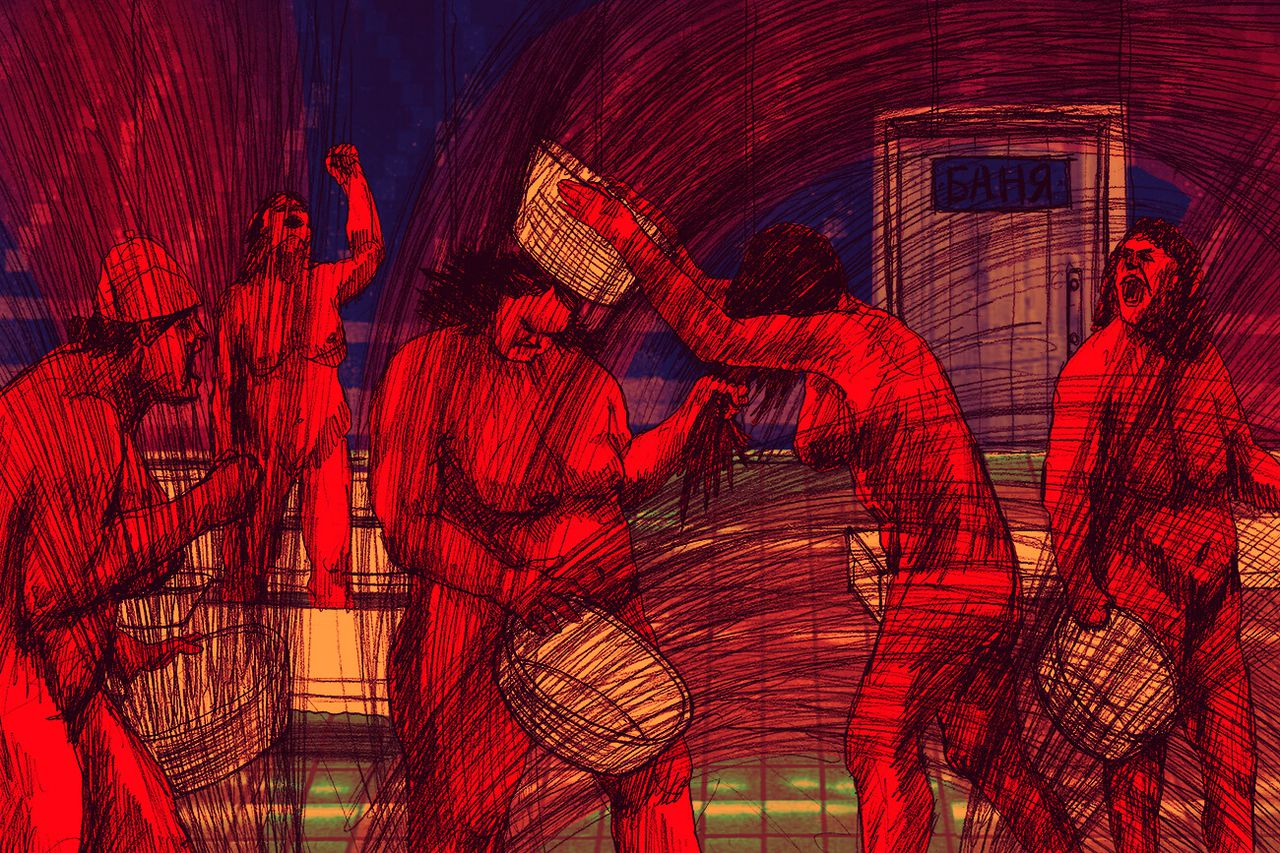
There is a rule: in the bath we don’t swear, we leave all the negativity behind its walls. Therefore, in the steam room on the 17th line, everyone is usually satisfied and kind. But there was a couple of years ago the incident: Chkalov baths were closed for repairs - and from Petrogradka the people went to us. The ladies from Chkalovskaya considered that they were soaring in Vasilyevsky incorrectly, and arranged a fight. The banner called the police. They arrived, went into the hall and stand-they just can’t do anything: naked women beat the basins, not noticing some men in shape. “And what can be done with them - it is even impossible to seize them: they are slippery from soap, slip out, hammer wildly. So the police stood, looked until one of them guessed to take a hose along which ice water was going on to the pool and water them. Somehow spread out, ”says an eyewitness. “Here's the wildness. It’s good that I was not there, ”says the other. - And then suddenly I would like to join. By the way, who won in the end? Vasileostrovsky? "
Village magic and steampunk
If you delve into ethnography and folklore, it is easy to notice that the bathhouse was considered something “unclean”, for example, it was impossible to go to church after it-probably because the bathhouse was often used as a place for magical rituals.
In the dissertation of Marina Vadeisha “Anthropology of the Russian Bath” (Faculty of Anthropology EU, unpublished manuscript), the author indicates that in traditional culture the hygienic function of the bathhouse is almost no matter, the main ones are ritual meanings. The unchanging attribute of weddings, fortune -telling, magic rites, the bathhouse was nevertheless considered a place “unclean”. Vadeisha refers to the book of V.-F. Ryana “Bath at midnight: a historical review of magic and fortune -telling in Russia”: “The American Slavist gives not only numerous examples of the use of a bathhouse for witchcraft and fortune telling, the treatment and transfer of special knowledge, but also considers its role in the rituals of the life cycle.
In general, Ryan’s book leaves the impression that the space of the Russian bath has a complex semantics, and its image in culture has developed over the centuries. Noting that in Russian baths everywhere it was accepted as the norm of joint washing of men and women, Ryan suggests that the intolerable attitude of the Russian Church to him originates in the ancient and Byzantine tradition, where public baths were foci of prostitution and witchcraft. ”
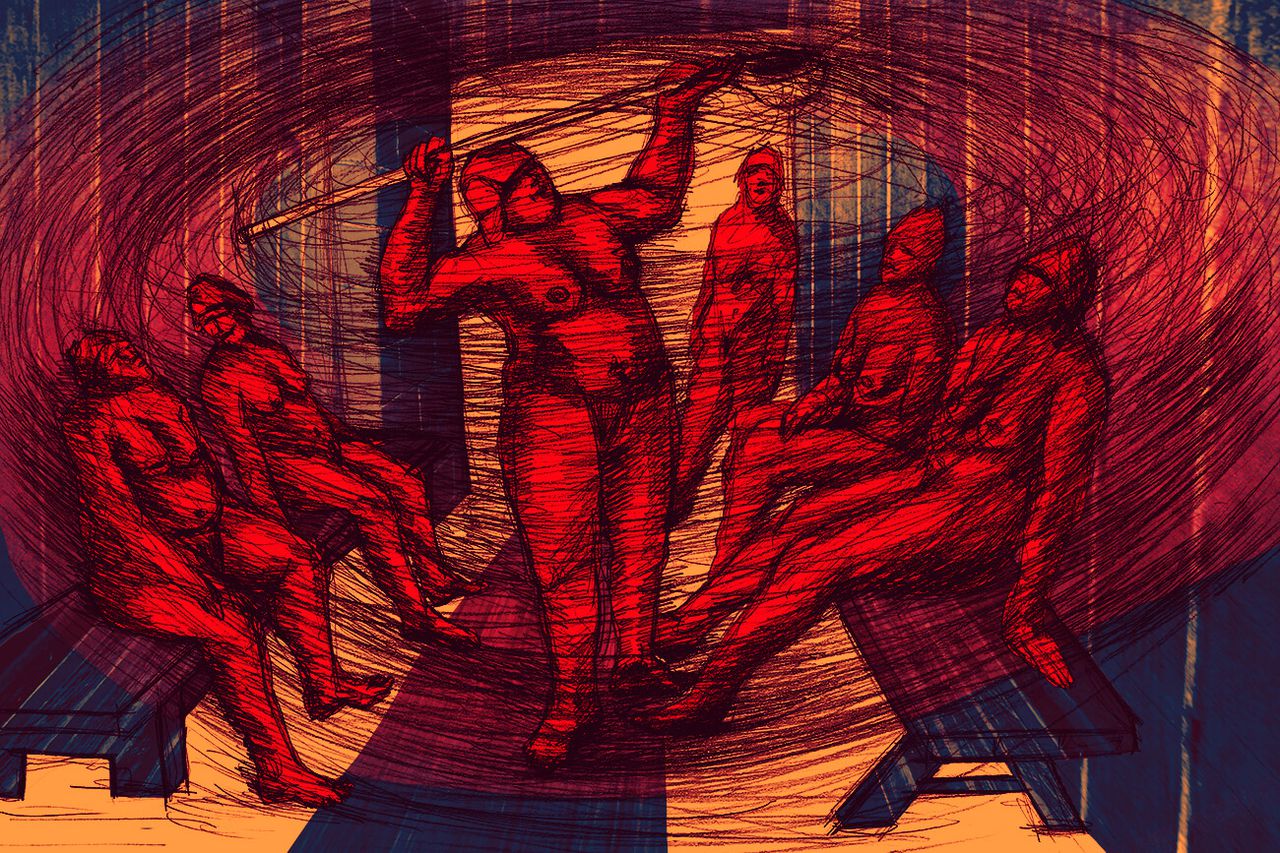
The brothels under the guise of baths existed in the 20s, which Bogdanov wrote about, and the connection with the Byzantine tradition is obvious, if we go to the old non-tourist hammas in Turkey. The orders and sensations are absolutely the same, except without woolen hats and brooms. And so - the same bodily relaxation and spiritual peace, buzz in the moment devoid of all aesthet. I was not in the sauna in Finland, but the Turkish women in Hammam do not differ from women in the Vasileostrovsky bath: they also smile, rub their shoulders, breathe deeply and are busy achieving bath harmony. Even a cockroach, as in a bathhouse on Vasilievsky, was also. In general, the bath tradition is obviously older than our states, religions and churches, and if technical issues differ, then the meaning, content of bath processes are similar.
Vadeisha, exploring the village Russian baths and without touching the city "washing", nevertheless records the traditions that I observe in my bath: a ban on noise, swearing, loud conversation, it was impossible even to rush each other. And you can’t stand and sit on a bath threshold - it is amazing, but in our bath they also drive everyone off the upper step, however, for reasons, so that they do not interfere with the women from the upper tier. Many bath rituals are associated with faith in the Baennik - a bath spirit, or in the fact that after the third (second) couple in the bath, devils are hovering. The church rejection of the bathhouse and the swoop of superstitions around her contrast, firstly, with a persistent desire to steam in the bath, and not just wash, even if you do not live in a communal apartment and you have a bathroom. Secondly, with a cult of special bath pleasure. Vadeisha in her work refers to folk wisdoms (happy, like from a bathhouse, a bathhouse is not a nanny, but at least anyone appears, the soul loves coolness, but flesh - steam) and the comic commandment “Remember Saturday Day - go to the bath!”
“Judging by the many contexts, the pleasure associated with the bathhouse is equated with sexual pleasure:“ The bathhouse and a woman are one fun. ”This is especially bright in a mystery, where the soaring process itself is encoded almost exclusively in terms that describe sexual actions: ... how sweet, as softly, you still want!”

Probably, due to general relaxation and satisfaction in the bath, as a rule, love and kindness reign.
They give in, the process is in full swing, the people are bending to the floor. A girlfriend of the succumber rises and quickly scraps the walls with infusion of mint from a small broom.
Voice from the corner:
“You are some of us, what?”
- No, go to church with this, but I have mint!
And really magically smells mint, some even straightened up. We are sitting quietly, everyone is waiting for the couples to fall. Suddenly:
- Have you gangled beer?
- No, these are brewed bread crusts. A very useful thing, you can drink it!
- Oh, Ning, will you treat?
- Svetochka, but not a question! Swim "table" from the "travia".
Of course, they don’t drink anything in the steam room and the songs do not sing, so the Svetochka and everyone else was fed together, and then again and again, and then something with the text played in the wardrobe: “You are not driven with the cops, and everything will be fucked up.”
Shy workers, crooked mirrors
The current large paired and soapy in city baths come from Leningrad. In the thirties, bans-giants were built here with huge bandwidth, for several thousand people a day, for hundreds per hour. There were not enough “raging”, in the bathhouse in the early morning lined up, and in the soapy under one shower two or three people shed at the same time. Such a conveyor reduced the bath to a deplorable state, apparently, and giving rise to an unsightly image of city public baths, which is today.
Igor Bogdanov describes the problems of the Leningrad baths in this way: there are no soap, faulty taps, not enough bulbs, dirty linen cabinets, garbage and web behind the stove, lousy workers, curved mirrors, everywhere theft took off their gangs, unscrewed the taps. The authorities declared a “five -year plan of purity”, allocated 28 million rubles for the reconstruction of old pre -revolutionary and the construction of new baths. But at such a pace of baths there was not enough. And many preferred pre -revolutionary steam rooms, precisely because there was good steam. Behind theft and dirty cabinets, she nevertheless erupted, a magical, Byzantine, real bath, with a “pattern of life”, as Bogdanov calls this pleasure. In 1935, the bath department of the improvement department studied the phenomenon of the popularity of baths. It turned out that the Leningraders did not go to the bathhouse for the shower. Every third "always climbs into the steam room and spends from five minutes to 1 hour 20 minutes." So the party found out that citizens love to bathe.
The director of our bathhouse on Vasilievsky Ivan Maksimovich Pavlov has been working there for thirty -one years: in 1988, he came to the bathhouse as a chief engineer. Now it is a city (and therefore cheap) bath, where even an increase in the cost of washing on Tuesday from 25 rubles to 60 caused a storm of indignation.
The bathhouse was a Gup and in the jurisdiction of the municipality, and in the zero enterprise, according to the director, “forced to influence”, but the city remained the only shareholder. Many other baths went through reconstruction and went into the property of the investor: they can be found out by “civilian” repair and price tag from 200 rubles per hour. “Neptune”, Chkalov baths and several more points on a bath card - dinosaurs, system ruins with a democratic price tag and a flalor of history.

All bath activities are controlled by the Committee for the Development of Entrepreneurship, but you can’t call a bath economy with business: according to Pavlov, “you won’t earn money in a bathhouse, this is not a business. You can go to work in the bathhouse and provide a service. ” The director himself is steamed every week with friends in the entrusted steam room. When asked if he likes to be the director of the bath, Pavlov replies that he no longer has a choice.
- There is, for example, such a specific profession - a banner, a banner is difficult to choose, this is a whole selection. We invite a person for a trial period, we choose, as a rule, from visitors. If we see that a person is “infected”, that he has a craving and he treats the bath with his soul, we begin to communicate with him. If he cannot work himself, we ask someone to recommend someone. He comes ... In general, this is a long process. One out of ten approximately one of ten is fixed from banners. If a person is subject to some kind of vices, visitors reveal any heated alcoholic, thief or homosexual. It is cut through for two to three days. The responsibilities of the banner have always been and are approximately the same: to serve people, to communicate, the main thing is polite. Человек должен обладать определённой выдержкой, не быть вспыльчивым, грубым, хамоватым. Иногда кажется, что человек нормальный, а он может оказаться хамоватым и воровитым, по карманам может полазить.
— Когда у людей появились ванные комнаты, они стали меньше ходить в баню?— Да, раньше бани были санитарно-обмывочным гигиеническим предприятием, а в районах было определено количество посадочных мест на тысячу человек населения. А потом коммуналки стали расселять, люди разъезжались по спальным районам, и бани постепенно стали если не досуговым, то оздоровительным заведением. Сюда не столько мыться ходят, сколько за здоровьем, чтобы попариться. Хотя и тот контингент, который ходил сюда мыться, не пропал: коммуналок по-прежнему достаточно. Люди иногда приходят с таким запашком, что вот по улице ещё идёт человек, а уже дышать невозможно. Существуют трущобные квартиры, в которых нет возможности помыться. Но надобность именно в санитарно-обмывочном предприятии отпала. Поэтому погибли Гаванские бани, например на Декабристов баня тоже закрылась. И у нас с двухтысячных идёт резкий спад посещаемости. Сейчас чем дальше, тем заметнее год от года. У нас же есть отчётность по количеству помывок — от него зависят субсидии. Статистика ведётся, и она с отрицательной динамикой. Помимо уменьшения количества коммуналок, уходит поколение людей с определённым менталитетом, на которых мы работаем.
— Слушайте, ну у нас в женской парной и молодёжи достаточно.— Вы увидели ещё трёх-четырёх девчонок, и вам кажется, что молодёжь ходит. Но мы ведём анализ, и данные говорят, что молодёжи мало. Сейчас ведь много саун при фитнес-клубах, например. Люди болеют, умирают, уходят, любителей русских парных всё меньше. Думаю, лет пять ещё пройдёт — и эти «коммунальные» бани просто изживут себя. При том, что у нас такие цены, а если мы ещё коммерческие введём… У нас сейчас по выходным 250 рублей час, и всё равно все ходят в будни, по 60. Вот вы были в выходной? Как вам, есть разница?
— Да, но мне больше нравится в будни. В выходные людей мало, баня сухая. Вот именно, ведь русская баня хороша, когда она полная, когда много людей. Бани, которые прошли через инвестдоговора и сделали парные бизнес-класса по четыре тысячи в час, могут функционировать даже если у них пять-семь человек в день. А у нас загрузка 27% – когда не удаётся организовать массовость, то предприятие надо закрывать.
— Снесут да и всё. Хочется, конечно, заговорить о «сохранении наследия», о том, что как-то неприлично 112-летнюю баню сносить. Но такие рассуждения будут калькой с высокопарных и наивных выступлений петербургских градозащитников. Я лишь покажу, почему мою баню ни сносить, ни закрывать нельзя — с точки зрения пользователей, а не абстрактной «нашей истории», которую за эти 112 лет переписали множество раз.
***
Однажды, на редкость тёплым летом, женщина среднего возраста вышла из мыльной отдохнуть-подышать (на улице — редкие +27, в парной страшно представить сколько, но уличную жару потом не воспринимаешь). Разговорилась с банщицей.
— Какое у вас полотенце-то красивое. Приятное!
— Да, ещё прабабушка вышивала, видите год? (Я через три шкафчика вышитый год не разглядела, но примерно прикинула, что полотенце прабабушка этой дамы вышивала наверняка до Второй мировой). Хорошие тогда полотенца были. Бабушка покупала рулоном и из него сама шила...
— Да, а потом в пятьдесят седьмом была китайская выставка, помните? И у всех появились «китайские полотенца».
— Да, у меня до сих пор дома висит, хорошее, сейчас китайцы таких качественных вещей не делают.
Возвращаясь из отпуска, мы все думаем про баню. Едешь домой и думаешь не «ну вот, опять на работу», а «скорее бы в баню, смыть поезд/самолёт». Я слышала даже такой диалог:
— Ой, как хорошо, наконец-то добралась, так мечтала о бане!
— А чего на прошлой неделе пропустила?
— Да я в Японию летала, только вчера вернулась.
— И как там, в Японии?
— Да в Японии-то хорошо. Только обратно лететь долго: десять часов до Дубая и оттуда ещё пять. Устала ужасно, всё ждала, когда же в баню приду, восстановлюсь.