
Translated material
Bone pensions and income: Putin's rating fell to a minimum in 13 years
31.7% of Russians trust Vladimir Putin, follows from the VTsIOM survey on May 19. This is the lowest result since 2006, when VTsIOM began to publish ratings according to this technique.
Details
- Despite a decrease in trust, Putin still leads the rating of politicians in this indicator. In second place with a large lag - Minister of Defense Sergey Shoigu (14.8%), in the third - the head of the Ministry of Foreign Affairs Sergey Lavrov (13%).
- In 2005, Putin's trust was 45% (the indicator was relatively low against the background of the monetization of benefits), and the peak fell on March 2015, when 65% of Russians approved the current president. Such indicators were called the head of the VTsIOM Valery Fedorov in an interview with RIA Novosti.
- Simultaneously with the rating of VTsIOM trust, it measures the level of distrust of Russians to politicians. To do this, they are invited to answer the question: which of the politicians cannot be entrusted with the solution of important issues. According to this indicator, Dmitry Medvedev is the leader (he is not trusted with 23.4%). Putin is in fourth place, 6.6% of respondents declared distrust him.
- In terms of consolidated indicator, “trust minus, Putin leads. The "trust index" was 25%, Shoigu - 14%, and Medvedev - minus 16%.
- With all this, the Presidential approval rating remains high: 65.8%.
What with Putin's electoral rating
- Simultaneously with the level of trust, the current president also falls the desire of the Russians to vote for him. According to the Levada Center for April 2019, if the elections were held at the time of the survey, 55% of the country's citizens would vote for it. As in the case of a rating of trust, this is the worst result in the entire history of surveys according to such a technique. The first was held in April 2014 and showed the figure 60% of the number of ready to vote. In the real elections in March 2018, Putin received 76.69% of the vote.
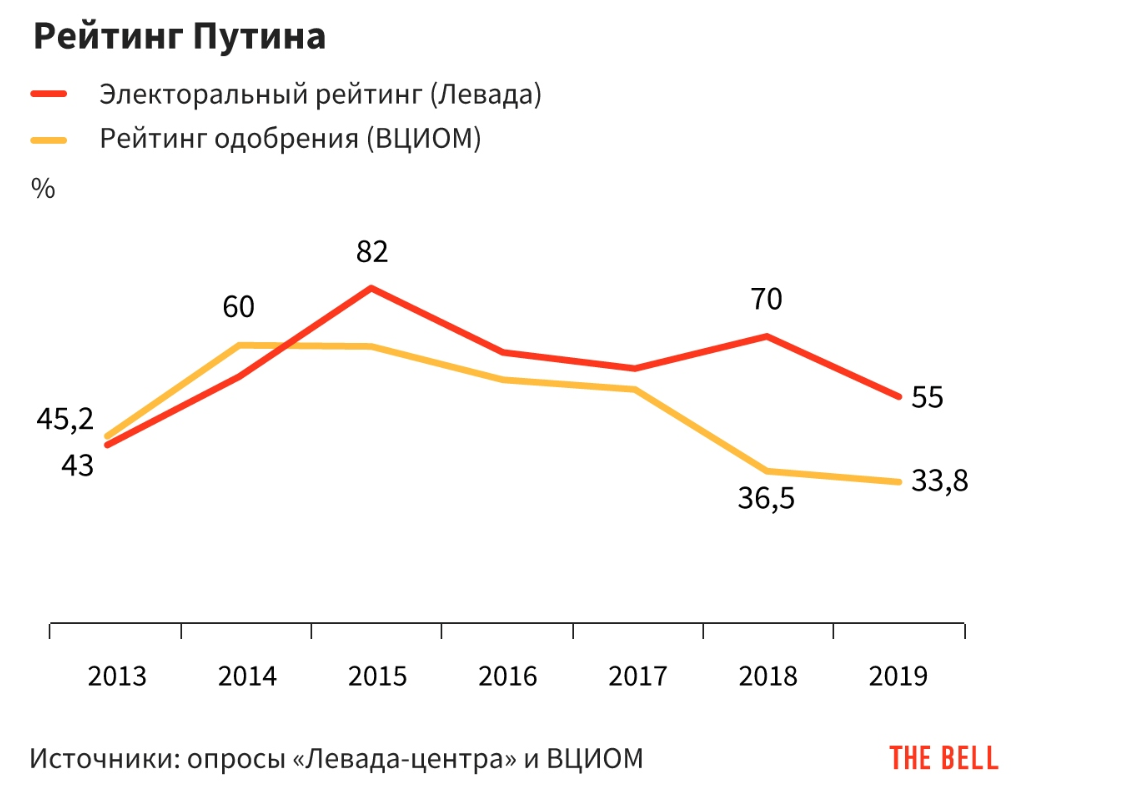
Read also 55%left: what is happening with Putin's rating
Why ratings are reduced
- A shock fall in the electoral rating occurred due to pension reform . After this collapse, he not only did not recover, but also continued to fall. In general, the gradual decrease in both ratings (approval and desire to vote) began back in 2014-2015, but in addition to the pension reform of obvious triggers for a sharp fall.
- Another reason for the fall of ratings may be that the Russians began to live worse in financial terms . The percentage of those who have already felt the crisis on themselves and believe that it is long, continues to grow. This year, according to the study of GFK, there are more than 53% of them - so many respondents believe that economic difficulties will last another four years. Back in 2017, there were 44%of such pessimists, in 2015-29%. These sensations are reinforced by the forecast of the Accounts Chamber: the real incomes of Russians will fall in 2019, and poverty will not decrease, according to the department of Alexei Kudrin.