Translated material
Who are the Tofalars?
How the case of a fight between an official and a priest in the Siberian taiga became a source of information about the life of the Tofalars at the beginning of the 19th century
At the end of December 1817, police officer Loskutov and Archpriest Orlov went to the outskirts of Nizhneudinsk to collect tofalar ruga (parish collection) from the nomadic people and perform spiritual services. In the evening they met in a yurt and drank alcohol. When the priest refused to continue drinking, police officer Loskutov began to persuade him and, having received several refusals, jokingly hit the archpriest on the back with a whip.
The priest took this as an insult and ordered to report to his spiritual superiors about the “bullying” by the official. As a result, the drunken outburst escalated into a major conflict between the officials and clergy of the Irkutsk province and entered official history.
In addition, the case left behind extensive correspondence and reports that mention the Tofalars, a small indigenous people of Siberia. In archival documents they are mistakenly called Karagas, after the name of one of the Tofa tribes.
These materials contain important information about the life of the Tofalars and their complex relationships with Nizhneudinsk officials. They talk about forced removal of furs, monopolization of trade and other abuses of power.
How did the Tofalars live under Russian rule?
The Tofa people or Tofalars are the indigenous people of the Eastern Sayan Mountains. Tofalaria is the land of tofa, bordering on the lands of the Tuvans-Todzhins, Soyots and Buryats. The Tofalars are one of the smallest Turkic-speaking indigenous peoples in Russia. In the XVIII-XIX centuries. their number was approximately 400 people. According to the latest population census, which took place in 2020-2021, 721 representatives of the Tofa people lived in Russia.
The name of the people was first mentioned in Chinese chronicles of the 5th century - in them it appears under the name dubo . These sources say that the Dubos “..roamed east of the Khagases, north of the Uyghurs; their lands adjoined Kosogol (now Lake Khuvsgul in Mongolia).”
The ethnonym tubo or dubo is found even in the “Secret History of the Mongols,” an ancient chronicle of the Mongols, which tells how Genghis Khan’s son Jochi conquered local forest tribes.
Why do Tofa live in the Sayan Mountains? The answer to this question can be found in the Tofalar legend, which was recorded by the Khakass ethnographer Nikolai Katanov. According to it, the Tofalars once lived in fertile places without mountains or taiga. With the arrival of the “white king,” the small people were subjected to severe oppression and were forced to leave for the inaccessible Sayan Mountains. There they mastered hunting, fishing and reindeer herding, lived in harmony with nature, and kept songs and legends.
But the peace did not last long: the people of the “white king” found them in the mountains. The Tofalars again began to pay yasak and forever remained to live in the Sayans, from where there was nowhere else to go.
When did tofa become part of the Russian state?
At the end of the 16th century, forts began to be created in Siberia - wooden fortresses that served as strongholds from where the Cossacks moved further to the east. Cossack detachments lived in the forts; they collected yasak from the indigenous peoples and controlled the rivers. Over time, forts turned into cities and control centers. From there Russian power and Orthodoxy spread.
Before the arrival of the Russians, the Tofs paid tribute to the Buryats, until in the first third of the 17th century the Cossacks came and “intercepted” this tribute dependence.
Thus, from the middle of the 17th century, the Tofalars regularly paid yasak in furs to the Udinsky fortress. This meant the actual entry of their land - Tofalaria - into the Moscow state.
The Tofalars paid yasak, that is, tax, in sables. Every man from 16-18 years old to 60 had to pay it. To pay yasak and resolve administrative matters, tofalars gathered at suglans, which were usually held in December.
In the 1830s. In the valley of the Biryusa River (the Tofalars call the Yna River) gold-bearing placers were discovered. From that time on, Biryusa became the Siberian Klondike for the Russians. But in those days only nobles and merchants could conduct exploration and mining of gold. The indigenous population did not have the right to mine or sell gold on their own - they were only allowed to participate in the mining.
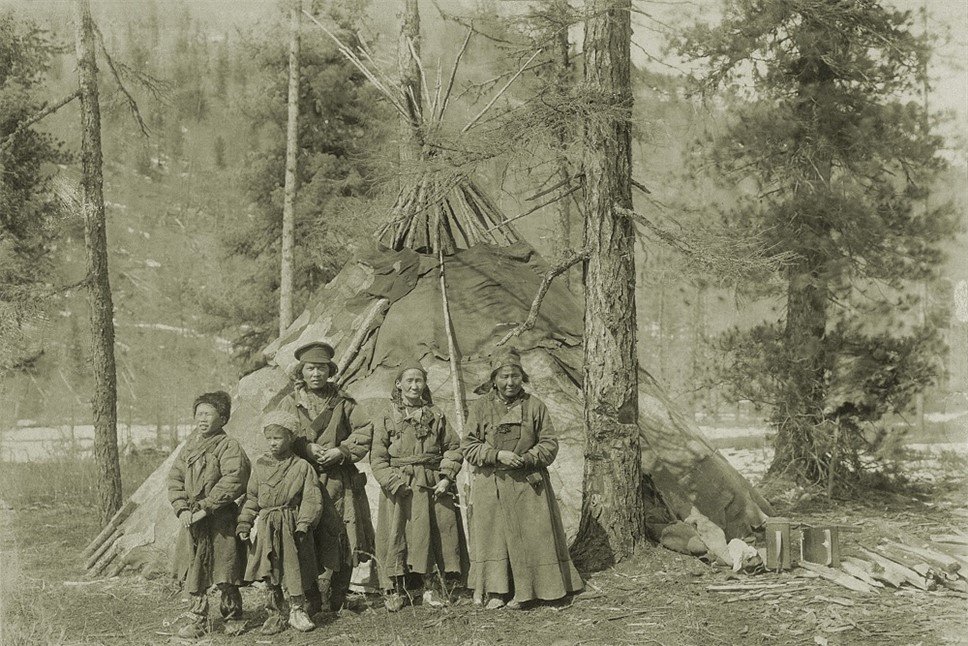
By the end of the 19th century, a serious turning point occurred in the life of the Tofalars: the people experienced a massive loss of reindeer, and many families lost their herds - and with them the basis for their existence. Therefore, the Tofalars began to be hired for auxiliary work in gold mines. They mined gold, cut down forests, and harvested hay for the needs of the mine.
But here’s what statistician Nikolai Astyrev noted in his study, which was published in 1890: the labor of the Tofalars was valued significantly lower than the labor of Russian workers. Astyrev calculated that in a Russian family the average income per person was approximately 168 rubles, and in a Tofalar family it was only 33 rubles, which is five times less.
Moreover, according to the statistician, the owners of the mines sold the Tofalars flour, gunpowder, and lead, necessary for life and hunting in the taiga, but at prices that were two to three times higher than the government prices. Therefore, many Tofalars found themselves in debt: they worked in the mines, bought food there and gradually fell into debt bondage.
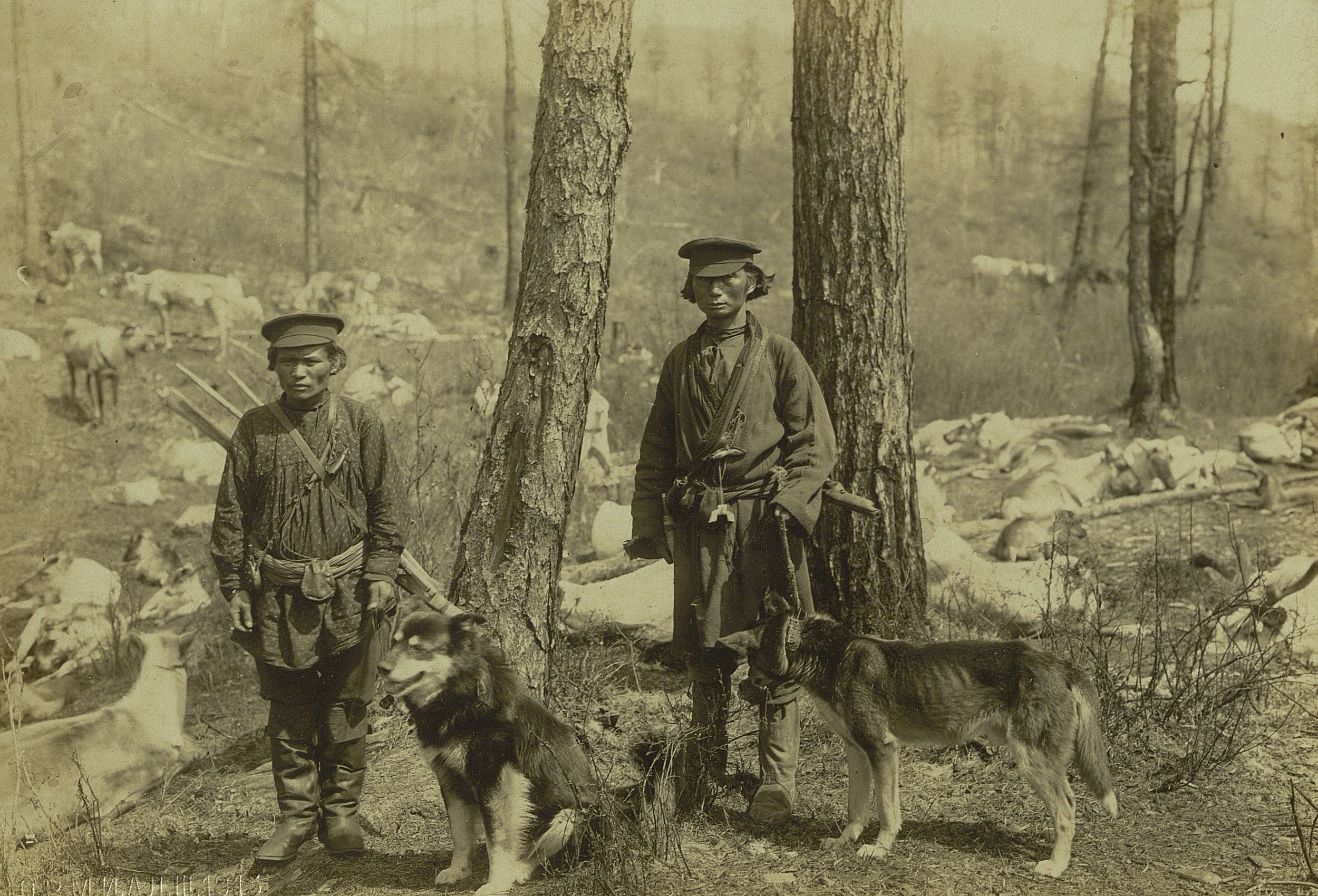
Hunters with dogs. Tofalars. Irkutsk province, V.N. Vasiliev, 1908. Photo archive of the Russian Academy of Sciences
“As a result of this kind of “trade relations” of this tribe, it turns out that it is all around in debt and in hopeless bondage,” Astyrev wrote in his study.
In addition, there was also a system of the so-called “rotation”, when hunters took supplies and weapons from a private entrepreneur, for which they were obliged to give him part of the spoils, most often one third. In essence, this was another form of dependence and enslavement of indigenous peoples.
“Pokruta” was so widespread in Siberia that Russian peasants who became rich from the exploitation of the labor of Evenks and Tofs were called “Tungusniks” or “Karagasniks”. Local government officials were also involved in this kind of “business.”
At the same time, at the end of the 19th century, newcomers began to penetrate into the ancestral hunting grounds of the Karagas, which created serious competition for hunting resources. The Tofa competed with both the Buryats and the Soyots, but, as researcher Bernhard Petri wrote in the first quarter of the 20th century, it was the Russian population that caused them the most problems.
According to Petri's observations, old-timers from Nizhneudinsk, Tulun and other villages went to the taiga for squirrel and sable. They used passive hunting methods, that is, they set samolov traps and, moreover, not one trap per square kilometer, but a hundred. Such intensive and, in fact, barbaric hunting quickly led to a reduction in the populations of fur-bearing animals.
For the Tofalars, this turned out to be a real disaster, because fewer animals meant less prey and less opportunity to earn a living. That's why many went to work in the gold mines. The economic situation of the people worsened year by year.
Forced transition to sedentarism
The coming to power of the Soviets radically changed the life of the Tofalars. In the 1930s when the Siberian ethnologist Bernhard Petri arrived on the lands of the Tofalar, who worked under the leadership of the Committee of the North.
In the early Soviet years, the Committee of the North was engaged in the study and management of the country's indigenous peoples. The committee was supposed to “integrate” nomadic and semi-nomadic peoples into the Soviet system and vertical of power. To do this, scientists sent by the committee went on expeditions to the indigenous peoples, during which they made descriptions of the life and economy of the indigenous people. Later, these data were used for planning collective farms and administrative reforms.
Bernhard Petri conducted a detailed study of the economy and life of the Tofalars. He saw that the Tofalar economy was viable and profitable. In his opinion, hunting and reindeer herding had to be preserved as the basis of the livelihood of the Tofalar people.
Petrie advocated gradual, gentle changes in the Tofalar lifestyle. The scientist developed a project for the so-called cultural centers, that is, centers that would work on the principles of self-financing and self-sufficiency. Petri understood perfectly well that the scale of the reforms was enormous and changes had to be introduced gradually.
However, the Soviet government chose the path of a forced transition to settled life and collectivization. All this took place without taking into account local features.
In five years, three permanent villages were built: Alygdzher, Nerkha and Verkhnyaya Gutara. The people were settled taking into account the previous territorial division of the Tofalars into three nomadic groups. In the early 1930s. organized three collective farms: “Red Hunter”, collective farm named after Kirov and “Kyzyl Tofa”. All hunting territories and pastures were declared state property and divided between collective farms.
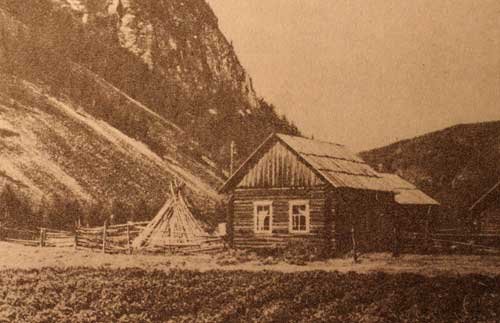
The transition to a sedentary lifestyle also meant moving from tents to log houses. At the same time, settled life was difficult: many people set up tents in their courtyards in the summer and slept in them. In 1975, when the 50th anniversary of Soviet power was celebrated in Tofalaria, the local district committee ordered the removal of plagues from courtyards as an attribute of an “outdated way of life.”
At the same time, jobs are appearing in the villages in shops, offices, schools and cultural institutions. But they were mainly occupied by the Russian population - they were more literate and could keep records in Russian. The indigenous people remained mainly hunting and reindeer herding.
Tofalar language
The Tofalar language is similar to the Tuvan language, as well as the languages of the Soyots and Mongolian Uighurs, but, according to linguists, it is the most archaic of them. For a long time, the Tofa language existed only in oral form, without an alphabet or written language.
Before the advent of Soviet power, the nomadic Tofalars had no formal education. It appeared with the advent of Soviet power - in the form of a boarding school, which was opened in the Tofalar village.
Education at the boarding school was conducted exclusively in Russian. Due to the fact that the children spent most of the year in boarding schools, away from their families, they gradually lost their native language. Generations of people have grown up for whom Russian has become the only language.
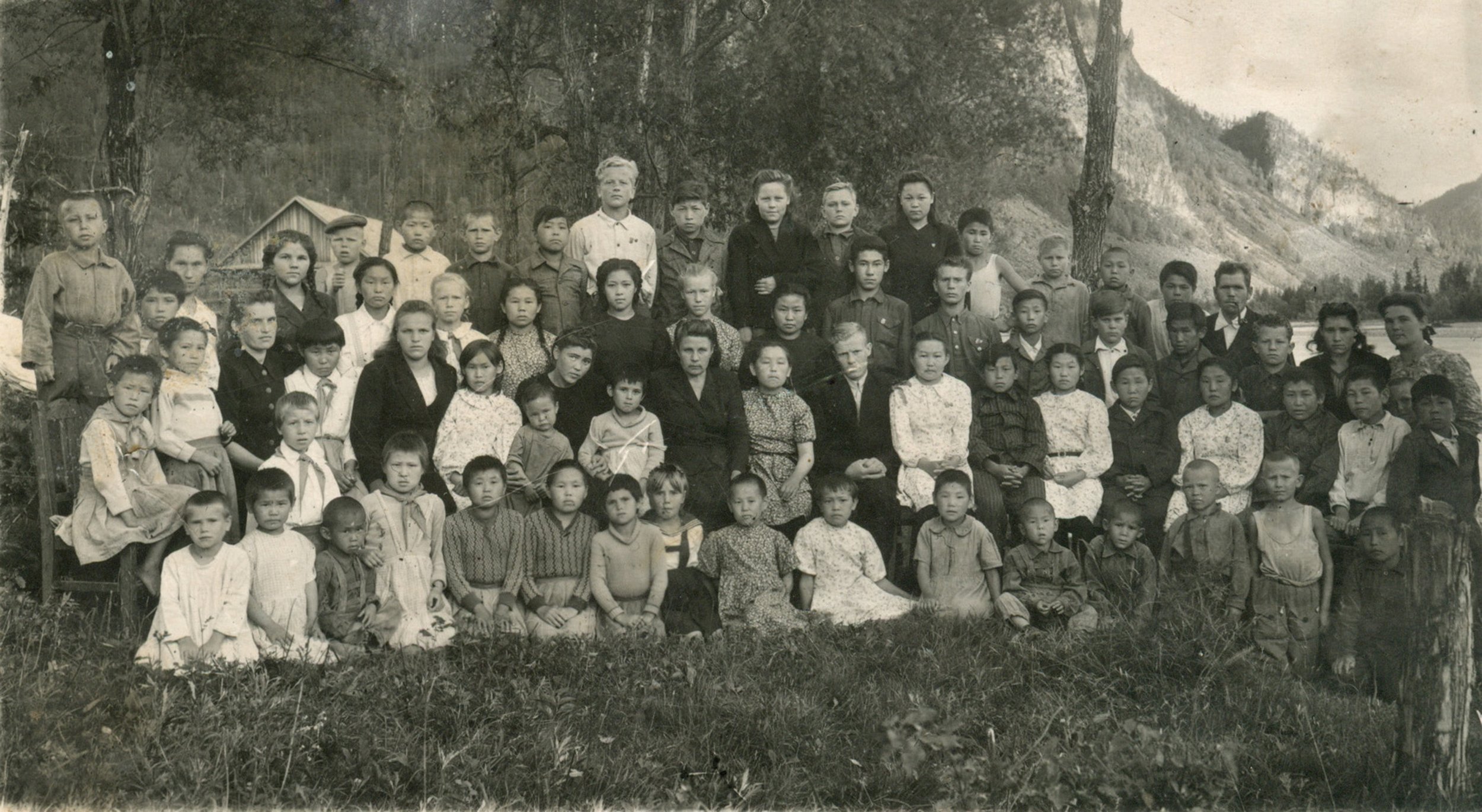
students of a boarding school in Alygdzher (1940)
American linguist David Harrison, who studies endangered languages, quoted Konstantin Mukhaev in his research:
“When I was a child, we were sent to the village school. The lessons were only in Russian, and I could not understand anything. The teacher beat me when I couldn't answer in Russian. In the morning he checked his stick to see if it was flexible enough to hit us.”
The Tofalars tried to ask the Soviet authorities to allow the teaching of their native language in schools, but things only moved forward in the 1980s. after the adoption of the resolution “On measures for the further development of areas inhabited by the nationalities of the North.” It obliged to create writing systems, dictionaries, and textbooks for small nations.
But there was a problem with the Tofalar language: it simply had not been studied enough. Linguist Vladimir Rassadin created a script for it based on the Cyrillic alphabet in the mid-1980s. In 1989, this writing was officially approved, and with it the first primer was published. And since the early 1990s. The Tofalar language began to be taught in primary schools and kindergartens.
By November 2020, there were fewer than five full-fledged native speakers. Over the 25 years from the 1990s to 2020, the share of Tofalars who consider the language their native language fell from 33% to 12%.
Teaching language in schools is now only possible as an elective due to the lack of qualified native speakers. Today, almost 100% of Tofalars speak Russian in everyday life.
List of sources:
Harrison K. David - When Languages Die: The Extinction of the World's Languages and the Erosion of Human Knowledge . Oxford, Oxford University Press, 2007.
Kuryshov A. M. - The essence and significance of the transition of the Evenks and Tofs of the Irkutsk province to commercial fishing in the late 19th - early 20th centuries. , 2008.
Mathanova N.P. - Case “About the quarrel between the spiritual and civil authorities in Siberia” // Series “History”. Novosibirsk, Institute of History SB RAS, 2015. T. 11. P. 133-159.
Ragulina M.V. - Methods of ethno-economic research of indigenous peoples of Siberia on the eve of collectivization // Internet journal “Naukovedenie”. 2015. Vol. 7, No. 5.
Kurdyukov V.N. - Modern tofalars (experience of interval studies) // New
Melnikova L.V. - Tofs: a historical and ethnographic essay. Irkutsk, 1994.
Rassadin I.V. - New forms of social relations and spiritual culture of the Tofalars in Soviet times // Power. 2013. No. 1.
Melnikova L.V. - Tophs and gold mining in the Biryusa River basin // Taltsy. 2000. No. 3 (10).
Rassadin V.I. - History of the ethnographic and linguistic study of the Tofalars // Turkological collection. M., Nauka, 1978 (collection for 1975).
Katanov N.F. - A trip to the Karagas in 1890 // Notes of the Imperial Russian Geographical Society. Department of Ethnography. St. Petersburg, 1891.
Sirina A. A. - Forgotten pages of Siberian ethnography: B. E. Petri // Repressed ethnographers / comp. D. D. Tumarkin. 2nd ed. M., Eastern literature, 2002.
Turkic peoples of Eastern Siberia / resp. ed. D. A. Funk, N. A. Alekseev. Institute of Ethnology and Anthropology named after. N. N. Miklouho-Maclay RAS. M., Nauka, 2008.
Trofimova S.M. - Rassadin V.I. as the creator of writing for the Tofalars and Soyots. Elista, Kalmyk State University named after. B. B. Gorodovikov.
Kuryshov V.N. - General analysis of the ethnosocial and economic problems of the Tofalars // News of Irkutsk State University. Series: Political science. Religious Studies. 2017. T. 19.
Astyrev N. M. - Essay on the life of the Karagas tribe of the Nizhneudinsky district // Materials on the study of land use and economic life of the rural population of the Irkutsk and Yenisei provinces. M., 1890. T. 2, issue. 2. Adj. 1.
Sherkhunaev R. A. - Fairy tales and storytellers of Tofalaria. 2nd ed. Kyzyl, 1975.
Tofalar language // PostNauka. 12/10/2020.