
Translated material
Rave in front of the Georgian parliament
You never know how the weekend in Georgia can end. We publish the very story of Ida Ivanova, who accepted the Holy San, interviewed in prison, was afraid of mountain roads and shot a documentary about rave culture in Georgia.
The same story is a legendary section that makes samizdat samizdat, transforming our readers into our authors. You can also send us your story. Write to our editors Kostya Valyakin and Semyon Sheshenin .
In May last year, I spontaneously flew to Tbilisi for the weekend. There was a Moscow friend and comrade Styopka Polivanov. He had already lived in Georgia for two weeks, so when I flew in, she knew exactly what we would do.
In the afternoon we walked around Tbilisi, drank wine and discussed Georgian techno, which has become actively developing recently, attracting the attention of the whole world. Styopa, along with Arina Noskova, wanted to make a documentary about Georgian techno. It was supposed to be their second documentary about music. The first - “turning the plate” - told about Vinyl in Russia.
We began to discuss the topic whether it happened in Georgia when riot police burst into clubs and arranges the so-called “masks-shows”, and agreed that this was impossible in Georgia. Freedom -loving Georgians will not tolerate this.
Rave near the parliament building
It was in the evening, and we planned to go to Basiani - this is the Georgian equivalent of Berghein. Before the club, it was decided to go to the Drama bar in the Pre-Pati. We went up to the Drama and met friends there, who said that riot police burst into Basiani - everyone went to the way there. We went there together, the club had a mixed crowd of visitors and the police.
Emotions went out. I have never been on strikes - in principle, I don’t know what it is, but my friend Styopa is just fed in this matter. He was at rallies in Russia and knows how to behave. However, rallies in Russia and Georgia are slightly different things. Here, in Georgia, you are a free person and, if you want to rally, you just go and do it. Everything looked strange in place: someone was detained, taken away, but no one left, but only more and more people appeared.
It’s already five in the morning, nothing happens - the detention began at about eleven in the evening. We decided to go home, there we continued to watch Storis on Instagram-it turns out that all the people who stayed there went to the building of the Georgian parliament. We go to bed, and after about a couple of hours on Facebook comes an invitation to a rally near parliament, organized by the White Noise movement, which advocates the decriminalization of drugs and helps people if they were detained.
The whole area in front of the building was filled with people, completely different - not only youth, but also older. All this time I tried to find a good camera to shoot everything, because this is a historical event - it is simply impermissible to shoot on an iPhone. It turned out that my friend, documentary operator Lesha Elagin is now in Tbilisi, and he has a camera that allows you to shoot in good resolution. As a result, we took off everything. In the afternoon was a rally with an open microphone, and in the evening the speakers were brought in and cut the music. By this, the protesters seemed to say: “You do not allow us to hang out in clubs, then we will hang out on the street,” and the clubs were really closed.
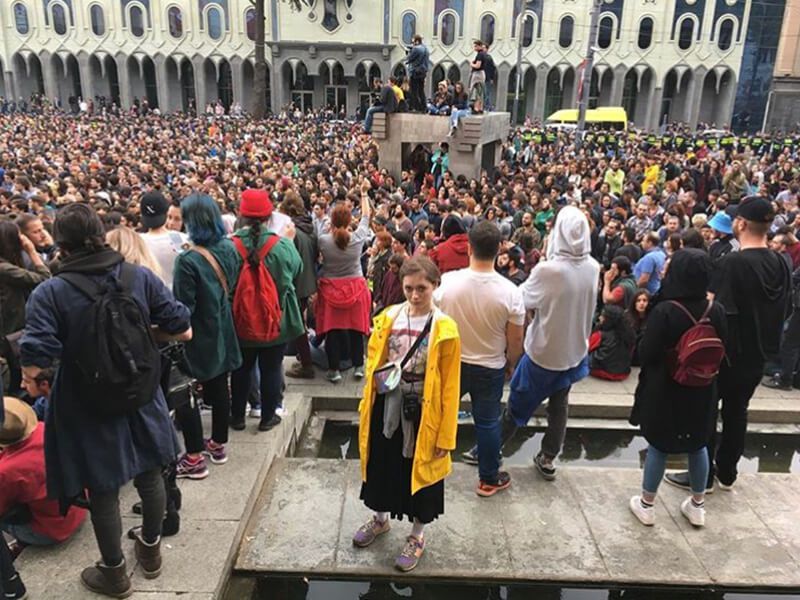
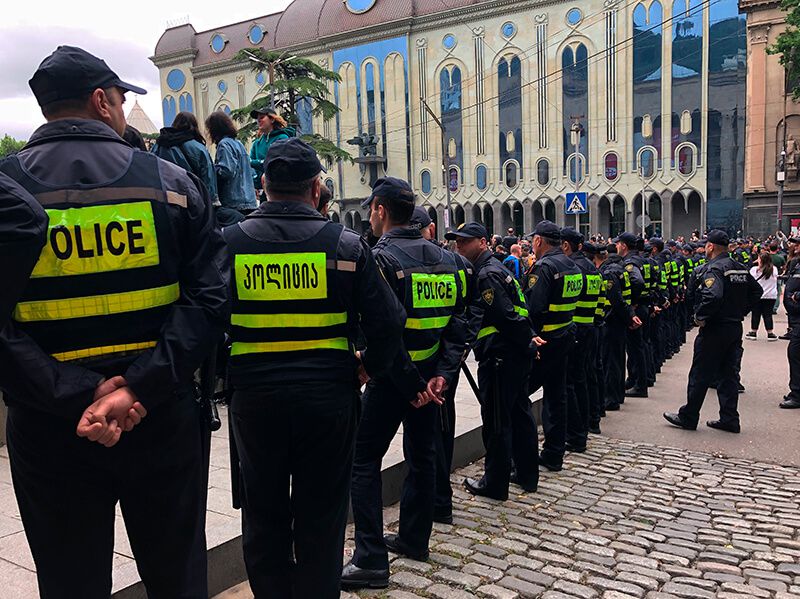
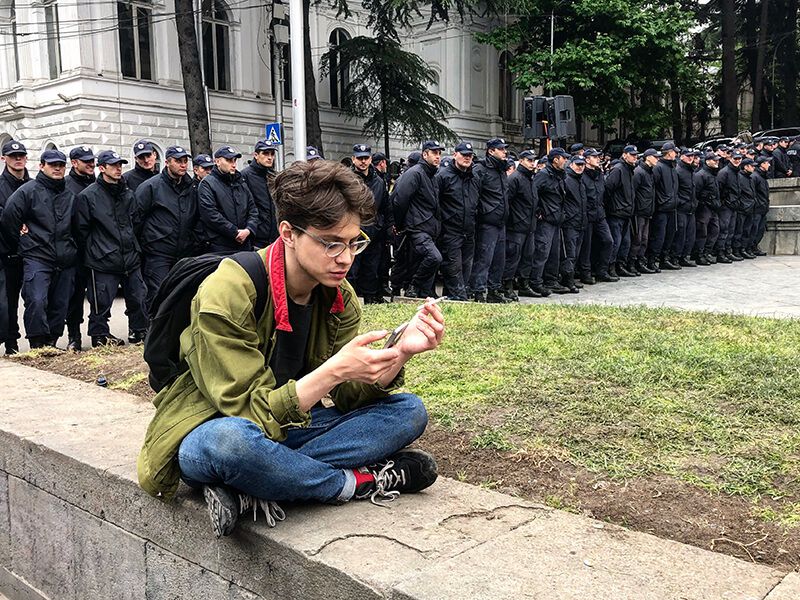
All the DJs who were supposed to play in the Basiani played at the parliament. They arranged a huge rave, blocked the movement on the main street - Rustaveli. All this happened on Saturday. This, perhaps, was the best rave in my life - I never experienced such a flurry of emotions. The music stopped at exactly 23:00. Protests protests, but you need to respect the personal space of living in the neighborhood. Everyone went to bed in order to return with new power the next day.
And woke up in Batumi
The captured material did not give me rest, and I tried with all my might to find support from some video subachen. A film of this scale is difficult to do alone, especially if you have just finished VGIK. As a result, it was possible to attract Stereotactic. Our film crew was very compact: the director-operator of Styop Polivanov and three producers-Arina Noskova, Anna Sarukhanova and I.
Because of this compactness, we had to combine several functions. Styopa was both the director and the operator. And for example, I learned sound engineering and wrote a sound on the site. Anna is a Georgian and has been living in Tbilisi for a long time, she was a translator from Georgian and a guide in a Tbilisi party, explained all the events and introduced interesting people.
Arina Noskova gets along very well with people, so we always trusted her to make an appointment for an interview. Georgians are very open and kind people, it is pleasant to spend evenings with them. But as for some business meetings, there may be problems with this. For example, they can agree on a meeting, then stop answering calls and eventually be late for two hours. We call this "Georgian situation."
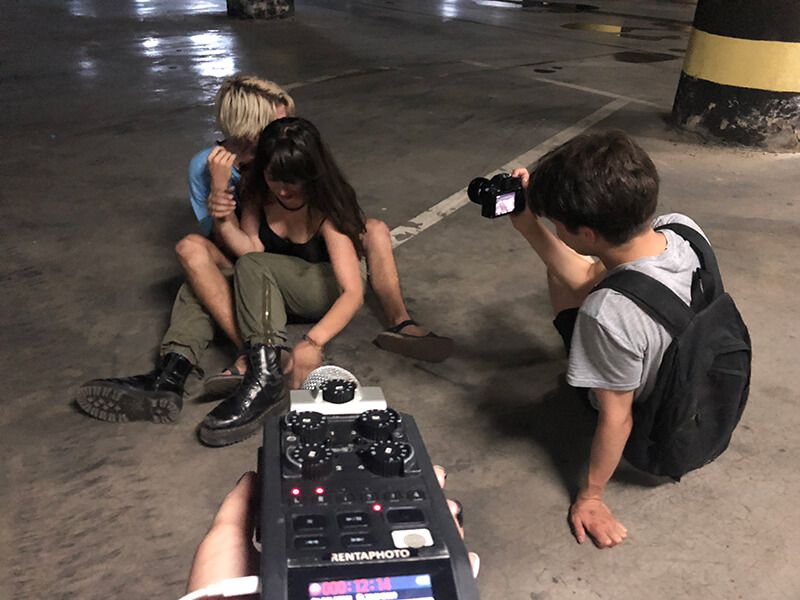
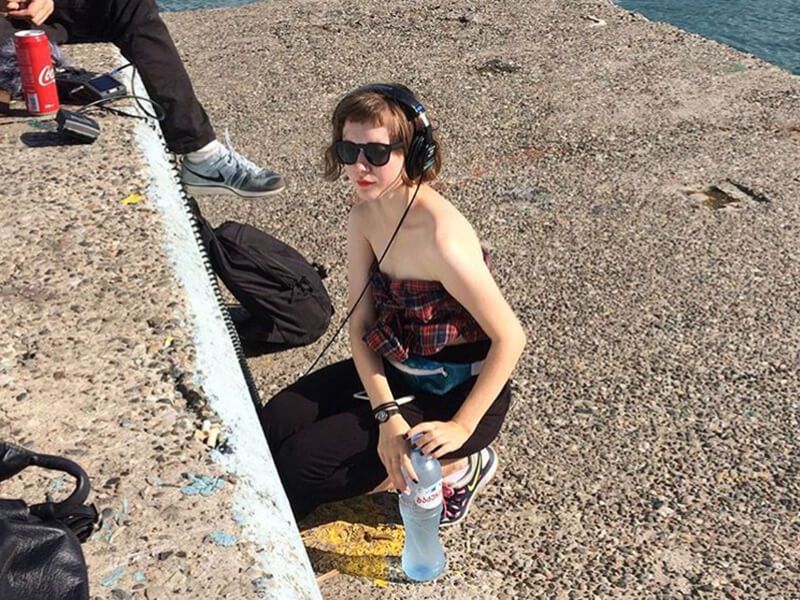
One of the beloved “Georgian situations” happened when we hunted for the elusive Kayakata-this is an experimental hip-hop-duet from Tbilisi, they are real stars in Georgia. We had to leave soon, and we were completely desperate to interview them. Suddenly, the frontman Zura calls and says that he is ready to give an interview, but he is in Batumi (this is a city by the sea). This is also a normal situation for young Georgians - to accidentally end up in Batumi, especially in the summer. We immediately rushed to the bus station and caught the first minibus to Batumi. It was an absolutely crazy trip.
The minibus was very old and broken - uncomfortable seats, neon lights under the ceiling. All the time of our journey, the Russian chanson played very loudly in a circle. I thought it would never end, but after six hours we ended up in Batumi. It was a deep night, and Zura again stopped in touch. We had to look for the night. And in the morning we got through to Zura and took a cool interview against the background of the sea.
In fact, I am glad that everything worked out like that. Otherwise, we would not have visited the sea. For this I fell in love with documentary cinema: you never know where you can actually bring you.
Escape to the mountains
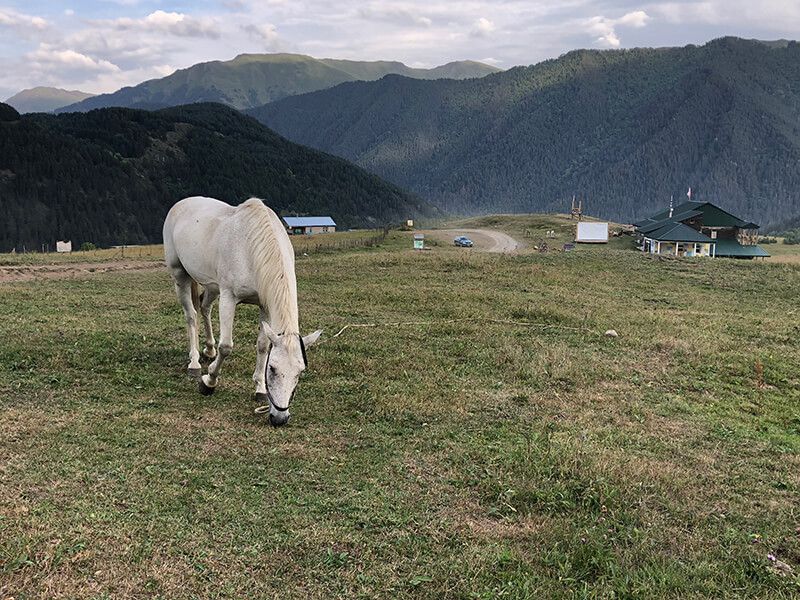
There is a place in the mountains, which can be reached only on the most dangerous road in Europe. This road is really frightening and dangerous - it is in a rock under a waterfall, there are no fences, only crosses are on the site of traffic accidents. They say that people often get drunk before going through it, because they are very scary. I closed my eyes out of fear. But after this hellish path, you find yourself in a peaceful mountain place called Tusheti.
There is Aqtusheti - the festival, the residence of artists and the hostel at the same time. Artists come there to create, because it is an ideal place for inspiration. There are problems with electricity and water, because this place is torn from civilization. But this does not stop anyone - anyone can come there in order to enjoy nature and art.
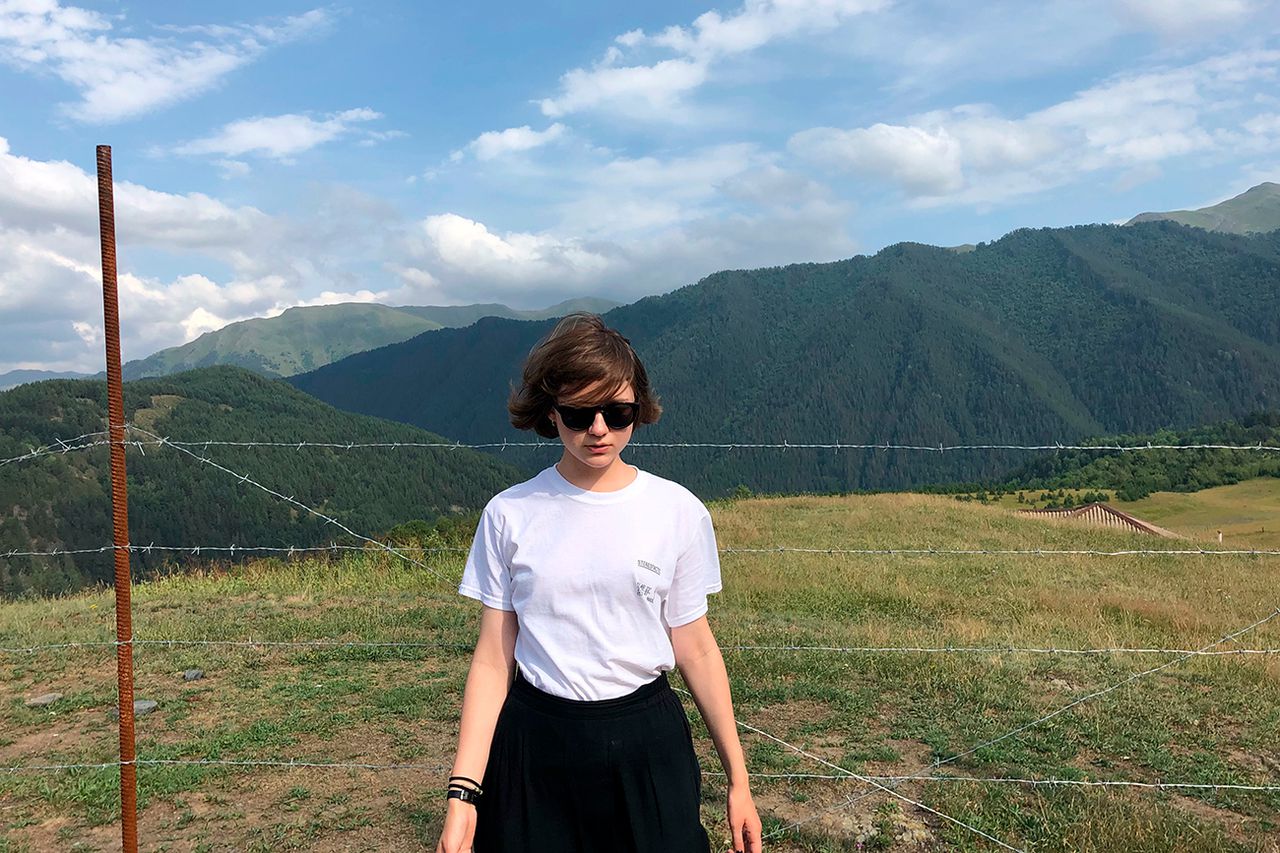
I have never been to this in the mountains, and no one warned me that it was very hot in the afternoon and terribly cold at night. Therefore, I dressed up in all the clothes that I had - it seems to me that I looked like from the last Vetements show. With everyone who lives in Aqtusheti, you feel some kind of general connection, especially when you are going at a long table and eating Georgian cuisine, while it does not matter in what language you speak. For example, we met there with one American who abandoned everything that she had in New York, and at fifty, she moved to live in Georgia. She spends summer in the mountains, along the way she writes paintings. Every evening in the residence, there were liverines, and we shot all this, talked with musicians and local residents.
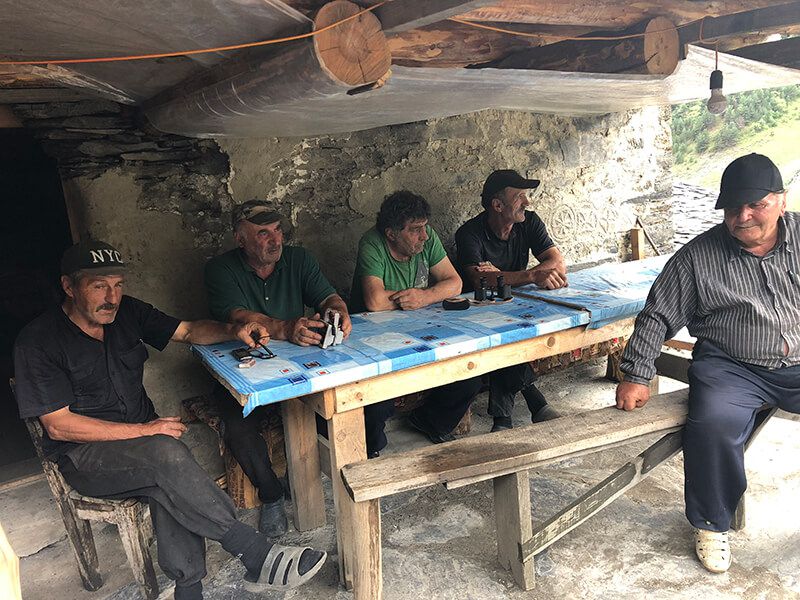
We went to take off the highlanders to the neighboring village. There were four of us, as usual, three of them are girls, two of which, including me, do not understand in Georgian. We sat, without suspecting anything, smiled and did not understand what was being discussed. And after, when we had already interviewed, it turned out that our speaker speaker in Georgian producer Anna these men asked if we had grooms, and hinted that they wanted to steal us for their sons. It was embarrassed to us, and we rejoiced that they had run away from there.
Biblical freedom
During the filming of the film, I not only tempered my character and pumped myself as a producer, but also accepted the sacred dignity in the Christian Evangelist Protestant Church of Georgia, which is called biblical freedom.
In Georgia, the Opposition Political Party "Girchi" (translated means "bump") found a legal way of liberating young people from the army. The party officially registered a religious organization entitled “Christian, Evangelist, Protestant Church of Georgia is biblical freedom”, where anyone can enter and receive a holy rank in about five minutes. Which I did.
The initiation was as follows. The day before, I decided that I had to fast, so I did not eat Hinkali. I arrived at the Girchi office, which is located outside the city, hemp is growing freely in the flower beds. I needed to go into a small shed. In front of me stood several young guys who barely reached the age of age. When the line reached me, the sitting at the table asked if I recognize the fact that the main principle of the highest value is the rights and freedom of man. I nodded my head and held out my passport. I was discharged a certificate confirming the presence of a sacred dignity.
Sound recording studio in prison
The most unusual shooting was in prison. We interviewed the Michailo DJ, he is sitting for finding a few drugs with him. He was allowed to equip one of the rooms in a recording studio in which he can spend six hours every weekday. Michailo writes music and releases tracks right in prison.
This was my first experience of visiting places of this kind. At the entrance we were completely searched and asked to leave all their things in special lockers. In fact, it turned out to be very clean, it smells normally, there is no extra things. But there is a large library, a drawing studio and everything resembles some typical school in the suburbs. True, bars on the windows, barbed wire, an empty concrete floor and the protection with weapons did not allow us to forget where we were. But this prison cannot be judged by all prisons of Georgia, because it is the most liberal.
It was interesting to listen to the Georgian intelligentsia. Working on a documentary, you can chat with those who are inaccessible to you in ordinary life. So we got into the house to the former Minister of Foreign Affairs of Georgia. He told how the rallies were going on before the parliament and how many revolutions he survived. If you look at the chronicle from the Rose Revolution, which occurred in 2003, then at some point there also turned on music near the parliament and the protesters began to dance.