
Translated material
All for one
Participants in the "Teacher for Russia" program - about how they survived the bullying at school, and attempts to fight it now
Anna Tokmakova, German teacher, Maloyaroslavets
In our school, in principle, everything is not easy with bullying - it is everywhere, at all levels. I understood this right away how I got here: in September 2017. Then the new girl Polina came to the eighth grade (the name was changed. - Approx. TD ), and I perfectly understood her: I was new at this school too.
Polina had many friends left from the previous school, and behind her - 11 years of training folk dancing. She is bright and active - she is not shy about demonstrating her knowledge, she likes to be in the spotlight ... But soon I noticed that Polina could not communicate with classmates. They collectively pounced on her for any reason, laughed at her and called him. For example, the guys became aware that Polina smokes - and on this occasion they began to mock her. She meets with a young man older than her - and this topic also did not bypass.
Polina is not a victim, she will not endure or cry if she is attacked, but will answer the same. Her periodic response aggression is a protective reaction. Sometimes Polina “gets sick” and does not come to school. And I understand why. She could easily disappear after the next skirmishes with classmates, especially if the teacher was inaccurately interfering. Then she did not find the strength to cross the threshold of the class - it is easier to stay at home.
I was poisoned in school, in high school. I know what it feels like, and I immediately see when this is happening. I just had to understand Polina, because I had an active leadership position at my school. When we encountered the interests with the director’s granddaughter, she connected the persecution of everyone, including the class teacher ... I well remember what it feels like to miss the school. Just because you can't go there.
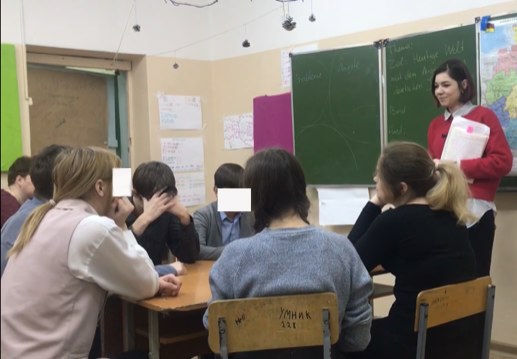 In the lesson photo: from personal archive
Once, during the lesson, Polina asked to leave her mother. A few minutes pass, and I hear a wild cry in the corridor: one of the teachers saw that Polina was not in the lesson. We all remember how teachers know how to raise their voice, but it was some kind of nightmare. Everyone in the class is silent. I go out, try to explain that I let Polina call it myself - and then they are screaming at me: "Anna Valerievna, return to the lesson!" Other teachers come out of the classes, the head teacher appears, the director ... Polina stands, something chirping-and everyone screams around her. This rampant scream is the reality of an ordinary Russian school.
Everything changed one small journey. For the second year I have been led by children to the German movie festival of Goethe-Institute in Moscow. Last time I took several students and Polina with them. So the girls found themselves in an informal setting and began to warmly communicate with each other. Now they continue to be friends - now Polina has someone to communicate at school.
How to explain the grass that took place in the class? It seems to me that a lot in this regard is coming from home. If the child is not good at home or they don’t pay attention to him, he will still find a way to declare himself - even through a manifestation of cruelty.
The distribution of roles primarily concerns the fifth classes: when moving from elementary school to secondary classes, it is often disbanded and mixed. So fifth graders quickly lose their resistant roles. And the education system is built in such a way that teachers themselves push students to occupy certain roles. The construction of the hierarchy, the choice of the headman, the emphasized praising of some and the censure of others - it is convenient for teachers to hang the “Excellence”, “Dvornik”, “Tychnya”, “Loser” ... and it is convenient to consider that they have the right to clean their daily fear or aggression on whom the teacher indicated to them.
Irma Rakhmanova, former biology and art teacher, Kozelsk
My school had a very high level of children's aggression. If we talk about bullying, then I observed this situation more than once. In one class, I managed to correct the situation - in the other, my efforts have not led to anything. Therefore, I do not have a universal recipe - only the personal experience that I can turn to.
Success history occurred in the sixth grade. They collectively poisoned Alina (name changed. - approx. TD ), a very quiet and shy girl. She refused to answer verbally in the lessons - she was just silent. Odnoklassniki hung a stigma on her, apparently after the teachers. They often said about her: “What are you asking her, she’s a fool, she will not tell you anything.” They did not want to communicate with her, did not want to work together, sit nearby.
Alina has a feature - she never writes down: often makes mistakes, but never spies on others. And once, on a biology control, she received the first five. Then she waited for the end of the lesson so that everyone left the class, came up to me, gave a leaflet and said: “There is some kind of mistake. I can't have five. ”
These were the first words that I heard from her. I answer her: “Well, look, Alina, here everything is true for you, here you wrote the correct answer - this is five, definitely.” She grabbed a leaflet, laughed and ran out of the class - did not believe me. But after this five appeared in the magazine, she changed her attitude to study: Alina began to listen to me, carefully recorded in the lessons. And the news that this one recognized by everyone got the five, quickly scattered throughout the class.
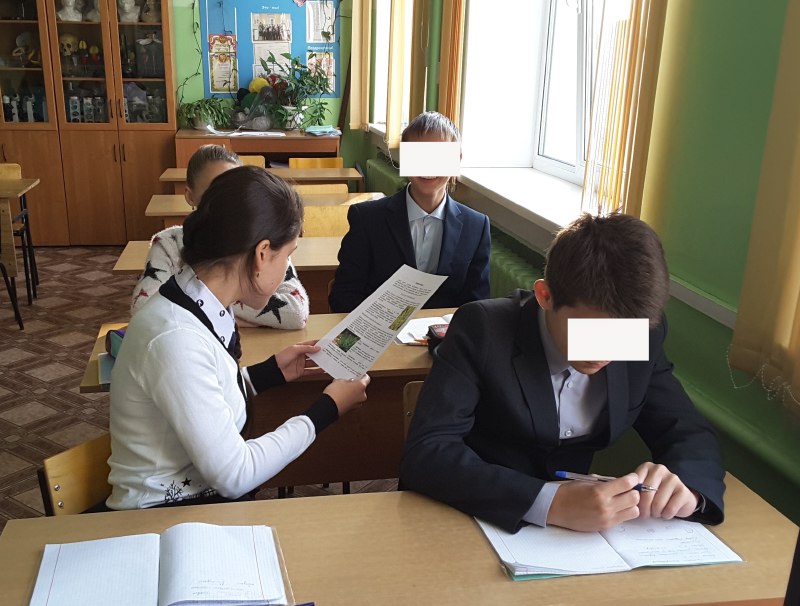 In the lesson photo: from personal archive
Next year, an oral test in biology had to be ahead-and it was obvious that she would not surrender it: Alina still refused to answer verbally. I asked her if she agreed to four or would have fought for the five on the standings. She shook her head: four, four ... And then her two classmates say: “Wait, do not put it! We will help her. ” She and Alina moved to the back desk, took the textbook and began to ask her questions on the topic. Alina answered everything - and received her five in a quarter. Classmates were waiting for Alina after the offset and rejoiced for her as for themselves: “What, five, five? Yes? Well done!"
And the story of failure is about a completely different child. Seventh grader Gleb (name changed. - Approx. TD ) - a real rebel. He loved to tear off the lessons and show that he was here at school, nothing needs. He studied in the most aggressive class that I have ever seen. Gleb constantly tried to hurt, released sharp comments addressed to him. No one wanted to be with him at the same desk or in the same group. Everyone was not loved.
Gleb was fond of computers, but he had no computer at home. I arranged a hacaton in the SCRATCH programming school at school: it often came - and we were engaged in my laptop. He really liked this - and in between, he improved the marks on biology from doubles to four. But this did not lead to improvement in the classroom. Gleb is a sociable guy, and the whole situation was uncomfortable for him. But he simply could not afford to reduce the level of aggression: in his eyes and in the eyes of his classmates it would be weak.
Kozelsk is a military town. These are officer families. This is the school principal - a former military man. And this is a tough hierarchy, at all levels. Children live in conditions of constant frustration and stress - and they cannot even express it within the framework of the system. The only way out is aggression.
I myself survived the injury. In the third grade, after the gymnasium, I went to a regular school. In the gymnasium class, they managed to instill me that knowledge is good that it is important to be interested in new ones. And I did not immediately realize that this did not work in the new school: I noticed which of the classmates where I did not understand what, and actively offered my help. Absolutely everyone hated me. They regularly mocked, called on ... All the other years I studied in isolation, no one talked to me.
Apparently, therefore, I am well in contact with the guys whom the class does not accept, and I am much worse in contact with the guys socially successful. But I want to be a worthy teacher for other, popular children. It is difficult when you come to high school and see girls there, like two drops of water similar to those who poisoned you in childhood ... Inside, everything is involuntarily compressed. And you have to make an effort to remind yourself: for example, it is you is an adult woman, and this is a confused child.
Of course, my experience with bullying is not universal. But he tells me that the best line of behavior is to try to build a relationship not inside the class, but with a specific child who ended up in trouble.
Anastasia Nazarova, Literature teacher and class teacher, Tarusa
My fifth grade is to a greater extent “boy”. When I came, I did not know anything about the problems inside the class. I spend only three lessons a week with the guys-it took time to understand that something was going wrong.
Read also The role of the school in the bullying "Bulling" is a completely unpretentious word until your family encounters the bullying directly. Shock, anger, resentment and other emotions often prevent parents from adequately assessing the situation and understanding what steps should be taken, where to turn, what to tell the child and how to behave with offenders
Lesha (name changed. - Approx. TD ) stood out among other guys in the classroom. There is reason to assume that he has a hypodynamic syndrome: he is slow, phlegmatic, he needs to sit on the task or think over the answer. He has scattered attention, and in the lessons he speaks very little. Usually he sits at the desk alone, because no one wants to sit next to him. Such a cute, unhurried, soft boy. Smiles a lot.
I began to notice that part of the class is periodically trying to hurt Lesha. They laugh rudely above it, calling them, they can clamp in the corner and provoke on physical skirmishes. Recently, the boys, leaving the school, simply spat on his bicycle. Lesha is a very closed child, and at home he does not tell anything about what is happening to his mother. When she asks him how to do at school, he invariably replies: "Everything is fine."
Not to help comments here; This turned out to be a difficult systematic story that was stretched from a younger school. I set myself the task of finding out what was happening. Gradually, we began to build a trusting relationship with part of the class: the girls began to come and tell what happened. Lesha himself, with all his closeness and detachment, is also trying to speak.
It was not so easy to communicate with the offenders. At some point, it seemed to me that the children heard me. The atmosphere in the class became calmer, the guys began to play with Lesha on the breaks, I have not heard about new skirmishes for a long time ... But I was happy early - soon it all started again. And even with more aggression than before.
 At school photo: from a personal archive
The guys say: "He is an autistic ." According to them, he calls himself that. In my opinion, he does not have an autistic spectrum disorder. I imagine that children subconsciously feel: Lesha is different from them. However, they do not understand what exactly, and this ambiguity partially scares them. Because of this, they put pressure on Lesha and often shift the responsibility for what is happening on him. Due to the overload of negative emotions and a constant sense of danger, Lesha himself can sharply respond to a provocation-and so involuntarily becomes the initiator of a new skirmish. Perhaps the guys see their justification in what adults say to them. As a rule, my parents answer me: “I know that my child is not a startress, probably someone else began it.” Or, just like their children, they transfer arrows to Lesha.
Probably, it was a mistake - to fight this alone. I just recently connected the director to this situation. Before that, I was afraid to connect other people: I thought that this obvious “clicked” would violate our trust with the class, which, first of all, would be worse than Lesha himself. But now I understand that I need a third person - who is not involved in the situation so emotionally that can help.
If I could give advice to myself, I would advise you to do it right away - to connect other adults. If the school has a good psychologist or social teacher, this should be used. It is also necessary to talk with parents, from all sides, even if it is difficult: we need the same assessment of the situation from adults who will not mislead children.
But, frankly, I myself need advice now.
Children teenagers School