Translated material
A sense of freedom. Expensive
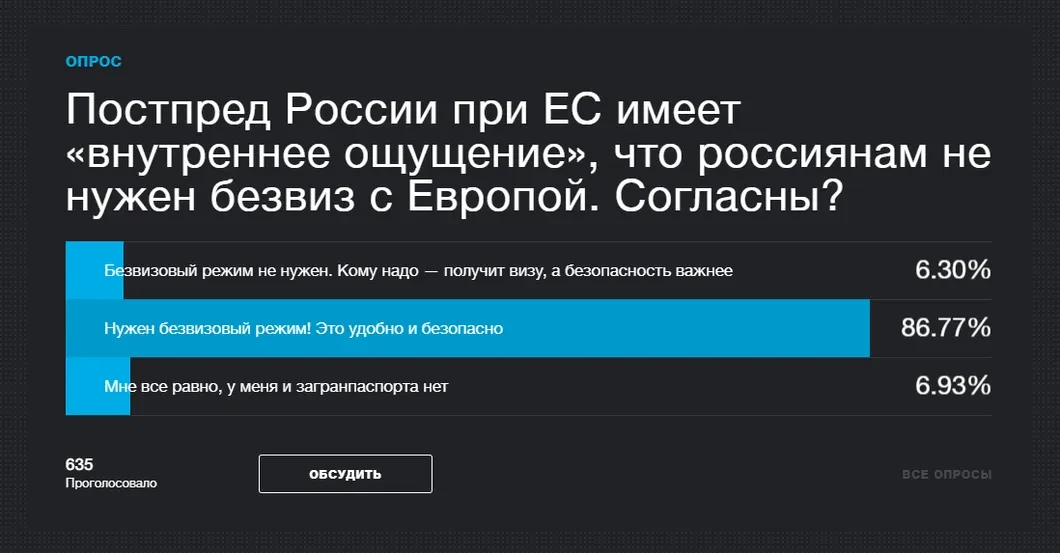
Do Russians need a visa -free regime with Europe (the Russian Permanent Representative to the EU is sure that - no!)
In the Brussels airport, once again flying to Moscow, I often see a familiar Russian senior diplomat in the international zone, where there is no access to mere mortals. "Are you flying away?" - I ask him on duty. “No, I meet my wife (or I see),” he replies. The wife arrives in an evening flight on Friday and flies away on Monday night. I did not want to leave my favorite work to move to the place of diplomatic service of her husband.
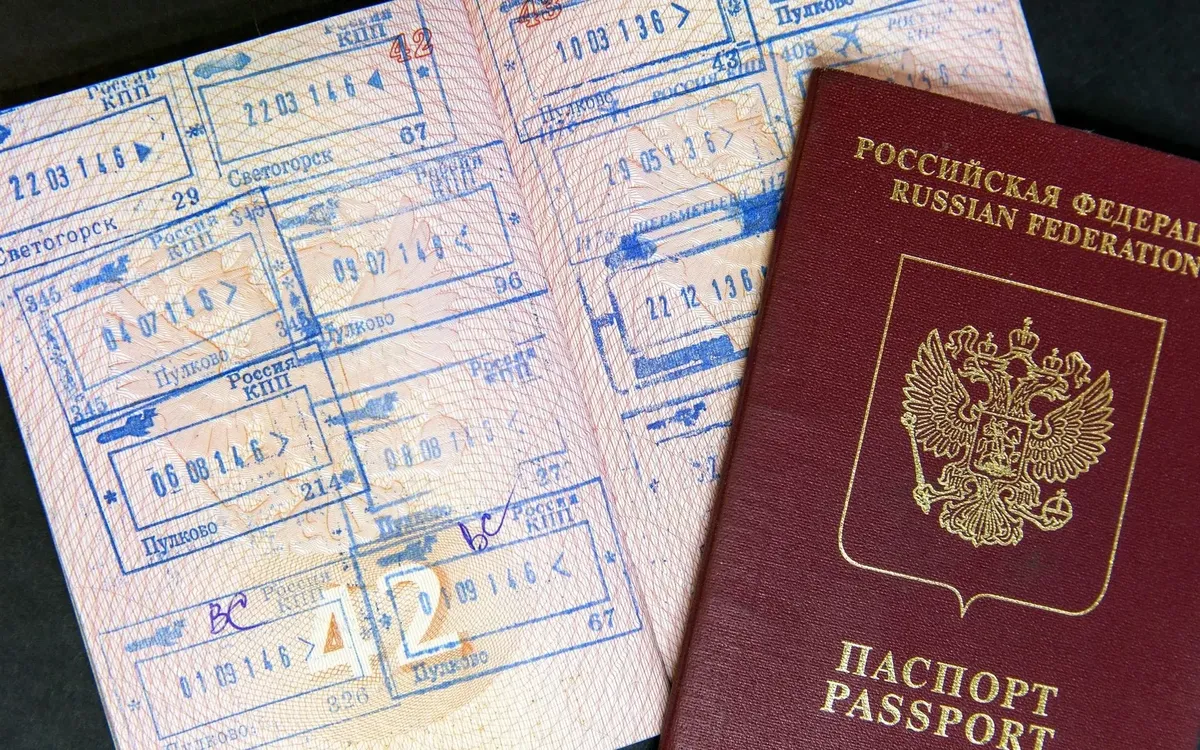
With diplomats and members of their families, the issue of "visa -free" has been resolved in Europe. They are called state people. But citizens are different.
On the May holidays, guests came to us: a wife’s sister with a daughter and son -in -law. They decided, phoned, bought tickets for the date when cheaper, and flew in. He put them in the car, brought them to Paris to look at the burned out nototre-da and to make a outlet in Saint-Denis. Then to Holland, to Ceykenhof, to admire the tulips. When they arrived six years ago, there was a whole story with the straightening of my invitation, early planning and trips from the province to the capital for a visa. But my childhood friend Yura, who, as in that film, dreamed of “seeing Paris and dying” and to whom I regularly sent an invitation since the 90s, and died, never having gone abroad. The fact is that the wife’s sister lives in Kremenchug ( Ukraine - Ed. ), And Yura lived in Astrakhan.
The history of "visa -free" between Russia and the EU has more than two decades, it was born shortly after the Gorbachev perestroika opened a big world to Soviet people. Of course, the EU began to cancel visas to the countries that sought to enter it.
None of the serious politicians thought about Russia's joining Russia. But who said that you can become normal by all signs by the European country only by joining the EU?
The main thing is that there is a democratically replaced power, a clear separation of powers, a market economy without state dictatorship, that the courts are independent, the press is free, human rights are respected, the world is with neighbors, and such a thing as the spheres of influence was forever forgotten.
In the very beginning of the 2000s, the head of the European Commission Romano Prodi, during which the EU expands east has to be expanded, told me that, they say, the visa regime with Russia has been living in recent years, and even called the term: 2008. In 2003, at the Russia-Es Summit in St. Petersburg, this was recorded as the general goal of Russia and the EU. The idea of creating four common spaces was also accepted and approved there, the “road maps” of which became the goal of strategic partnership. The total space in the field of economics, for example, involved the removal of all barriers on the path of movement of goods, services, capital and people, the creation of Russian enterprises in the EU, and European in Russia, a situation in which people could freely move from the country to the country and engage in the business that they have chosen for themselves. The total space of freedom, security, cooperation and justice implied a transition in the future to a visa -free regime, free movement within states.
The European Union is really a difficult negotiator. There is no single boss, but there are 28 states. In addition to technical requirements (concluding agreements on the rejection of migrants, reliability of passports), there is also political will. And in Europe, it changed proportionally by the quantity of became in the voice of the Russian leader and his diplomats.
Either a violation of human rights and the persecution of the opposition, then the war in Georgia.
Only in 2010, the case moved from the stage of “study of the problem” to the development of “joint steps” and the preparation of the text of the agreement. In parallel, work was going on to simplify the visa regime. The agreement on this was signed in 2006 and entered into force on June 1, 2007. Visas have fallen in price, benefits appeared to certain categories of citizens (including "visa -free" for diplomats), the practice of issuing Schengen multivisions. The further deepening of these provisions came across the demand of the Russian side about the spread of “visa -free” to the owners of service passports. The Russian Foreign Ministry insists that the owners of category A have official passports (for example, civil servants and employees of the Presidential Administration) had the right to visa -free stay in the EU without limiting the deadlines. Such a condition did not initially suit Europeans.
They began to find out why there are so many “blue” passports and how they are issued. Well, people do not know that in Russia 150 thousand officials of category “A”.
While studying, events broke out in Ukraine. All EU cooperation programs with Russia are frozen, including visa -free dialogue.
Meanwhile, the mood in the Kremlin has changed. Here is what the Permanent Representative Vladimir Chizhov said back in 2011 in one of his online interviews.
Vladimir Chizhov in 2011. QUOTE
“In my opinion, the presence of visas in Europe is an anachronism in Europe. Without freedom of movement, it is pointless to talk about the development of contacts between people, about the real integration of business, especially small and medium, into the general economic space, and the stimulation of scientific and cultural exchanges. ”
He noted that the vast majority of questions to him in this interview concerned visas. Apparently, this topic then worried about Russian citizens. Has what has changed now? Here is a recent quote of the same diplomat.
Vladimir Chizhov in 2019. QUOTE
“I do not feel that the Russian public is so striving for a visa -free regime. <...> I did not conduct a survey, but this is my inner feeling if you want (video) ...Firstly, on the basis of an agreement on visa simplifications, most of those who really were really interested in registering their entry into the territory of Schengen, they received these visas.
Second: a rather strange practice has developed when Russian citizens from the EU countries are issued at the request of third states to bring them to these third states accountable. There were a dozen and a half cases. "
According to various sources, depending on the criteria (citizenship, language, origin) in the EU lives from 1.5 to 6 million Russians. Perhaps much more than in the Crimea and in the Donbass, combined. In Germany, only up to 3.7 million. Now, not only in every large city in Germany, but the Dutch Amsterdam and Rotterdam, Belgian Antwerp and Brussels, Russian shops, restaurants, a travel office, there are Russian -speaking lawyers and even medical institutions. The highest concentration of the Russian-speaking population in the land of Baden-Württemberg, where factories of companies such as BMW, Porsche, Daimler-Benz, Bosch, branches of IBM, Sony, Mitsubishi firms are located. These enterprises also work Russians, and they bring more benefits to humanity, including Russia than other Russian state people.
And the "European Russians" have relatives and friends in huge Russia, from Voronezh to Siberia, from St. Petersburg to the Caucasus. And they want to be able to visit such as my wife’s sister from Kremenchug, and not the same as a friend of the childhood of Yura from Astrakhan. And many of the migrants left Russia not forever. They are just free people and are self -realized where it turns out better. If the author of the new model of Citroen-Picasso is easier to self-realize not in Paris, but in Togliatti, he will immediately return to Togliatti.
Politics and diplomats should work to contribute to the communication of citizens of their country with the outside world, and not to promote the state interests that are falsely understood by them. But officials are convinced that Russians can go to Europe in only three qualities: in public service, as a tourist, preferably as part of a group, and an emigrant. The representatives of the elite, who stuffed their pockets at their homeland at the expense of the cut of the budget pie, are not forbidden to create a European base by buying real estate. And then for the time being. Probably, among them there are mainly those who are so concerned about the diplomat, recalling one and a half dozen cases of issuing Russian citizens from the EU to the third states to hold accountable.
Meanwhile, Ukraine (even under Yushchenko), as well as Georgia and Moldova, as part of partnership with the EU, unilaterally abolished visas for Europeans. As the Georgian diplomat told me then,
The logic is simple: if the goal of “visa -free” is the communication of citizens of different countries, then it is reached by a unilateral cancellation of visas by 50 percent. Russian diplomacy considered such unacceptable for Russia.
According to the Permanent Representative of Chizhov in 2011, "Ukrainian diplomats lost all negotiation trump cards." “Russia will not follow this path,” he emphasized. “We will only have a conversation about the mutual cancellation of visas.” In 2015, he argued that the European Union would not soften the visa regime for Ukraine, and "European countries in their right mind will not allow the abolition of visas for Ukrainians", in the near future there will be no tangible changes. " Now citizens of Moldova, Georgia and Ukraine go to Europe without visas.
And what is the readers of the "new"?