
Translated material
What data did the FSB ask Yandex? Did the service previously collaborated with special services?
Answers to the main questions about the dispute of "Yandex" with state bodies

What did the FSB demand from Yandex?
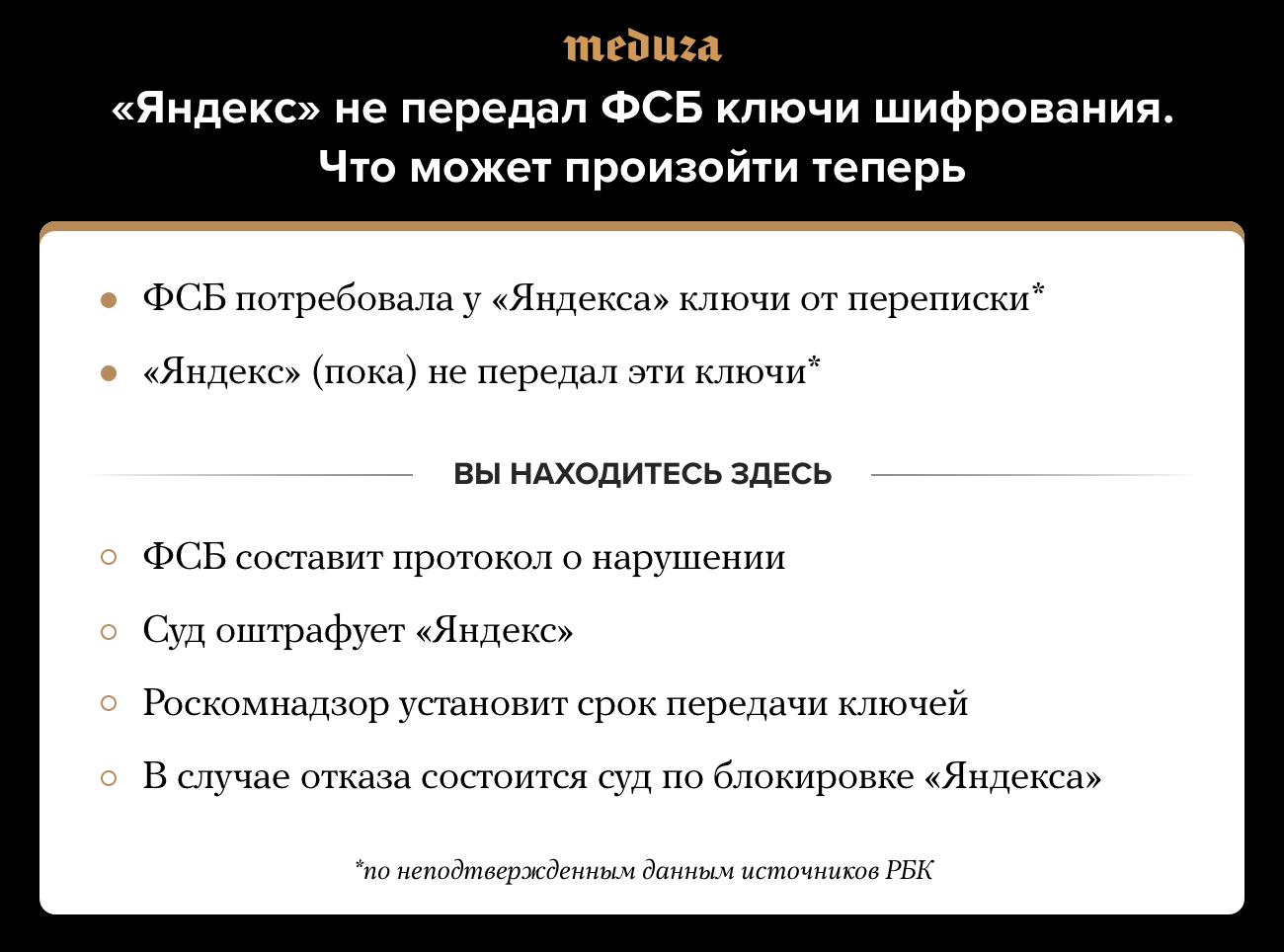
According to RBC, the special service requested from the service the session keys of Yandex.Do and Yandex.Disk - they allow you to decipher all the data transmitted between Yandex and a specific user within the framework of one session (for example, the browser tab is open). Knowing the session key, you can find out the user's login and password that are transmitted by a secure connection. Thus, according to the sources of the newspaper, the FSB requested unlimited access to the accounts of specific users from Yandex. The request was sent "a few months ago", but the FSB did not receive the keys.
This request, according to RBC, is sent to Yandex within the framework of amendments from the Package of Yarovoy to the Law on Information, which oblige companies recognized by the organizers of the dissemination of information (Ori), to issue information to “decode accepted, delivered, delivered and (or) processed electronic messages”. In 2014, Yandex was included in the Ori Register one of the first - after VKontakte and the Mamba dating site.
Update. The source of Vedomosti in the “large Internet company”said that officially “Yandex” did not receive requirements from the FSB, “but the idea of such a request was discussed at several meetings.”
What does Yandex say?
In Yandex itself, they refused to confirm or refute both the request from the FSB and the fact that the company did not transfer the keys to the special service. At the same time, the Yandex press service has emphasized that "the implementation of the law is possible without violating the privacy of user data."
Application "Yandex"
Application "Yandex"
Today in the media there was information that Yandex turned to the “Yandex” demanding to provide encryption keys. The law referred to by media representatives is applied not only to Yandex, but to all organizers of the distribution of information available in the Russian Federation, including all postal services, messengers and social networks. The law refers to the provision of information “necessary to decode messages”, it does not follow the requirement to transfer the keys that are necessary to decipher the entire traffic. The purpose of the law is to comply with security interests, and we completely share the importance of this goal. In this case, the implementation of the law is possible without violating the privacy of user data. We consider it important to observe the balance between the safety and privacy of users, as well as take into account the principles of equality of regulation for all market participants.
The Yandex refusal to give any explanations may be associated with additional restrictions that the law imposes on the company. Since 2018, the organizers of the dissemination of information are prohibited from disclosing any information about interaction with special services. For this, a fine of 300-500 thousand rubles is provided .
Previously, Yandex issued information on the request of special services?
Yes, by court decision. “In the case of the director of the library of Ukrainian literature in Moscow, Natalia Sharina “ Yandex ”, by decision of the court, provided the FSB by its correspondence from e -mail,” said Ivan Pavlov, head of the human rights “team 29” Medusa. According to Pavlov, court decisions are executed by most Russian services. In the Human Rights Group "Agora" and "Human Rights Cards" they said that they did not encounter business when law enforcement agencies would request information from Yandex.
In August 2018, against the backdrop of a mass discussion of criminal cases due to publications on VKontakte, the social network promised to reveal the statistics of requests from state bodies-as large Western IT companies do, in particular Facebook , Twitter and Google . VKontakte still has not presented this statistics.
“We do not disclose this statistics,” answered the press service of Yandex to the question of Medusa, whether the company plans to do this.
What will happen if Yandex will not convey the keys that the FSB requires?
Unknown. The situation with Yandex is the second case when it became known about the requirement of encryption keys to the Yarovaya Package. For the first time in 2017, the creator of Telegram, Pavel Durov, spoke about such a requirement. The messenger was demanded to open access to the correspondence of the accused in the case of a terrorist attack in the metro of St. Petersburg. The messenger’s lawyers in court explained that in this way a vulnerability will be created to control the correspondence. Durov wrote that it was “about the transfer of universal encryption keys with the aim of subsequent uncontrolled access to the correspondence of an unlimited circle of people”. Due to the fact that Telegram refused to transfer the keys, the messenger has blocked in Russia since the spring of 2018.
Mikhail Zelensky, Sultan Suleimanov