
Translated material
Regulation without regulations
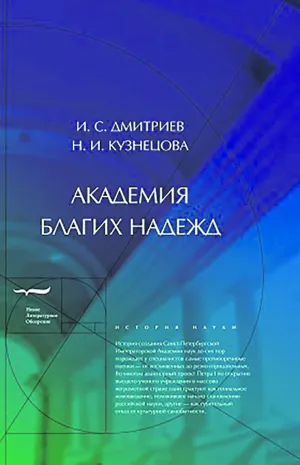
The new book on the early history of the Russian Academy of Sciences, Diptikh Igor Dmitriev and Natalia Kuznetsova is a big conversation about a personal example in the development of sciences. Igor Dmitriev writes about the brainchild of Peter I in the context of the development of European institutions and vicissitudes of domestic history of the XVIII century, Natalya Kuznetsova explores the Academy - how work in a scientific institution influenced the self -determination of invited and local scientists. But both author insist on one thing: although the tasks set before the Academy were determined by the general European requirement of the prosperity of sciences and arts, the structure of the regular state, military and diplomatic circumstances influenced not only the well -being of the Academy, but also its position in society. The significance of the Academy was never determined by the sum of the merits of its members, given that the highest project of the Academy did not correlate with the ratio of ranks, nor to the dignity of education as such. After all, the head of the postal station, who refused to give horses to an academy employee in 1781 and achieved his arrest for a day, and the director of the St. Petersburg printing house, who did not want to print Huygens as a book, nasty scripture, and contrary to Peter I, considered themselves completely knowledgeable people, even correctly educated people. The Enlightenment of the Western type could only be maintained by additional costs - Peter I ordered, on the advice of Jacob Bruce, to print the “cosmotheia” with a huge circulation, regardless of whether it would buy it or not, and Princess Dashkova stood up for academicians who combined scientific classes with the duties of an accountant or a pipe caretaker (as they do not recall “responsible for fire safety” in the fire Nii).
The main plot of the book is the life of the Academy without its own regulations or with a contradictory and petty regulations, without charters for individual units (the Academic University was not regulated by any document, and therefore St. Petersburg University thought itself as a continuation of the pedagogical institution), without any opportunity to think over and stipulate its own conditions of existence, differed from the supreme power of current tasks. If Peter I himself, doing everything to create an army and navy, welcomed the Academy as a necessary state expense, as a system that allows you to receive new strategic data, then his successors sometimes did not really understand why it was needed. Academics perfectly understood their mission, but even a simple collection of statistical or ethnographic information by academicians or involved specialists demanded the highest command, otherwise they did not understand why the data was needed, without which they had previously managed. The only universally recognized foundation for the existence of the Academy was then involved in international events, such as astronomical research, as in the honorary case of all European courtyards.
Of course, the Academy was created as part of a regular state, and Peter I was inspired by the ideas of Leibniz. But the study of Dmitriev and Kuznetsova shows that the choice in favor of the Academy as a necessary imperial service, and not universities, was not so obvious. Negotiations with Christian Wolf, who, unlike his teacher, Leibniz, was a supporter of the development of universities, could be successful. True, Wolf requested a lot of money, referring to the examples of genuine fees by the famous court doctors and astronomers, including the student of Galileo Vincenzo Viviani, the rich and favorite of the Tuscan Duke (it should be noted that Viviani was showered with privileges, because the duke was afraid that the astronomer would lose to himself Louis XIV). Lavrentiy Blumstrost, Peter Life Medica and the actual father of the Academy, wittyly replied that for such payments not enough the talent of the scientist and generosity of the sovereign, one must still be able to be at the right time in the right place.
At the same time, Peter the Great, of course, being an adept of a regular state, wanted to regulate the life of the academicians themselves. For example, they should not have eaten in the city, but only in the academic dining room, so as not to get drunk and not to adopt the bad customs of local residents (while in Western universities it was corporate discipline, and not the fear of the outside world). Without this struggle of power for the predictability of academic behavior, it is not clear the behavior of Lomonosov, which neglected the conventions of academic etiquette, but at the same time mastered the court etiquette in its most cost manifestations, starting from the construction of a three -story building with a garden. It is not an aristocrat by origin and at the same time a person influential at the court, an academician, but behaving like a single academician would not dare either before or after, Lomonosov could only break a closed system that interfered with free production of knowledge - Mosaic and Lomonosov’s books, of course, were part of such free production.
The book of Dmitriev and Kuznetsova sadden the homelessness of academicians of the 18th century. The Academy, which achieved self -governing only in 1746, which consisted mainly in the fact that academicians will not involve state work, and in their apartments - to place a soldier, and did not become a privileged institution. Count Kirill Razumovsky was appointed president of the Academy, who ordered employees under the threat of deprivation of salaries to constantly listen to each other, without reading even scientific journals at meetings. All stories, like a salary were paid by books, only confirm that the staff of the Academy and then had to not so much educate as to look for a common language with a different education, proving aristocracy or the clergy of the need for academic books. After two generations, the Barin will pick up the Masonic book, after four generations, the seminarist will be natural-scientific. But this is a completely different story.
Alexander Markov