
Translated material
The study of ancient proteins


The traditional image of an archaeologist is a person who is burned in excavations, who uses a shovel, a scoop, and for special occasions, a brush to clean especially fragile finds from dust. However, thanks to the development of chemical archeology, antiquity researchers appeared, dressed in snow -white robes, the main instruments of which are spectrometers. They study biomolecules discovered on ancient artifacts - proteins and nucleic acids, which give additional information on grains about how human ancestors lived.
One of the most effective ways to obtain information about our distant ancestors, both already mastered the straightening and moving, still leaning on the front limbs, DNA analysis has long been considered. This, among other things, allows you to distinguish different biological species from each other. However, any method has its own applicability boundaries. From the point of view of archeology and even more paleontology, nucleic acids are very ephemeral evidence that inevitably destroy over time. The most ancient DNA samples with which the researchers had to deal with the ancestor of a modern horse, and their age is 560–780 thousand years [ 1 ].
Unlike DNA, other biopolymers, proteins, are more stable. Currently, paleontologists have samples of functional proteins, the age of which is three times more samples of DNA record holders. Recently, it was possible to study the protein isolated from dentin of the fossil rhino, whose age is about 1.77 million years [ 2 ].
Sometimes paleontologists manage to detect more ancient proteins; As a rule, they are strong and resistant to the environmental effects of structural proteins. In 2003, a group of researchers, led by Mary Schweitzer from the University of North Carolina, discovered the skeleton T. REX , whose age is 68 million years 1 . Typically, the petition process replaces all organic substances inorganic, leaving only a stone copy of the original. However, when during transportation, the femoral and large berets of the dinosaur were accidentally broken, the researchers found fibrous and flexible fabrics. The reptile bones were mummified, there was no complete petrification. This is what made it possible to distinguish from them structural proteins of connective tissues, collagen, which can be stored unchanged for millions of years. A comparison of protein structures with proteins of existing biological species showed that the dinosaur collagen is more close to protein sequences characteristic of newtons, chickens and frogs, and this corresponds to the established ideas that modern amphibians, reptiles and birds are descendants of dinosaurs [ 3 ].
The stability of ancient proteins and the information that they can contain have allowed over the past two decades to paleontologists, archaeologists and anthropologists to develop new methods of analysis of protein material found at the excavations. Most often, it is collagen to analyze - it is part of the skin of muscle fibers and, which is especially important for archaeologists and paleontologists, in bones. As in the case described above with the dinosaur, the bones, turning into fossils, can “preserve” collagen and other proteins woven with it.
In the early 2000s, the University of York (Great Britain) developed a technique called “mass-spectrometric zooergology” (Zooarchaeology by Mass Spectrometry (Zooms), with the help of which we can identify biological species, studying collagen [4]. The essence of Zooms is that collagen is extracted from the sample, and then divided into shorter peptide chains using enzymes. Then these chains are studied using highly effective mass spectrometry. Since in various biological species the primary structure of proteins is individual, the results of mass spectrometric analysis allow you to obtain signatures characteristic of each biological species.
Since collagen is just one of the many proteins contained in biological tissues, and can provide scientists with relatively moderate information, over the past ten years, the methods of protein analysis in archaeological and paleontological samples have continued to improve, and now the number of proteins available for studying chemical archeology has grown significantly.
Getting useful information when studying proteins is fraught with a large number of difficulties. Those proteins that are best preserved are usually contained in mineralized samples protected by bone tissue or tooth enamel. Therefore, before the separation and analysis of proteins, the procedure of demineralization has to be carried out, and very carefully so as not to damage protein samples. With the release of protein, the problems do not end with fossils - despite the fact that the protein chains are more stable than DNA, it should be borne in mind that during the “storage” in fossils, and proteins can be destroyed or changed during working with them. First of all, the structure of the samples can affect the processes of hydrolysis (the destruction of the protein chain on shortened circuits or individual amino acids in the presence of water) and deamiding (separation of groups NH2 from the residues of glutamine and asparaginic acids). Fortunately, all these changes in the composition of proteins can be determined using mass spectrometry. And, of course, to work with fossil proteins, it is necessary to adhere to exceptional sterility so as not to pollute the objects of the study by modern proteins. For this, both their own and laboratory protective clothing for chemists-archaeologists should be synthetic-even cotton and linen fabrics, not to mention silk, wool and skin can become a source of modern proteins and peptides.
Despite all the difficulties, the analysis of proteins gives specialists in chemical archeology great opportunities - in the structure of the protein, you can reconstruct the body of the body and understand what biological appearance it belongs to. In some cases, proteins can tell even more than DNA.
Recently, the German-Chinese group of researchers through the analysis of proteins found that the jaw found on the Tibetan plateau, whose age is about 160 thousand years, belongs to the hominid related to Denisovites [ 5 ]. Denisovites, or Denisov people ( Homo sapiens denisovan ), is an extinct subspecies or a type of people who were previously known only from the materials from the Denisova cave in the Solonshensky district of the Altai Territory 2 . Researchers could not distinguish from the DNA jaw found in the thybet - the destruction of nucleic acids contributed to both the age of the jaw and the chemical nature of the surrounding jaw of sedimentary rocks - that is why it was necessary to resort to the analysis of proteins. Highly efficient liquid chromatography was involved in the mass spectrometry. This analytical method made it possible to distinguish from the dentin's detected dentin to be distinguished from the dentin's teeth, which were different in structure of protein molecules, all of which belonged to the collagen family.
According to Frido Welker, the head of the study, thanks to the analysis of proteins, not only for the first time it was possible to find out how the lower jaw of the Denisovites looked, but also to get material for comparison with other fossilized remains of hominids found in the territory of China, for which they did not conduct protein or genetic analysis. Without the analysis of these remains (which have accumulated a lot), it is still impossible to say what kind of biological species they belong to representatives.
The establishment of a biological species is not the only scope of the study of proteins and chemical archeology. For example, chemical archeology allows you to determine the food addictions of our distant ancestors. So, researchers working under the leadership of Christina Warinner did not simply identify the remains of domesticated animals discovered during excavation of ritual burial in the Mongol steppes. They decided to find out what goals the ancient inhabitants of Eurasia raised sheep, goats and larger animals three thousand years ago: for milk or only for meat.
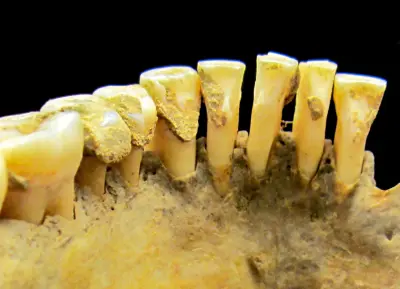
Squirrels that could suggest what was part of the menu of ancient people began to look in a tooth stone that could encapsulate proteins that fell into the human body with food [ 6 ]. When studying the tooth stone of nine people, milk proteins were discovered - caseins, which means that these people no longer disdain cow, goat and sheep’s milk. At the same time, the genomic analysis showed the absence of mutations in these people that allow you to absorb milk in adulthood, that is, they can be called pioneers of animal breeding for milk (at least in modern Mongolia).
Thus, Warinner's studies allow you to make a complete picture of how the breeding of animals for the sake of milk spread through the globe. How can this be done? People, like all mammals, feed on milk in childhood, but mammalian body is genetically programmed so that when growing, they cease to develop lactase - an enzyme that promotes the absorption of milk sugar - lactose. This, in turn, is the cause of lactose intolerance, which is massively observed in ethnic groups that have not moved to the practice of dairy farming. Representatives of other ethnic groups, those that began to grow cattle not only for the sake of meat, but also for the sake of milk, an genetic mutation was fixed over time, which contributed to the continuation of the production of lactase and adults, so they had the ability to absorb milk sugar at any age.
Another interesting area that specialists in chemical archeology is also associated with the analysis of milk and other proteins - an attempt to restore the "cook book of primitive man." So, Jessica Hendy is trying to find out that the proteins found can tell us about the methods of cooking by ancient people. To solve this problem, it is necessary to compare modern information about the chemical processes occurring during cooking, with the structure of proteins found in tartar stones and on the dishes in the places of ancient parking [ 7 ].
The extraction of proteins from ceramic products found during excavations of an early Neolithic agricultural settlement in Turkish Chatal-Kyuyuk (according to radio-carbon analysis, people lived there about 8 thousand years ago), and their subsequent study made it possible to find protein markers of Zerekov, legumes, dairy products and meat.
Before reliable methods for determining the structure of proteins with archaeological significance appeared, the researchers studied the remains of fats on ancient ceramics. Lipid markers, which remained on the dishes, also allowed conclusions about the food addictions of our ancestors. Thus, the analysis of fat made it possible to find out when the process of cheesepiece began in Northern Europe [ 8 ]. However, the study of proteins significantly expands our knowledge about those products that in prehistoric times were contained in a particular vessel. Handy says that, studying proteins, it is possible to understand whether milk, grain or beans had prepared in the millennium, ceramic dishes that had reached us through millennia. True, analyzing only the protein material, it is still impossible to say whether milk, grain crops, beans and meat at the same time, or after cooking legumes, without washing, were used to cook dairy dishes. To find out more precisely, you need to study more in detail layered deposits of inorganic substances that formed on this antique dish.
Arkady Kuramshin,
cand. chem. Sciences, Associate Professor of the Chemical Institute of KFU
1 of the work of Mary Schweisers were criticized and had problems with reproduction.
See for example. TRV-SCIENCE.ru/2008/09/16/park-yurskogo-prioda-otkrytie-otkladyvaetsya . - approx. Ed.
2 About Denisovites see trv-science.ru/tag/denisovcy/ .
About the Tibetan Denisovs-trv-science.ru/2019/05/21/tibetskij-denisovec/