
Translated material
Rook at the Pyramid in the Hugla era
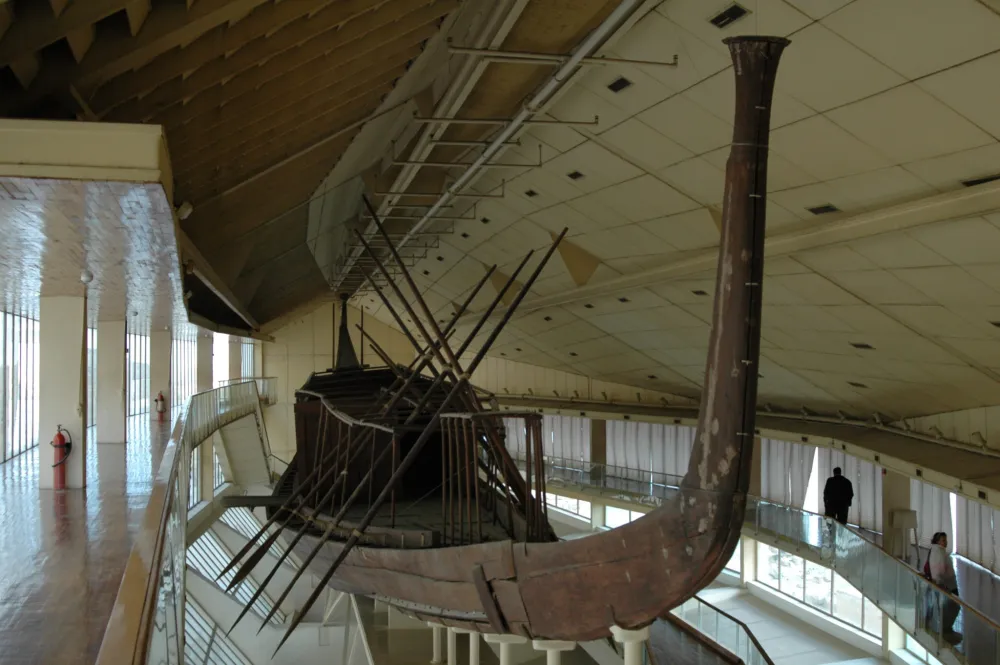
On May 26, Google devoted his dudl to the famous archaeological find, made 65 years ago in Giza near the Cheops Pyramid (Khufu), his royal rook. The event did not become a turning point in the history of Egyptology, but still causes various interpretations, hypotheses and speculation.
Modern afterword to a long opening
The background of the find

A group of Egyptian archaeologists, headed by the chief inspector of the Department of Antiquities Zaki Nurom and the architect-egiptologist Kamal El-Mallah, on May 26, 1954, cleared the prayer site from the southern foot of the Cheops pyramid from archaeological garbage. It was then that two stone cache were discovered there. In one of them there was an object that was almost equal in importance to the pyramid itself - the wooden rook of the pharaoh of Heops.
It is worth noting right away that the presence of such burials (or hiding places) with boats next to the pyramids of Egyptian kings in itself was no discovery. In total, five such caches were found in the Pyramid complex of Huf (see scheme). Three of them, located east of the pyramid and, unfortunately, loosened in antiquity, were well known to the Egyptologists by that time. Two of them were located parallel to the eastern face of the pyramid, the third - parallel to the ceremonial procession road. These giant structures (one of them has a length of 51.5 m and a width of 6 m) even their shape resembled a boat with a narrow nose and stern.
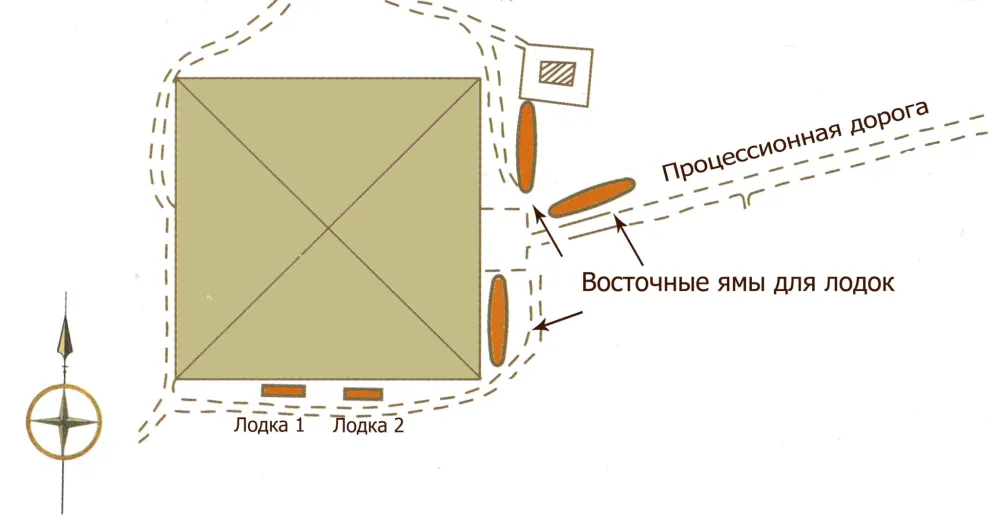
For the first time, the existence of hiding places was noted by the German Egyptologist, archaeologist and epigraphist Richard Lepsius in 1843. The English pioneer of Egyptian archeology William Matthew Flinders Pitri also dug them in 1880-1882, but at that time scientists had no clear idea of their functions. In 1924, the American archaeologist George Rezner repeatedly explored the “pit” along the ceremonial road and discovered gilded wood in it. It was he who called this construction by a pit for a solar boat, that is, a rook on which the king traveled around the sky along with the ancient Egyptian god of the Sun Ra. Finally, the Egyptian archaeologist Selim Hassan, who conducted in 1934-1935 the systematic archaeological excavations of this territory (but did not find two cache with boats at the south side of the Huhu pyramid), repeatedly investigated the pits for the roles and suggested that “ the boats were oriented by the East - the West and regardless of whether they were found whether They are one by one or in pairs, can be easily identified as sunny boats . ” In addition, he noted that one of these boats could be a daily boat in which the king traveled along with the sun to the west, and the other night, to the east [ 1 ].
Russian Egyptologist Tatyana Nikolaevna Savelyeva, who devoted his life to the study of material and written culture and the history of Egypt of the Era of the Ancient Kingdom, wrote in 1986 an afterword to the popular book of the English journalist and researcher Nancy Jenkins “Rook under the pyramid” [ 2 ], which remains one of the few science science publications this. Savelyeva notes that “ after the archaeological excavations of the necropolis by expeditions, who were headed by the largest scientists of the world - W. Helsher, G. Junker, J. Rezner, V. Smith, S. Hassan, A. Fakhri and A. M. Abubakr-did not expect any new remarkable discoveries in this territory. Nevertheless ... first they found the remains of the wall surrounding the sacred road for processions around the pyramid, then two stone caches carved in a rock and covered with enormous limestone slabs (weighing up to 16-17 tons each). The plates were tightly driven to each other and fastened with a solution of pale pink, which was used only during the ancient kingdom ”[ 3 ].
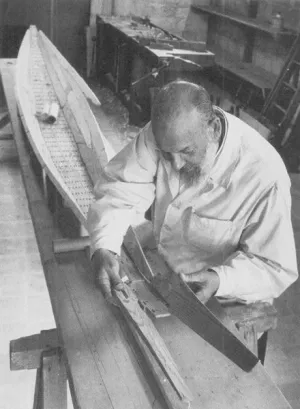
A pit for a boat, about 33 m in length, was significantly smaller than the boat itself. Therefore, the Egyptians who built a cache dismantled the ship into separate parts - the nose, stern and about 650 parts, which, in turn, consisted of numerous details (see photo below). The total number of wooden puzzles, with which the Egyptian restorers later had to work, was 1224 pieces. The disassembled parts of the vessel were carefully laid in a cache in a certain order. In the western part of the cache there was the nose of the boat, in the eastern stern, in the northern - boards of the right side, in the southern left. Separate parts of the case were laid at the bottom of the pit and on the sides, part of the support structures were placed on top of the rest of the parts. This is the circumstance, as well as the important fact that the carpenters have survived on certain details, allowed the ship to completely restore the ship in the future. In the cache, oars, ropes and mats were also stored [ 4 ].
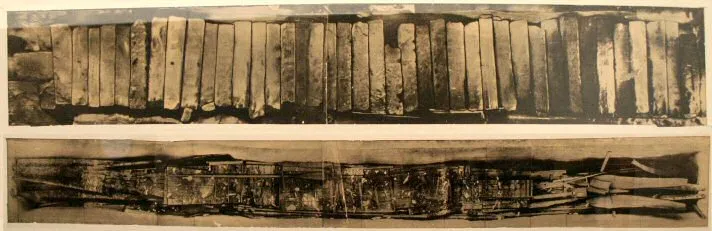
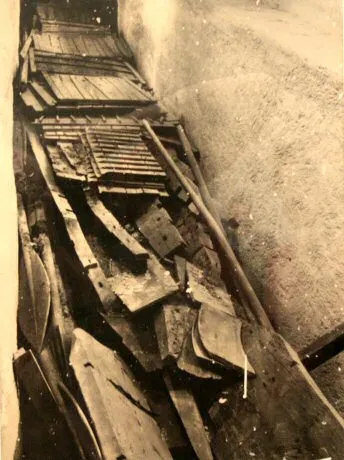
The first rook of the Cheops
Savelyeva also reports that “ for about six years it took an autopsy and examination of a stone cache, climbing it covering it with heavy limestone slabs (the method of their careful rise was developed by the specially organized committee of Egyptologists and engineers led by prof. Abdel Monya Abubakrom; Egyptian engineer Salah Osman invented a special lifting mechanism), chemical analyzes and chemical analyzes and chemical analyzes and chemical analyzes and chemical analyzes and chemical analyzes and chemical analyzes and chemical analyzes and chemical analyzes and chemical analyzes and chemical analyzes and chemical analyzes and chemical analyzes and chemical analyzes and The conservation made by Dr. Iskander, the seizure of parts of the boat and its reconstruction by the main restorer of Egyptian antiquities by Ahmed Yusef Mustafoy ”[ 5 ]. The restaurants were finally cleared in the fall of 1957. However, the restoration process itself dragged on for almost a decade.
The merit is that the boat was collected primarily belongs to the Egyptian restorer Ahmed Yusef Mustafa. The whole first year of work, he, along with his assistants, was engaged in drawings and the manufacture of models of each individual part of the rook on a scale of 1:10. The restorer believed that it was thanks to these models that he would get the opportunity to experiment, without enduring the genuine parts of the ship. He also carefully studied modern methods of building boats. However, by the end of the first year of work, Hajj Ahmed and his ten assistants were ready only 90 out of 1224 models. The restorer himself was ready to spend more than ten years of his life on the implementation of his plan, but at that time Egyptian government officials who needed to present the results of a sensational find, finally lost their patience. At the end of 1958, the new head of the Antiquities Service suddenly declared the press that the royal boat would be finally restored in three months. Of course, by this time the restorers did not have time, but the work on assembling individual fragments themselves began. As a result of the titanic work of restorers, long trials and errors, the first reconstruction option was ready in 1968. Ironically, due to the fact that the authorities did not immediately decide on the project of the Museum for the boat, the restorers had to disassemble and gather a boat five times! And each time, Hajj Ahmed made some changes to the design [ 6 ]. In its final form, the Khufu boat was exhibited in the museum of the same name, built specially for her next to the Cheops pyramid only in 1982.
Rook: view from the inside
The study of the boat showed that it was made of the Lebanese cedar, separate details were made of wood of local Egyptian breeds: Egyptian acacia, Zizifus (Zhuzhuba) and Sikamora. The Cheops boat had 43.3 m in length and 5.6 m in width. Despite such monumental sizes, the ship had a rather low sediment. There were two cabins on the royal boat: a small canopy on the nose and the main deck cabin, which occupied all the stern. The boat was equipped with five pairs of the so -called rowing oars on the front deck with a length of 6.5 to 8 m, as well as two steering oars on a stern of a length of just more than 6.5 m.
What is interesting to us by the Khufu boat and what is the uniqueness of its design? First of all, it should be paid attention to the fact that the ship, like many other Egyptian boats, was flat -bottomed, and instead of keel it had a kilo board that did not differ from the thickness of the sheathing. The Greek historian Herodotus paid attention to such a feature of the design of Egyptian boats, but these words were considered fiction for a long time. The longitudinal strength of the vessel was provided by massive longitudinal beams at the level of decks - one central and two on the sides, which in itself represented a very extraordinary technical solution. The transverse structure was strengthened by the frames - the rib of the vessel.
The boards of the sheathing had an impressive length - more than 20 m, and they were fitted perfectly. They were connected with each other with the help of rope nibs, and, unlike the Phoenician and Greek traditions, the seams were located across the corps, and not along it. Knights passed through V-shaped grooves in the edges of the boards. In addition, the spike is also used - the groove between the boards.
The ship had a continuous deck, and its ends - Stravni - were decorated with high decorative details imitating papyrus stems. Jenkins notes that “ both stucks were precisely fixed with pointed boards protruding from the corps. The high stem and Ahtershteshne, bending forward, turned out to be unusually heavy, but the amazing attachment system not only held them on the nose and stern, but also gave strength to the entire body of the boat ”[ 7 ]. In this case, a direct connection is found with the first papyrus rafts, the presence of which, however, is also indicated by the sick -shaped shape of the vessel body.
In addition, the boat was collected without a single metal part. According to Jenkins, during the seizure of individual parts of the vessel, with the exception of several fragments of almost clean copper, no details were found [ 8 ].
Features of the design of the vessel, as well as unusually heavy oars, allowed researchers to put forward the assumption that a vessel of this type pulled other boats in tow, and rowing and steering oars served mainly in order to hold on a chosen course [ 9 ]. According to another hypothesis, all these oars were steering.
The second boat of the Cheops
The fate of the second cache found in 1954 is also curious. At that time, archaeologists, guided by a number of reasons, primarily with uncertainty in the possibility of preserving the find, as well as the desire to leave one cache in the original form for the next generations of scientists, decided not to open the second cache. In 1987, Egyptian archaeologists, together with the American National Geographical Society, conducted a study of a cache. They drilled a hole for the camera, which was removed the disassembled ship, and also took the samples of wood through this hole. There was really another boat in the cache, but smaller and in worst preservation.
In 2008, Japanese University of Vasheda allocated $ 10 million to conduct excavation of the second disconnected boat. Judging by certain information, starting in 2012, fragments of the vessel began to lift to the surface. However, it soon became clear that water from the neighboring museum, where the first boat was put up, and the wood from which the ship was made, was very damaged [ 10], regularly fell into this camera with a disconnected boat [10 ]. Today, work on conservation and lifting the vessel is still ongoing. It is known that individual details of the vessel were folded in 13 layers. Before analyzing, each layer is scanned using a laser for obtaining a 3D model. After that, each part is photographed, sketched, measured and impregnated with special protective compounds. Then each detail is already scanned and goes to the restoration laboratory [ 11 ]. The future fate of this second boat is currently certainly unknown; It was suggested that after the completion of its restoration, the boat will be exhibited in a museum built near the pyramid for the first boat, and the very famous first will go to the Bolshaya Egyptian Museum in Giza.
What Nila swimmed the ramraon of Faral Hufu?
Scientists are still arguing about the purpose of the Khufu boat. To begin with, the custom of placing boats in special pits-tags was characteristic of the ritual practice of the era of the ancient kingdom. Special pits for rabbits, and the boats themselves are found in the royal funeral complexes and tombs of the nobility dating back to the time of the I - V dynasties. The most ancient boats of this type were relatively recently found in Abidos by archaeologist David O'Connor [ 12 ].
There are several main points of view on the functional purpose of such boats. Almost immediately after the discovery of the boat in the magazine Egyptian Archeology, an article by the famous Czech archaeologist Yaroslav černy was published, in which the hypothesis that the Four Rooks of the Faral Hufu (two, found south of the pyramid, were put forward, were nominated by the two, and the two, which once occupied the laid pits from the eastern side) were special ritual ritual boats designed to travel the king to four sides of the horizon. On the fifth boat (the very one, the traces of which was discovered by Rezer in the pit near the procession road) the king’s body was delivered to the burial site [ 13 ]. Egyptian archaeologists A. M. Abu Bakr and A. Yu. Mustafa also believed that all five boats, allegedly buried next to the Hufu pyramid, had different functions. On three of them, the king in the afterlife visited such important religious centers as Heliopol, Sais and Buto. The two remaining were used during the life of the pharaoh in coronation and funeral ceremonies [ 14 ].
I must say that most modern Egyptologists agree that these were sunny boats on which the king went to God Ra or traveled with him in the sky. The German Egyptologist Hartwig Altenmüller put forward an interesting concept on the basis of studying the data of archeology and images of ships in the tomb of the nobility of the ancient kingdom. In his opinion, we have special royal vessels buried for the needs of their sovereign owners in a different world. These vessels, as a rule, moved by flotillas consisting of two ships: a night barge and a daily barge. During a night trip, sailing boats were used, and a night barcone sailed ahead, during the day - funny, and the flotilla headed the daytime. Two vessels found in two hiding places on the south side were funny boats. The largest (the famous first boat of Khufu) is a daily boat, the second (smaller) rook is hufa - night. Two non -preserved boats on the eastern side were most likely sailing and were intended for daytime swimming. The fifth boat (with this, perhaps all Egyptologists agree) could be a funeral rook on which the body of Huf was brought to necropolis [ 15 ].
Finally, another explanation belongs to the former head of the Higher Council for Antiquities of Egypt Zahi Havass. The boats found from the south side of the pyramid (the first and second boat of the Hufu) were sunny rooks intended for the symbolic journey of the king’s soul along the sky along with the sunny god. Rooks from hiding places located near the upper temple (eastern boats) were used by the king, who was considered a choir, to travel to Egypt in order to maintain order in the country. In the room, cut down parallel to the procession road, apparently there was a funeral boat on which the king’s body was brought to his last refuge [ 16 ].
In the discussions of Egyptologists, many arguments are given in favor of the fact that the royal boat of the Cheops has never been launched. So, supporters of the hypothesis of a real ship refer to the fact of the presence of ten rowing and two steering oars on it as confirming its running qualities. However, there is an objection that such oars, too heavy and bulky, could well have exclusively symbolic significance.
Another argument of the supporters of the practical use of the boat is the fact that on some wooden parts of the boat, traces of a dense winding have been preserved with ropes in order to ensure the water resistance of the vessel. However, their opponents object, evidence that the boat was never used, much more. The remnants of white paint on the surface of some parts of the boat and the complete absence of traces of water on the body say, in their opinion, that it never swam across the Nile. Zaki Iskander, who led the preservation of the boat, came to the conclusion that the boat was built near the place where they later buried. The specialist in the field of Egyptian shipbuilding Bern Landstrom claimed that the ship was never painted or decorated, from which it could be concluded that it was built in a hurry [ 17 ]. So this boat, which in itself is a wonderful monument of the Egyptian shipbuilding, is fraught with many questions and puzzles that are still awaiting final permission.
Elena Tolmacheva,
cand. East. Sciences, Vedas. scientific. sore. Center for Egyptological Research of the Russian Academy of Sciences
1. Hassan S. Excavates at giza vi.i, pp. XIV, 55.
2. Jenkins N. Rabbet under the pyramid (royal boat of the pharaoh of the head) . M., 1986.
3. Savelyeva T. N. afterwood. In the book: Jenkins N. Rook under the pyramid (royal boat of the pharaoh of Heops). M., 1986, p. 123.
4. Savelyeva T. N. afterwood ... p. 124. Nour Mz, Iskander Z., Osman MS, Moustafa Ay the Cheps Boats. CAIRO 1960.
5. Savelyeva T. N. afterword ... p. 124.
6. Дженкинс Н. Ладья под пирамидой… с. 53–73.
7. Там же, с. 68.
8. Там же, с. 58.
9. Там же, с. 72.
10. Ветохов С. В., Лебедев М. А., Малых С. Е. Пирамиды над раскопом. Египет глазами российских археологов. М., СПб., 2017, с. 156.
11. Там же, с. 157.
12. amazon.com/Abydos-Egypts-Pharaohs-Aspects-Antiquity/dp/050028900X
13. Černý J. A note on recently discovered boat of Cheops. In: Journal of Egyptian archaeology 41, 1955, pp. 75–79.
14. Abubakr AM, Moustafa AY, The Funerary Boat of Khufu. In: Beitrage zur Agyptischen Bauforschung und Altertumskunde 12, 1971, pp. 1–16.
15. Altenmüller H. Funerary Boats and Boat Pits of the Old Kingdom.: In Filip Coppens (ed). Abusir and Saqqara in the year 2001. Proceedings of the Symposium (Prague, September 25th-27th, 2001). Archiv Orientální 70, No. 3 (August 2002). Prague, pp. 269–290.
16. Хавасс З. Царские ладьи из Гизы. В: Хавасс З. (ред.) Сокровища пирамид. М., 2014, с. 164–171.
17. Там же, c. 171.