
Translated material
Cold thermocoud à la google
A little story

Alchemists not only believed in the possibility of turning the elements (say, lead or mercury into gold), but also tried (sometimes at risk for themselves) to realize this faith with life. Scientific chemistry proclaimed the invariability of the elements and thereby imposed a ban on such transformations - as they said then, transmutation. This ban was refuted by the discovery of radioactivity at the end of the 19th century - transmutation was possible.
The physical nature of the instability of the elements was understood only in the 1930s, when quantum mechanics appeared, neutrons and neutrinos were discovered and theories of alpha and beta-decompades were created. However, a couple of decades before the scientific press has repeatedly reported about newly open transmutations, which, as we now understand, were strongly impossible. When this impossibility was realized on the basis of new physics, such sensations became the destiny of Fricks.
Thirty years ago, this trend was broken, and with great noise. On March 23, 1989, the University of Utah announced in a press release that the member of the British Royal Society and the ex-president of the International Society of Electrochemists Martin Fleischmann and the head of the chemical faculty Stanley Pons launched a self-supporting reaction of nuclear synthesis at room temperature. University President Chase Peterson told reporters that this is an epoch -making achievement only with the mastery of fire, the discovery of electricity and the creation of cultivated plants. The state legislators have urgently allocated $ 5 million on the institution of the National Institute of Cold Synthesis (and the university requested another 25 million from the US Congress!).

This message, which immediately became a world sensation, was welcomed by specialists in the USA and abroad. The godfather of the American hydrogen bomb Edward Teleler congratulated the authors of the opening and even announced the organization in the Liverrand National Laboratory of the Research Group to work on this topic.
Fleischman and Ponce claimed that they forced the deeria nuclei to merge with each other at regular temperatures and pressure. Their “cold synthesis reactor” was a calorimeter with a aqueous solution of salt through which an electric current was passed. True, the water was not ordinary, but heavy, not H2O, but D2O. The cathode was made of palladium, and the composition of the dissolved salt included lithium and again deater. Through the electrolyte for months, a direct current was missed non -stop, so that oxygen was released on the anode, and heavy hydrogen was released on the cathode. Fleishman and Pots allegedly found that the electrolyte temperature periodically increased by tens of degrees, and sometimes even more, although the power source gave stable power. They explained this heating by the intake of intra -core energy released during the merger of the nuclei of the deater.
How real is it?
In their explanation, undoubtedly, there was its own logic. It is well known that Palladium is among the few elements that very effectively absorb hydrogen. At atmospheric pressure and room temperature for every ten Palladium atoms in a crystal lattice, there may be up to seven hydrogen atoms. Fleishman and Pons considered that the density of the deater inside the palladium cathode reaches very high values that allow the editrons to merge into the alpha particles, the nucleus of the main isotope of helium. This process goes with the release of energy, which, in accordance with their hypothesis, heats the electrolyte. This explanation bribed with simplicity and completely convinced politicians, journalists who did not shine with scientific knowledge, and even, oddly enough, some chemists.
Nevertheless, nuclear physicists reacted to him, to put it mildly, skeptical. They knew that two deitrons could enter into a thermonuclear reaction, but the chances of such an outcome at indoor (and even much higher!) Tempens are negligible. To merge, these particles should approach each other at a distance of the radius of the action of nuclear forces - approximately 10-15 m. Since both they are charged positively, they need to overcome the barrier of the Kulonovsky repulsion, which is necessary for the kinetic energy of about two KEV, two thousand electron -volts. Such energy corresponds to the temperature of the star subsoil - 20 million or more Kelvins.
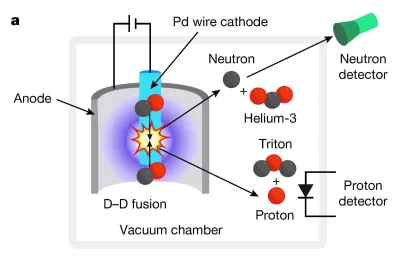
But the point is not only this. Suppose that in some mysterious way, the deitrons inside the palladium really come closer to the desired distance. What will happen next is well known. The nuclear reaction between a pair of actiontons almost certainly ends with the birth of the nucleus of tritium and proton or the occurrence of a neutron and the Helia-3 nucleus, and the probability of these transformations are approximately the same (perhaps the birth of an alpha particle and gamma quantum, but the chances of this outcome do not exceed one ten millionth). If there really was nuclear synthesis inside the palladium at the macroscopic level (otherwise the solution would not have been heated!), It had to generate a large number of neutrons with energy of about 2.45 MeV. It is not difficult to detect them either directly (using neutron detectors), or indirectly (since in a collision of such a neutron with the core of heavy hydrogen, a gamma quantum with an energy of 2.22 Meav should appear, which can again be registered). The energy of the gamma quantum, which should be born in the synthesis of an alpha particle of two action, is also well known-24 MEE. In general, it was easy to check the flashman and ponce hypothesis using standard radiometric equipment.
However, nothing came of it. Fleishman used ties in his homeland and convinced the employees of the British nuclear center in Haruella to check the work of his “reactor” for neutron generation. Haruell had supersensitive detectors of these particles, but they showed nothing. The search for gamma rays of the desired frequency also turned into a failure. Physicists from the University of Utah came to the same conclusion. Employees of the Massachusetts Technological Institute tried to reproduce the experiments of Fleishman and Ponce, but again to no avail. Therefore, one should not be surprised that the application for a great discovery was defeated at the conference of the American physical society (American Physical Society, APS), which took place in Baltimore on May 1.
Unlucky applicants for the opening of a cold thermal unit could not recover from such a blow. In the summer of 1989, both American and foreign scientists came to the final conclusion that the claims of chemists from Utah were either a manifestation of extreme incompetence or elementary scam. True, there were also dissidents - even among the scientific super -elite. The eccentric Nobel laureate Julian Schwinger, one of the creators of quantum electrodynamics, so believed in the opening of chemists from Salt Lake City that in protest canceled his membership in APS. In the early 1990s, several laboratories tried to reproduce the modified versions of the experiments of chemists from Utah, but they never found the desired effect. Some kind of attempts in this kind were made both later and again with a zero result. The new abbreviation Lenr - Low Energy Nuclear Reactions remained from them.
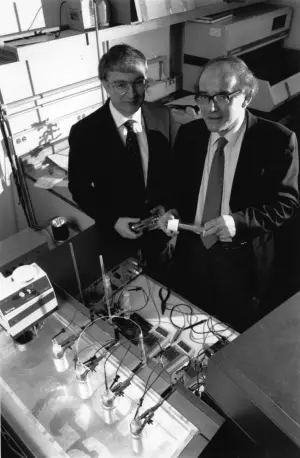
The academic career of Fleishman and Ponce ended quickly and ingloriously. In 1992, they left Utah University. True, they managed to convince Toyota Corporation to create a laboratory in France for further work on a cold thermal unit. It lasted six years and was closed behind the lack of results. Fleishman returned to England, where he died on August 3, 2012 at the age of 85. Stanley Pons settled in France, where he lives to this day.
Google intervention
The “cold thermal unit” of Fleishman and Ponce remained in the history of science as a pathological curious, a briefly inflated media. It seemed that he was forever doomed to deserved oblivion. However, fate in the person of Google Corporation intervened, which allocated 10 million dollars four years ago for a comprehensive test of their work. Thirty specialists from Canada, the USA and Britain agreed to participate in the project. In 2016, they began experiments that stretched for a couple of years. On May 27, the report on the results of this project appeared on the website of Nature 1 magazine. It must be admitted that the team of “checkers” was very solid, and the professor of chemistry and chemical and biological technologies of the University of British Colombia Curtis Berlinguatt and his colleagues did a great and difficult job. They invented and experienced several samples of palladium electrodes, which allowed to increase the degree of absorption of the deater from the electrolyte, increased its concentration inside the cathode crystal lattice to eight deater atoms per ten atoms of Palladium, which, of course, could not reach the flashman and Pons. Highly effective calorimeters were also created and the temperature measurement technique was improved. In general, they worked on fame.
It is easy to see that the participants of the Google project reproduced the experiments of Fleishman and Ponce in the most favorable conditions, increasing the likelihood of observing the announced effect. Nevertheless, their efforts did not lead to anything. According to the authors of the article in Nature , " so far we have not found any abnormal effects declared by supporters of cold synthesis, who could not get a less exotic explanation ."
However, Professor Berlinguatt and his colleagues did not stop there. They also reproduced an experiment of physicists from the Los Alamos National Laboratory, who in the mid-1990s subjected the palladium cathode to the bombardment of greatly dispersed deeria ions. The leader of the group Thomas Clayer and his colleagues then said that the experiment led to the appearance of tritius atoms, which could only arise in the reactions of thermonuclear synthesis. The members of the Google team checked this statement and received a zero result. In the third series of control experiments, they heated metal powders in media with a high hydrogen content, but also did not reveal any signs of thermonuclear reactions.
What's in the dry residue? Participants in the Google team created very advanced calorimeters, re -investigated the processes of the interaction of hydrogen and palladium, and received a number of results that are of interest to electrochemistry and materials science. There is no doubt that they honestly worked out their generous grant. In the end, it would be unnatural if the experimenters did not take the opportunity to master the money received for the benefit of their scientific disciplines. They also showed undoubted courage, agreeing to work in such an unconventional project. All this is understandable. Another thing is incomprehensible: why Google allocated as many as ten megadollar to an experiment with a previously known result. So you can sponsor Perpetuum Mobile projects!
Alexey Levin
1 Curtis P. Berlinguette, Yet-Ming Chiang, Jeremy N. Munday, Thomas Schenkel, David K. Fork, Ross Koningstein & Matthew D. Trevithick. Revisiting the Cold Case of Cold Fusion .