
Translated material
Two trillions for the development of the village: whether the new government program will help stop urbanization
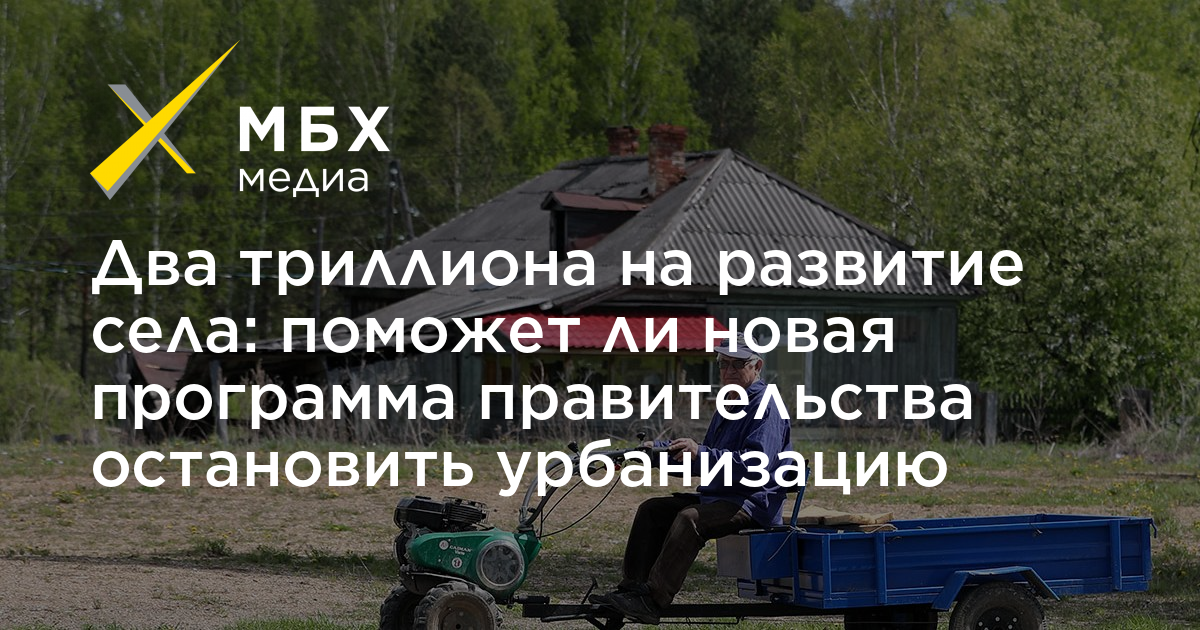
The Russian government approved the development program of rural areas, according to which it is going to spend 2.3 trillion rubles on the development of the village for 5 years. The first goal of the program is to suspend a reduction in the share of the rural population, which means that urbanization is inhibition. Moreover, earlier part of the officials, on the contrary, urged urban agglomerations by the priority of the country's development. Experts surveyed by MBH Media notes that it is impossible to stop the urbanization process.
As indicated in the government decree, the share of the rural population from 2017 to 2020 will decrease from 25.7% (37 million people) to 25.3%. Then, thanks to the implementation of government plans, the share of the rural population is stabilized at the same level. “Although the program does not have a single word about urbanization, it has an indirect attitude to the processes of urbanization, since the main goal is stated as the main goal of the share of the rural population,” says Ekaterina Shcherbakova, senior researcher at the Higher School of Sciences Institute of Demography.
Support for 400 thousand families is planned. 201 thousand families should receive a mortgage at a rate of 0.1% to 3% per annum, the rest - loans with a rate of up to 5% for home equipment and the creation of engineering infrastructure. Thanks to this, the share of landscaped housing should grow from 32% to 50%, and the average monthly disposable resources of rural households should reach 80% of urban in 5 years. The program also indicates measures to improve medical services and build 2.5 thousand kilometers of asphalt roads.
Probably, the achievement of these goals should contribute to the stabilization of the fraction of the rural population in the country, but in the passport of the program they are formulated as equivalent, Shcherbakova notes. “There is a sufficiently intelligible substantiation of such goals in the program in the option that is available now. As there is no understandable strategy, although there is a description of a number of subprograms, ”she says. “If the infrastructure development of rural areas seems quite understandable and justified, then the task of holding the share of the rural population at a fixed level seems not reasonable.”
It is almost impossible to stop the influx of the population from the villages to the cities, the demographs interviewed by MBH Media say.
“It is difficult to stop urbanization, since the population is aging and a decrease in the birth rate, and for this reason the rural population is reduced. Urbanization is a global process. Attempts of its restrictions are usually unsuccessful - that in our country, in other countries. Most often they try to solve the problems that she generates, ”says Shcherbakova.
“A decrease in the share of rural residents in the population was very slow in the last quarter of the twentieth century, and in the 1990s it remained almost stable at a slightly less than 27%level,” says Shcherbakova. In the 2000s, the share of the villagers continued to decrease, by the beginning of 2018 it amounted to 25.3%, and by 2025, according to the latest forecast of Rosstat, it will reach 25%. This indicator is also affected by the administrative absorption of the villages of the cities, says Shcherbakov.
“It is unrealistic to stop urbanization. In addition to serfdom, nothing will help, ”says Boris Denisov, senior researcher at the Laboratory of the Population and Demography of Moscow State University.
According to the government program, most of the funds will be spent from regional budgets in the Far East, Arctic, the North Caucasus and Crimea. “The village in Russia is heterogeneous, there are large regional differences. The rural population in the European part of the country is one species, in the North Caucasus - the other, there is an excess population, since so far there is a high birth rate. There, the problem with work and the youth leaves where there is an opportunity to get education and earnings. For European regions, the population is in the first place. The youth leaves to study and almost does not return, ”Shcherbakova explains.
At the same time, the development of agriculture with the number of rural population is in no way connected, as Denisov says. “The share of the rural population is higher than in other countries, and the share of employed in agriculture is even higher. The problem is that we have low labor productivity in agriculture and this is the main problem of the Russian economy. ”
“The relative number of the rural population of Russia is sufficiently large compared to the number of employees in agriculture - about 7% are employed in rural and forestry, hunting, fishing and fish farming. A significant part of the rural population is younger or older than working age. The villagers of working age are often not occupied by agriculture, but in other sectors of the economy. And how much is needed for the development of agriculture - depends on the level of its manufacturability and labor productivity, ”says Shcherbakova.
Earlier, a number of Russian officials - for example, the head of the Accounts Chamber, Alexei Kudrin and Moscow Mayor Sergei Sobyanin - spoke out for the development of urban agglomerations.
“In our rural areas, the conditionally extra 15 million people live today, who, taking into account new technologies of productivity in the village, are not needed for the production of agricultural products. These are either officials, or social workers, or someone else, ” said Sobyanin in December 2017.
In turn, Alexei Kudrin announced the need to create competitors of Moscow agglomeration. In his opinion, 20 priority agglomerations with special status should be distinguished to maintain the competitiveness of the country of Russia. Kudrin drew attention to the fact that by 2025 60% of the global GDP will be concentrated in 600 large cities, and 35% of the world GDP will produce only 100 cities. “If you look at the map of Russia, so far only two major cities in Moscow and St. Petersburg can at least somehow compete in this global competition,” Kudrin said .