
Translated material
Delivery culture
In April of this year, after a ten -hour work shift, the deliveryer Yandex.Dar Artyk Orozaliev died. A month later, the Delivery Club delivery service launched social advertising about the profession of the courier and real employees of this service, which caused a wide resonance. Samizdat figured out the modern culture of delivery and found out how the couriers' everyday life pass, whether the myth of the individuality of delivery is true and why in an ordinary delivery man we see not a person, but only an addition to the functionality of this service.
Delivery services in the post -Soviet space began to develop rapidly since 2015, and today the Russian market “food to home” is approaching world standards. Large aggregators appeared, and the generation of Zumers will no longer remember how their parents ordered food on the phone, and not through the application. However, the average client - a city resident of eighteen to thirty -four years - is still reluctant to go beyond the limits of the world's paintings proposed by companies.
The situation with the deceased by the Courier Yandex.Deys, the twenty -era -year -old Artyk Orozaliev, was almost silent. The microblogger Pavel (the name changed at the request of the hero) issued information about the precedent from a closed group to his Twitter with an audience of 50,000 subscribers: “Many couriers wrote words of gratitude to me, but they themselves will not rebel, because they understand that they can’t fight such a large company, they will rather be fired.”
> Funned Yandex food application lags
- Dr. District (@gipotez4) April 18, 2019
> You write in support
> They tell you that they will try to solve the problem and offer to cancel the shift without a fine
> You shoot the shift
> Everything is like ok
> The penalty still comes pic.twitter.com/hcojkerpcv
Among the tweets about Billy Ailish, Danila of the transverse and the problems of schoolchildren, a different tone of the discussion and a series of posts about the work of Yandex.Dera arose. It turned out that the automation of the work process through the application is not a technological good, but a digital hard labor that requires overcoming four kilometers in fourteen minutes without personal transport and turning a salary to the employer due to fines.
Twitter complaints
After the scandal with the death of the courier, the twenty-year-old student, Pavel, urged the indifferent to share the unpleasant experience associated with Yandex.Saea. Next, he promised to prepare the material about the old player of the delivery market in Russia - Delivery Club. However, the blogger attracted attention to the problem, which in reality cannot affect.
He did not plan to draw attention to the service sector on his twitter. His acquaintance courier often talked about his work, so after the death of an employee Yandex.De, the blogger had a desire to open the approaching one: “It doesn’t matter who is specifically to blame - a courier or service. I just wanted this to not happen again. Well, at least medical examinations were made, since people are subjected to physical exertion. ”
For example, customers do not know that no one processes food bags, they are stored at the couriers of the housePavel believes that the consumer is incorrectly imagined by the delivery service: “For example, customers do not know that no one processes bags for food, they are stored by the couriers of the house, - the Suvenue is completely not obvious to him. At the abstract level, the consumer suspects that work in the service sector is not pleased with the working conditions, and probably heard about emotional burnout. ”
Internal indifference to working conditions occurs due to a shuttle of personnel. People do not perceive work in delivery as constant. They go for money, peck on a promise of easy part -time jobs with a flexible schedule, worthy of payment and team spirit. There is no need for companies to fulfill the working conditions promised in advertising. The turnover not only completely satisfies them, but they are largely supported by them. The main thing is to have a fairly attractive message for applicants, so that there is always someone to hire.
After the scandal, Yandex immediately remembered social responsibility, saying that he would solve the problem through “technological solutions”. This only indicates that not only consumers perceive the courier as a temporarily acting drone, but the services themselves often literally repeat the gaze of the French philosopher Julien Ofre de Lametri from his famous work “Man-Machine”, seeing in their employees only a mechanism that realizes logistics tasks. A little more complex than the watch, but essentially similar.
Alexandra and Dmitry
Pizza delivery became the forerunner of the digital delivery culture - it was this bunch of product and services that became a characteristic phenomenon of urban life and entrenched in art characteristic!
Alexandra and Dmitry (the name of the man was changed at his request) worked in different positions, for various reasons and at different times, but in one pizza delivery.
Having thrown the university in the second year, Alexander took various vacancies and the administrator’s work in the delivery of pizza as a transshipment point: “I went to work from despair, because I was looking for work for a month, and at the time when I left a very important interview with the refusal, they called it. Alas, I did not know how bad everything is there. ” The proximity of the office to the house and the promise of a flexible schedule played a role. True, it turned out on the spot that workers were needed for a night shift, but this did not upset Alexander. On the contrary, she took it as an opportunity to competently use problems with sleep.
The work of the administrator implied the coordination of the actions of almost two dozen couriers and the same number of kitchen workers. “I had to check what orders the courier went to, monitor their implementation, keep in touch with the call center in order to know with what order the problem is, and warn the kitchen about it. - The work was harder than Alexander imagined. - All the revenue from the orders of couriers was under my responsibility. For each penny, you are responsible with your head, as for each incorrectly broken penny, one of the thirty -two cash desks. All the mistakes of couriers, cashiers are my fines. ”
In addition, there are also a “gray zone” of fines, which are written out for the fact that the cameras allegedly can be seen that the employee did something wrong. The camera’s office itself is almost everywhere. A blind area of cameras saved from the gray zone of fines, in which workers had the opportunity to relieve stress with alcohol. But Alexander, like other administrators, was not up to this: "We performed a huge amount of accounting, all reports and documents for the bank also on us, and we were often fined." After some time, when the courier revenue was accepted, she began to keep all the reports for herself so that there was nothing to present. This lasted about three months, and Alexander fought off many fines.
In her opinion, the authorities simply shifted their duties to subordinates, while doing nothing with either the working conditions or with the attitude to their employees.
“ Varlamov worked one day with a courier and fucking. I worked every day. " - After the army, Dmitry desperately needed money, so he got a job to deliver pizza. The main problem was the need to pay for gasoline himself. The constant haste was strained: late pizza delivered were written off from the salary. It turned out that everything stimulated the couriers to agree to crazy shifts at sixteen hours and work on the weekend.
Dmitry himself did not encounter force majeure, but he was heard that Alexandra observed from the managerial position: breakdowns that the couriers themselves pay for, and frequent accidents. “The way the salary is quickly disappeared is forcing you to be distracted from how they relate to you,” Dmitry believes that the ideas about the bad attitude to couriers and reality looks very different and reality is tougher.
The client is always right
The client perceives the order and delivery as something organized specifically for him, on his own conditions. The courier, on the other hand, deals with the depersonalized mass of the people he serves. Therefore, the consumer scolds the late courier and leaves an evil review if the delivered food is slightly remembered - the product and service, which are allegedly executed exclusively for him.
It happens that customers cause delivery, and then do not open the doors. Couriers pay for this. According to Alexandra, this happens especially often at night: “It so happened that customers were trying to beat the courier. A lot of drunk people are ordered, and if someone generously rewards with tips, then the other will give on the head and roll up a scandal. ” In a special category, administrators distinguish those who calculate the minutes for the action with a free pizza and then immediately begin to call and demand without understanding the exact conditions.
“About the fact that the couriers are given tips, I learned from the Varlamov video,” says Dmitry. “At the same time, it is strange to blame the guilt on the customer: he did not organize the delivery service in this way.” Dmitry believes that there are situations when there is no one else to demand a human attitude, except from the consumer. “The problem is not in random people who can crap you, but in those with whom you are constantly working. If the administrator is an asshole and the company harnesses the yoke from the shares “in 45 minutes or pizza for free”, then in all situations the courier will be a scapegoat. Although we had many adult men who suited everything. Education is different - they look differently at things. If for my generation it turns out to be worse than we thought, then it is better for them. ”

A similar phenomenon also says Alexander: "Adults understand where who is stealing, where they tear off the excess from them - this is true." In her opinion, in her youth, people are tended to perceive such professions as a more or less constant part-time job, which prevents him from soberly looking at the minuses.
Alexandra says that there was a case when a drunken courier was in the office for three days, picked up to the workers, slept in the courier zone - and none of the bosses began to do this: “The most funny that this courier was the father of the head of the entire courier service. Until I told the couriers forcibly stuff him into the car and take him home, he just wandered from the street to the room. ”
Courier or personality
Dmitry understands that the competition for the consumer is high, and is joking: "Everyone perceives the client as the one who is shocked and immediately climbs into the barricades, learning that someone was fading at his food." According to Alexandra, in order not to throw away spoiled products, they “interrupt” the expiration date. Moreover, such a deception is not obvious even to most employees of the company. Not knowing exactly what the interruption looks like, without explanation it is possible not to understand that yesterday's products.
When hiring for delivery, the administration is guided by two criteria - gender and age. Men are almost not taken by administrators, and women - couriers. However, Alexandra recalls: “There was one woman-courier, she worked for two days-and no one else saw her. Very hard work is both physically and morally, not even all guys withstand. ” This division of Alexander explains as follows: "Men are not taken by administrators to the call center to look more presentable and dilute the team." The company assumes that in any case it will be more pleasant to communicate with women, so they are taken to all positions where communication will not be limited to the order. Men, in the opinion of the leadership, are easier to endure the loads and super -exploration.
Administrators are usually girls from nineteen to twenty -six years old, and again Alexandra recalls the exception: "There was one thirty -year -old, but did not last long." Couriers are men from nineteen to forty -five. Workers of the call center are girls up to twenty-five. Such a gender skew is generally characteristic of the delivery sphere. Women are less hunting for a courier (even a car). And objectively a small number of women are trying to get a courier.
There are many reasons for this state of affairs: this is a stereotype that physical work is suitable only for men, and the fact that most Russian recruiters read training manuals and business literature, which say that routine work comes better for women better. But rather, it is a matter of the totality of personal elections, according to which women for the most part are not interested in being a courier.
“I myself use the delivery and relate to couriers as biorobots,” Dmitry, although he himself was engaged in delivery, also believes that in fact, most people perceive the courier as a function. The consumer begins to humanize the courier in situations where he is in something to be mistaken, and then everyone recalls that in front of them is a living person with whom you can come into conflict.
After a year of a bad attitude towards himself, an unstable salary and difficult working conditions, Dmitry resigned. They fired Alexander six months later - according to her, under a far -fetched pretext. She believes that this happened due to her complaints to the founder of underpayments. Now the former administrator is remotely engaged in translations and works in the Korean cosmetics store. “When I quit, I was forced to examine all the pockets of the cooks, to paw them from head to toe - if only they did not steal anything. It was unpleasant. Both to us and the cooks, ”she adds.
Artyom
After graduating from the university, Artyom (the name was changed at the request of the hero) settled on a courier on a large international courier company DHL: “I got there on the recommendation of a friend. The selection there is harsh, out of five accepted one - me. "
Now he carries from twenty to forty “packages”, mainly with business correspondence, and on average about twenty -five kilometers pass for a day. Unlike other companies, here the courier is not motivated to the invention of the teleport, sending it to roam throughout the city, but is assigned to the “square” employee - a territory in which traffic activity does not allow drivers to work.
“He used to work as a waiter, and in comparison with the work of the courier it was hard labor, it was not shameful for me to come drunk in the morning,” he says. Having experience in the field of unskilled labor, Artyom especially notes the difference in the level of the organization, where at the top of DHL, and in the abyss of chaos, construction.
The working day begins at 8:30 in the office, where the courier receives packages and independently makes himself a day for a day. Next is the hour at which he travels with the driver. Most of the couriers of the company are drivers, they differ in that they carry boxes, and on foot are envelopes and packages.
Varlamov worked one day with courier and fucking. I worked every dayThe main working day consists of two parts, and in addition to delivery, the courier also accepts orders. Cycle "A" is part of the day until 15:00. If it turns out to deliver 60 % of packages until 12:00, then the employee is given a bonus. If the courier manages to smash everything, then he goes to the “B” cycle. This cycle begins after 15:00, and the courier himself chooses what will be delivered. You just can’t leave at this time, and there are two options than you can take yourself. Firstly, it is profitable to work in the “B” section, as it gives bonuses and the next day it will be necessary to smash less packages in section “A”. Secondly, according to Artyom, there is an opportunity to relax: “Of course, you need to work formally-to smash a couple of envelopes or accept three or four orders, but no one will prohibit an hour to sit in KFC. In general, the manager always sees through the application how you deliver orders, but at the same time there is no pressure on the delivery time. It is impossible to control everything. ”
The DHL system is built under the control of the results through parallel reporting and the promotion of workers. The deliveryer accepts the order, reading the mark from the phone, and this immediately fixes the manager. In this case, the courier makes all tactical decisions - from building his route to the distribution of the load on the working day; Here he is both the logist and consultant.
Artyom says: “If I come to pick up the order and they tell me that everything will be ready in ten minutes, and then after another ten, I just leave. At the same time, there will be no complaints from the leadership. It is believed that the client needs it, since no one will bring this order to him anymore, while anyone can deliver pizza. ” He says that he does not observe frames: getting to work is relatively difficult, and the conditions are better than the average in the market. The earnings of such a foot courier are compared with what a programmer receives with a little experience. Artyom believes: “Such a work has no status, so they motivate me primarily money.”
Initially, he thought that he could combine work with his small textile business, but it turned out that "there is time, but fatigue is still wild." It seemed to Artyom that the courier’s work was an excellent occasion to listen to audiobooks, but he liked the podcasts more, as he often has to take off his headphones to communicate with customers.
Nevertheless, the lack of time is only the second most important minus. Artyom is more concerned about the injustice in wages. Due to the binding to the percentage of delivered orders, it turns out that the amount of work done is not directly related to payment. The one who initially falls out to smash twenty packages in any case will receive more than the one who came across forty. К тому же территориальные «квадраты» не равны по числу приходящих заказов, но при этом оплачиваются по той же схеме. По мнению Артёма, ситуация абсурдна: «Чем меньше работы, тем больше денег получишь».
В этой сфере нет карьерного роста ― можно проработать десять лет и стать начальником, с работой чуть проще и зарплатой чуть больше. Вместе с тем Артём замечает, что это не вальяжная прогулка по карьерной лестнице: «Большинство людей не представляют, насколько курьеру физически сложно. Без подготовки и привычки первые месяца три просто страдаешь, да ещё поначалу и не понимаешь, как организовать логистику, проходишь в день более тридцати километров. Я за первые месяцы потерял восемь килограмм».
Точно так же многие не учитывают, что ходить приходится постоянно с грузом за спиной. Медосмотр есть, но всё равно большинство соискателей отсеиваются в первые полдня работы. На курьера всегда влияет погода, и кажется, что она никогда не бывает хорошей. Артём упоминает о том, что пешими курьерами не принято брать женщин, и делится секретом: «Вообще, курьеры ненавидят праздники. Это означает лишь то, что на следующий день надо будет доставлять больше заказов».
Технологии DHL внедряет очень осторожно, так, чтобы не нарушить работоспособность текущей системы. О грядущей роботизации Артём не переживает: «Думаю, что когда всё будут делать дроны, то элитный сегмент доставки предложит handmade, это модно. У всех дроны, а у тебя человек».
Артём говорит, что возникает множество неформальных ситуаций, когда крайне важно быть человеком. К примеру, пойти навстречу клиенту, который не оказался на месте или не успел сам разменять деньги. В конечном счёте, человечность — это тоже услуга, и за неё сегодня платят. Артём не уверен, что так просто можно заменить людей дронами: «Здесь первая реакция у многих детей будет ― закидать камнями, а у взрослых — спиздить. Сколько угнано каршерингов, хотя, казалось бы, сплошь камеры и датчики».
Миф об индивидуальности доставки
Любители еды на дом, вероятно, смогут вспомнить, когда в сфере доставки фастфуда и недорогой пищи появились наклейки «контроля качества». Они показывают, что после приготовления коробку или пакет никто не открывал.
Странно в этом искать некий сакральный смысл, но интересно отметить предпосылку. Она заключается в предположении, что, несмотря на официальный договор, работодатель предполагает, что курьер может попытаться как-то испортить блюда. Профилактикой чего и должна быть наклейка. Иными словами, это вопрос недоверия и, что немаловажно, его буквальная физическая отметка. Из таких мелочей и складываются народные архетипы вроде тайком плюющего в суп официанта. В конечном счёте, если наклейка имеет место быть, то она зачем-то нужна?
Стоит также помнить, что, помимо материальных штрафов и жёсткого графика работы, в доставке обязывают носить униформу. Причём попытка её снять, естественно, наказуема. На пешем курьере униформа ― по сути, ещё и рекламный баннер компании. Конечно, это условия труда, на которые человек соглашается сам, но иных условий на рынке нет.
Онлайн-сервисы доставки предоставляют структурно простую услугу, для организации которой особого предпринимательского таланта не требуется. Во многом такие компании полностью взаимозаменяемы, поэтому основная конкуренция происходит на ниве уменьшения времени доставки. Потребительский комфорт в такой сфере важнее качества исполнения и тем более этики.
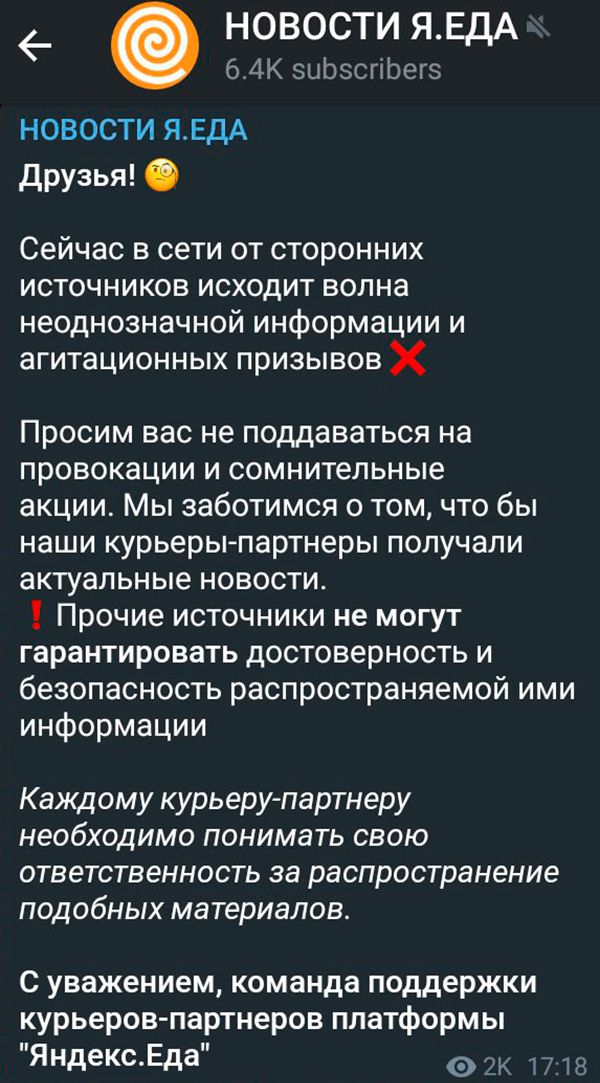
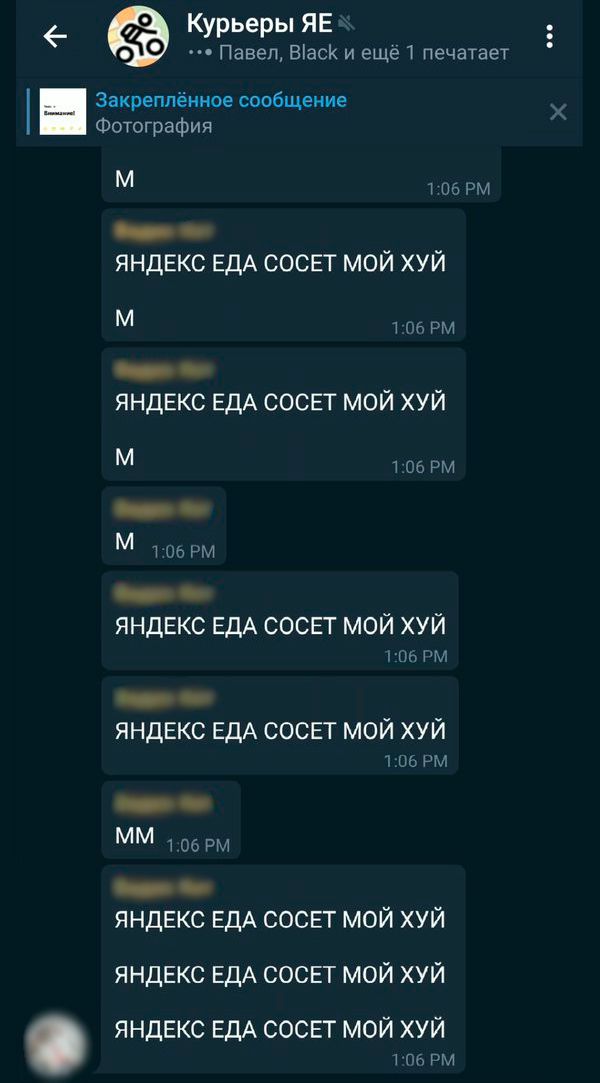
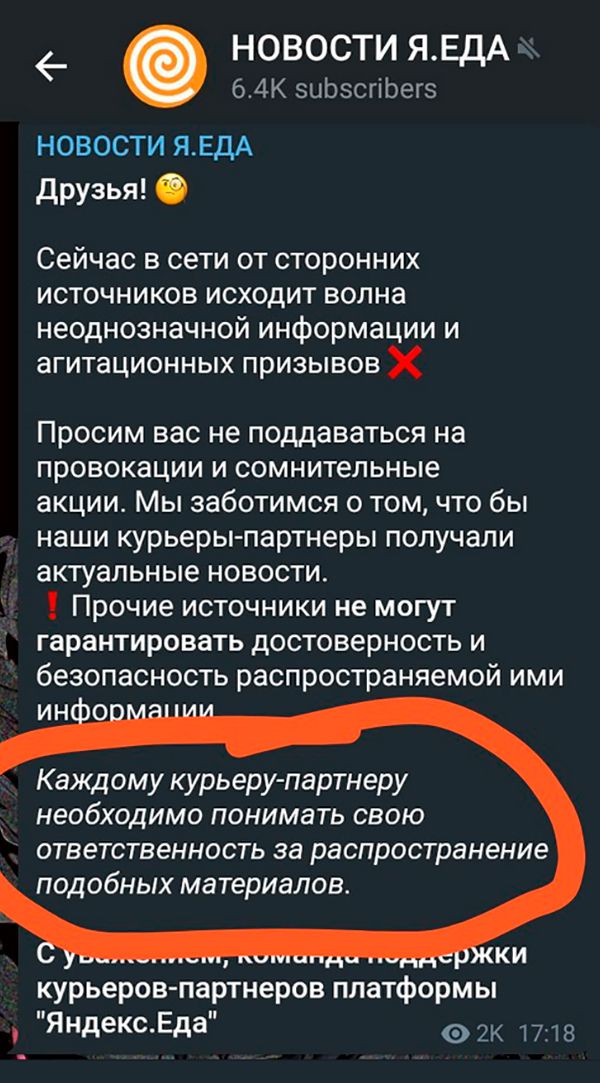
Особенно заметно это в том, как упомянутые компании реагировали на смерть курьера: как на инфоповод, на почве которого можно дать клиентам привлекательные обещания о том, что всё станет лучше и больше такие новости не будут нарушать их комфорт. Внутри Яндекса курьеров предупредили, что распространять информацию не стоит. По данным Павла, в среде курьеров предупреждение было воспринято как намёк, что за это будут увольнять.
Культура доставки — это закономерное следствие того, что современному жителю большого города хочется поменьше сталкиваться с другими людьми. У жителей мегаполиса количество личного пространства и их благосостояния прямо пропорциональны. Что и доказывает исследовательская группа Human Dynamics из MIT , демонстрируя две тенденции.
Во-первых, горожане концентрируются по признаку благосостояния. Выбирая торговый центр, кинотеатр, фудкорт или галерею, они отделяются от одних людей и соединяются в группу схожего достатка с другими. Во-вторых, чем богаче человек, тем больше у него личного пространства ― вокруг заведений для обеспеченных людей всегда много свободного места.
Потребительский миф о доставке звучит как песнь об уникальности, экономии и удобстве. Клиенту кажется, что специально для него везут особый заказ; на деле же он всегда встроен в логистическую цепочку из таких же заказчиков.
Курьеры ненавидят праздники. Это означает лишь то, что на следующий день надо будет доставлять больше заказов В случае с мифом об экономии многие потребители просто попадаются в классическую ловушку. Заказ через доставку может быть дешевле, так как из цены вычтена аренда помещения ― как это часто бывает с доставкой цифровой и бытовой техники. После определённого порога вам всё привезут бесплатно. Но надо понимать, что доставка происходит только тогда, когда она будет выгодной. Потратить столько, сколько нужно продавцу, — это буквально противоположная экономии вещь.
Доставка действительно удобна, но это не бесплатно. Современный маркетинг нацелен на работу с каждым клиентом, на максимальную цепкость, чтобы у него не было шанса выбраться из воронки продаж. Базируется всё это на простой вещи — нужно достать личный контакт потенциального покупателя. Строить физический магазин, который как-то сам по себе будет кого-то привлекать, и тратить огромные средства «в воздух» — для многих предпринимателей это в практическом смысле прошлый век, но вещь статусная и иногда позволяющая добраться до отдельных сегментов аудитории. Куда практичней взять телефон, а если не получится — электронную почту и без особых вложений донести до потенциального клиента своё рекламное послание и «прогреть» до новой покупки рассылкой с акциями.
Бодрийяру явно бы понравился такой пример гиперконформизма масс, когда из побуждения отделиться от всех и получить уникальный сервис современный человек до скончания времён попадает в огромную базу клиентов. Возможно, в какой-то момент надпись или специальный значок «минимальный CRM» станет способом сильно повысить цену на свою услугу. Уже сейчас культура доставок действует по схожим законам сегрегации, что и физические магазины. И там, где заказ ― это не пара долларов за фастфуд, а несколько тысяч за деловую документацию или микросхему, ситуация выглядит иначе. Не компания нуждается в клиенте, а клиент в ней — в том, что она может сделать всё за него с необходимыми гарантиями и в нужные сроки.