
Translated material
Anton Petrunin: Life of Luke
Anton Petrunin  Unauthorized protest of currency borrowers / mskagency.ru
 Congress of foreign currency borrowers / AGN "Moscow" / Photo: Ermakov Dmitry
 Anton Siluanov / Photo: Avilov Alexander / AGN "Moscow"
 Unauthorized protest of currency borrowers / mskagency.ru
Rospotrebnadzor and the World Bank found that about 60% of Russian borrowers have difficulty repaying loans and it is unlikely to give out new ones. At the same time, most of Russians continue to occupy both banks and microfinance organizations simultaneously.
These are the preliminary results of the study that the departments conducted together in 2018-2019 to evaluate how difficult it is for Russian families to fulfill credit obligations. They interviewed 4013 people in 16 regions, including Moscow and St. Petersburg. The report is still preparing for the publication, the World Bank planned it for autumn. But in early June, part of the data was already presented at a meeting with representatives of the Central Bank and the financial ombudsman. We got acquainted with the presentation in RBC.
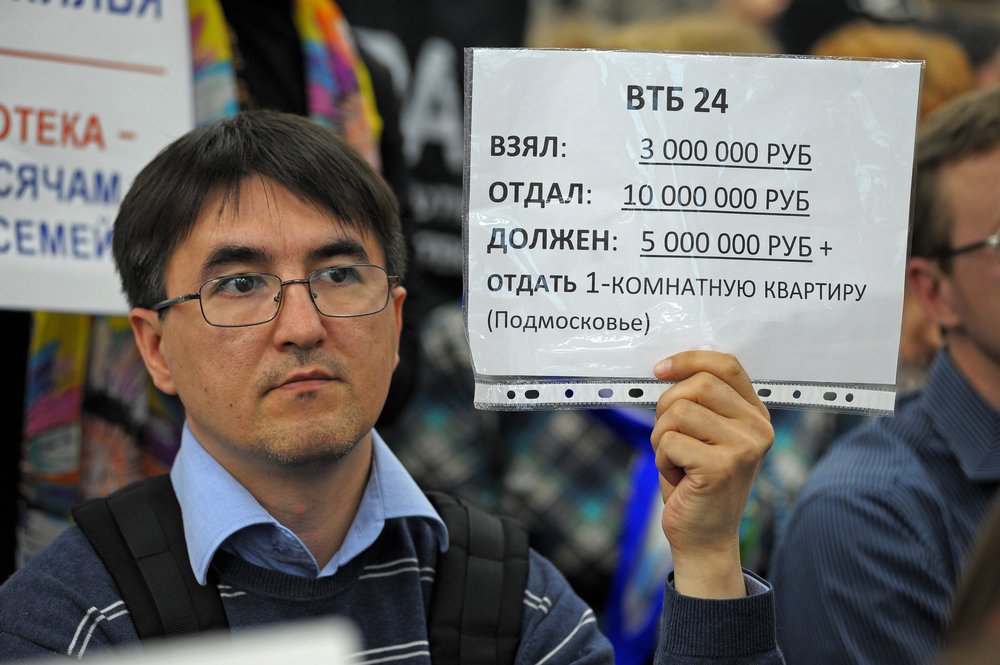
Congress of foreign currency borrowers / AGN "Moscow" / Photo: Ermakov DmitryThe study showed that 9% of families with the debt were expired, and 10% restructured it or received a loan refusal, 14% difficult to pay the commission, 26% spend on payments on loans, everyday needs and utility bills of more than 75% of family income, and only 41% does not experience any debt difficulties. But in 26%, according to experts, problems will arise even with a minimum worsening of the macroeconomic situation or a decrease in income.
The largest demand is for an inappropriate consumer loan, it is the most expensive. Families with an income of more than 70,000 rubles spend this money on the purchase of furniture and household appliances, more poor - for food and current consumption. Among families with an income of less than 30,000 rubles are almost 45%. At the same time, almost three quarters of Russia, according to VTsIOM, think that now is not the most successful time for loans. According to FOM, the share of families with loans increased from 34% in May 2017 to 38% in May 2018 and 44% in May of this year. If in May 2017 14% of respondents spoke about the difficulties with paying loans, then in May 2019 there were 16% of these
Recall that the head of the Central Bank Elvira Nabiullina said last week: “People take loans from a good life. People with low income apply for loans to maintain a standard of living. ” The discussion occurred during the PMEF. Initially, the head of the Ministry of Economic Development Maxim Oreshkin said that GDP growth occurs due to the growth of consumption. To which Nabiullina immediately objected that it was inappropriate to focus on this indicator and added that it was necessary to ensure that the growth of consumer lending would not turn into a social problem.
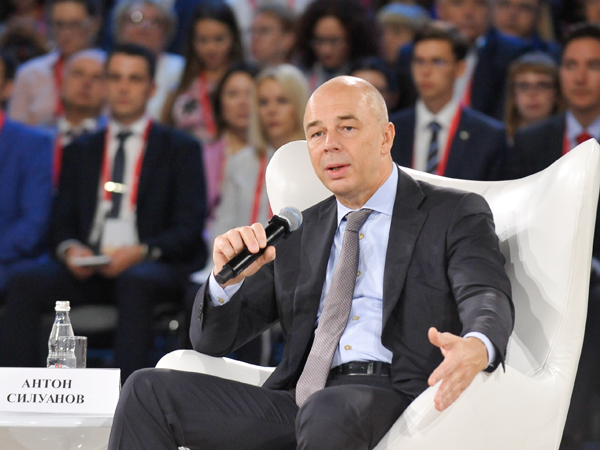
The head of the Ministry of Finance of the Russian Federation Anton Siluanov said that he considers life to be normal on credit. The minister emphasized that today there is a high level of development of lending to the population around the world. He believes that such a trend does not say that people have no money. Siluanov believes that the increase in the number of loans is due to the fact that people want to purchase any car, apartment or equipment as quickly as possible.
Anton Siluanov / Photo: Avilov Alexander / AGN "Moscow"They paid attention to the problem in the State Duma. The Chairman of the Committee on Labor, Social Policy and Affairs of Veterans, Yaroslav Nilov, said that the initiative to purchase “products on credit” could lead to a collection bondage. He believes that collectors will be for "sausage, milk, bread and kilograms of potatoes to knock out money, forcing to sell the apartment."
Andrei Belousov, assistant to the President of Russia on Economic Affairs, believes that the active growth of consumer lending puses a threat of a recession in the economy, so it is necessary to “slowly tighten this growth”. And although officials argue with each other, most likely, loans in Russia will soon become more expensive, and it will be more difficult to get them.
From October 1, 2019, banks will have to calculate the maximum debt indicator for the borrower - PND. The debt load indicator is calculated as the ratio of the total payment on loans to the total income of the borrower, respectively, if the amount of payments on loans exceeds a certain percentage of income, the bank must refuse to issue a new loan. In Lithuania, the restriction on the maximum value of the debt load indicator is set at 40%, in Canada - at 42%. In Israel, the bank cannot approve the housing loan, according to which the debt load will exceed 50%. In Russia, this figure has not yet been defined.
See also: Anton Petrunin Rosstat spoke about the feelings of the poor and wealthy Russians Katerina Norseeva, Russians are drawn into debts due to unnecessary things Anton Bykov why banks began to lend to youth