
Translated material
FBI against Chinese billions: startups in the United States refuse money from funds from China
Chinese money unexpectedly became toxic in the USA, writes The Wall Street Journal: American startups refuse to accept it, fearing to lose potential state contracts. The state encourages this approach: the FBI recently even released the brochure of “Protect your Startup”, in which it explains how to calculate technological spies among employees. Since May 2018, when a trade war has begun between the United States and China, the volume of investments of Chinese companies in the American technological sector has fallen more than doubled.
The scale of the problem
- The volume of investments of Chinese companies in American technologies reached record values in early 2018 - almost $ 500 million per quarter (sliding average in three months), and by the summer of 2019 fell 2.5 times, up to $ 200 million, the Rhodium Group analytical company says . This is a reflection of a large trend - the volume of China’s direct investment in the United States from 2016 to 2018 collapsed by 90% - from $ 46 billion to $ 5 billion.
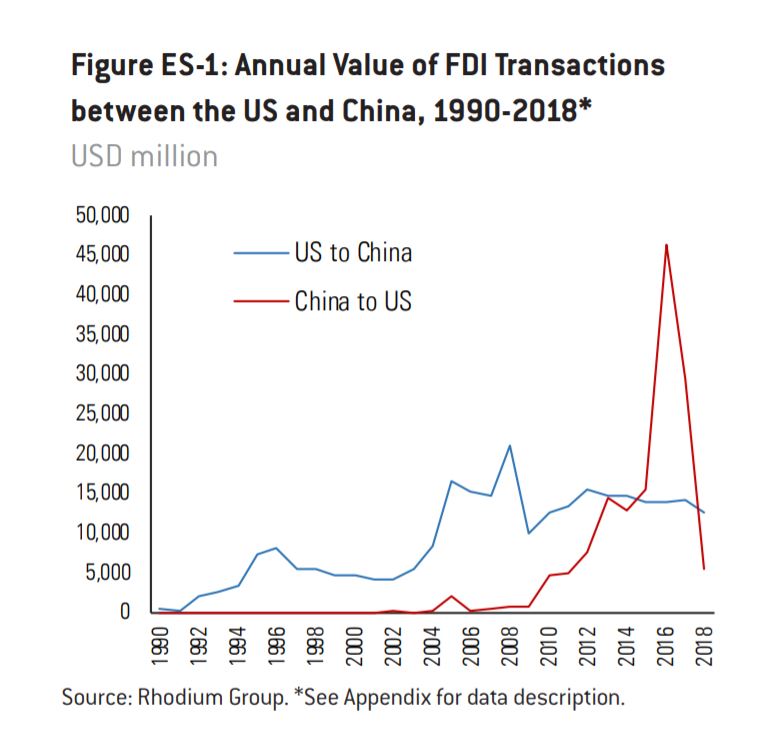
Mutual direct investments in the United States and China. Source: RHODIUM Group
- WSJ tells several offensive stories for Chinese funds. The saddest thing is about the Pilot AI startup from Palo Alto. In 2015, the Chinese Digital Horizon Foundation (former Danhua Capital) became its first institutional investor, investing $ 500,000. But in the summer of 2018, after the outbreak of the trade war, the startup decided that Chinese capital would prevent him from receiving state contracts. The founders demanded from the chairman of the board of directors Digital Horizon, a professor of physics from Stanford Zhang Shouchen to sell a package. According to the sources in his environment, Zhang was furious, and a few months later he committed suicide, leaving a dying note that spoke of depression.
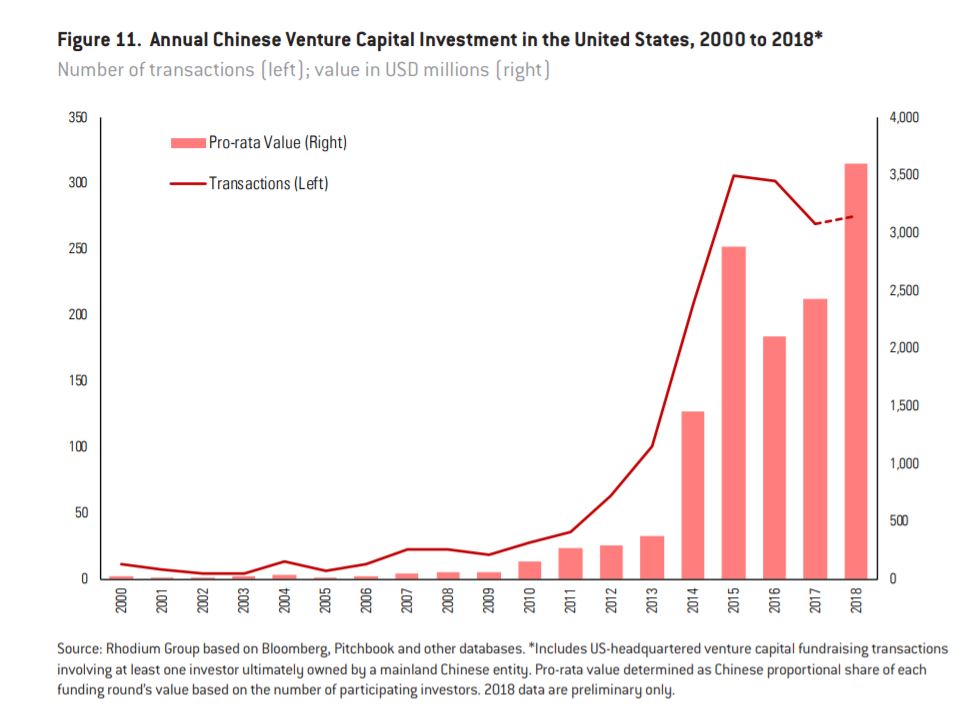
Chinese venture investments in the USA. Source: RHODIUM Group
- Other Chinese funds are trying to hide their nationality: they remove signs in Chinese from their offices and Chinese flags. Some simply leave the United States-such as Sinovation Ventures, whose board of directors is headed by one of the largest experts in the field of AI, the former top manager of Google Kai-Fu Lee. Large Chinese investors who do not want or cannot leave the market try to get out: the Baidu Ventures Foundation hires when closing transactions of a third -party nominal investor and refuses the place in the Council of Directors of the Company. Alibaba is trying to prevent his share in the startup to be too large (in one of the last transactions, the Chinese giant limited himself with modest 7%).
Reasons
- There are no formal prohibitions on Chinese money - but many startups are counting on state contracts and the subsidies of the Pentagon, for which shareholders from China can become an obstacle. The most toxic funds are those that fell into the report of the American Ministry of Trade from November 2018 as "funds that are trying to take American technologies to China."
- It has become a little more difficult to get foreign investment as a whole: a law was adopted in the United States, which obliged foreign investors to receive the approval of the US Foreign Investment Committee under technological transactions.
- American officials carry out targeted work with startups. A group of senators and officials of the Trump administration recently held a series of private meetings with businessmen from Silicon Valley, who reminded them of the risks of doing business with China and called for the danger of “theft of technology” to China.
- The FBI recently released a brochure on the same topic with the heading "Protect your startup." It describes how to identify among employees and partners of a potential Chinese industrial spy. It is recommended that you pay special attention to people with relatives in authoritarian countries, potential victims of blackmail (abuse alcohol or drugs, have illegitimate bonds, live not within the means), excessively ambitious employees who consider the company's product to be their own. It is proposed to calculate the disloyal employees by a set of signs: they talk about a foreign country or the company “we”, and about the USA - “they”, they note important life events in the country where they come from.