
Translated material
I tried to pilot a light -engine aircraft. It turns out that this is not easy
In GTA, everything turned out without problems.
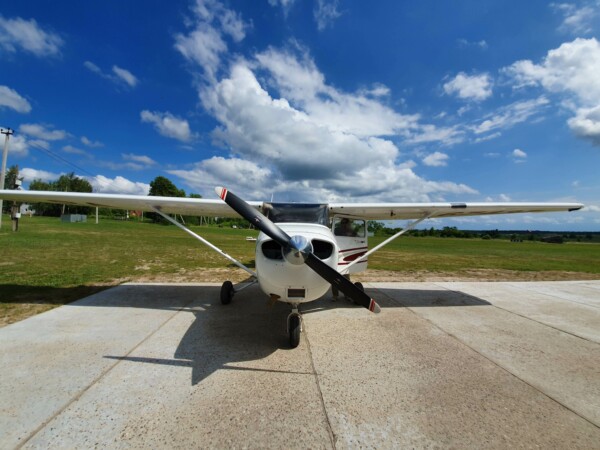
On Sunday, we went near Kolomna to the AIST-M airborne club: I tried to steer by plane. Everything went successfully, and although quite quickly, during this time I managed to find out something new.
Communication with the pilot - his name is Alexander - began with the fact that he asked to move the time of flight time an hour earlier, because he wanted to have time to work out the monitoring of the forests. According to him, it is monitoring that is its main activity, and the sale of individual flights is rather an additional part -time job. Private orders come to him generally through a third -party agency and, it seems, does not cause much interest to him.
Alexander said that he has a joint company with his younger brother Vyacheslav, and they work under state contracts - it seems, directly with the Ministry of Emergencies. An hour of flight during forest monitoring brings them 30 thousand rubles, while private orders are only 16 thousand (so it is clear that it is more profitable). During the monitoring, they usually look at whether there is a fire, or study the places of deforestation, after which they take photos through a special application on the tablet: it saves the photo along with the necessary metadan (like geolocation). Most of the time, the brothers live directly in the aero club - they have several houses there. They rent the land under the field for a long time, but they want to redeem into private ownership-they say some problems. Here is their site , if someone is interested.
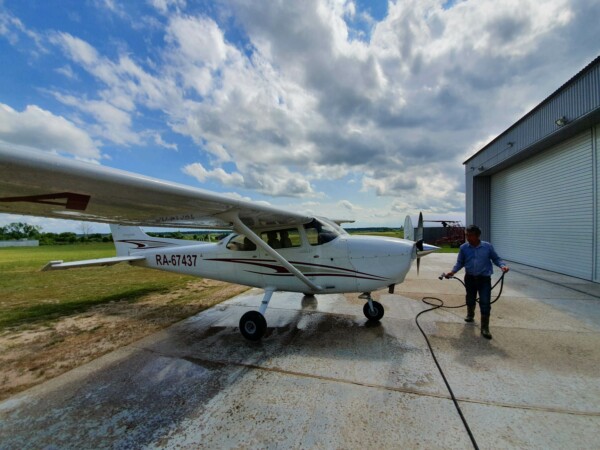
The plane in the company on the go is one. The model is the most popular of light -engine, Cessna 172 Skyhawk: two seats for pilots in front and one passenger behind. He has one engine, develops speed up to 120 knots (about 220 km/h), and fuel tanks will be enough for about six hours of flight.
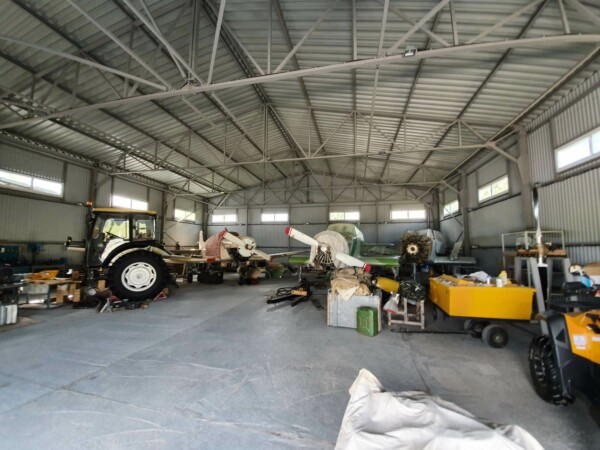
In the hangar there are two more yaks, but they are at a pre -sale repainting. Another aircraft was damaged when sitting on landing - hit the chassis released and tapped in the strip, but the pilot survived. I learned all this after the flight, so I didn’t think about anything before taking off.
Honestly, I expected some kind of pre-full preparation and detailed briefing what should be done in the air, but most of the instructions on the rise of the take-off touched how to sit down on the plane, so as not to hit my head on the wing and not break the chassis of the chassis, stepping on it. The fact that I have no parachute, and that if we fall, then everything to death, I understood already in the air.
During such a flight, the second pilot is actually not a pilot, but simply an observer - I myself am the desired sequence of the tolerance for the preparation for take -off I can’t press, I won’t put the plane. And I don’t know how to communicate with dispatchers. From the outside, all this looks easy: a certain sequence of the inclusions of the toggle switches, then a couple of words to the dispatchers like “I am such and such, allow the take-off from such and such a runway”, and then the acceleration itself begins.
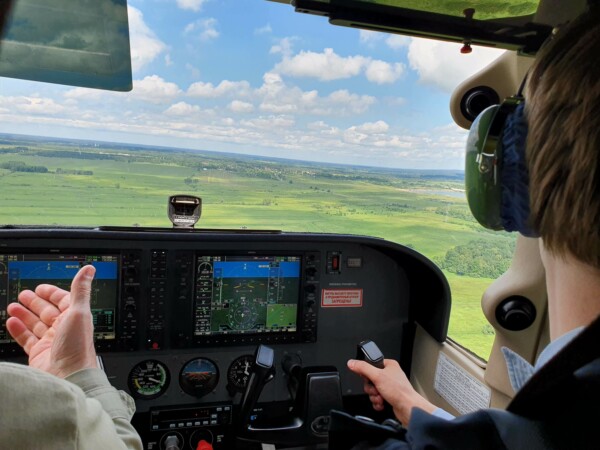
In front of me is the dashboard, and Alexander constantly poked his fingers in it, illustrating different statements about current engine speeds or height. But so much information is displayed on it at the same time that it is difficult to perceive it even with hints: almost no of the indicators are signed. However, quite quickly I caught that the most important thing is to monitor the testimony of the altimeter in order to understand whether it is necessary to adjust the angle of inclination of the aircraft in order not to lose or, conversely, not to gain height.
The take-off turned out to be deceptively light: we accelerated on the field covered with grass up to 100 km/h, and the plane flew in fact by actually, at some point, breaking away from the ground on a bump. Even the riding of the wrong field was relatively smooth.
There was little interesting in the air: I watched the pilot’s actions, while he slightly corrected the uncomplicated course around Kolomna, and also reacted to the instructions of dispatchers regarding the height occupied. Typically, light fitting fly at 300-500 meters above the ground, but sometimes they are told to decline or vice versa to rise stronger.
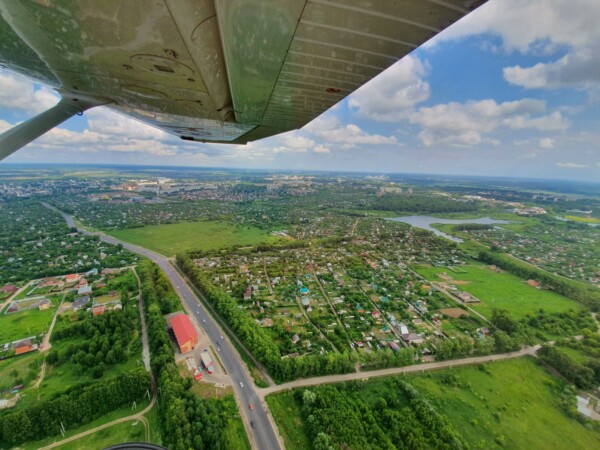
We flew at a level of 550-600 meters, and although on that day the weather was relatively good (light cloud cover), the aircraft talked significantly in the air. After the flight, it became clear why the pilots sometimes refuse to fly even under not the most severe (for an outside observer) conditions: the wind quite significantly affects the behavior of the ship in the air and the sensation of passengers. It may be a moan: polyethylene bags are allotted everywhere, and Alexander carefully warned that if he was sick, then the request to raise the headset microphone, otherwise it costs $ 400 and it would not be cool to glue it and break it.
At some points, I took control for myself for a while to feel how much the aircraft surrendered in my hands. Actually, there are three main tools to control: the helm that regulates the roll (left/right) and tilt (down/up), pedals that regulate the rotation (also left or right), and the fuel supply level that regulates the engine speed.
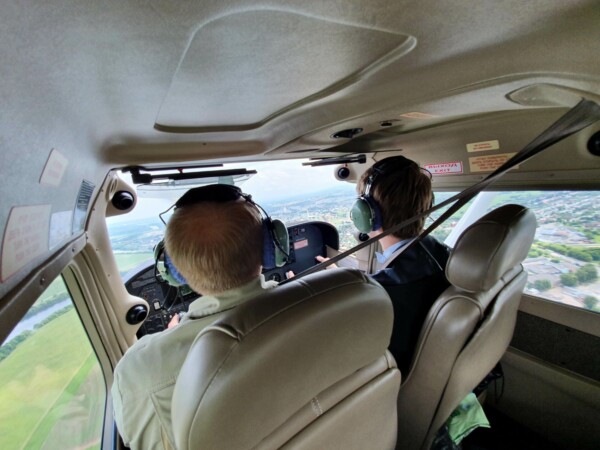
I had the experience of flights only in GTA and other similar simulators: in fact, the management was exactly the same there, so it was not difficult to get used to the mechanics. But what is a significant difference is in the level of return: the transfer of movements on the real machine is not as accurate as on the computer, and you need to constantly check how the position of the aircraft has changed after the maneuver made. In general, the sequence looks like this: in order to turn to the left, you need to tilt the helm to the left and at the same time give the left pedal, and after a couple of seconds, return everything back. If you need to turn more, do actions again - and so on until the end of the maneuver.
When the pilot Alexander removed his hands from his helm and left control to me, I was very worried: nifiga, all the responsibility for the lives of three people on me. So the hands of themselves dug into the helm, as if it were a rifle, and the movements became constrained, in addition, when shaking, my hands transferred fluctuations to the helm and reinforced the shaking. But Alexander noticed this nervousness and wisely commented: “It is not just the name of Self-Lite. He flies. Let go. " And however, if you release the helm, then nothing bad happens - the plane flies further itself. But at some point, you need to remember the whole sequence of buttons, monitor the set of unsigned indicators on the scoreboard, steer with one hand, turn on the fuel suction of the second, the legs are also busy-and the pilot Alexander, in addition, also managed to conduct a tour of the core.
We also sat down without any problems: probably, only a sonorous signal calling for a decrease, I scared me slightly when I thought a little more than 600 meters of height. When landing, the speed is dropped to 60 knots (110 km/h), which at first glance does not differ much from the average 90 knots with which we flew, but it feels like we have stopped at the ground and now we will fall. However, there was no blow to the ground, Cessna 172 villages gently and evenly - but this is only because Alexander Vetana has hundreds and hundreds of hours.
According to Alexander, several pilots have already come out of them with the fiber club, but to study for a long time and quite expensive. But the very thought of the possibility of lifting such a car into the air, flying wherever you want and sit down, quite attractive. He talked about the Australia expedition, in which he participated in the relatively distant past, and regretted that we did not like in the north of the United States: “In the nineties, every tenth resident of Alaska had the rights of a pilot and their own plane, even roads crossed the cities with a runway. What are we worse? "
#Personal Power #Aviation