
Translated material
Ivan Kurill: "Why is the Kremlin a crisis out of the blue?"
Ivan Kurill 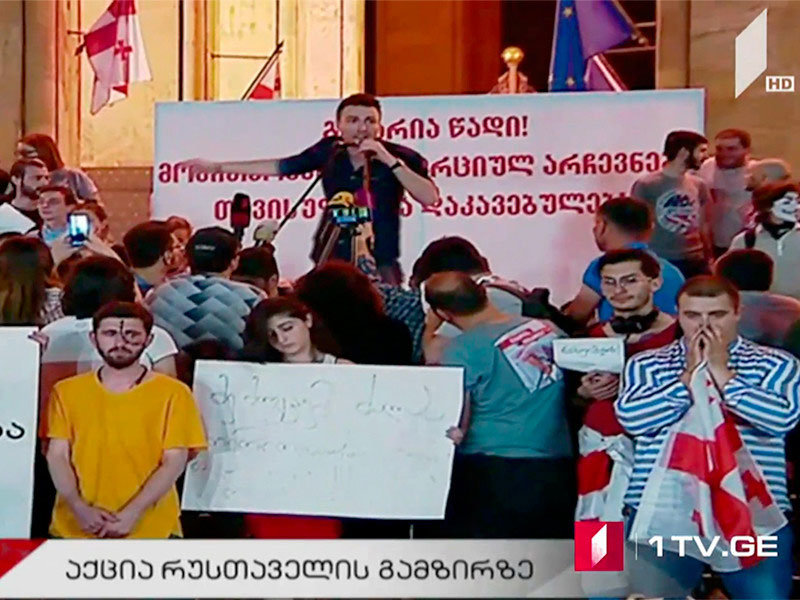
“It seems important to me to dilute several plots, which often in the discussions are in a heap. And it looks like everything is like“ Russophobes in Tbilisi staged a pogrom, these Russophobes are both in power and in opposition, so you need to urgently save Russian tourists, and for this to ban air traffic with Georgia, ”the historian writes on his Facebook page.
“The first one. The attitude to Russian tourists in Georgia is excellent. None of the tourists suffered during the protests, and, on the contrary, due to the turnover that Russian politics from Thursday adopted, I had to listen to many confessions in a good attitude to Russians from acquaintances and unfamiliar, from colleagues to people on the street. As for the protests, they are concentrated on the heel near the parliament building, and there are no“ unreasonables. Crowds "(author - Director of VTsIOMA) does not walk in Tbilisi. Therefore, I quite responsibly declare - what Russian authorities and Russian propaganda about some threat to Russian tourists in Georgia says and writes - lies.
The second one (a propos to the first): If there were a threat to tourists, the termination of the air traffic is not an adequate response to it: planes fly to obviously less safe countries in the world, and in countries where Russia is not much more definitely like in Georgia. Replace the presence of danger, but leave a choice to citizens, do not treat them as a meaningless herd.
Third. The attitude towards Russia (as a state) and to the Russian government in Georgia is really bad. We can argue about the right and guilty in the Georgian -Abkhaz war and the South Ossetian conflict and the role of Russia in each of them - there is no dispute for the Georgians: the most common (probably the only possible) point of view here - Russia occupied 20% of Georgian territory. About this - all those posters at rallies that Russian social networks post as "Russophobic".
In Russia there are consonants with this point of view, but most still sees here at least a more complex story. The Russian opposition can consider the Georgians allies in the anti -Putin emotion, and the Russian official propagandists consider such an assessment a sign of "Russophobia" - it seems to me that neither is wrong. But I must admit that Georgians have no reason to love Russia-state. However, once again: the assessment of the Russian state as an invader is not to be transferred to the attitude towards tourists from Russia. In addition, Russia is considered an invader (if not in Abkhazia, then in South Ossetia, but if not there, then in Crimea) a significant part of modern states. This is not "Russophobia" (the word itself seems artificial to me).
Fourth (adjacent to the third). Russian statesmen fundamentally refuse the Russians to make an attitude towards their own state and the people - in fact, why? Because "I scold the government myself, but when I hear how a foreigner does it, I am annoying"? There is something in this - not when the government itself and the propagandists who joined it resemble this annoying. What is happening now in Russian propaganda can only be called an inciting anti -agent sentiment.
Fifth. It is precisely because Russia (the state) is perceived in Georgia so unequivocally - it plays the role of the constituting another, that is, domestic political disagreements often take the form of disputes about Russia (and competition in rhetoric criticizing Russia). In fact, in recent days we see the intraograzian political conflict in which the opposition (here Saakashvili's supporters are “Mishists” and his rivals), finally found a reason for the release of a long -accumulated stress.
The opposition accuses the ruling "Georgian Dream" ("Dreams") and its leader Bidzin Ivanishvili in the fact that they lead the country on the wrong way. When it became known here about the invitation of the deputy Gavrilov in Tbilisi, the opposition unfolded the campaign to prevent his arrival, and when Gavrilov not only arrived, but also ended up in the chair of the speaker of the parliament, this played the role of the detonator. Gavrilov left on the same day - but he was not a goal, but a reason. All the requirements of the opposition are not about Russia, but about the resignation of heads of departments and the change in voting rules in the upcoming elections in 2020 (they demanded proportional, it seems to be consent to a proportional system with a zero entrance threshold, so that, apparently, to blur party lists by one-day parties).
Sixth. I saw in the FB a version of some Americans standing beyond the protests (“Why did they come there on the eve of the events?”), - such a conspiracy thermalology seems to me nonsense, mainly because it refuses the people to subjectivity. Yes, I myself came to Tbilisi on the eve of the events, - in what conspiracy did I participate?
Seventh. Why is the Kremlin a crisis out of the blue? It was already correctly noted that an external threat often helps to overcome the domestic political crisis - and the Russian government seems to be in a crisis. Another possible explanation is the fear of the victory of the next "Maidan" - the fulfillment of the requirements of the protesters who went to the street (and even more so the assignment of power) is the most terrible phobia of the present Russian authorities. They try to punish the country in advance for what can happen there (or maybe not). The Kremlin loves to buy elites, but cannot win the sympathies of the masses - hence his fear of democracy.
By the way, the current opposition, of course, is more pro -Western than the ruling party - however, the intensity of the "choosing Georgia between the North and the West" (Russia and the USA/Europe), which was characteristic of the period before 2008, in the present Georgia. Including because so many Russian tourists came to the country - their influence on the country's economy, on the mood of the population and its attitude to Russia is obviously a benevolent nature for long -term relations between countries. But the Kremlin without hesitation breaks this "soft power" of Russia, which itself cannot control.
The eighth. Since the version of some danger that awaits Russian tourists in Georgia is obviously lying, we see once again as the Russian leadership punishes the neighboring country, limiting the capabilities of our own citizens. These are the next "counter -sanctions" - the even more obvious "Voronezh bombing" than the ban on European products.
Finally, the ninth. Do all Russians know that Georgia introduced a visa -free entry into the country for Russian citizens, while for Georgians entry to Russia exclusively by visas?
PS separately outrages the fake policy, in which the explanation is not obvious to politics: in international law there is the concept of “sanctions”, and if the state of Russia wanted to “punish” the state of Georgia for some reason, then let it impose sanctions, and do not “take care of security”, detect a delay in airline’s payment or “deterioration in the quality of wine”. In general, it would be interesting to see the lawsuit (to the Constitutional Court) from the part, for example, airline or travel agencies regarding the losses inflicted on their business (by the way, no one explains to me what the President’s powers that would prohibit commercial activity in a certain direction). ”