
Translated material
Small criminals
How can an administrative fine in Russia turn into a criminal case? Date Department of Novaya Gazeta explains the technology
Can a fine of 1000 rubles break a person’s life? Yes, if you pay it from the wrong bill. The Date of the Department of Novaya Gazeta analyzed part of the sentences under the article of the Criminal Code of the Russian Federation “Assignment or waste” and came to the conclusion that for an absolute, it would seem, trifle can be obtained by a real criminal prosecution. As in the era of the notorious Stalinist “Law on Three Spikelets”, according to which people were severely punished for the slightest offenses. It is curious that this occurs during the period when many large -scale corruption crimes (if we are not talking about demonstrative flogging of governors and smaller officials) are not investigated at all or are not investigated very deeply, without affecting large people at the federal level.
"Socially dangerous acts"
The death penalty in Russia, of course, has been canceled for many years, and for thefts they are not punished so severely. However, in the modern Criminal Code there is an article resembling the "Law on Koloski." For example, Article 160 of the Criminal Code of the Russian Federation is “Assignment or embezzlement, that is, the theft of someone else's property entrusted to the perpetrator.” Part 3 of this article refers to acts committed using official position and on a large scale.
Help "New"
The Law on Three Koloski is the popular name of the Decree of the Central Executive Committee of the USSR “On the protection of property of state enterprises ...”, adopted in 1932, which ordered to shoot for theft of collective farm and cooperative property. The most “successful” punishment was replaced by 10 years of camps. The absurdity of such measures was quickly understood, already in 1933 the Presidium of the CEC in his decree demanded to stop the persecution for small single thefts. The law was so cannibalized that even one of the “engines” of the Stalinist repressions of the USSR prosecutor Andrei Vyshinsky spoke in the defense of the convicts. In 1936, a mass revision of the Coarse cases was made, as a result of which 79% of the sentences were retrained, and 32% of the convicts were released for 10 years.
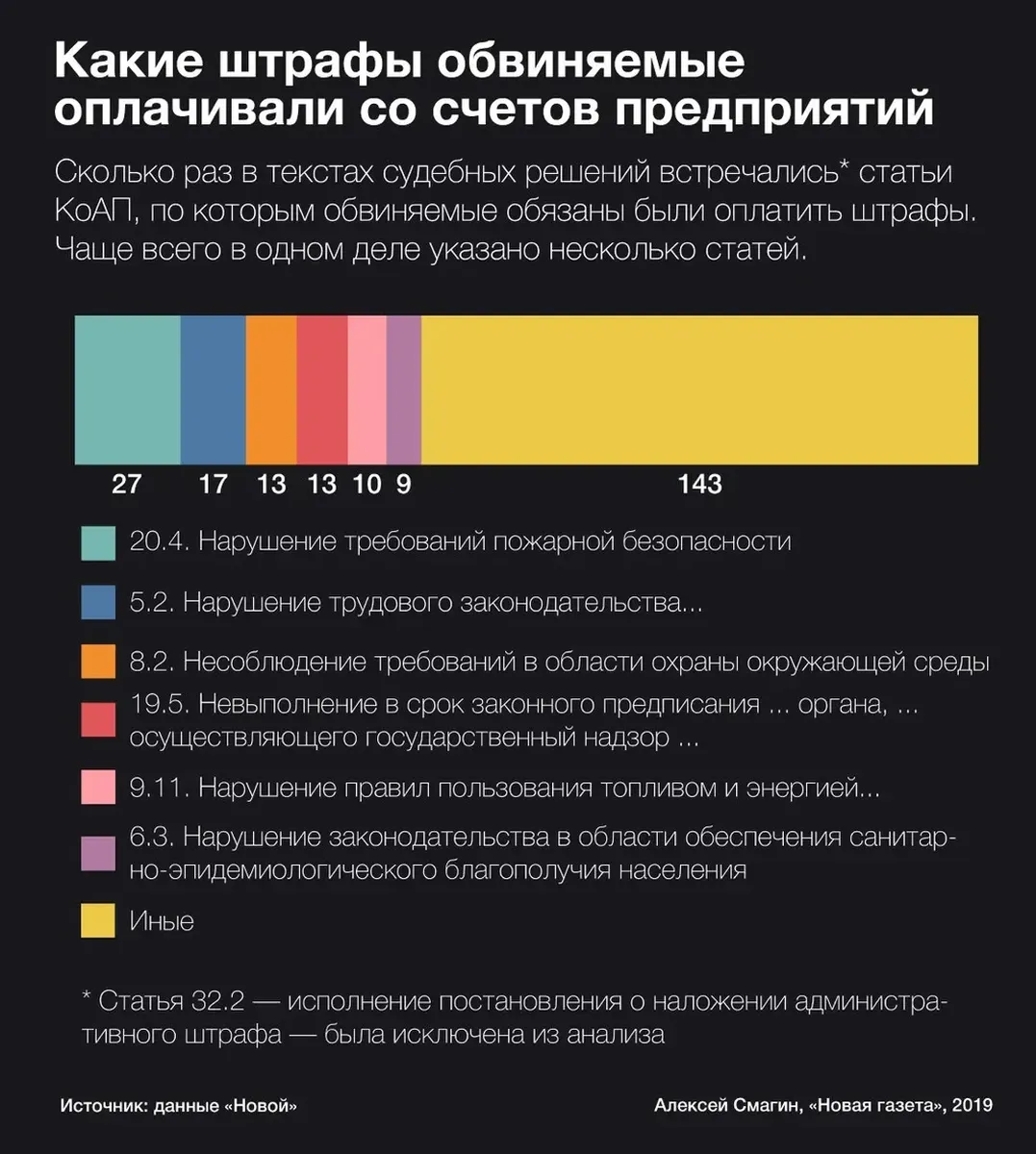
Among this article there are, of course, serious crimes. But absurd cases are especially noteworthy when, for example, the naive head of the village council conducts an administrative fine appointed to him through the accounting department. We unloaded similar decisions from the Ros administration website on key phrases “Administrative fine”, “subjected to administrative punishment”, “wanting to pay the specified fine”, “Payment for the specified fine”. So we found and manually analyzed 88 court sentences. In reality, there are much more such cases, since not all sentences are posted on the “Federal Administration”, and key phrases do not make it possible to get a full sample. Most sentences were issued in 2010-2012, but single decisions were met later - in 2013, 2014 and 2017.
The peculiarity of these cases lies in the fact that the convicts only paid fines imposed on them as officials, from the accounts of enterprises.
Here is an example of one such “socially dangerous act” (as stated in a court decision) - the head of the municipal enterprise of the Novotarskoye Village Council paid for a fine imposed by the inspector for remuneration from the enterprise:
“Shunko A.G., by virtue of his position, acting intentionally and realizing the unlawful nature of his actions, <...> ordered the chief accountant <...> to prepare a payment order in the amount of 1000 rubles to pay a fine on the decree <...> on the appointment of an administrative punishment <...> issued by the state labor protection inspector in his name. After that, <...> at about 11 hours, the chief accountant <...> not suspecting the criminal actions by A. Shunkko, at his direction, while at the workplace <...> prepared a payment order. "
The man received for this "embezzlement" two years conditionally with a test period of 8 months. Although the term is conditional, it is not worth it to underestimate it - this is a full criminal criminal record. For an official, an employee of a municipal or state enterprise, this is actually the end of a career, even if a direct ban on making any posts is not taken out.
Sitting for "United Russia"
However, sometimes soft sentences are also found under this article, if they are judged by a member of the ruling party, albeit committing a more significant waste. Here is an example - the case of the head of one of the village councils of the Mainsky district of the Ulyanovsk region:
“<...> extremely positive characteristics, the presence of diplomas, honorary letters and letters of thanks, numerous petitions of labor collectives, the Council of municipalities, the secretary of the local political council of the regional branch of the All -Russian political party“ United Russia ”, the court recognizes circumstances mitigating the punishment of the defendant, and considers it possible to assign punishment in the form of a fine.”
We analyzed the dependence of the size of the fine and the duration of the conditional term on the amount of waste. And they found that within the limits of the error between the crime and the punishment under this article, in general, in general. This can be explained by the “individual approach” of judges to impose punishment and taking into account the personal qualities of the accused. However, the more probable cannot be excluded: that the decisions under this article are simply made randomly.
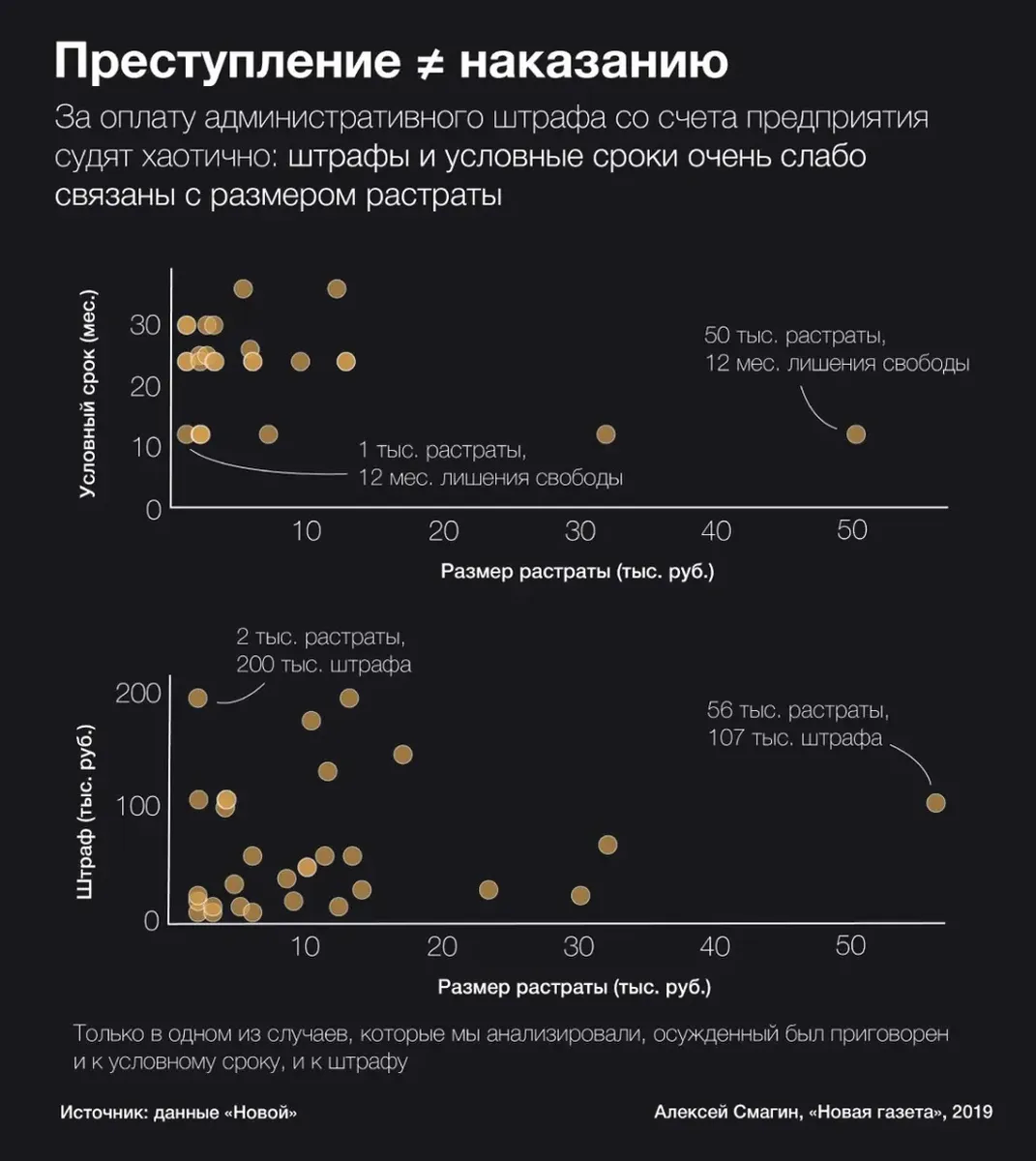
Other things being equal, the “individual characteristics” of the defendants (the presence of recommendations from “United Russia”, singing in the choir, honorary letters) in a fairly large sample of cases should not affect the dependence of punishment on the amount of damage. Another could only be on condition that the largest waste is made exclusively by persons with “honorary diplomas”.
“The hypothesis of the chaotic use of punishments may have grounds, especially with regard to the size of fines,” said Kirill Koroteev, head of the international practice of the Agora human rights group. - But, it seems to me, judges often understand that condemnation on such cases is an unnecessary phenomenon, so they seek to impose punishments that are not related to deprivation of liberty, which, by Russian standards, is softly. They cannot justify. ”
The Supreme Court is stood up
All these sentences are conditional, and in modern Russian practice, conditional condemnation and lawyers and defendants are perceived in virtually as an acquittal. What are they important?
And they are important by the fact that absurd sentences for minor acts are carried out by the same judges who consider the cases of activists after rallies, pursue Jehovah's Witnesses for religious beliefs, and justify the torture in the police.
The absurdity of the receipt of criminal criminal records for a petty act is also aware of the Supreme Court. In his Bulletin (No. 4 for 2018), as exemplary, he makes a decision of the Presidium of the Perm Chrysud in the case of a certain director of the municipal enterprise, which became a criminal due to a fine of 1000 rubles paid from the bill of the enterprise. It took a decision of the deputy chairman of the Supreme Court of the Russian Federation so that a cassation appeal was considered and the verdict was canceled. The basis for the cancellation is the simplest: part 2 of Article 14 of the Criminal Code of the Russian Federation, according to which an action formally containing signs of any act provided for by the Criminal Code is not a crime if, due to insignificance, it does not pose a public danger.
Among the judicial acts we found, there is not a single case “for spikelets”, the decision on which would be made later than 2017.
“Similar stories arose often. This is a criminal for Internet memes, courts of doctors for errors or even just for a bad outcome of treatment that they could not control, ”says lawyer Kirill Koroteev. “Sometimes such criminal cases can be terminated.”
According to the expert, for some reason the prosecutors, the Investigative Committee refuses to do new such cases, and they do not go to the courts. But in many other cases, there is no direct dependence between the position of the Supreme Court and the decisions of the first instance. So, in relation to the article - “excitement of hatred or enmity” - the Supreme Court has repeatedly stated that it was necessary to take into account the context of the statements, and not just copy the data of the examination provided by law enforcement officers. But even after such statements, the case under this article continued for more than one year.