
Translated material
The mat addressed to Putin in the Georgian program led to protests in Tbilisi and the suspension of broadcasting of the television company (video)
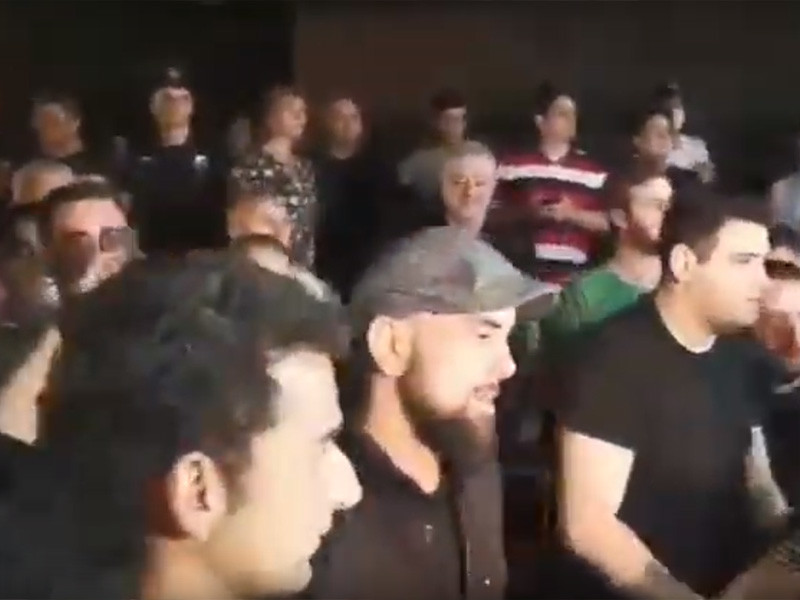
The Georgian television company Rustavi 2 temporarily stopped broadcasting after hundreds of Tbilisi residents expressed dissatisfaction with the performance of the television journalist George Gabunia - on Sunday evening he began his author's program “PS” with a swearing to Russian President Vladimir Putin, RIA Novosti said.
“First of all, I want to convey a huge -otter greeting hello to our great friend, Russian President Vladimir Vladimirovich Putin,” the journalist began the program, after this, calling the president “Vovochka” and was speaking, for the most part consisting of obsceneity. During it, Gabunia invites the president to “get out of Georgia along with his slaves,” calls the president a “smelly invader” and mentions the president’s mother in rude form.
In response to the performance, the townspeople threw a television company with brooms, eggs and bottles, demanding to dismiss the host and dismiss the general director Nick Gvaray.
The message on the television company says that broadcasting was stopped due to the inability of the Ministry of Internal Affairs to ensure the safety of journalists. They reported that after the scandal there were attacked several employees. According to local media, one of the operators of the television company quit in protest. On the morning of July 8, the broadcasting was resumed.
Earlier, commenting on the incident, the general director said that he considers an unacceptable mat on the air, although he shares the position of the TV presenter. The company extended an official statement in which it apologized for the obscene vocabulary of the journalist. The behavior of the journalist was already convicted by Georgian President Salome Zurabishvili, Prime Minister Mamuka Bakhtadze and the head of the parliament Archil Talakvadze. The country's Foreign Ministry said that he was regarding his speech as an attempt to make tension in the relationship of Moscow and Tbilisi. The diplomatic mission emphasized that Gabunia’s words “have nothing to do with freedom of speech” and are “pure water”, Kommersant reports.
On the website of the Ministry of Foreign Affairs of the Russian Federation, the speech of the journalist was called "a striking example of where the fierce Russophobia" and "open provocation of Georgian radical forces, aimed at undermining Russian-Georgian relations". At the same time, the Foreign Ministry emphasized that the Georgian authorities "found the strength to dissociate themselves from provocateurs," but the Russian authorities expect an adequate reaction from specialized international and regional organizations and a journalistic community. “There should be no place for such manifestations in civilized countries,” the Foreign Ministry concluded.
A wave of protests in Georgia began on June 20 after the State Duma deputy Sergei Gavrilov at a meeting of the General Assembly of the Inter -Parliamentary Assembly of Orthodoxy took the place of the speaker of the Georgian parliament. Several thousand demonstrators gathered at the parliament building in the center of Tbilisi, demanding the resignation of the head of the Ministry of Internal Affairs George Gakharia and the chairman of the parliament. Protesters attempted to storm the building. The police dispersed the rally by applying tear gas, rubber bullets and waterlets. The number of victims was 240 people.
After that, Russian President Vladimir Putin signed a decree on the ban on Russian airlines to carry out flights from the Russian Federation to the country from July 8. Tour operators are recommended to refrain from sales of vouchers to Georgia. Following this, the Ministry of Transport forbade Georgian carriers to fly to Russia, explaining this by the need to "ensure a sufficient level of aviation security" and the debt of companies to the Russian Federation for aeronautical services. In the tourism market, the decision of the Russian authorities is called political.
The Russian Foreign Ministry indicated that one of the reasons for the decree on the ban on flights was the statement of the Georgian President Salome Zurabishvili that the responsibility for aggravating the situation in Tbilisi lies with Russia - the "enemy and occupier" of Georgia. Later, in an interview with Euronews, Zurabishvili said that tourists from Russia should not suffer from exacerbation in the relations of the two countries. Tourists themselves are actively ironic over the next wave of prohibitions of Georgian products and declare that they are not ready to refuse relaxing in the country.