
Translated material
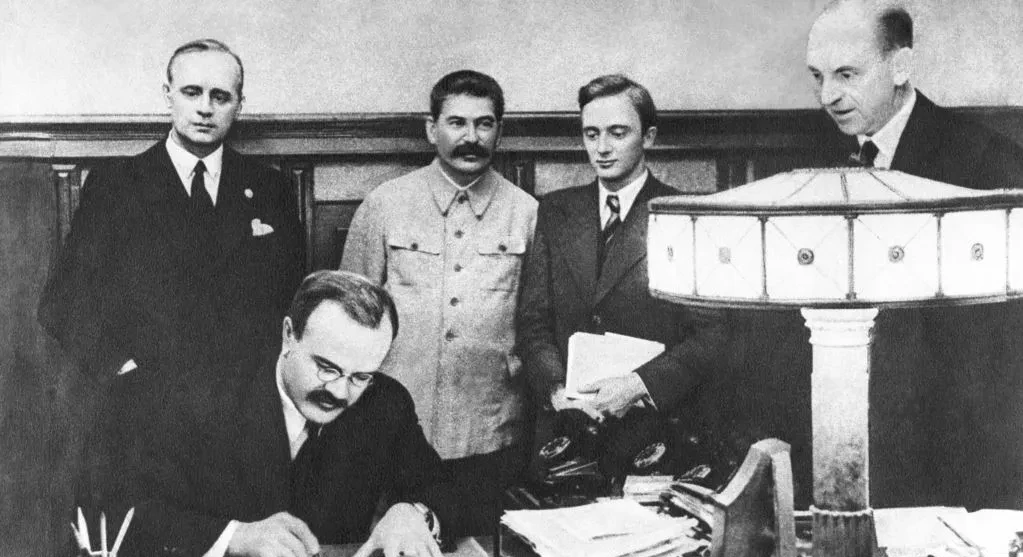
Molotov, Ribbentrop, Ivanov
They try at the highest level if you do not rewrite history, then give it the only true interpretation
The new chairman of the Supervisory Board of the Military Historical Society, Sergei Ivanov, decided to speak out about the Soviet-German Pact, the 80th anniversary of which falls on August.
At his press conference, Ivanov touched on the question of who became the arsonist of World War II. He called the "nonsense" of the accusations against the USSR and Stalin in the torn of the global conflict and said that they would "deliberately picked up." “Many say that you need to repent and pay, but this, of course, is complete nonsense and impudence,” Ivanov said.
He also noted that the pact was not a conspiracy of two dictators.
According to him, if the Soviet troops had not occupied Poland in 1939, the Wehrmacht would be at the old Polish-Russian border.
The briefly and quite dismissively Sergey Borisovich responded to the so -called “secret applications” to the pact. In his opinion, “in fact, they have not been“ secretly, they have not been. For the first time, applications to the Soviet-German treaty of 1939 were published in the journal New and Newest History in 1993. They are declassified. Those who are interested can see and read. ”
But, for my taste, one could dwell on applications and in more detail. At least to explain why Soviet diplomacy and propaganda so fiercely denied their existence in general for 50 years. At the same time, the originals were reliably hidden in the archive of the CPSU Central Committee (and even members of the Politburo were deprived of the admission to them) and only after they were in the presidential archive, in 1992, the head of the parliamentary commission, General Volkogonov. But it was in these “applications” that the arrangements on the division of Eastern Europe were formulated in a completely open text. What to be shy between your own?
Molotov-Ribbentrop Pact. QUOTE
“In the case of territorial and political reconstruction of the regions that make up the Baltic states (Finland, Estonia, Latvia, Lithuania), the northern border of Lithuania is simultaneously the border of the spheres of interests of Germany and the USSR. At the same time, the interests of Lithuania in relation to the Vilnius region are recognized by both sides.In the case of territorial and political reconstruction of the regions that make up the Polish state, the boundary of the spheres of interests of Germany and the USSR will approximately pass along the line of Narev, Visla and San.
The question is whether it is desirable to preserve the independent Polish state in mutual interests and what the boundaries of this state will be, can be finally clarified only during further political development.
In any case, both governments will resolve this issue in friendly consent.
This protocol will be preserved by both sides in strict secret. ”
At the school, which I graduated in 1970, I was taught that the Soviet-German treaty became an outstanding victory of Soviet diplomacy. That the Western powers, with whom we have long and honestly tried to agree on the creation of the anti -Hitler coalition, pulled time, and themselves spoke with Germany behind us, setting it on the USSR. And Stalin brilliantly destroyed these insidious plans. We received two peaceful years that were so necessary for the re -equipment of the army. We pushed the borders, reuniting Western Ukrainians and Belarusians with the fraternal family of peoples, and therefore in 1941 we started the war not near Minsk, but near Brest. We had to take care of ourselves first of all. And our government fulfilled its duty to the country and the people. Yes, hugging with Ribbentrop was unpleasant. But we had nothing else left.
I’m afraid that my peer Sergey Ivanov did not recognize anything new after the school of the decade, I didn’t read it, I didn’t think about it.
The fact of the matter is that Stalin and Hitler were not just agreed not to attack each other-they agreed to attack those who were unlucky to be their neighbors. During the ratification of the contract, Molotov told the deputies: “We are firmly convinced that the interests of the USSR coincide with the indigenous interests of the peoples of other countries,” but the Poles, Lithuanians, Finns, and all the others, neither Molotov, nor deputies did not ask for any interests about them.
The USSR tried to take advantage of the happy (as it seemed to his leaders) and get a lot of pleasures from the truly unreasonable pre -war policy of Western democracies. But what to do, Western democracies had the grounds not to trust the USSR - no less, in any case than that of the USSR - them.
Moreover, life quickly showed that Stalin had much more in common with Hitler Germany than with the French and the British. What, by the way, Soviet leaders in their public speeches did not hesitate to openly admit. For example, in November 1939, all the same Molotov angrily stigered from the rostrum of the session of the Supreme Soviet of the USSR of the British and the French.
Molotov. QUOTE. 1939
“Germany ... is in the position of a state striving for the speedy end of the war and to the world, and England and France, who were still advanced against aggression yesterday, are standing for the continuation of the war and against the conclusion of peace. The roles, as you can see, are changing ...Recently, the ruling circles of England and France have been trying to portray themselves as fighters for the democratic rights of peoples against Hitlerism, and the English government announced that it was as if the purpose of the war is no less than the “destruction of Hitlerism” ...
Ideology cannot be destroyed by force, you cannot end the war with it. Therefore, it is not only pointless, but also criminal to wage such a war for the destruction of “Hitlerism”, hiding behind the fake flag of the struggle for democracy ”...
And in December, all the same 1939, Stalin so answered Ribbentrop to his telegram on the occasion of his sixtieth birthday.
Stalin - Ribbentrop. Reply to congratulations on the 60th anniversary
“Thank you, Mr. Minister, for congratulations. The friendship of the peoples of Germany and the Soviet Union, fastened with blood, has every reason to be long and durable. ”Together spilled blood by this time was only Polish ...
The Italian Minister Chiano wrote in his diary for Ribbentrop: “During the second trip to Moscow, he had the opportunity to talk with members of the Politburo at a dinner arranged by Stalin. Old members of the party were also present from the German side, like Gauliter Forster, who at the end stated that everything was going as if he was talking with old comrades. And he himself (Ribbentrop) could not get rid of such a feeling. ”
"Old comrades" cost each other. They did not stop thinking how to deceive each other, and both were held by both the bosom. It so happened that Hitler was the first to hit.
And yet.
They will ask: where is that line behind which a reasonable compromise turns into a betrayal of principles? And the devil would be with them, with the principles, when so much is put on the card. And politics in general is a dirty and vile thing. But, oddly enough, immoral policy - almost always - is unprofitable. And in our case, the conspiracy of 1939 cost its participants beyond the best. The Soviet Union - in several tens of millions of lives; We still do not even know how exactly. Now the figure is officially recognized - 27,000,000.
It can be assumed that it is - including the price of unsuccessful friendship.
Of course, history does not know the subjunctive mood. And what a pact prisoner with Germany will cost our country, no one knew in 1939 either. But now we know something. And people justifying - today! - This contract is also necessary. And not only the moral side of the agreements with the Nazis is in question. Stalin generally made an unforgivable mistake:
It is enough to say that Hitler used the “peaceful respite” for two years, and this is an indisputable fact.
Thanks to the Pact, the Soviet Union far pushed its borders to the West (in connection with the precisely predicted "territorial-political reconstruction" of neighboring states). But whether this helped so much if the defense in the "new territories" collapsed stunningly quickly. One example. Moscow began a shameful war with Finland (in full accordance with the “secret application”, by the way) supposedly only in order to protect Leningrad. For almost four months this “winter war” with an incomparably weaker enemy was going on; As a result, the border pillars moved the cost of huge losses, the beloved city could sleep calmly. But how long did it take to the same Finns in order to go to the old borders in the summer of the 41st? Two months! Only two! By August 31, the Finns stood at the gates of the City of Lenin.
Sergei Ivanov headed the Supervisory Board of the Military Historical Society in April this year. It can be seen that the issues of environmental safety, which the special representative of the president and the permanent member of the Russian Security Council should deal with, are all resolved, and this leaves him a lot of free time for public work. In general, are they all too passionate about the story, which none of them did professionally and did not study this - Naryshkin, Shoigu, now Ivanov? ..
Sergei Borisovich, by the way, said that, in his opinion, the decision of the Congress of People's Deputies of the USSR with condemnation of the contract with Hitler should be canceled as erroneous. Consistent comrade. Stalin would be pleased with him.
"The fates of the world were performed by groups of politicians"
Message of the Commission on the political and legal assessment of the Soviet-German agreement on non-aggression of 1939. Exposure from the report of the chairman of the commission A.N. Yakovleva on December 23, 1989 at the II Congress of People's Deputies of the USSR
Bowing for the truth is the engine of history. The historical conscience is designed to save progress from crawler, from the devilish temptation to play hide and seek with the past. We would make a double mistake, trying to take the “uncomfortable” topics by the brackets. To justify their own falls with the sins of others is the path not to honest self -knowledge and renewal, but to historical unconsciousness.
The German attack on Poland on September 1, 1939 was the beginning of the tragedy. But the ending of politics in relation to German imperialism. The course held, as a rule, without the Soviet Union and often against its interests.
High -grown decisions that mystify the irrationality of perception of reality were a common disease at that time. The fact that London and Paris were imagined by the “crown of peace” of Germany, guaranteeing democracies, Hitler perceived the comfort and peace for years and decades as a frank signal to the power struggle for hegemony in Europe. Almost after Munich there was no question, there would be a war or there would be a war, it was about something else - who would become another victim and when.
Read also
The conspiracy of the ambassadors? There is reason to assume that the last attempt to prevent the war was made in May of the 41st
Now, of course, it is difficult to guess. The story has already taken place. Even assumptions and those are not indispensable for normal logic, since the behavior of all subjects of politics was unpredictable. You can’t get rid of the impression that players, not politicians, were lying on the stage of history. One thing is clear: no responsibility, not to mention wisdom, was lacking for everyone that humanity was brutally paid.
In the same context, one can also consider the following question: was there a real threat to the attack of fascist Germany on our country in 1939? Naturally, the answer to him goes beyond the capabilities and goals of our commission. Science is called to give it. The real analysis of this problem was not given either then or later. Nevertheless, the documents say that Soviet policy was then built more often on operational messages than on deep strategic calculations.
Was it possible to negotiate with Berlin only to conclude a non -aggression agreement? The analysis testifies - of course.
And in the form in which the contract was signed on August 23, 1939, he would replenish an extensive catalog of settlements known to world politics. By that time, Germany had exchanged similar mutual obligations in different ways, in particular, with Poland-1934, with England and France-1938, Lithuania, Latvia, Estonia-1939.
In contrast to the assessment of secret protocols, according to which there was complete unity in the commission, different opinions were expressed regarding the contract itself.
The first is that in specific conditions of that time, the contract was legitimate politically. The policy of Germany and Japan, the position of Western democracies did not leave the Soviet Union of another exit. The leadership of the USSR was obliged to take measures to ensure the security of the country, at least delay the beginning of the war and use the won time to strengthen the economy and defense.
And another - that Stalin went to conclude a non -aggression agreement for other reasons. Its main motive was not the agreement itself, but precisely what became the subject of secret protocols: that is, the possibility of entering troops into the Baltic republics, Poland and Bessarabia, even in the future in Finland. That is, the central motive of the contract was imperial ambitions.
Read also
"You are Rusachkov to us, let's!" Why the identification of Jews has become the highest problem in the post -war USSR
Having weighed the components of the past, distinguishing lessons for the future, the commission of the Congress of People's Deputies of the USSR on the political and legal assessment of the Soviet-German agreement on non-aggression of August 23, 1939 came to the following conclusions.
The contract itself from a legal point of view did not go beyond the agreements adopted at that time, did not violate the internal legislation and international obligations of the USSR. Legally, he lost force on June 22, 1941. All Soviet-German agreements that existed at that time were completely crossed out with the first salvo of the guns at dawn on June 22, 1941. This is not only our position. This is a recognized norm of international law. As for post-war Europe, it was built on international legal norms with other sources, which is reflected primarily in the UN Charter and the final act of the pan-European meeting.
Another question is that Stalin and some people from his environment could already have imperial ideas, alien to the principles of socialism.
... But this goes beyond the contract itself as an international legal document.
In the same way, the illusion has nothing to do with this assessment, which, apparently, Stalin surrendered after the conclusion of 1939 agreements. Illusions that did not allow properly used a peaceful respite, which largely demobilized and disoriented anti -fascist forces, which could not but damage the subsequent struggle against Hitlerism and its allies.
The commission formulated the assessments in relation to the protocol. They are such.
First. The secret additional protocol of August 23, 1939 existed, although its original was not found either in Soviet or foreign archives. The copies available to the governments of the USSR and Germany can be recognized as reliable at the level of modern knowledge. And the subsequent events themselves developed exactly "on the protocol."
Second. The initial protocol was drawn up at the German Foreign Ministry and was adopted by Stalin and Molotov with small amendments. Soviet negotiation participants, not to their honor, forgot their original wishes about the double guarantees of the independence of the Baltic countries. They did not insist on the reflection in the protocol of Germany’s readiness to reason Japan, satisfied with the oral promises of Ribbentrop on this subject.
Third. The fact of preparation of the protocol did not inform the political and state instances of the Soviet Union. Molotov did not have properly issued powers to sign it. The protocol was removed from the ratification procedure and was not approved by the legislative or executive bodies of the country.
Fourth. Being adopted bypassing the internal laws of the USSR and, in violation of its contractual obligations to the third countries, the protocol in the legal sense was initially unlawful document, and was a conspiracy that expressed the intentions of the individuals that signed it.
Probably, for the first time about the events of difficult prewar Time is mentioned in such severe and unconditional formulations. But once the whole truth should have been said, even the most bitter.
Read also
"The man who won the war." The intelligence officer handed over to Moscow a plan of the Germans on the Kursk arc three months before the start of the operation
The secret protocol of August 23, 1939 accurately reflected the inner essence of Stalinism. This is not the only, but one of the most dangerous mines of a slow -out action from the inheritance of the minefield inherited, which we now want to clean with such difficulty and difficulties. You need to do this. Public mines of corrosion do not know. We cannot help but do this in the name of perestroika, for the sake of affirming new political thinking, to restore the honor of socialism, straightened by Stalinism.
... In conclusion, I want to say the following. The story is a prosecutor and a judge. But, plunging into it, we cannot abstract from the fact that pre -war events developed in another coordinate system. Then the countries have not yet realized themselves in a single stream of mankind; Neither pan -European nor global ideals of justice and humanism made their way to social and especially state consciousness; The voice of thinkers who saw the limit of civilization was blocked by the topot of the soldier's boots and applause in honor of the leaders; The fate of the world performed with closed groups of politicians and politicians with their ambitions and egoism, demagogy and detachment from the masses; Many people wanted to do the service of these groups forever, and even participation in mutual extermination.
Понадобилось ввергнуть мир в пучину безумия, прежде чем идея взаимосвязанности и судеб, и коллективных действий во имя избавления Земли от тирании и возрождения мира начала утверждаться как объективная истина.
Рано или поздно правда выходит на свет божий, фальшь отметается. Без такого нравственного очищения немыслимо развитие цивилизации. Сегодня признать это важнее, чем когда-либо прежде. Народы могут спокойно жить и быть уверенными в будущем только все вместе и никак не друг против друга.