
Translated material
The eighth color of the rainbow
We study the long list of the Enlightener: Natural Sciences
In early June, the Long List of the Enlightener Prize, which is awarded for the best popular science books, became known. This year, 25 books were included in the list. Gorky talks about the second part of the list - about six books about natural sciences and technology. A review of books on medicine can be read here .  That's for sure. Damn a dozen comics about science and scientists. M.: Exmo, 2018
The first book from the current long-list of the "Enlightener", which causes albeit easy, but still bewilderment. Well, that is, formally everything is cool: the easy feed of important and complex material, here we are briefly and clearly tell us about chemistry, biology, physics, geology or computer science. In one comic book, real scientists (for example, the great biologist Konstantin Severinov), invented junior researchers, meaningful cats and long -dead geniuses can act. According to the genre, comics can be either more or less realistic or sliding into a frank fairy tale. For example, to Severinov from Antarctica, microbes fly on an airplane fastened to armchairs (safety precautions above all, especially if you work with microbes), and a reasonable block comes to the rescue in difficult times. There is only one problem - the comic book is essentially an advertising avenue of Skoltha. Which in itself is quite good, but it seems a little strange as part of the award.
 Tim Skorenko. Invented in the USSR. The history of inventive thought from 1917 to 1991. M.: Alpina Non-Fikshn, 2019
This is the second attempt by a prose writer, a bard and author of books on the history of science and technology of Tim Skorenko to storm the top of the “Enlightener”: two years ago he got to the final with “invented in Russia”. This time he describes (more fluently than in the first book) the achievements of Soviet technology and science - both practice and theory. Soviet scientists invented a deep drilling, launched the first nuclear power plant (the Americans built their own before, but the Soviet station used to give energy for general -degree needs), the first to launch a satellite, animal and man into space; The first supersonic passenger aircraft is our (albeit rather useless) and our first atomic icebreaker is also ours - moreover, no one is building them besides us. Skorenko is boring in a good way, he explains everything thoroughly, believes in progress, fights myths and prejudices. The only problem of this book is that it falls between the audiences. Skorenko’s new work is too simple for adults and slightly complicated for teenagers. Probably, specifically, this volume was worth it to revise in a book for smart schoolchildren and add color pictures and schemes there. Moreover, Skorenko knows very well how to work with a children's audience.
 Arkady Kuramshin. Elements. A wonderful dream of Professor Mendeleev. M.: AST, 2018
The book begins with the bearded joke “ The wife never understood Dmitry Ivanovich Mendeleev and often pronounced him for saying not a family in the first place, but hydrogen.” But then there is a completely serious text: one chapter - one element of the Mendeleev table, the main characteristics of the element and funny or simply curious stories related to its discovery. For example, element number 117 was proposed to be called “Octarine, OC) in honor of the“ eighth color of the rainbow ”from the novels about the flat world of the British writer Terry Pratchett, who died in March 2015. According to Pratchett, only wizards (and more cats) see the octar, nevertheless, it is quite real and indicates the presence of magic. ” But chemists have chosen a more boring name “Tennessin”, in honor of the American state, where the most important research institutions are concentrated. The chances of winning this book, for our rags, are low. Although this is a high -quality chemical scientific scientist (which is rather a rarity than a common phenomenon), the author does not offer any approach to the topic, except for the most obvious. Yes, this is a good book for those who want to recall what you forgot after school, and certainly the perfect gift to the student who is used to getting good marks not by knowledge, but lustling teachers with exciting stories-but it is unlikely to inspire someone on chemical exploits.
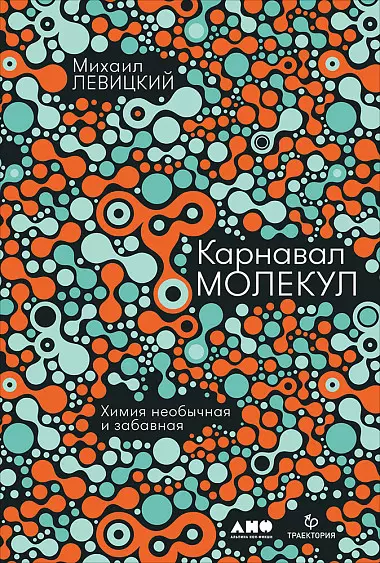 Mikhail Levitsky. Carnival of molecules. Chemistry is unusual and funny. M.: Alpina Non-Fikshn, 2019
Another book on chemistry, this time with an original approach. The author is trying to make chemistry closer to the reader, telling about it through strong visual images. The assembly of the molecule here looks like a focus, which in front of the reader makes a skilled illusionist. Then the author finds parallels between the device of molecules and architecture or even heraldry. The device of the molecule here can be compared with the chair, or they can talk about it through the theory of handshakes. In fact, this book is not so much about chemistry as about how to teach it - with the help of extremely unexpected and unobvious parallels. I’m not sure that such a technique will make a chemistry that is understandable to absolutely any student or reader, but the book of a pleasant stunning, of course, causes. A strongly strong contender for getting into a short list.
 Vladimir Surdin. Astronomy. Popular lectures. M.: MCNMO Publishing House, 2019
The issuing astronomer and outstanding popularizer Vladimir Surdin already received the “Enlightener” in 2012 for the book “Intelligence of Far Planets”. Now, we have a lecture on astronomy, but not just to decipher, as was the case in the history of the award, but an excessive text. In principle, it is difficult to find complaints about this book. Surdin is a wonderful storyteller, he belongs to the type of really great specialists who know their subject so well that they will never drop to a patronizing and dismissive tone. Nothing will hide from the gaze of Surdin: neither obsolete, but interesting theories, nor the latest discoveries; It applies to astronautics, and the search for exoplanets, and black holes, and Martian water. And even one cannot say that the new book is the repetition of the old: no, these are different works, Surdin knows about astronomy so much that it may not be repeated. But still, there is no doubt that Surdin is a real enlightener. So it is better this year that a reward will get to one who does not yet have such an unconditional status.
 Vladimir Lipunov. From a large explosion to great silence. M.: AST, 2018
Another book on astronomy, which is built on the principle of "obvious - incredible." Astrophysicist Vladimir Lipunov first shocks and even scares the reader with some strange fact: “The world that we see around us is a world that is no longer there! True, in everyday life we do not notice this. The light now passes for the now fashionable nanosecond. The distance from St. Petersburg to Moscow overcomes the light for 2.5 ms-the time not recorded by the human organs. For example, the eye reacts to temporary intervals of more than 0.1 s, during which time the light will almost bother the entire Earth. But, for example, the moon is visible as it was 1.5 C BAY, the sun is 8 minutes, and the nearest stars - several years ago. ” These are literally the first lines of the first chapter. And then he will shock the reader every ten pages. Why is the universe color? The presence of color is not the most obvious fact. The paradox follows a paradox, this is not even a dialogue with the reader, it is rather a boxing duel. In fact, you only think that you know something in astronomy, in fact you know nothing. The manner is quite shocking.