
Translated material
A gift to turn a reader into a character
Biography and prose of Joseph Conrad
He loved Dostoevsky and did not like Russia, he taught readers to turn into books of books, he believed that the person alone was not able to comprehend the world: at the request of the “Gorky”, the philologist and prose writer Andrei Astitzaturov tells about Joseph Conrad and explains how to read his books.They most generously endowed the world culture with the masters of paradox most of them. Oscar Wilde made a paradox with his creative instinct, Bernard show skillfully used a paradox, exposing English society, Lewis Caroll created a fairy -tale universe turned inside out, Ivlin, Ivlin, impressed readers with brilliant paradoxical artistic decisions. But only one artist of that era managed to become a paradox himself, the egregious strangeness of the British literary tradition - Joseph Conrad.
The history of his life, the story of his literary career is a series of amazing paradoxes. The Pole by origin, who learned French in the adolescence, then - English, who spoke in this third language with a strong accent, he very soon became the leading English author, a unique stylist whose lessons did not pass without a trace for subsequent literary generations. Another paradox: Konrad lived in Russia for a long time and was even a subject of the Russian Empire, but did not learn Russian at all and did not show any interest in Russia at all-a stranger, faceless, chaotic, imperial, bubbling abyss, where the European gentleman should not look. And this in the past, a wounded Polish young man, the son of a deprived of the rights of the nobleman, in adulthood reveals to himself Dostoevsky and immediately changes the entire system of his composition. Can I love Dostoevsky and not love Russia? It is unlikely. But Konrad was somehow unthinkable. The third paradox is associated with a literary career. Konrad, who wrote many unconditioned masterpieces in his life, became famous and financially secured due to his weak essay - the extremely mediocre novel “Case”. Mediocre, however, for Conrad. If there was some other, little-known name, the author could be applauded.
The paradoxical decisions of Conrad are finally paradoxical, including its way of influencing readers. Conrad enters into literature when a non -romantic theme experiences its flowering in Britain. Stevenson, Haggard and many others, less discharged, fill the book market and periodicals with adventure novels, where there are remote exotic lands, endless southern seas, compulsory sea trips to the endless southern seas, treasures, pirates, natives, native beauties and more. But the main thing is a hero. Eternal Jim Hawkins. In everyday life - an ordinary, except that has a habit of dreaming, but fully revealed in unexpected dynamic circumstances. Konrad retains adventure entourage, using it skillfully, with knowledge of the matter-he, being a professional sailor, unlike his contemporaries, indefatigable fantasiers, had plenty of all this. However, he goes beyond the established genres, constantly creates paradoxes, turning the usual adventure that the reader is configured into a philosophical parable, into a political novel. Or even in the apocalyptic prophecy - as in the story "The Heart of Darkness."
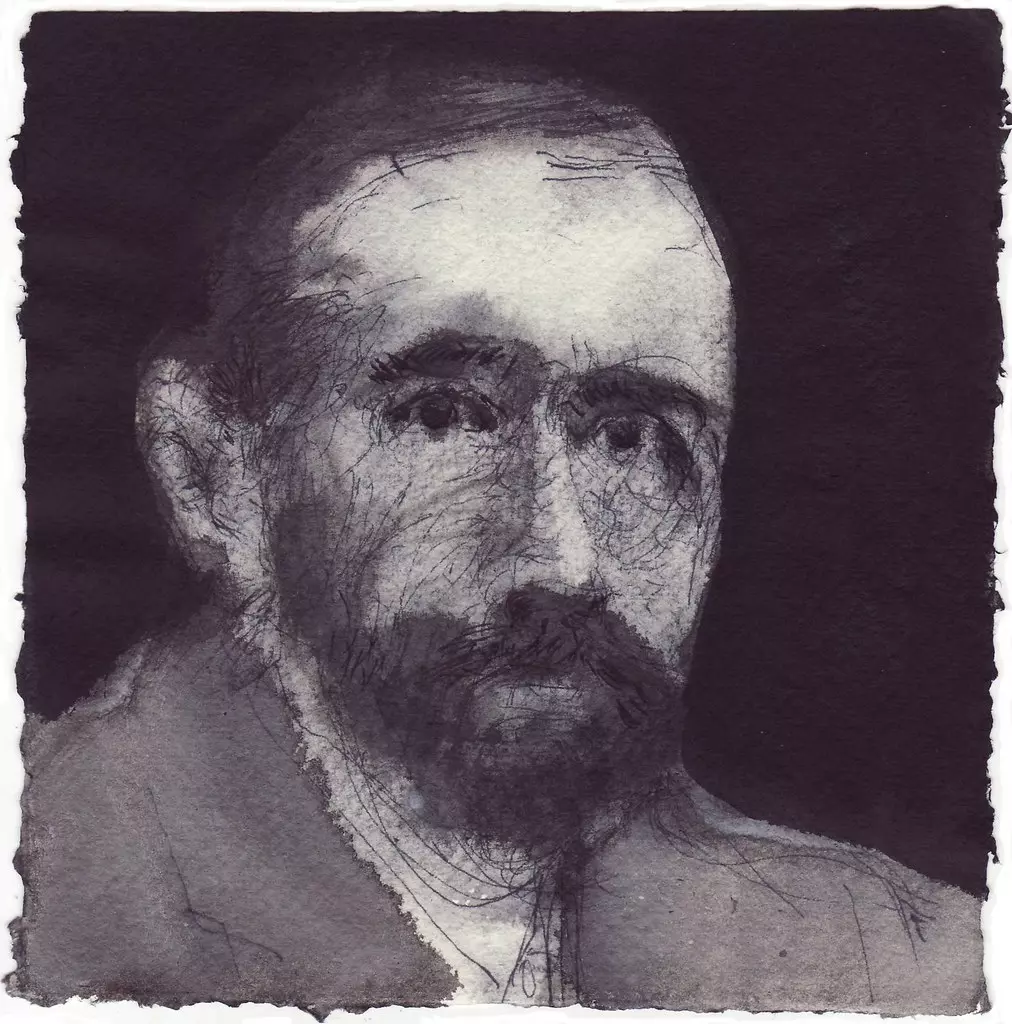
Joseph Conrad. Pen, mascara
Photo: Tim Brown
But the main effect of his texts (it is especially obvious in the novels “Lord Jim” and “Nostromo”), the main paradox of Conrad prose is that, using a whole system of techniques, it makes us fully feel the reality of the fictional, believe in it and at the same time see the prescription, the ghost of the fact that we are not every year. He, like his student, William Folkner, has a rare gift to turn his reader into a character, force him to think, master the world and make decisions on a par with fictitious heroes.
It makes no sense to spread in detail about Conrad’s biography - it is known to everyone. The son of a Polish nobleman, sent for revolutionary activities in Vologda, a talented man who translated a lot from English, Konrad (then Theodore Kozhezhevsky) remained an orphan early. He was brought up with his uncle, then at the cousin. He did not show much interest in school at the school, with the exception of one subject - geography, which is not surprising for the future sailor. He was also fascinated by romantic poetry and sea novels; One of the most powerful literary impressions of the young Conrad is Victor Hugo's Trucks.
At 13, he announced to his uncle that he would certainly want to become a sailor, which caused a general -seal bewilderment. If he said that he wanted to fight for the freedom of Poland, no one would probably have led the eyebrow: Grandfather Conrad fought as part of the Napoleonic army against Russia, his father participated in the anti -Russian rebellion. But go to the fleet by a simple sailor? Polish young man of noble blood? It was extremely strange for the family.
 In the autobiographical book “Personal Affairs”, Conrad noticed about the English language that it was not he who took possession of the English language, but the English itself took possession of it. Apparently, the non -romantic spirit of the time, looking for travelers, captains, discoverers of new lands, captured him with the same manner. And yet - the pan -European Faustic feeling that Oswald Spengler wrote about in the “Sunset of Europe”, the desire to overcome himself, move beyond all the limits, to the distant borders of space, time, human nature and words. Conrad more than once told the same story - as he stood in a huge geographical map in childhood, poked his index finger in white spots (and then there were many) and said to himself: “I will definitely go there.”
And everything came true. But even when it came true, he experienced guilt for interrupting the family tradition, broke with his relatives, left the rebellious homeland, who desperately needed people like him - strong, honest young people with a sharpened sense of justice. This awareness of guilt and awkwardness is felt in the prose of Conrad, where he seems to be justified, each time withdrawing his character with tragic, defending illusions, incompatible with the natural course of life. It was precisely the same, judging by the book “Personal Affairs”, that his relatives seemed to him - revolutionaries, rebels, prisoners, losers, who lived with passions, fierce ideas, who denied the changing time and inevitable state of things.
In the Navy, Konrad made a brilliant career, going from a simple sailor to the captain. He walked under French, Belgian, English flags. The last time he went ashore already the way we know him from photographs. A typical British gentleman, with a neat beard and a calm, slightly frozen expression on his face. Perhaps the photographer asked not to move, but, most likely, Conrad was like that - at least outwardly - calm, slightly alienated, impassive observer, who did not want to succumb to strong feelings and lose their mental balance. When he published his first novels (“Olmeyer's caprise”, “Negro from the Narcissus”, “Lord Jim”) and when reproaches of rationality, in cold analytism, did not deny anything on him. He said that “owning oneself” has always been his life principle, that the world should not be changed, should not be measured by human passions and intentions that the world was “created only for observation and admiration”.
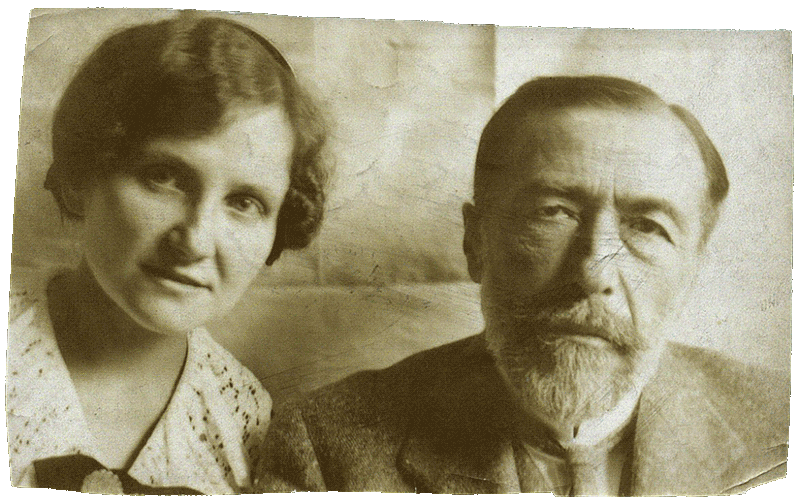
Photo: Wikimedia Commons
Perhaps here is the most important word - "admiration." Konrad, according to the testimony of people close to him, had hypertrophied sensitivity, the ability to grab, remember, experience what happened, all details and circumstances. The more strange look for the surrounding his external calm, rather suitable for the English lord than the son of a revolutionary and a sea wolf. Apparently, amazing concentration, the ability to plunge into strong feelings and at the same time observe them, be close and keep them, be at the same time with life and be outside it and gave rise to this amazing talent. They probably aesthetically led the Flobert's impersonal, the severity of observation, the desire not to describe, but to recreate the world, seen soberly, many times, from different eyes, and various optical devices. And yet - Christian humility, a complete distrust of one’s opinion, the desire to hide your "I" and thereby help the narrative to develop independently.
Thomas Sterns Eliot, one of the most attentive readers of the “heart of darkness” and “Lord Jim”, once noticed that Conrad did not possess a coherent philosophy, but was endowed with a special way of peace, which was close to religious, which allowed him to bring together a variety of sensations, all the vectors of his own personality, the images, completely, at first glance, not related to each other. It is quite possible. Konrad shunned open statements and rarely shared with readers with philosophical thoughts. In the book “Personal Affairs”, he states that thoughts, even the most sober, he prefers a word that is much stronger and more effective. That if something changes the world, then rather words, their sequence, their rhythm, their sound, rather than ideas. Nevertheless, a certain system of views by will-nilly opens in his images and characters.
At the base of all things, in objects and people, he clearly distinguishes between power, almost Schopenhaur, blind, irrational, hardly, contrary to Friedrich Nietzsche, controlled. In its purest form, this will, the source of all things and man, is a genuine nightmare, abomination, hell, averting the gaze of a true gentleman, a genuine European, even a colonialist who put it on the rule of “owning himself”. She appears in the story "The Heart of Darkness." But she inexorably entails a person, traveler, pioneer, tireless romance, researcher. She beckons to herself, like a snake, hypnotizing a stupid little bird. Here, probably, the explanation of Konradovsky psychologism should be sought. Traveling through the southern seas, to exotic lands, to the natives, turn into his prose with consistent penetration into the depths of the human “I”. Emotions, strong sensations, illusions are analytically revealed, turning out to the shells of other, deeper feelings, and those, in turn, reveal other root causes. This analysis occurs until the narrator will feel the archaic foundation of the entire personality system, he will not see that a ragged savage is sitting inside every good European.
The sailor Wate, the character of the novel “Negro with the Narcissus”, apparently, a notorious loafer and a simulator: he pretends to be patient to work his work. In fact, Wate is really mortally ill, and he plays the simulator dramatically in front of him, trying to convince himself that he was quite healthy. Every day he inexorably approaches death, in vain trying to delay it. Even after death, Waite's creature seems to be symbolically refusing to accept it - the coffin with his body slides into the water impossible slowly, as if reluctantly. Preparing superficial feelings, Conrad discovers their psychological basis - the inability of every person to accept reality, the universal movement of life, will, and fate.
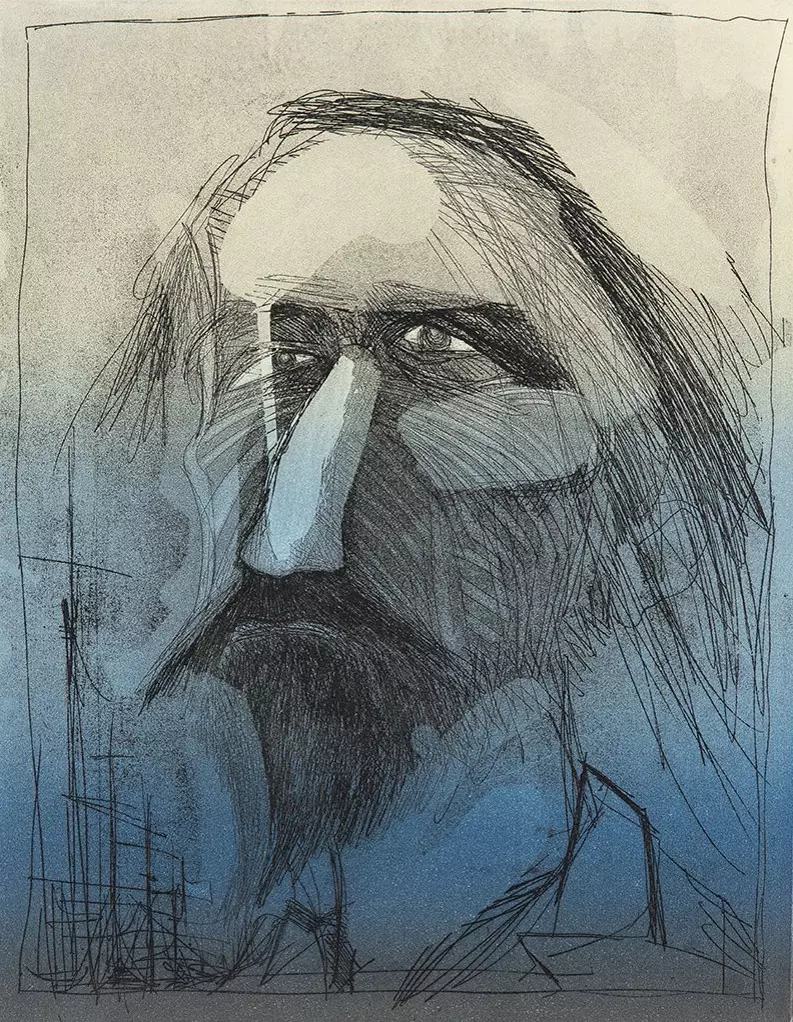
Photo: Peacock-Visual-Arts
A similar principle of psychological analysis is present in Konrad more mature novels - for example, in the Lord Jim. The title character who violated the debt and cowardly escaped from the ship voluntarily appears to the court. For what? After all, there is an opportunity to leave, to avoid shame, somewhere for the time being to hide. But Jim is necessary to accept the blame, to repent. However, repentance is not indispensable, and the character himself does not know about his true motives, about self -love, vanity, the desire to appear in the halo of a tragic hero. Of course, he seems to regret that he exposed people to mortal danger, but in fact-about the missed opportunity to realize his heroic-romantic ideal. Having gained, after years, the inner harmony in the sacrificial ministry of the native residents of the Patuzan settlement, Jim stumbling again, involuntarily becoming the culprit of the death of the tribes of the tribe. When he faces the revenge of the natives, Jim again refuses to escape. And not because of the stoic courage, as it seems to him, but out of the desire to play a romantic tragedy in front of himself.
This skepticism in relation to a person and his experiences leads Conrad to the idea of the inability of every person alone to comprehend the world. His characters are hostages of illusions, principles, beliefs and experiences, closing them on themselves and separating reality from a changeable flow. Only the author who got rid of the complex of the assumption can come close to life, from a single point of view. Hence the desire of Conrad to give a voice to many, to look at life from different eyes, to combine several points of view. This multiplicity of the gaze, extremely difficult to read Conrad, is present in most of his novels, but most clearly in the “Olmeyer whim”, in “Lord Jim”, in Nostromo. The same things, the same events are woven into different biographies, are examined through different optics, each time testifying not about themselves, but about who observes them and evaluates them. And every time the reader is forced to ask the question of why things and events are evaluated in this way, and not otherwise, and led by the narrator, rushes to the foundation of human feelings. There is another effect here - the coincidence or mismatch of the reader with the narrator. The reader looks at the world through the eyes of the narrator, but his personal experience will inevitably lead him to another conclusion from the storyteller’s position. He will begin to think on his own, to complete, to evaluate, quietly becoming even with the co-author, as it may seem to someone, but by the character of the Konradov text, building his own psychological line among other characters. This is precisely what one of the paradoxes of Conrad is explained - his ability to give the composed, fictitious visibility of the real.
The voluminous, real, real in the novel Nostroma is invented, never on any maps of the existing geography of the Republic of Kostaguan. In this novel, as in many others, Conrad deliberately destroys causal and temporary ties, subordinating the text to the spontaneous logic of imagination, which opens the complexity of time and space, shows that the space is repeatedly, that time can flow as you like, that life is monstrously irrational. And since it is irrational, since there is no logic in it, since spatial and temporary coordinates are simply consolation for reason, a person with all his culture is inevitably doomed to defeat. The consciousness of man and the stream of life are fatally torn. This theme sounds already in the first novel by Konrad “Caprice Olmeyer”. In "Lord Jim", "Heart of Darkness", "Nostromo", "Victory" she will only acquire new variations.
After the attentive reading of Dostoevsky, Conrad tries his forces in political prose, which he certainly succeeds. His famous novel “Secret Agent” about revolutionaries, double agents, provocateurs and stories on political topics (“Anarchist”, “Inverse”) combine his famous psychologism and plot dynamics.
Conrad's creative path ends with the novel “Victory”, unconditional success, parables about the greatness of human nature, at the same time heroic and patient, and that life is always worthy of justification.