
Translated material
“On average, the dollar is released a year”: Interview with the creator of Opera and Vivaldi browsers and vivaldi
Norwegian programmer Jon von Tekner with partner Heir Ivarsem created in 1994 a system that eventually turned into an Opera browser. He gained particular popularity in Russia and the countries of the former USSR due to a small size, speed, saving of traffic, and later - the functions that allowed to bypass blocking. At the peak of Opera, 350 million people used.
Having left the company due to conflict with investors, von Tecner in 2013 began the development of a new browser-Vivaldi, the first version of which was published in 2016. Vivaldi is designed to become the most flexible browser aimed at users who spend all day on the Internet and appreciate the convenience of settings. So far, Vivaldi is hundreds of times inferior in the audience of the market leader - Google Chrome and does not even have a mobile version.
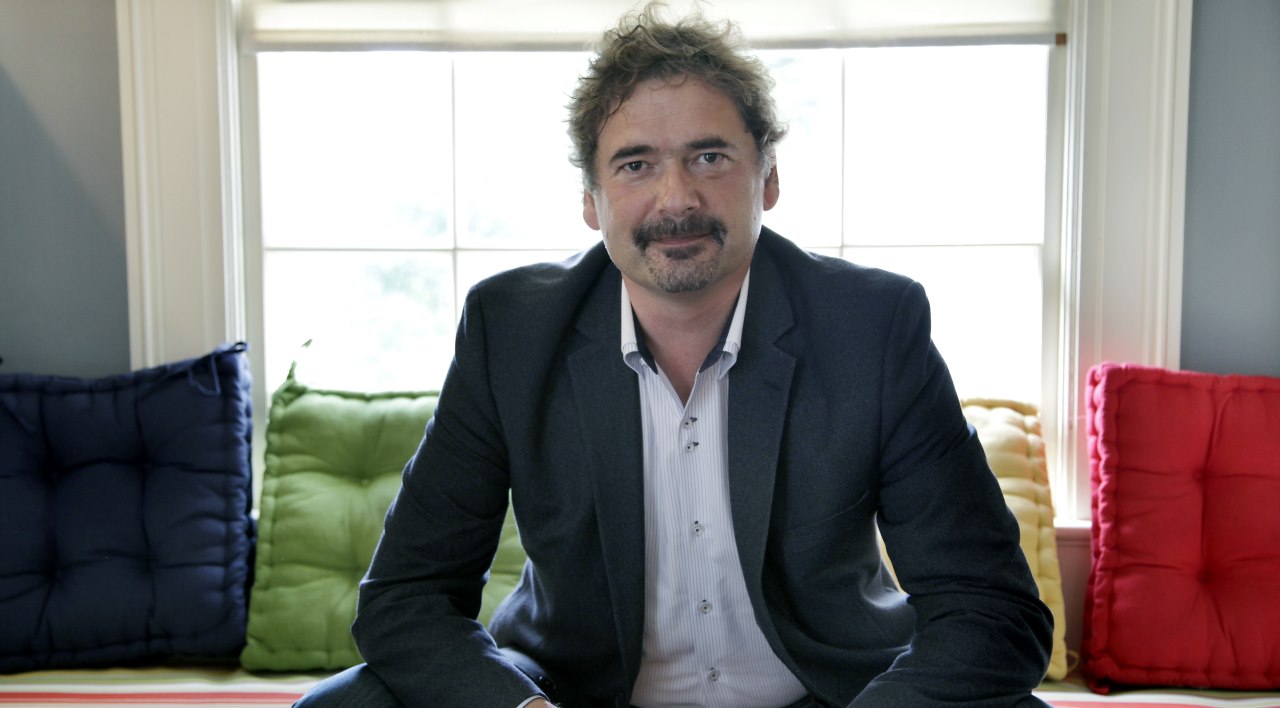
The new company von Tekner, Vivaldi Technologies, is funded independently, it is not planned to attract investors in capital. The Bell interviewed the creator of Opera and Vivaldi, learning how to earn on free browsers, which is the competitive advantage of Vivaldi and how many people are needed to exit the browser for payback.
This interview was taken for the weekly technology building of The Bell. You can subscribe to it here .
Opera and after
- In 2005, you tried to cross the Atlantic in honor of the successful launch of Opera 8. It was a very inspiring story. Are you ready to do something similar for Vivaldi ?
In 2005, Jon von Tekner said that if Opera 8 gains a million downloads in 4 days, he would cross the Atlantic, starting in Norway and ending the swim in the United States with a stop on a cup of chocolate in his native Iceland. Opera 8 gained the right number of downloads, a frivolous promise had to be fulfilled , but the inflatable boat of the PR manager, who accompanied the floating von Tepner, was very successfully leaked, and the swim was canceled.
- I no longer planned such trips (laughs), but it was an excellent entertainment. Obviously, however, that an attempt to swim to the States through the April Ocean is a big challenge. But, as you know, the hole was formed in the boat of my guide, so I could not allow him to die, I had to cancel everything. So yes, it was a short fun trip.

Rescue operation during the swim of John von Tekner
“But then you set yourself a certain goal that justifies the heroic venture.” Maybe now there is one?
- Let's see what will happen next. We like to fool around, and it would be nice to set good goals, but now we are concentrated on the development of a fantastic program - we have fun, introducing new functions.
- Tell us, why did you even leave Opera ?
- Investors and I diverged regarding the direction of development of the company. I wanted to grow Opera, and they - to sell. I had an ambition to make a fantastic tool from Opera and focus on the needs of end users. And they wanted to focus on financial results and not think about products, users and all this.
You obviously saw what happened to Opera when I left. I mean - Presto was killed. The products have changed a lot. And a significant part of the company simply separated. This is just a different approach. I tried to build a magnificent organization and products, and, it seems to me, we did it. And while we were doing this, then we received excellent financial results. But again, investors simply asked: "Okay, can we sell this company?"
They saw an obstacle in me because I never wanted to talk about sale. I always said that the last word is behind investors, but we do not want to sell. They didn't really like to hear it. So there was always great pressure, and after some time I was tired of this pressure and internal disputes, because it lasted 7 years.
I think my thought was like this - if I quit, maybe the company will receive ... I mean, I knew the guy who would come to my place, and I thought that he would adhere to the previous direction. In the end, this led to terrible changes. Such things. [In 2016, Opera sold the Chinese Golden Brick Capital Private Equity Fund I LP for ~ $ 600 million - approx. The Bell]
- But now you have your own browser and, as far as I know, your own financing is without investors.
-Yes, the past taught us something. Clear business, we then had to cope, and this is difficult. It is not easy to compete with large companies, but our products were able to take good positions, because people liked what we create.
But the problem was that we had to spend a lot of time on investors. And now everything is clean in this regard. We just make a magnificent browser. We create a browser for our friends. We are trying to make a very flexible browser with many functions that people actually want to see. This is our goal as a company.
Browser market
- Usually people do not choose self -financing if they do not believe in the enterprise. How do you estimate the current browser market and Vivaldi place on it?
- Browsers are flocking animals. They try to simplify the interface, sometimes focusing on a business model. Getting rid of bookmarks or history greatly limits them. Such browsers encourage the search, [but not because the user wants it, but] to increase income from him and advertising.
We approached this differently. We tried to build the best work with tabs and the most flexible setting. For example, the management of tabs and the function of the history of visits, which really helps to figure out how you visited sites.
We are trying to come up with a solution that would satisfy everyone. There should be a certain flexibility. You should have a browser that is especially effective if you spend a lot of time on the Internet - with convenient keyboard reduction, tabs control, and so on.
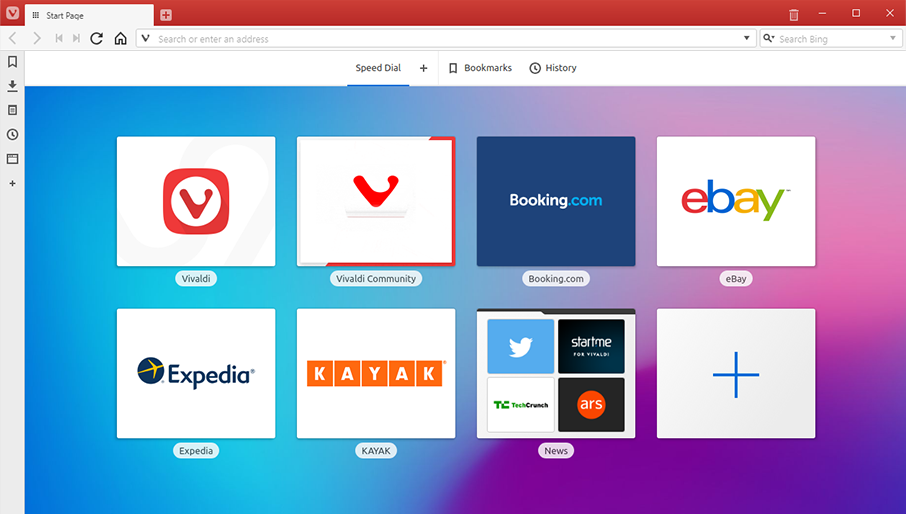
Vivaldi browser in one of the standard topics
- The browser market is rigidly divided into two directions - desktop and mobile. What do you think of mobile browsers and ecosystems? As far as I know, there is no mobile Vivaldi , but you thought about it.
- Yes, we are working on him. I [already] use Vivaldi on my phone and would not use any other browser. I think that it is really good, because it is based on the same principles of greater functionality than you use.
And, obviously, in some points it copies the functions of the desktop version. Due to a very small screen, there are certain problems, but our goal is to make it to feel that the desktop and mobile vivaldi are related products working together.
Naturally, there is synchronization there, and we synchronize more information than ordinary browsers, because we wrote their mechanism and put their servers for synchronization, not related to the Google world.
I think people will like it. We are already close to the release of mobile Vivaldi.
- I looked at Wikipedia that Vivaldi’s market share in December 2018 was 0.05%, probably you can see more relevant data on Statcounter . How many years are you going to get 10%? 20%?
- The audience of my first browser company, Opera, reached 350 million users. Now the share is much lower, something around 10% of the peak. But vivaldi does not need 10, nor 20, nor 30% of the market. All that we need is several million users to go out for self -sufficiency.
And this game with numbers is quite interesting for us, because at the first level we reach several million and pay off. Then we try to build the audience as much as possible, but the most important thing for us is good products, so we focus on this.
We need to pay on the bills, but I firmly believe that we will succeed, because the payback requires only 5 million users, and if we manage to get 100 million, it will be very good, really. [In March 2019, Vivaldi had 1.2 million active monthly users. - approx. The Bell]
- In the general list of browsers, your browser falls into the “experimental” category with Brave and Epic *. These two browsers are primarily proud of their approach to privacy. Can you name browsers who look more like * vivaldi ?
- We are often compared with large browsers, including Chrome, Edge, Opera, and we, of course, like it. But it’s good when there are a lot of browsers and there is something to choose from. The same Brave is a newcomer in the market, like Vivaldi. Until recently, the choice was small in the market for table browsers.
As for us, we compare ourselves in many indicators with Chrome.
About people and options
- I read that you have a saying "If you doubt it, make this an option."
- Yes, and we follow this principle. During discussions, we often find that several strong proposals arise inside the group. And someone says-you need to do so, others against. Most often, this is simply easiest to implement in two ways and give the user a choice. We still need to choose how the browser behaves by default, and we will continue to argue about this. But those who really want to, now they can configure everything in their own way.
The idea that stands behind this is that people are different, and their requirements are different, and there is no single correct solution.
- If we talk about people and choosing, Vivaldi began as a forum. It was created from the MY Opera forums . Can you tell about it as part of the product?
- Yes, we try to work as users as close as possible, and their reviews are the key part of the communication.
I think this is the difference between us and large corporations, which are impersonal in communication with users. We are talking to them, there is a unique group of people who help us. We have many volunteers, they often answer users in the local language. They do fantastic work, and we, in turn, feel that we must answer them with a good product. For example, not to follow them, but to listen when they want to communicate.
There are many advantages in considering users as friends. I think we have a special relationship with the user base.
- How do your communities affect your business?
- This is a very important part of the business, because everyone who is going to use Vivaldi enters the forum, asks questions, this is an important factor in building an audience.
Then, there is a mouth. Our users talk about Vivaldi, including on social networks. They become essentially our advertising channel. We need it. We do not have funds for large advertising campaigns or buying distribution, so we will depend on the people who like and who tell their friends about us. This is the key part of Vivaldi.
About money and personal data
- Where is the money in this business?
- If we talk about financing, the bulk of our income is a search. We also turn on the bookmarks, some of which bring us money. We try to choose partners that our users will love. In general, these are just links.
If we talk about the search, then we have an agreement with Yandex . We also have a deal with Duckduckgo , an indirect deal with Bing and others.
We have several more contracts in the bookmarks. We do not get a lot in the calculation of the user. On average, about $ 1 per year comes out. But, if we pick up more users, this will become enough, and we will pay for expenses.
- What do you think of paid browsers like Wavebox ? For example, they have paid functions that attract users - I say based on my own experience. Do you see the future in niche browsers or paid scenarios?
- Our focus in the free distribution of Vivaldi, not only of himself, but also functions. For example, we give synchronization for free, which, obviously, uses server power. We have a free postal service, blog and forums. Our goal is so far it is possible to provide free services, we do not set the goals of creating premium versions.
The only exception is the situation in which we will understand that there is too expensive service that we cannot afford, but so far we have not reached that, and I don’t want to come to that point. Our goal is a free browser for users.
- One friend of mine said: you know, any browser sells clickstream (aggregated stream of sites visited). Do you sell the history of user clicks in any form, including depersonalized and aggregated data?
- No, we do not do that. I agree that the practice of collecting information, unfortunately, is very common in the browsers market, but we do not collect or store information - neither locally nor on servers, never. And we do not store the history of visits.
We think how many users we have, so we have some information, but we use it specifically to calculate the user base. And we do not follow what people are doing. Many browsers watch how you use a browser to improve the program. But we do not even do this and do not sell important information about how you use Vivaldi. We do not want it to be with us.
- It complicates your work. How do you find out who uses your product and how if you are not collecting information?
- We interview our users. I even like it. Instead of peeping behind them, we believe them with a word.
So, if our users say that we would like to do it or this, we listen. This, in particular, means that we look not only at statistics, but also at the requests of individuals.
The user says: I would like to see it. I would like it to work like this. Let's say this can be some additional special way to handle tabs, we have a lot of them. And our idea as a whole is that if one asks for this, he has like -minded people. We work. Quite often, we put a request for forums and with the help of voting we determine whether it is necessary for others.
Of course, there is a list of what needs to be done and what to do costly. But sometimes someone asks for a function that can be realized in a few minutes, and we just make it.
-Recently, the privacy itself has become a business model. Something that is considered as a marketing and competitive advantage. In addition to advertising, it seems that four business models arise. Privacy as a service, customization and thin tuning ( Vivaldi case ), orientation to local markets and a paid model, including electronic trading. How do you work in these - non -Classes - directions?
- We try to close many of these needs. For example, flexibility leads to the creation of many language versions. When you adapt to local markets, for example, you provide a specialized experience - say, the sets of bookmarks differ depending on the language and the market.
Naturally, the privacy is also an important factor for us. But we solve this issue from the inside. We said: Okay, first of all, we do not play these games. That is, we do not collect your information. We would like to do more, but our main trick is not to be part of the data collection industry. It’s a little scary to see how companies just think that they can collect any information about users, they really think that this is their information.
Personally, I think that such issues should be regulated by law. The collection of excessive information should be imposed outside the law. For me, this is not a question of obtaining permission, you simply should not have been allowed to do some things.
Probably, there may be exceptions for research projects or something very, very highly specialized, if you represent, say, navigation or geoservice, then yes, you need the user's location. But there is no need to keep it forever and sell it to someone else, right? You can still provide your service and have access to worldwide data on the movements of people and transport, but you should not be able to sell information about users.
And I think that for this we need laws. This is the best solution. I am concerned with concerns that people have to hide in order to do something normal on the Internet. This should not be. People on the network, with the exception of those cases when they do something very wrong, should do what they please, and no one should follow them.
- Mary Miker in Internet Trends Report 2019 wrote that over 50% of people live in a country that blocks or censors their Internet access. And when we are talking about privacy, as well as concealing our actions, we often say that users are hiding from the authorities, not advertisers. Opera provided an excellent VPN *-service, which was used, including for such cases. Can you think, can * VPN or the anonymizer be built into the future in Vivaldi in the same way as the planned email client or an existing expansion mechanism?
- So far you can use Vivaldi with a third -party VPN. We must see what we can do in the future. VPN is one of the fairly costly services. In addition, since we do not collect and do not use data from users in any form, we cannot earn indirectly on them, because we just have another business.
Would I like to do something like this in the future? Maybe. I think this is a good service, and I understand what needs in it. But normal users probably should not use these services, right? This is my point of view - you, as a user, should not do this [hide]. But I agree, there are problems and understandable need for such services.
Technology and dependence on Chromium
- Before the interview, I used Vivaldi *for several months. Пересел с * Chrome на Brave *, а затем на * Vivaldi *, потому что * Brave так сильно защищал мою личную жизнь, что ломал некоторые сайты. Сейчас я использую Firefox *, потому что у всех проектов на * Chromium одна и та же болезнь — ошибка Aw *, * Snap при заполнении памяти, вызывающая перезагрузку вкладок. Почему вы использовали Chromium ?
— Самым логичным выбором был бы [движок Opera] Presto, но он был недоступен и, кроме того, не обслуживался. Нам пришлось отказаться от идеи с Presto, и самым безопасным на тот момент выбором был Chromium. Если бы вы посмотрели на код Firefox в то время, шла существенная переделка, и мы сильно рисковали. Так что момент диктовал выбор Chromium.
— Отсюда логичный вопрос о браузерной монокультуре . Chrome подбирается к 70% рынка, а вместе с браузерами на Chromium занимает уже более 70%.
- Yes, I agree. Лучше, если люди используют разные подходы. Не я хотел убить Presto, когда работал в Opera. Компания убила движок после того, как я ушел, но лично я считаю, что предоставить выбор очень важно. Мы выбрали Chromium, но я разделяю ваше опасение, что использование одной и той же кодовой базы — проблема.
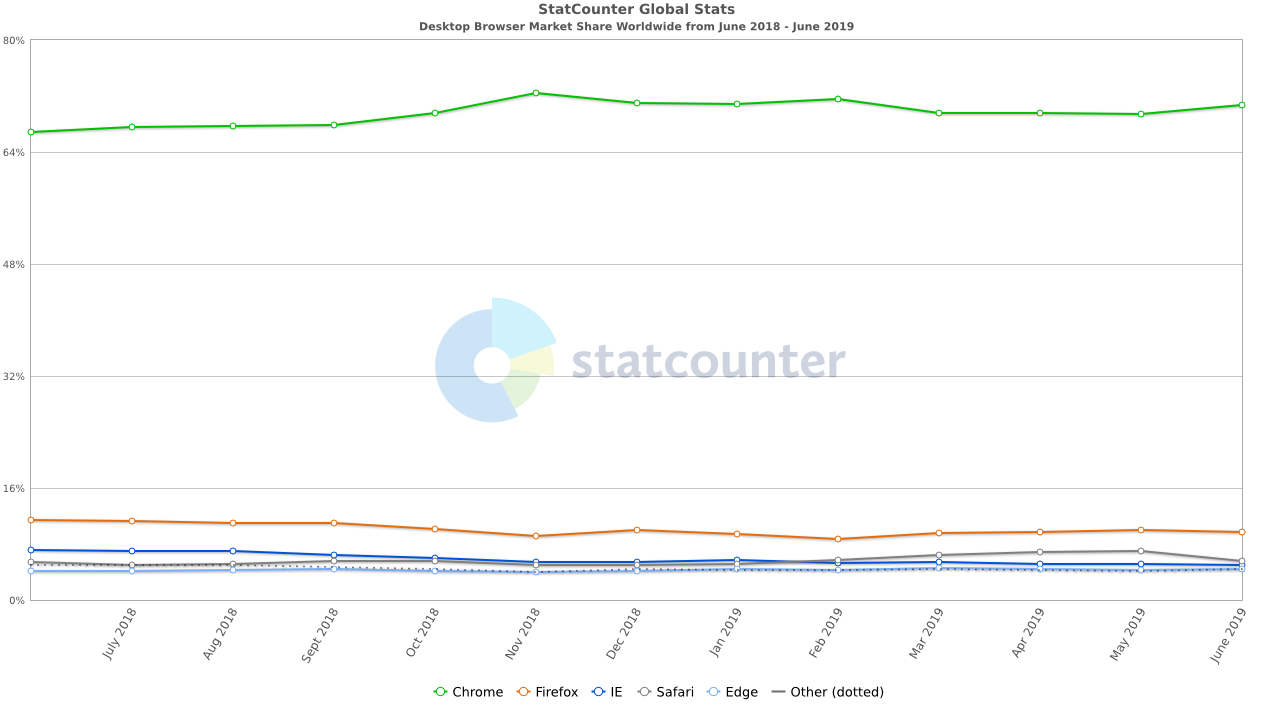
Доли рынка настольных браузеров в мире. С огромным отрывом лидирует Chrome, на втором месте Firefox
— Opera выпустила браузер Opera GX , который нацелен на геймеров и старается сократить потребление ресурсов. Я думаю, есть нишевая аудитория, которая может выиграть от таких узкоспециализированных браузеров. Вы ничего подобного делать не собираетесь?
— Мы сейчас расширяем функциональность в Vivaldi и еще до Opera GX запустили интеграцию с цветовыми системами Razor Chroma для геймеров и также поддерживаем Philips Hue.
Такие вещи мы продолжим делать. Что касается потребления ресурсов, у нас реализована «ленивая» загрузка вкладок, которая в целом важна для сокращения потребления памяти браузером.
Думаю, это что-то важное, что пригодится всем, а не только геймерам. Так что мы выбираем гибкость, возможность встроить то или иное решение в Vivaldi и настроить браузер под себя. Разработку мы продолжим в этом направлении.
Что же касается Opera, и, кстати, мы такого при мне не делали, но после моего ухода Opera запустила несколько новых продуктов и убила их. Это произошло не раз и не два. У них был мобильный браузер, который они убили, и теперь у них вот этот новый настольный браузер.
Я думаю, это другой подход. Когда мы что-то делаем, это задел на будущее, часть нашего продуктового предложения. При мне мы не сокращали функциональность или даже отдельные возможности браузера. Если мы добавим крутую функцию, она будет доступна каждому.
«Альтернативный путь работает»
— Вы запустили Vivaldi в апреле 2016.
- Yes.
— Прошло три года. Что пошло, как ожидалось? И, что важнее, что пошло не так?
— Мне кажется, большинство вещей мы сделали правильно. Возможно, есть много вещей, которые, как вам кажется, нам не удались. Don't know. Я чувствую, что у нас подобралась по-настоящему хорошая команда. Все работают над созданием наилучших продуктов, и я рад видеть командную работу.
Да, конечно, хотелось бы не так затягивать с выпуском мобильной версии и выпустить ее. Мы пробовали реализовать одну вещь, которая оказалась сложнее, чем мы думали, так что пришлось пойти по другому пути. Но этот альтернативный путь работает.
Мне нравится заглядывать в будущее и пытаться представить, как сделать что-то наилучшим способом и извлекать уроки из прошлого. Но мне кажется, что мы на верном пути, потому что пользователям нравится то, что мы делаем. Так что мы просто выпускаем новые версии, и скоро появится по-настоящему крупный релиз, над которым мы долго работали.
То есть мы же говорили о почте и мобильной версии, и это огромные функции. Там задействовано больше, чем можно подумать. Так что мы надеемся, что людям понравится браузер, который ограничен не тем, что он может делать, а тем, чего от него хотят пользователи.
— Если бы вы могли дать только один совет при выборе браузера, каким бы он был?
— Подберите браузер, который лучше всего впишется в ваши нужды. So simple. Естественно, мы верим в это, потому что стараемся адаптироваться под ваши нужды. Если думать шире, то, возможно, имеет значение еще и то, зависит ли бизнес разработчика от сбора данных. Я думаю, это должно повлиять на решение.
— Хотите что-то сказать российским пользователям?
— У Opera была по-настоящему большая аудитория в России, так что я надеюсь, что со временем гораздо больше россиян откроют для себя Vivaldi. Я думаю, что философия того, что мы делаем с Vivaldi, когда пользователь ставится на первое место, покажется им знакомой.
Я всегда гордился тем, что у нас в России столько пользователей, и надеюсь, что мы со временем увидим те же пользовательские группы. Так что я просто приветствую всех и уверен, что каждому, кто попробует Vivaldi, этот браузер понравится.