
Translated material
"A project that can be proud of"
Astrophysicist Sergey Popov-the importance of launching the spectrum-RG telescope for Russia and world science
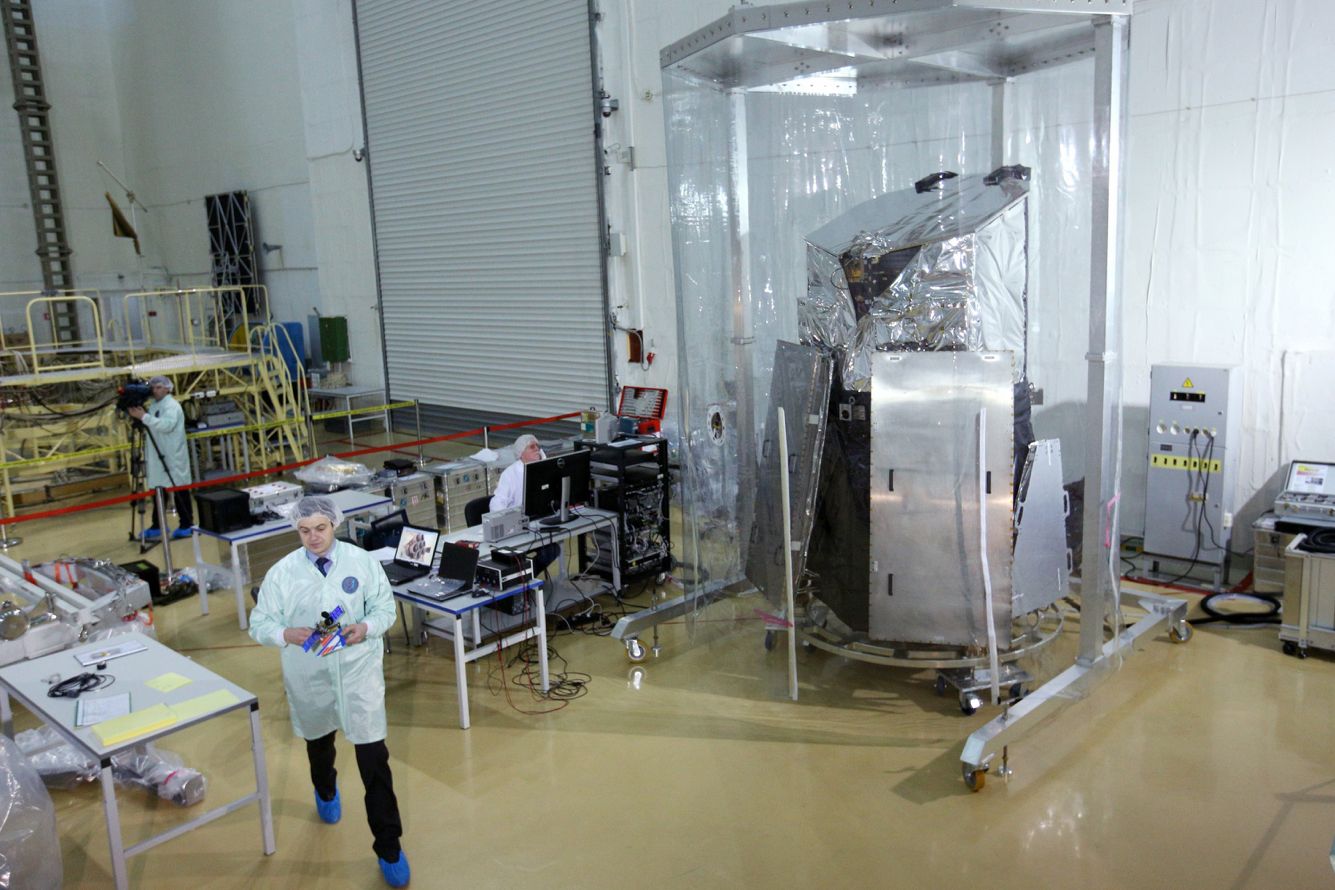
On July 13, the Baikonur cosmodrome launched the Proton-M launch vehicle with the Spectr-RG space observatory. This mission has been prepared since the late 1980s-scientists hope that the device will help to better understand the laws of the universe. Medusa asked for an astrophysician, a leading researcher at the State Astronomical Institute of Moscow State University Sergei Popov, to talk about why Spectr-RG is so important for world science.
-“Spectrum-RG” is an orbital observatory. Why are such observatories needed?
- The main thing is for what the orbital observatory is for is observations in the range of the spectrum, in which the earth's atmosphere completely absorbs everything. The Spectrum-RG works with the X-ray range, and it is simply impossible to observe x-rays from the surface of the earth. Therefore, until the 1960s, when the first X-ray detectors began to be sent into space, there were no data on the radiation of astronomical objects in X-ray ranges.
- Why is it important to work in the X -ray range?
- My favorite analogy: you come to the doctor who tells you to make an X -ray. You say that you just made an ultrasound, why also an X -ray? But the fact is that X -ray shows something else.
Suppose you just looked around. In the visible range, you will only see what you see. If you look at the radiodiapason, you will see Vifay points in the next rooms, radio stations and so on. And in the infrared range you find that a rat lives in the office, which no one has ever seen. You will receive fundamentally new information. Make an important discovery.
So in space. If we want to study how stars and planets are formed, we need to observe in the infrared range, since they have not yet warmed up. We study ordinary stars - we use first of all the usual visible range. And if we, for example, the substance flows to the surface of the neutron star , then there it heats up to a gigantic temperature and radiates the main fraction of energy in the X -ray range. Accordingly, if we want to study, for example, black holes in double systems , then we first need an X -ray tool.
- It is indicated that this is the first Russian telescope with the optics of oblique fall. What does it mean?
- X -rays are poorly reflected. With similar situations, we all came across. Look from above at the surface of the water - and see the bottom. Then look along the water - you will see an almost perfect reflection. We see that in the case of an oblique fall and at the surface of the water, reflection is better. And in the case of an X -ray, only an oblique fall is possible. Nothing will work if you try to reflect the X -ray, just putting the source in front of the mirror - the mirror will completely absorb it. Therefore, you need to run the beam at a very oblique angle, because of this, such telescopes are very unusual-very long. Without the mirrors of a slanting fall in the X -ray range, just do not take a normal picture.
-The story of the Spectra-RG began back in the 1980s. Why did it take so much time its development?
- We need to make a small preamble - the Big Soviet Cosmonautics to a large extent ignored astrophysical studies. If we compare the number of astrophysical devices that our country has taken to orbit until 1990, then we lose even to Europe, not to mention the United States.
But there were several successful projects. Due to the fact that they were-primarily a grenade satellite-people wanted more. There were groups that were able to make equipment and work with data. There were good astrophysicists who could set tasks.
But the project was delayed. The main reason is the crisis of the late 1980s-early 1990s. Just at this time, the expected time of launching the first version of the “spectrum-RG” would have to. People tried to do something, but there was no money. Then the money appeared, but other difficulties began. The filling and equipment completely changed, because someone was part of the collaboration [of the creators of the project], and someone went out. New scientific tasks were set, as the old ones were already solved. Finally, a modern design of the apparatus was formed a few years ago - it was also coordinated for a long time.
The X-ray telescopes were made for a long time-and [made in Germany and which is part of the observatory "Spectrum-RG"] Erosita, and the Russian Art-XC. There were delays in the development of a satellite on which all this is installed. Then a long process of information was in all processed. In recent years, once even sanctions have been influenced - it was necessary to buy a microcircuit in the States, but they did not sell it. But in the end, everyone brought to mind.
In general, if you look at the story, it is generally difficult to recall the device that flew in time, which clearly indicated five years earlier. Usually, shifts and transfers always begin.
-This is a Russian-German project. What contribution to its creation did the parties make?
- Everything is very clearly shared. Satellite - Russian, launch - Russian. There are two telescopes on the satellite: the main is German, and the accompanying, additional, is Russian.
-And the results obtained will also somehow share between the parties?
- People always giggle when they find out how everything will happen. Data from the Russian telescope will be entirely Russian - this is understandable. Further - initially it was decided that the data from Erosita would be divided equally. The question was how to divide equally? The fact is that the first four years, the satellite has a review of the sky - it spins and scans the whole sky. Does this eight times in four years, that is, one scan of six months. Therefore, it was possible to share differently. As a result, they decided that the best option was to divide the sky in half. There is a Russian half of the sky, there is - German. It is always very funny to see the map of the sky, where the German flag is on one half, and the second is Russian. Accordingly, the data for all four years on one side will belong to the Russian side, on the second - German. Then they will already decide for themselves with whom to share these data.
All the last year there is a conversation about how the Russian and German side will exchange data, because there are small sources that fall on the border. For example, part of the object can lie on the German side, and part on the Russian side. Accordingly, people create joint groups and detail the process of data exchange. They are very serious. These data will not get into open access.
- Does the Russian telescope capture the whole sky?
- Ultimately yes.
“Then why are there two telescopes on the satellite?”
- They are completely different. They work in different ranges, there are different devices, and they see all in different ways.
Again, imagine that you made a person at the same time MRI and ultrasound. The ultrasound data is entirely - yours, data on MRI above the belt also gave you, and the data below the waist - to another doctor. So telescopes do not duplicate each other. No one would spend a lot of money for the sake of double.
- Is this the first such Russian project?
- If we talk about X -ray, then yes. But in our history there was one cosmic astrophysical project, which is known by the name " Radio Astro ". In fact, the name of the satellite is “spectrum”. This was the first launch within the framework of the program of four satellites with the name “Spectrum” working in different ranges. “Spectrum” is the first satellite where they worked with the radiodiapas, “Spectrum-Rentgen-Gamma” (“Spectrum-RG”)-the second, “Spectrum-ultraviolet”-according to the third plan, and it is also incredibly done. There are very distant plans to do the fourth “spectrum” for working in a millimeter infrared range.
It is clear that reviews of the sky in the X -ray range in the world were previously made. But in space astrophysics for serious projects there is a strict requirement: each next should be ten times better than the previous one in all respects. Therefore, the situation is approximately as follows: twenty years ago you bought a laptop, and now you bought one more. Is the new laptop something better? He is better for everyone, although it costs the same.
- How are you doing with similar projects in other countries? Is this project important for world science?
- Yes, this is a world -class observatory. In her class, she fulfills this requirement - to be ten times better than the previous one in the world. There was a German satellite who made a review of the sky in the 1990s, and since then there has been nothing like that.
- What in the USA with similar projects?
- They did not launch x -rays for many years. They develop a little differently-how some country may not make trams, but at the same time produce high-speed trains. The Americans launch many x -rays of various types, but they do not make x -rays of the sky.
- When will the telescopes make their work, that these pictures will give scientists?
- The main task is to overview of the sky, respectively, the telescope will see everything that is in the sky. This is a huge number of different sources [radiation], so potentially there are a huge number of problems that can be solved. In fact, the data will be obtained according to all classes of astronomical objects that only exist.
But there are priority tasks. For Erosita, this is an observation of accumulations of galaxies in the X -ray range. The cluster of galaxies is the largest structures in the universe. And observing them at different distances, we see them in different eras of the life of the universe. The accumulation of galaxies well reflects the [process] of the formation of a large -scale structure, and this, in turn, is one of the pillars of modern cosmology.
A little exaggerating-Erosita will be able to see all the accumulations of galaxies to the edge of the universe. Some fantastic number, about 100 thousand [clusters] of galaxies. For comparison: about a thousand is well studied well now. So at least this is important for clarifying cosmological parameters, and potentially for solving cosmological problems. To understand our universe as a whole.
- What, besides the accumulation of galaxies, will be studied?
- Many things. It is difficult to build everything in the order of significance, but, for example, these are active cores of galaxies. Those very ultra -massive black holes in the centers of galaxies - a very large database of new data will be collected on them.
Already traditionally, all X -ray devices are exploring double systems with neutron stars and black holes. Here you can also expect many interesting results.
I have a main personal request for Erosita, and maybe to the second telescope - to open solitary accusing neutron stars, which should be about a billion in our galaxy. They fly in the interstellar environment and can attract this environment.
[X -ray] This is the only way to see and observe such a neutron star. This was understood back in 1970, and it would be beautiful for the 50th anniversary to see the old single neutron stars. This is very important for understanding how they live and evolve. While we are studying mainly young neutron stars. Or old, but in double systems, and they have a little differently arranged life.
- Why is it important?
- We are interested in evolution. Imagine you are an alien who flew to the ground and looks at a small child. You have no idea what happens to him further. You will not understand that the child can then learn the general theory of relativity, and, for example, a puppy, which also does not speak and climbs somewhere, no. A priori to understand this is quite difficult if you are an alien and flew for five minutes. You can find out only by seeing objects of the deadline. We do not know about neutron stars how they evolve - this is a rather large piece of physics and astrophysics.
-It is not known exactly what we get from the Spectra-RG?
- Well, yes. In a good way, the conclusions can be drawn after the end of the reviews. Somewhere in a year there will be the first data, then, as always, people will learn to work with them. Optimistically, I would say that in a couple of years something will begin to appear, and in five years, people will slowly begin to give complete data.
-Theoretically, can we get some breakthrough results?
- Speaking without exaggerations that the media love so much, then it is impossible to predict this in principle. If the result is guaranteed and predictable, as with gravitational waves, then it is obviously not a breakthrough, because it is a planned thing. Interesting discoveries are always unexpected. This is the point of making devices ten times better. There is always a high probability of seeing what you have never seen. That is, the answer to the question: maybe, maybe not.
-We have an example, the predecessor of “spectra-RG”-“spectrum”, which was launched in 2011. Did we get something important from him?
- It is difficult to rank the results, but I would single out the receipt of very detailed images of bright astronomical radio sources. Scientists were able to consider important details in the streams of [plasma], which are beaten from the centers of active galaxies, are thrown out of the environs of ultra -massive black holes. To understand how the active cores of the galaxy work, this is very important. From the Earth, such a result cannot be obtained in principle.
I would not say that it was a completely test project, but no one had ever done such a project of such a scale before. Let's just say - this is a pioneer project in which there were many things that had to be tried. The project met expectations from this point of view, plus gave a lot of good scientific results. But there were no breakthrough ones, in my opinion. But this was not planned.
-Will the “spectra-RG” be useful only from the point of view of science? There will be no applied application?
-The practical use of something is often asked incorrectly. For example, a physical education teacher tells the children to sit down 50 times, and oh they ask where in adulthood it may be necessary to sit down 50 times. Answer: Nowhere will it be needed, it would be strange. But there is a great sense in the squats. Then you can run away from someone, you can move someone with your foot, and in general the lower back simply will not hurt.
With scientific research often the same way. The action is not necessary, but what it is connected with is useful. In the case of an X -ray, there are several examples. X-ray scanners, which we are faced with at the airport or at the station, in the 1960s was developed by a company that was actually created to work on the first X-ray detectors for astrophysical studies.
In general, the long -term development of X -ray astronomy has led to the fact that now there are no longer in the drawings, but in the gland there are promising systems for navigation of satellites in the solar system - they are x -ray. That is, the next generation of interplanetary stations will plow the spaces of the solar system, guided by x -ray sources - using small x -ray telescopes on board and all the developments created as part of research.
And this is much better, because the satellite will be able to determine not only his position, but also the speed without the connection with the Earth. This is very important. The stations will be completely autonomous and will not spend resources in touch with the ground.
- People from the outside are often skeptical of Russian space initiatives - they scold and criticize the same Roscosmos. “Spectrum-RG” is a project that can be proud of?
- I have already stopped seeing people who scold the cosmic initiatives. It was fashionable in perestroika years-I remember the poster where the sausage flies into space, in the late 1980s. But it seems that since then people have understood the benefits of research.
Roscosmos is a fundamentally different one. Similarly, are we scolding the elections or precisely the Russian elections? Are we scolding the legality system or the Russian system of legality? These are fundamentally different things.
I think that this project can be proud of, and it is far from the only one with us. Therefore, it seems to me that now in general people understand: space research should be done. Another thing is that you do not need to steal money, but you need to do the job. If everything is fine with this, then people seem to understand that the cosmos is more useful than harmful.
Pavel Merzlikin