
Translated material
Nation of amateurs
About the "death of the examination" of Tom Nichols
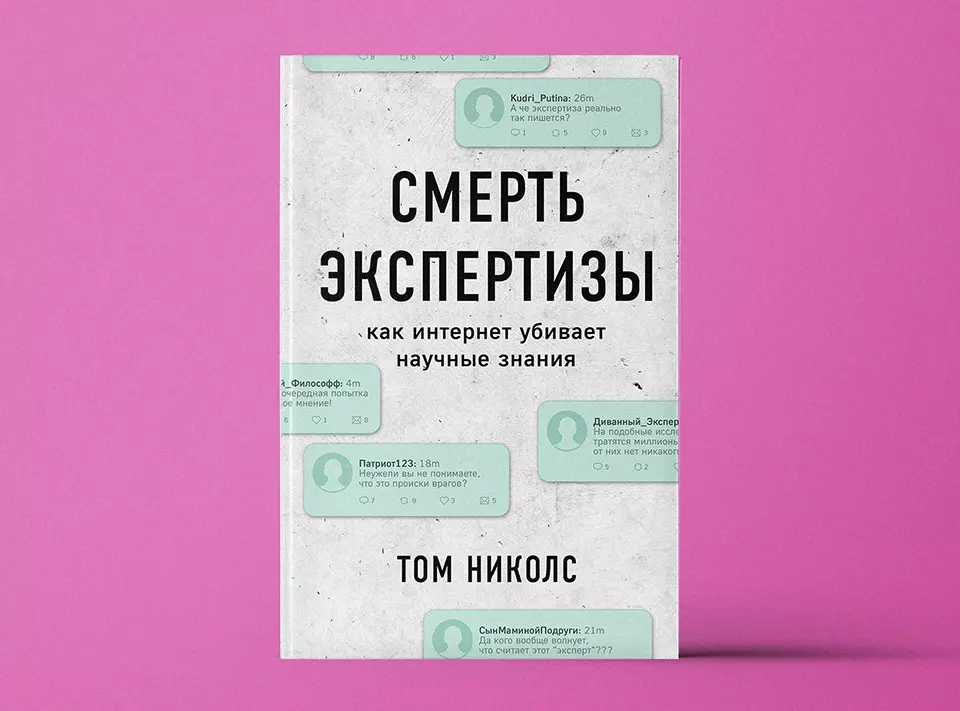
Why do we tend to believe bloggers more than an authoritative scientist? And how does the Internet contribute to the collapse of democracy? Eduard Lukoyanov is about the book of Professor Tom Nichols that has just published in Russian, in which he is looking for answers to these questions.Tom Nichols. Death of examination: how the Internet kills scientific knowledge. M.: Bombor, 2019. Translation from English by T. L. Platonova
“Expert: measles causes hepatitis”, “scientists have called the best product for cancer prevention,” “the political scientist told how to end the war in Syria.” We see dozens of such headings daily in the news. And, as a rule, anti -scientific nonsense is hidden behind them, produced either by self -proclaimed specialists from unknown “institutions” or frank charlatans.
Some of us sacredly believe everything that they write on the Internet, refuse vaccination and begin to absorb chocolate in kilograms, which will allegedly cure them from all diseases. Others, more skeptical, are once again convinced that science has turned into the notorious development of grants, and finally lose confidence in academic knowledge.
Which of this is worse? Such a question is posed by the reader Tom Nichols - an American political scientist, professor of the US Navy Military College, a professional erudite and multiple champion of the Jeopardy Textor.
Immediately make a reservation that the Russian name of his last book “Death of Expertise: How the Internet kills scientific knowledge” should not mislead the reader. In the original, it is entitled more restrained - The Death of Expertise: The Campaign Against Establined Knowledge and Why It Matters , and its content is far from limited to the Internet and Wikipedia Erudition. The general topic raised by Professor Nichols is the crisis of an expert community that can be much more dangerous for wide masses than it might seem.
First of all, together with the author, we try to figure out what generally includes the concept of "expert". In this matter, Nichols is unequivocal and conservative, his answer is unlikely to appeal to the egalitarists. An expert is a specialist who has specialized higher education and work experience in his field.
And here we are faced with a serious problem. In parallel with the expert community, inflation and higher education occurred, which, according to Nichols, turned into the next services market. Unfortunately, although the professor writes exclusively about the American university environment, some realities are understandable on this side of the Atlantic.
 “The new culture of education in the United States is that each person must go to college. These cultural changes are important for the death of expert knowledge, since as the curricula grow, responding to consumer requests, schools become falseuniversity, whose diplomas indicate more about training than training - two completely different concepts that merge more and more in public consciousness. In the worst case, diplomas are not confirmed by either training or training, but only a visit. And sometimes they even testify only to the timely entered training fee. ”
Nichols is sure: because of this, students began to treat teachers as a staff, and education as a few years of fun in the campus. True, it is not always clear where the author is objective, and where he pours out the soul of a professor, saddened by negligent students. For example, one of the roots of evil, he somewhat unexpectedly announces that students can now contact teachers via the Internet:
“Email, like social networks, is a great equalist, and students are pleased to realize that their correspondence with the teacher is like a typical communication of the seller of services with the consumer. This has a direct impact on the degree of respect for expert knowledge, because such a tendency erases any differences between students asking questions and teachers who answer them. ”
In fairness, we emphasize: Nichols in no case falls into neo -men and does not urge to turn off the network and go into the forest. He compares the emergence of a public Internet with the invention of a printing press, a great tool for science and progress, which many, alas, were used for not their intended purpose.
However, new types of communication are fraught with many dangers. Firstly, Nichols recalls that we all involuntarily strive to read information that confirms our point of view or corresponds to our political views. For this, the Internet gives us cyclopic arrays of information, and we do not always find arguments in disputes in sources that deserve confidence.
Secondly, in social networks everyone is equal in default: the specialist often has the same social capital as the self-taught one who read books on the topic (is it bad as it seems to Nichols, is a discussion issue). In this “equalnal”, the author blames not only the Internet, but also Hollywood, who created a pleasant image of a brilliant amateur for the layman (such as, for example, in the Oscar -winning “Wille Hunting” Gas Van Sent).
Thirdly, arguing in social networks, we become more aggressive and even cruel. Anonymity and remoteness make us irresponsible, and we are less and less ready to hear the arguments of the opponent.
However, all this is at least intuitively clear to the more or less active Internet users. It is much more curious how Nichols studies the devaluation of traditional media. Thinking the point of no return, which undermined confidence in the media, the professor turns to an extremely interesting episode, about which a wide reader may not know.
In the fall of 1979, Iranian revolutionaries captured the US Embassy and took hostage 66 American citizens. The compatriots of the prisoners were shocked - the incident was unique for his time. The crisis lasted a year and a half and from time to time was aggravated by extremely dramatic events like the infamous ORLEN CALOT operation. It is natural that what is happening in Tehran has become the main theme in the American media, which daily monitored the development of events. But then television people faced a serious problem.
“Just as the comedian Chevy Chase announced every week in the Saturday Night Live show that the Spanish leader Francisco Franco was still dead, so there were nothing else to report that the hostages are still hostage.”
 The way out of this unpleasant situation for producers was found on the ABC channel. Shortly after the capture of the embassy, the American audience was presented to the new Nightline program, completely dedicated to the events in Iran. “Every evening, ABC gave a screensaver with the inscription“ American hostages ”and indicating the number of days during which hostages remain in captivity. Throughout the airtime, the journalist <...> interviewed experts, journalists and everyone who had something to do with this crisis. ”
The creators of the program killed two hares with one shot. The new format did not require special production expenses, and the audience received maximum information about the all -exciting problem, bringing ratings. And so high that Nightline came out a few more years after the hostages were released, and there seemed to be nothing to score. The result of this production adventure we observe to this day and for a long time we consider the norm a given ABC format:
"Producers and reporters gave rise to selfless experts, inviting them to speak out for any reason - a temptation, before which only a few are able to resist."
So, the Institute of Experts, if not completely discredited, is on the verge of closing. What happens when trust in specialists is lost, but in return we get endless arrays of information? That's right - everyone is now an expert.
Talking about the consequences of this, Nichols gives the following at the same time a funny and depressing fact:
“In 2015, representatives of the liberal Policy Polling group, engaged in a public opinion poll, asked the question of both the Republicans and the Democrats, they would support the bombing of the country of Agrab. Almost a third of the Republican respondents said that they would support such an initiative, and only 13 percent were against it. The rest did not know what to answer. Democrats were less inclined to use military operations: only 19 percent of the Democrats supported the bombing, while 36 percent voted resolutely against.
In reality, the state of agrab does not exist. This is a fictional country from the cartoon "Aladdin". "
At first glance, this is an incident from a series of jokes about “stupid Americans”, but Nichols sees the problem much deeper, and his anxiety is difficult not to share. The trouble is not that the respondents were weak in geography. The trouble is that a significant part of them has a clear position on the issue that simply cannot arise before them. “How can a republic function if people who directed their representatives solve the issues of war and peace do not see the difference between agraus, Ukraine or Syria?” - Nichols asks rhetorically.
In his opinion, it was the death of the expert community that influenced political cataclysms, which we are observing everywhere. Using the features of the new information space described by Nichols, politicians deftly manipulate voters, forcing them to listen to their own (as they think) intuition and not listen to the opinion of those who really understand this or that issue. At the exit we have President Trump and the success of supporters of the UK from the EU. The solution to the problem of Nichols offers an elementary, but requiring moral and volitional efforts from all citizens:
“Experts should always remember that they are servants, not owners in a democratic society and the republican government. But if citizens are masters, then they must secure not only the proper level of education, but also a certain degree of civil liability in order to fully participate in the management of their own country. The amateurs cannot do without experts, and they should come to terms with this reality without any insults. ”
It would be a simplification to say that we have the next book about a bad Trump or instructions for information hygiene. The “death of the examination” is a kind of intellectual autobiography of the classical liberal and pragmatist, sincerely frightened by the fact that in our enlightened century emotions prevailed over the mind. This is a book about the conflict of old elites and inhabitants, in which the second is confidently won to the author of the author. From this angle, “Death of Expertise” is especially interesting and relevant far beyond the United States.
Separately, I would like to thank the Bombori publishing house for extraordinary editorial decisions. Already in the annotation to the book, we meet the word "bexpert". People who know how to pronounce a soft sign at the beginning of the word are less and less every year. It’s good that at least someone does not forget about their existence.