
Translated material
Scientists have found a new elementary particle, but this
Physicists discovered two new excited states of the lovely baron, which can be a new particle-lambda-b Barion or Sigma-B Barion. If the discovery of scientists, among which there are Siberian ones, is confirmed, this will clarify what the universe consists of.
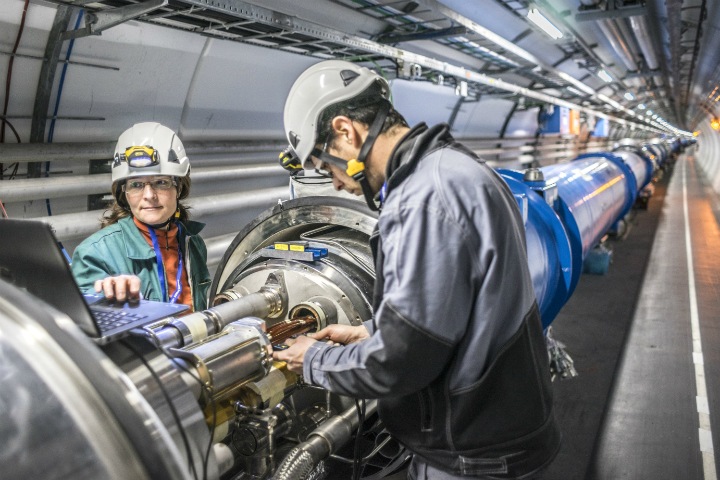
The new excited states of the lovely baron (this is a particle consisting of three quarks) was found by participants in the LHCB experiment in Cern, including the Institute of Nuclear Physics of the SB RAS and Novosibirsk State University. The measurement of the quantum numbers of the observed particles will help scientists to accurately interpret the results and confirm (or refute) the opening.
The quarter model is part of the standard model that describes how mesons and baryons are made up of quarks. The LHCB experiment on a large ADRO Collider is aimed at clarifying the quarrel model - this is necessary to better understand what the universe consists of. The quarter model is well worked out at the fundamental level, but the observation data is much less than theoretical predictions. Therefore, each new experimental observation of a new state is a big event.
“In high energies physics, it is customary to verify the results in independent experiments on other attitudes,” explained Pavel Krokovny, senior researcher at the Institute of Nuclear Physics of the SB RAS and the head of the physical and technical computer science of the Faculty of Physics. “In the Japanese experiment, Belle II, close to LHCB, on the Superkekb collider, in which electrons and positrons collide, lovely baryons are not born, therefore, there is no completely independent experiment in the world.”
According to the scientist, now there is a modernization of the large Adron Collider and the LHCB detector, in addition, another modernization of HL - LHC is planned, which will end in 2026. This will be a almost new experiment that will check the results in 2019.
Previously, Taiga.info wrote about the project of the Novosibirsk synchrotron and the creation of a scientific school of quantum physics at the Far Eastern Federal University.