
Translated material
So INION was created

About the generation of "Pentecostals", about the creation and heyday of INION, Natalia Demina, talked with the doct. Econ. Sciences Yuri Antonovich Borko , who recently celebrated his 90th anniversary.
"Pentecostal"
- You are from that generation that no longer fell into the war. Many of your comrades born in previous years have died ...
- I was born in 1929. 1926 was called up, and they went to the front, from 1927, many also got to the front, 1928 called, but they no longer participated in the battles.
- The guys born in 1929 at the age of 16 were no longer taken? If the war lasted another year, could you call you?
-Yes, although I studied in the 9th grade in Kazan, I was already attributed as a pre-conscript. In February 1945, I turned 16 years old, and I went to the military enlistment office. In 1946 they had to call me. But in 1945, the war ended, and the calls took place differently in the spring and autumn of 1946. Those who are 17 years old until graduation was allowed to finish it. Those who entered the institute in the fall were given a deferral for passing exams. The subsidies received from the call were exempted, because in almost all universities there were military departments, where all healthy students underwent military training. In the spring of 1946, employees of the district military enlistment office came to graduation 10th grades and campaigned to enter military schools. A considerable number of tenth graders heeded these calls, especially those whose fathers did not return from the war. It was also attractive that cadets entered the schools in schools - daily food and two sets of military uniforms - summer and winter. Life in the military and post-war years was difficult.
- Are you a representative of the “sixties” generation?
- I call myself "Pentecost." I even have such an essay - “Pentecostal”.
- And how do these generations differ?
- In fact, there is no difference. I call the “Pentecostals” those who, with the mind and understood the situation in the country still (or already) in the 1950s, was the death of Stalin and the exposure of the “case of killer doctors”, then-the liquidation of the All-powerful chief of the state security of Lavrenty Beria, the first works of writers and poets, which gave the name “thaw”, the report, the report, the report. Nikita Khrushchev at the XX Congress of the CPSU ... Vasily Aksyonov once said at a conference dedicated to the "sixties" (2007): " Of course, many of us are the" sixties ", but I am" Pentecost ", I have matured and understood everything before many ." When I read this, I thought that I and some of my friends at the Histress of Moscow State University are also “Pentecostals”, because they “ripe” at one time with Aksyonov. And then the “Pentecostals”, moving to a new decade, became “sixties” at the same time who also had a fracture in the views, and they became critical people - “dissenters”.
- Aksyonov and mother were repressed.
- His mother, Evgenia Ginzburg, in 1947 left the camp, but could not leave the Gulag zone and settled in Magadan. And Vasily in the war years lived with relatives in Kazan and, by the way, studied at the same school No. 19, in which I studied, three classes older, but I did not know him. Vasily came to his mother with a ninth grader and graduated from the school there. In general, the former political prisoner (“enemies of the people”), who passed the Gulag, was forbidden to return to Moscow, Leningrad and large cities in which they lived earlier. They could only settle outside the stock zone around Moscow - in Alexandrov, Tarusa, Zagorsk (now Sergiev Posad) and other small cities located at the same distance from the capital.
- Which of the poets, writers, musicians of that time were your idols? Okudzhava, Yevtushenko?
- Yes, first of all Okudzhava. I remember his performance at the Institute of World Economics and International Relations. And next to him Yevtushenko, Christmas, Voznesensky, Vysotsky. There are still two poets not so popular, but included in the Golden Fund of Russian poetry: David Samoilov and Yuri Levitansky. Both front -line soldiers. I have two book racks - almost completely poetry.
- I see: Pushkin, Rilke ...
- There are Russian, Western, Chinese, and Japanese poets.
- Great! What languages do you consider to be your workers? English and French?
- Yes. With great need, I can be German, I taught him at school, but did not like it because of the war. When I worked intensively in science, I had all three languages in use. Now I almost do not use German.
- Did you teach themselves?
- English taught at Moscow State University, then, working at school, he forgot, and when he moved to Imo, he settled again for English and quickly restored it. French did not teach either at school or at Moscow State University, but IMEMO had language courses. Many people came with one language and quickly “bleed” that you need to have at least two. I went to three -year French courses. The bias in the courses was social science, which was reflected in the vocabulary. For free reading of fiction, he was not enough, and there was no time to read it. And for reading economic and political literature was enough.
- What role did self -education play in your life?
- Huge! I read all the time. Three types of literature: special literature on their subjects, philosophical and political science literature, including Russian thinkers - Chaadaev, Herzen, Berdyaev, Fedotov. And, of course, the artistic is Russian and foreign.
- All this was taken out in a special guard or bought after perestroika?
-Something in a special guard, and something was open. The books of Berdyaev and Fedotov were in a special guard, I could go there freely. Few people know that in IMEMO, for example, there were two special guards. There was a common special guard, and there was a second special security officer, where the most “cool” foreign books translated into Russian - Zbigneva Brzezinsky, George Kennan and other most ardent anti -Soviets entered. For the chosen audience.
- Could you go and read?
“When I became the executive secretary of the editorial office and a member of the editorial board of the magazine“ World Economy and International Relations ”, his editor -in -chief Yakov Semenovich Havenson said:“ I will give you permission for the second special security. ” I was surprised: what is it?
- The second special security was much “cooler” of the first?
- Yes. A lot of literature went to this special guard. The censors sent everything that was considered bourgeois and revisionist literature. But they missed part: they read - and if they did not find direct attacks against the Soviet regime, then it is possible in the first. Since the 1960s, it has already been liberal time.
-I read in Wikipedia that the first director of INION had problems due to the fact that he allowed the employee to scan the Master and Margarita ...
- It may very well be. One young employee of my department in INION found a foreign “forbidden”. Naturally, they “hit” the director. He calls me: “Well, what is it? And what to do with it? " I say: “This is in my youth, the guy works well, is engaged in the reference on the safety problems of European countries.” Well, they made him a suggestion.
- Your institute was liberal and, probably, the authorities calmly related to dissidents? Or was it strict?
- We had both the people who served, and the “calm” dissidents. When in 1972, INION was headed by a corresponding member of the USSR Academy of Sciences V. A. Vinogradov, he said that he would not touch anyone, let them work, but keep their views with them. Then one of the dissidents left, the other remained.
INION
- Let's talk about INION, his past and future. Please tell us how you started working there?
- I came to INION in 1970. On October 22, 1968, a resolution of the Council of Ministers and the Central Committee of the CPSU “On the Development of Social Sciences” was adopted and published. In it, one of the points was established “ to create an institution of information on social sciences ”, so from the moment when it was decided to create an initial, 50 years have passed. In early 1969, the Presidium of the USSR Academy of Sciences on the basis of this document adopted a decision on the creation of the Institute of Social Sciences and appointed the director. The first director was the famous Chinese, a doct. East. Sciences Lev Petrovich Delusin (1923–2013). The institute began working at the end of 1969. And I was enrolled in INION in January 1970, almost from the moment of its founding. I was 41 years old. And I worked there for 20 years, until December 1989. From there he went to the Institute of Europe.
- How do you see the essence of the concept of INION? Why was it created?
- Oh, this is a very interesting and most important question. Under Stalin, all social science was partially defeated, and what was left was isolated from world science. Philosophy, political economy and history were in decline (then did not recognize sociology and political science at all). In a very primitive state, there was a country -stage.
After the death of Stalin in the “top”, and even then not immediately, came to the understanding that our social science is lagging behind and does not even satisfy the needs of power. By this time, the pre -war level of industry development was far surpassed and began to develop new industries, opened large oil and gas deposits and quickly increased their production. Economic ties with the developing countries of Asia, Africa and Latin America began to develop rapidly.
In addition, after the Caribbean crisis, when a nuclear war nearly began between the USSR and the United States, an understanding appeared that, if two “superpowers” of nuclear weapons, both of them are interested in stability. In 1963, the USSR, the USA and the UK entered into an agreement on the prohibition of nuclear tests in the air, on Earth and in water, and in 1968-an agreement on the non-proliferation of nuclear weapons. Soon, other states began to join both treaties - France, China, etc.
In the 1970s, the United States and the USSR began to negotiate a limitation of strategic missile and nuclear forces. The movement towards the discharge of tension took place in Europe: France under de Gaulle and Germany under Willy Brandt entered into negotiations with the Soviet Union on the preparation and conduct of a pan -European meeting on security and cooperation. To establish international ties, the government needed qualified experts that can analyze what really happens in the global economy and politics, especially in the developed countries of the West. So life itself led to the fact that in the 1960-1970s the state began to encourage the development of social sciences. Within the framework of the Academy of Sciences, several institutions were created - IMEMO, the Institute of the USA and Canada, and a number of others, including INION.
It was not created from scratch. The Russian Academy of Sciences, back in pre -revolutionary times, included a scientific library in social sciences. After the revolution, it was first renamed the Communist Library, then to the Fundamental Library of the Social Sciences of the USSR Academy of Sciences. A unique library with the most valuable fund of manuscripts, books, magazines, etc., not only domestic, but also foreign, covering the entire range of public disciplines. Therefore, it was decided to create INION on the basis of the fundamental library of social sciences. There were brilliant bibliographers, which since the 1920s classified subject and copyright catalogs.
But it was impossible to create an institute on the basis of the library. The qualifications of the bibliographers were not enough to receive abstract and analytical information on the basis of scientific foreign literature. It was necessary to invite scientists, researchers to the new Institute. Only one who is constantly engaged in science is able to select from all foreign literature what deserves to refer or prepare analytical reviews. So the idea of a multifunctional scientific institution arose, which we had not had before. There was no abroad. INION was supposed to combine the functions of the library, the scientific and information center and the research institute in which scientists who speak foreign languages and are experts in different fields of social sciences work.
The first director - Lev Petrovich Dlusin - did not work in INION for long, he had a reputation as a liberal, and in the science department of the Central Committee of the CPSU there were a very conservative authorities. And, as already mentioned, instead of him in 1972, Vladimir Alekseevich Vinogradov came (1921–2017). Before that, he was the head of the Department of External Relations of the Presidium of the Academy of Sciences of the USSR. He had good connections there, and he enjoyed trust in the CPSU Central Committee. The scientist, he might say, was no, and the organizer turned out to be brilliant. Everything that was said above about what institution was an initial was carried out under his leadership.
V. A. Vinogradov began by forcing the construction of a new building (it burned down on January 30, 2015. - Approx. Ed. ), By 1974 it has already been built. We constantly participated in subbotniks, and the director himself came and worked with everyone. In the very first months, he achieved a significant expansion of the staff of INION, and soon dozens of candidates and doctors of science joined him.
In total, in 1972-1975, approximately 300 scientists came to INION. The structure of the institute was determined: 12 or 13 departments of abstract and analytical information were created, including philosophy, literary criticism, economics, state and law, international relations, as well as regional departments - Latin America, China, Africa, Asia. The financing of INION was several times increased, partly on the salary of new employees, but mainly for the purchase of foreign literature-books, collections of documents and articles, dozens of scientific and socio-political journals.
As for me personally, I began scientific activities in IMEMO and MAMOM magazine. The transition to INION was a big event in my life. At the suggestion of L. P. Dlusin, I created the scientific and information sector of the capitalist countries of Europe, and V. A. Vinogradov invited me to reorganize the sector to the scientific information on the problems of Western Europe, the USA and Canada. By the end of my work in INION, 45 employees worked in the department, and more than 50 people along with graduate students.
- And who was the user of the analytical reviews created by Inion?
- In the days of the USSR there was a serious problem: a significant part of Western literature - mainly American and West European - went to the departments of special storage of libraries. At each scientific institute, at every university, in each public library there was a special guard department. And it was possible to read the literature located there only if there was a tolerance.
The permission for admission was given by the director of the institutes - our Vinogradov in INION, Academician of Inozems in IMEM, Academician Arbatov at the Institute of USA and Canada, etc. They understood the situation and took only those who were tested for “religicment” in the staff of the institute. And in each department of personnel there was a person associated with the KGB. If the KGB did not object to the institute’s admission to the institute, he thereby gave permission for admission to special security. But if the abstract was made according to special guard literature, then he remained in a special guard, and light access was needed for him. After all, many people needed it - employees of research institutes, teachers of public sciences in universities, employees of the Foreign Ministry, ministries of defense, foreign trade and other state departments. Therefore, for reading essays, abstract collections, analytical reviews of foreign literature, lightweight access was installed, these materials went under the stamp “for official use” (chipboard). We published our publications with circulations of hundreds of copies, maximum circulations - 1000, sometimes 2000 copies.
I wondered: at least 5-6 thousand people worked at the Institutes of the Social Sciences of the USSR Academy of Sciences in the 1970-1980s. Add several thousand teachers, professors and associate professors from Russian universities. Thousands of specialists worked in ministries. So about 15–20 thousand people used this literature. And this is a circle of people who needed such literature in the first place. Our reviews were read by both students who gained access in various ways, and many educated people who worked in a variety of places who learned about our unique publications and somehow got them.
In 1992 - I already worked at the Institute of Europe of the Russian Academy of Sciences - we created an association of European research (Aevis) in Russia. At first, she united 10 regional branches created on the basis of local universities, then there were about 30 of them. I was elected its president and was in this post until 2010. I very often visited departments, gave lecture courses on European integration, participated in conferences. And when I met, they told me: “Oh, is you the same Borko that issued collections on the problems of Western Europe and the USA?” I replied: "The same one."
And once again I want to emphasize: the novelty of INION was that it was created as a scientific institution of a new type. It combined three functions: libraries - reading rooms were always full; the scientific and information center , which published magazines, essential collections, analytical reviews and express information of various kinds; and the Academic Institute , whose employees were simultaneously both scientists-research and organizers of scientific and information activity.
- Is it possible to say that INION does not make sense in the country where there is no censorship?
- Partly yes. But this is what thing: a stream of scientific and other literature is huge. Why do we need bibliographers? Когда ученый приходит в библиотеку, ему надо искать свою тему, он сначала перебирает предметный каталог, потом находит в нем интересные фамилии. Затем идет в авторский каталог, роется там. В итоге он собирает обширный список работ по интересующей его теме, а их научная ценность весьма различна. ИНИОН продолжает выпускать реферативные журналы, тематические реферативные сборники и аналитические обзоры литературы, которые содержат информацию о наиболее содержательных работах. Так что, на мой взгляд, и при отсутствии цензуры научно-информационная продукция ИНИОНа остается востребованной.
К сожалению, закат ИНИОНа начался еще до пожара. «Лафа» закончилась в 1990–1991-м годах, когда произошла цепь драматических событий — крах советского «развитого социализма», распад СССР, рыночная реформа, жуткие цены, обнищание институтов и работников. Это был очень трудный период — с 1992 года до пожара. Средства на закупку зарубежной литературы сократились примерно в семь (!!!) раз. ИНИОН добывал ее путем обмена с зарубежными институтами, присылая им нашу отечественную литературу и получая их научные труды. Или, например, ИНИОН проводил научную конференцию, а иностранные участники привозили нам их литературу. Потом стали выезжать свободно и возвращаться с подаренными или купленными книгами. Тем более что досмотр ввозимой печатной продукции на наших границах был отменен.
Если в 1970–1980-е годы ИНИОН был авангардом, обеспечивавшим всю элиту научной информацией в области общественных наук, то в 1990-е годы его главной задачей стало выстоять и выжить. Конечно, после перестройки стало немного легче в том плане, что ушла цензура, можно было оптимизировать выпуск реферативных журналов, уже не раздельных по советской и зарубежной тематике, а единых. На этом направлении многое сделал В. А. Виноградов, остававшийся директором до 1998 года.
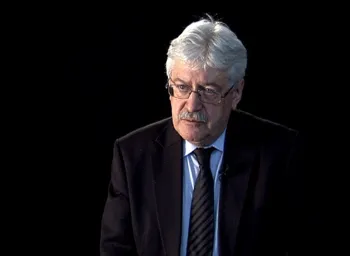
Фото с сайта tvkultura.ru
Вместо себя он предложил избрать директором заведующего отдела политологии, государства и права — Юрия Сергеевича Пивоварова. Тот окончил в 1976 году аспирантуру в ИМЭМО, но в институте его не оставили, потому что он уже тогда был замечен в связях со свободомыслящими людьми и диссидентами. В тот же год он был принят на работу в отдел государства и права ИНИОНа. Я его помню с первых дней его работы, потому что его отдел был расположен по соседству с нашим отделом. Тогда отдел гос-права возглавлял докт. Yurid. наук Николай Никанорович Разумович (1922–1990), чудесный человек. Юра и нам что-то делал иногда по моей просьбе, Его уже тогда интересовали политико-правовые проблемы Западной Европы. Он очень быстро проявил себя как талантливый исследователь. В 1998 году Юрий Сергеевич стал директором ИНИОНа, 17 лет возглавлял его в крайне трудных условиях, и коллектив института выстоял.
А потом — этот жуткий пожар (30 января 2015 года. — Прим. ред. ). Его причина ведь так и не известна. Был конец рабочего дня, пятница, и вдруг ночью в нескольких местах загорелась крыша.
— А какое будущее вы видите для ИНИОНа? Кто должен разрабатывать программу его развития?
— Когда произошел пожар, институт оказался в критической ситуации. Его переселили в здание на улице Кржижановского. Сначала предполагалось отдать им всё здание, там должен был поселиться весь коллектив института и работать до восстановления здания на углу Нахимовской и Профсоюзной. Но здание на Кржижановского освободили частично, два этажа оставили за выехавшей оттуда Академией сельскохозяйственных наук, а потом цокольные помещения дочерняя организация ФАНО (ФГУП «Управление служебными зданиями») начала сдавать под кальянную, кафе, магазин и т. п., а ИНИОН стало выгонять из здания. Институт четыре года работает в экстремальнейших условиях, и тем не менее он работает. Он выпускает рефераты, реферативную информацию, разные виды экспресс-информации. Десяток научных журналов, из них три входят в перечень ВАК, готовится вхождение этих журналов в международные базы данных. Институт функционирует, нельзя уничтожать коллектив, сложившийся за 50 лет, уже третье поколение исследователей!
Первым поколением были мы, вторым поколением — Юрий Пивоваров, Татьяна Пархалина, Ольга Новикова — зав. отдела Европы и Америки, зав. экономическим отделом Наталья Макашова, Светлана Левит — сотрудник отдела философии, организовавшая перевод на русский язык многих десятков книг по западной философии и социологии.
Как же можно разгонять этот коллектив, который с такой настойчивостью отстаивает себя и продолжает выпускать научную и научно-информационную продукцию?! Их журналы востребованы, у них идет обмен информацией с зарубежными центрами. Коллектив работает, он сумел найти варианты эффективной деятельности в новых условиях. Он сделал это!
— Но ИНИОНу говорят: «Вы должны разработать будущее на 10–15 лет вперед». Как вам кажется, каким должен быть идеальный ИНИОН через десять лет? В чем будет заключаться, например, профессия библиографа в будущем?
— Библиограф всегда будет нужен. Библиотека всё равно нужна, потому что книги и журналы будут читать.
— А какая библиотека? Всё переводить в цифру?
— Я не знаю, сколько десятилетий нужно, чтобы перевести в цифры библиотечный фонд ИНИОНа, в котором 14 млн документов. Сколько времени нужно, чтобы это перевести? Сколько десятилетий переводят в цифровой формат западные библиотеки?
Дальше — библиограф. Для грамотного оформления новых книг нужна квалификация. Вот я влез в Интернет. Там 99,99% информации — это для меня спам. Я как исследователь должен найти то, что необходимо мне. Как я могу обойтись без каталога? Раньше он был на карточках, теперь будет электронным. А кто будет делать такой каталог? Его должен делать специалист. Значит, нужны библиографы, которые классифицируют мировую литературу в любой отрасли науки. В ИНИОНе они есть, уникальные библиографы.
— Но вы говорите о библиотеке… Когда в Президиуме Академии наук было обсуждение ситуации с ИНИОНом, то оказалось, что некоторые академики видят будущее ИНИОНа именно в качестве библиотеки, а не института. А каковы должны быть задачи научного института?
— Может быть, когда-нибудь он будет не нужен совсем. Но сейчас он действует. Оставьте коллектив в покое и дайте ему возможность работать дальше! Они выпускают журналы, не только реферативные, но и научные. Работающие в нем ученые публикуют статьи и монографии. Не надо уничтожать или форсировать ликвидацию коллектива, который умеет работать и который дело делает. Что будет через 10–15 лет? Wait and see.
Что сейчас нужно? Во-первых, перестать дергать институт, только-только отметивший свое пятидесятилетие, и дать ему работать дальше. ИНИОНу нужно форсировать переход на электронную информацию, они не всё еще сделали, сил не хватало. Им нужно ускорить эту работу, чтобы все виды информации были в двух вариантах — печатном и электронном. И тогда все будут пользоваться не только библиографией, но и их научной продукцией, они издают ее в виде реферативных журналов, сборников обзоров, аналитических записок.
Нужно разработать концепцию ИНИОНа, в которой они бы оптимизировали свою деятельность. Там есть блестящие специалисты, в том числе по моей специализации — европеистике. Я их всех знаю, когда-то они были моими аспирантами, теперь уже кандидаты и доктора наук. Ученики, которые превзошли своего учителя.
— Нужно ли созывать какую-то конференцию или круглый стол для разработки будущего ИНИОНа? Или это созреет естественным путем?
— У них есть разработки. Но надо прекратить следствие по делу Пивоварова. Вместо того, чтобы дать человеку спокойно работать, выдумали этот вариант с хищением. Там уже три или четыре следственных группы работают. Никаких следов обогащения у Юрия Сергеевича, который живет в очень скромной обстановке, не нашли. Тем не менее ему предъявлено обвинение в сговоре и укрывательстве. Я знаю, что к президенту обращались Л. М. Алексеева, сенатор В. П. Лукин, академик А. Г. Арбатов. Говорят, что следствие должно дойти до конца, а там видно будет. Конечно, это осложняет жизнь и Ю. С. Пивоварова, и всего института.
— Сейчас обсуждают идею: объединить ВИНИТИ и ИНИОН. Думаете, это ошибка?
— А зачем это делать? Два разных учреждения, две разных концепции, две разных истории.
— А чем они так отличаются?
— В ВИНИТИ совершенно иная сфера науки, иного рода информация. Они рефератов или аналитических записок не делают, у них короткая информация по техническим наукам. Ничего похожего на ИНИОН! И созданием библиографии потока научно-технической литературы они тоже не занимаются. Они ведут каталог того, что сами выпускают.
— То есть вам кажется, что объединение вряд ли поможет делу?
— Ну, не объединяют же в Академии наук отделения философии и механики! Они существуют как отдельные структурные подразделения. В каждом объединены родственные институты. Конечно, долгосрочную концепцию развития ИНИОНа, лет на 10–15 вперед, надо разрабатывать.
— А кто может стать ее автором?
— Сам коллектив! Там есть прекрасные люди. Академик Пивоваров работает с 1976 года, Татьяна Пархалина, его заместитель по научной части, начинала свою карьеру в нашем отделе, пришла в 1980 году. Не хотела проходить «по блату» через директора, пришла ко мне, сказав, что хочет заниматься наукой. Я уже называл имена Светланы Левит, Ольги Новиковой. Могу назвать имена докт. East. наук Валерия Любина, докт. polit. наук политолога Натальи Лапиной. Это всё сложившиеся крупные ученые, они спокойно обсудят и утвердят концепцию.
Окончание в следующем номере