
Translated material
Science on the moon
On July 20, 1969, two earthlings-astronauts Neil Armstrong and Edwin Oldrin from the crew of the Apollo-11 spacecraft first step on the lunar surface for the first time. They were followed by six more expeditions to the moon, five of which also passed successfully. The triumph of the greatest technical achievement and the most powerful geopolitical resonance overshadowed the scientific significance of the Apollo program, and today few are able to remember what new knowledge a direct study of the moon gave us.

At the dawn of the space era, Selehenologists, thanks to astronomical observations, could confidently say: there is no atmosphere, water resources and any developed life forms on the moon. It is probably internally homogeneous and tectonically dead. However, there was no clarity whether it was possible to extend the results of observations to the back of the moon, because among other things, the hypothesis of the existence of the deepest depressions there was discussed, where the “remnants of the ancient atmosphere” and the conditions for the appearance of life could well be preserved. The question was clarified in October 1959, when the Soviet Station “Luna-3” transmitted images of the reverse side: although the surface relief there differs (more mountainous areas, less noticeable craters and “seas”), some anomalies indicating the places of possible habitat of aliens were not found.
At the same time, the statement about the absence of tectonic activity on the moon was called into question. Astrophysicist Nikolai Kozyrev, who conducted observations with the Kharkov Observatory spectrograph, recorded a powerful volcanic eruption in the lunar crater of Alfons on November 3, 1958, which added arguments to supporters of the theory of endogenous nature of the lunar relief 1 .
An even more unexpected opening was made using the American spacecraft “Lunar Orbiter - 5”, launched on August 1, 1967 and brought to the near -polar selenic centric orbit. During his movement over the round “seas”, regular “bursts” were seen in the values of the accelerations of the apparatus associated with the strengthening of the gravitational field. The most significant anomaly was detected above the rain. Scientists have suggested that there are excess masses that are called Mascoon (from Mass Concentrations). At first, selenologists were puzzled by anomalies, but soon there was a hypothesis that under the round “seas” are the remains of giant iron-nickel meteorites or large planetosimals, consisting of the dust of the protoplanetary disc 2 .
However, the most popular topic for discussions was a significant difference in the average density of the moon and Earth (3.3 g/cm3 versus 5.5 g/cm3), calculated in the 19th century. If both bodies are made of similar breeds, then how to explain the difference? Maybe there are extensive cavities inside the moon? But how did they form? In an attempt to answer these questions, three theories of the origin of the moon 3 were formulated.
The theory of interruption claimed that the young proto -ground rotated very quickly, making a full revolution in four hours. Due to the resonance caused by the coincidence of the frequency of the own oscillations of our planet with the frequency of sunny tides, the height of the latter grew until one of the tidal humps came off, then turning into a natural satellite. Since only the upper fragment of the proto -landing was in orbit, the moon is devoid of a metal nucleus, and its average density corresponds to the earth's mantle. The place of separation of the moon is probably the Pacific basin. The proposed theory has become universally recognized for a while. However, later the calculations were shown that even such a quick rotation is not enough for the separation from the proto-ground of any significant mass. In addition, the theory did not explain where the emerging planet had a high moment of the impulse and where it went later.
The previous one was replaced by the theory of capture. According to her, the moon was formed separately from our planet somewhere in the solar system (for example, in the main asteroid belt), and then was attracted by gravity at the time of mutual rapprochement. In the original version, the theory did not explain how the scattering of kinetic energy during the capture occurred, and the supporters had to introduce new assumptions: the protolun rotated in the other direction, her orbit had a high eccentricity, etc. The Nobel Laureate Garold Yuri suggested that there were several protols at a close distance from proto -ground; At some point, they collided, losing kinetic energy and forming a single body. Supporters of theory understood that such an event is unique, therefore it is unlikely. Material confirmation in the form of lunar soil was required: if its analysis showed that the moon is younger than the Earth, and substances characteristic of the asteroid belt prevail in the composition, then the theory could be declared realistic.
In parallel, the theory of the “double planet” developed, which states that the Earth and its satellite were formed by accretion from a protoplanetary cloud in a common selenic centric orbit near each other. The main problem of the theory was that without the introduction of many assumptions, she did not explain why our planet became “double”, and not, close in size to Venus and Mars, and why the moon has an abnormally low density.
Among the selenologists there was no unity on other issues - the age of the moon and details of its surface, endogenous or exogenous origin of its relief, the composition and structure of its subsoil, etc. The spacecraft of the Luna and Surveyor series, which managed to catch up, dispelled only doubts that they could make normal landing, but did not give reliable certificates in The benefits of any of these theories. From a certain point, it became clear that without an expedition with the participation of astronauts it is impossible to resolve any of the many years of disputes.
For four years, nine manned flights to the moon took place: Apollo 8 (12/21/1968–27.12.1968), Apollo-10 (05/18/1969–26.05.1969), Apollo-11 (07.16.1969–24.07.1969), Apollo-12 "" (11/14/1969–24.11.1969), Apollo-13 (04/11/1970–17.04.1970), Apollo 14 (01/31/1971–09.02.1971), Apollo-15 (07/26/1971–07.1971), Apollo-16 ")," Apollo-16 " (04/16/1972–27.04.1972) and Apollo-17 (12/07/1972–19.12.1972). The first two flights were tested and passed without landing on the lunar surface. The Apollo 13 expedition was unable to implement the mission program due to an accident on board the ship. As a result, only twelve astronauts visited the moon, who fell there inside the lunar modules (Lunar Module, LM), leaving a command-service module (Command and Service Module, CSM) of a ship with one crew member in selenic centric orbit. After the expedition program, the astronauts started in the take-off cabin, joined with the command and service module, and dumped the cabin, directing it towards the moon. With each new flight, the time of work on the surface increased (for comparison: the Apollo-11 commander Nile Armstrong worked outside the module for 2 hours 21 minutes, and the Apollo 17 commander Eugin Sernan remained outside 22 hours 2 minutes) 4 .
The first significant discoveries were made even during the Apollo 11 expedition. On July 20, 1969, astronauts Neil Armstrong and Edwin Oldrin landed in the Eagle module on the site in the southwestern part of the sea of calm. The inspection of the place of appendix confirmed the information obtained by unmanned vehicles: the surface is unambiguously solid and covered with a layer of loose chopping breed, called the regolithic and formed as a result of erosion exogenous processes (under a meteorite bombardment in a vacuum, hard solar irradiation and significant temperature changes). The soil is strewn with rather large debris, which are probably thrown out of the craters. Inside the craters, Armstrong saw the scattering of glass “drops”, which puzzled Selehenologov. Later, during laboratory analysis, many similar “drops” were discovered in lunar samples - most likely, they are formed during the evaporation and precipitation of the lunar substance when a meteorite hit 5 .
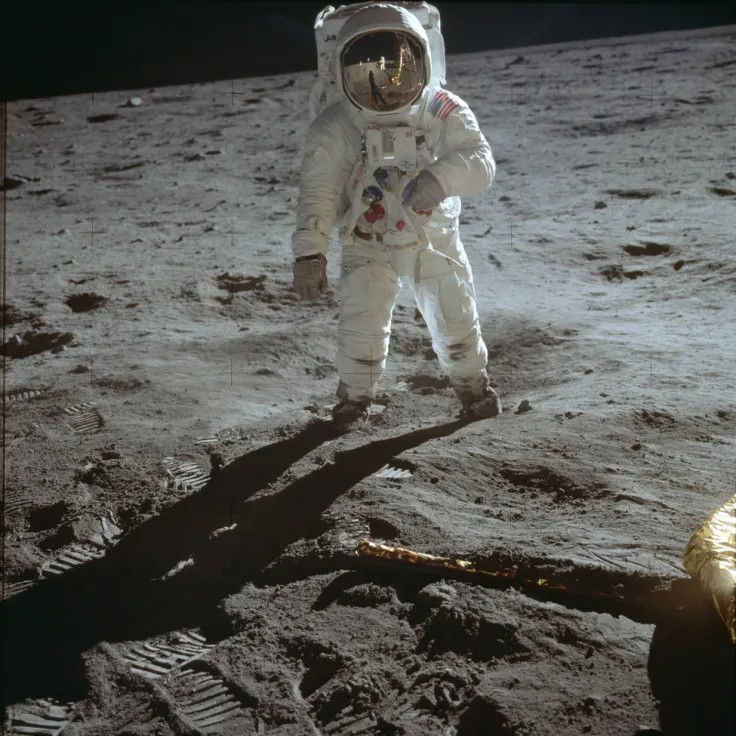 Astronaut Edwin Oldrin on the Moon July 20, 1969 (NASA, AS11-40-5903)
 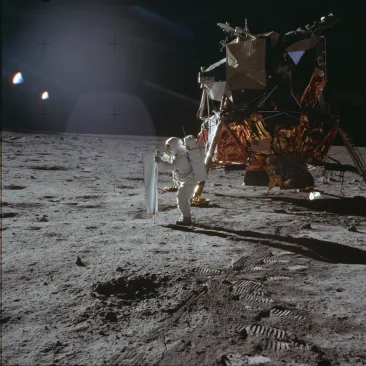 Astronaut Edwin Oldrin works with a SWC solar wind trap (NASA, AS11-40-5872)
 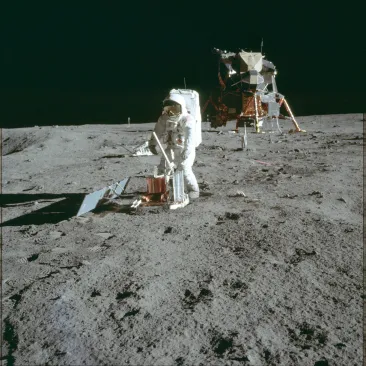 Astronaut Edwin Oldrin sets the PSEP seismic station (NASA, AS11-40-5947)
During the sorties, the astronauts used a stereoamer, which was installed vertically and allowed to shoot a “virgin” surface from a very close distance. Some pictures capture an unusual detail: spots of a thin layer of “glaze” on the particles of the soil. Astrophysicist Thomas Gold suggested that relatively recently (no later than 100 thousand years ago), the moon was subjected to sudden heating as a result of a powerful solar flash, in which, by one and a half minutes, the radiation increased by two orders of magnitude .
Although the work outside the “eagle” was short -term, the astronauts managed to collect rocks and install the set of scientific devices EASEP (Early Apollo Surface Experiments Package), which included the corner reflector of Lrrr (Laser Ranging Ranging Ranging Ranging) (Passive Seismic Experiment Package) and a SWC solar wind trap (Solar Wind Composition).
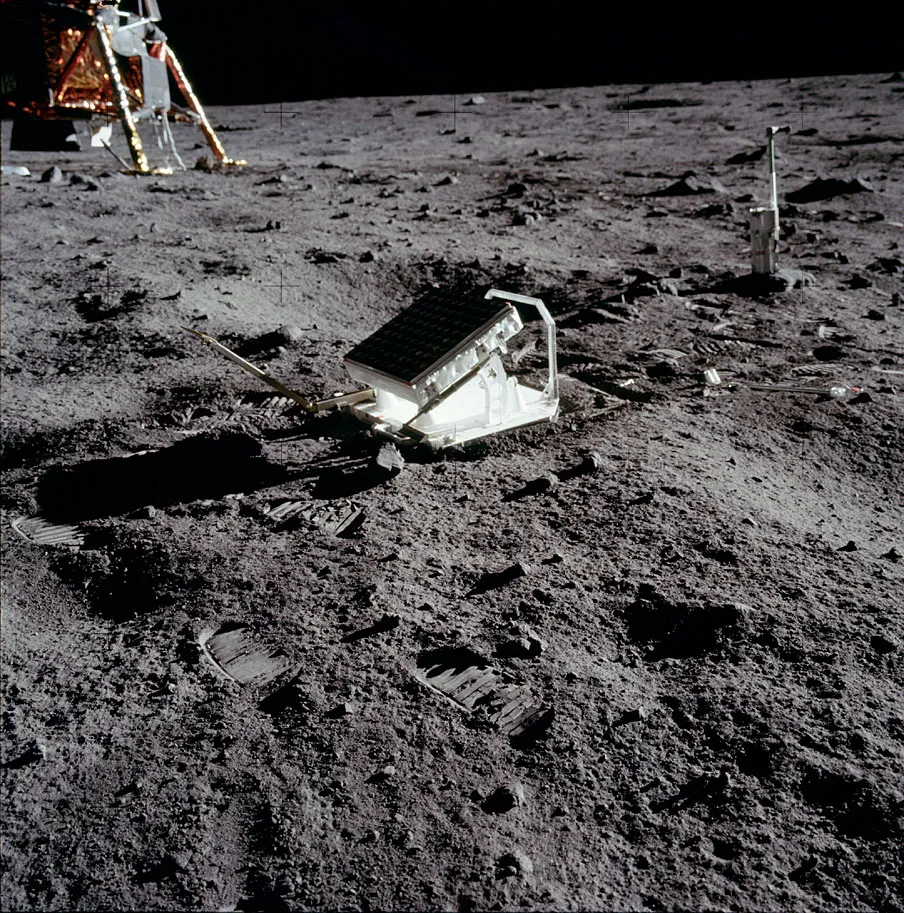
The LRR reflector was a panel of one hundred small quartz corner prisms in size 3.8 cm; It was created to clarify selenographic and geodynamic data. On August 1, 1969, the Lika Astronomical Observatory in California found it with a laser beam and received a confident response signal.
The PSEP station, powered by solar panels, consisted of four seismometers. Its sensitivity was such that after turning on PSEP “noticed” the steps of the astronauts. Unfortunately, the station worked for only three weeks, but managed to fix several moonlights.
The SWC trap looked like a sheet of ultra -low aluminum foil size 30x140 cm, fixed on a vertical telescopic pin. The meaning of the experiment was to explore the molecular structure of the solar “wind” through the determination of the isotopic composition of helium, neon and argon. In the laboratory, a sheet delivered from the moon was placed in a vacuum chamber, where it was heated to partial melting-the content of the released gases was studied using mass spectrometer 7 .
Samples of lunar soil caused the greatest interest of selenologists. Although they were collected in a hurry, the primary analysis made it possible to conclude: the surface breeds of the sea are similar to earth basalt, and their age is at least 3.3 billion years. Together with the data of the seismometer, this information questioned the theory of capture of the moon and testified in favor of the theory of the “double planet”. It turned out that the moon could not form somewhere far from the modern orbit and remains tectonically active 8 .
At the same time, scientists did not find any traces of the effects of water and water-containing minerals. The hypothesis about the presence of microorganics on the moon was not confirmed. In order to prevent mutual biological “infection”, experts sterilized spacecraft, and the crews after returning were strict quarantine. The precautions were superfluous: the study of the soil for the presence of organics showed that its content on average does not exceed ten parts per million, and this amount is explained by the pollution of the samples inside the spaceship 9 .
One of the most important tasks of the Apollo-12 flight was the approximation from the Servor-3 spacecraft, which since April 1967 has been on the territory of the Ocean of the Storms (Oceanus Procellarum). The landing of the Module "Unsuitable" took place on November 19, 1969. Performing work on the surface, the astronauts Charles Konrad and Alan bin noticed that when walking, the legs were deeply immersed in the ground, and the sampler managed to introduce a full length-about 70 cm (for comparison: the Apollo-11 crew could not take samples deeper than 15 cm). In addition, the samples delivered to the Earth were much younger - the average age of crystalline breeds amounted to 2.3 billion years 10 .

During the first sortie, the astronauts deployed a SWC (Solar Wind Composition) and a full -fledged scientific station ALSEP No. 1 (Apollo Lunar Surface Experiments Packke). The central block of the station included communication equipment, cables and the SNAP-27 radioisotope generator with a plutonium element. Nearby, astronauts installed PSE (Passive Seismic Experiment), LSM (Lunar Surface Magnetometer), a SWS (Solar Wind Spectrometer), LDD (Lunar Duust (Lunar Duust (Lunar Duuster). Detector) and the SPRUTERMAL Detector of the lunar ionosphere SIDE (Suprathermal Ion Detector Experiment). During the second sortie, Konrad and bin picked up the server-3 apparatus-scientists were interested in how space influenced equipment and materials. Since the spacesuits made it difficult to take action, the astronauts managed to remove only the television camera, a piece of cable, a section of an aluminum tube and a bucket-and-output.

However, the main surprise presented an experiment with PSE seismometer. After the start from the moon and the transition to the Apollo-12 command and service module, the astronauts separated the take-off cab and sent it down. She fell at a distance of 72 km from the place of landing "undaunted". Scientists expected that the seismic fluctuations caused by the fall of the cabin would subside quickly, but the reverb (the residual sound after the sound source is turned off) lasted 55 minutes! At a press conference, Selehenologists compared the phenomenon with the “rumble of a church bell”, which immediately revived conversations about the existence of cavities under the lunar surface of 11 .
In April 1970, the flight of Apollo 13 ship took place. Due to the accident, the landing had to be canceled, and the ALSEP No. 2 scientific station was lost. Nevertheless, the expedition made its contribution to selenology: the third step of the Saturn-5 missile weighing 13 tons was directed to the moon and on April 15 crashed into it on the territory of the crater Lansberg (Lansberg) this time the reverb lasted four hours, which excluded the possibility of measurement error.

The Antares module (Antares) of the Apollo 14 spacecraft with astronauts Alan Shepard and Edgar Mitchell shattered on February 5, 1971, 50 km north of the fraur Mauro crater (Fra Mauro). The device of the ALSEP No. 3 station, deployed by the new expedition, mainly repeated the Apollo-12 station, but with additional equipment: the corner reflector of LRRR, the CPLEE low-energy loaded (Charged Particle Lunar Environment Experiment) and installation for an active) ASE seismic experiment (Active Seismic Experiment). Selehenologists intended to find ancient deep species there, thrown out during the clash of the moon with large cosmic bodies. Samples really differed from everything previously investigated: they easily crumbled, contained rare minerals and were rich in a field spar. The basalt found in their composition had a respectable age - from 4.0 to 4.3 billion years 12 .

The Apollo 15 expedition opened a new stage: the specialists due to modernization increased the carrying capacity of the Saturn-5 launch vehicle, which allowed the four-wheeled Rover LRV (Lunar Roving Vehicle), which can be removed from the landing site of 9 km. As during past flights, the third step of the rocket was directed towards the moon and crashed into it, giving rise to many hours of reverb.
On July 30, 1971, the Sokon module (Falcon) with astronauts David Scott and James Irwin landed in the Hadley-Apennine area. There, the front of the Apennine mountain massif rises 3.6 km above the rain of the rain, and selenologists hoped to find the materials of the formation of this pool as a result of a collision with planetesimal.

Сначала астронавты испытали ровер, а после возвращения к «Соколу» развернули ALSEP № 4. По составу она походила на станцию «Аполлона-14», только оборудование активного сейсмического эксперимента ASE ученые заменили на прибор для измерения теплового потока из лунных недр HFE (Heat Flow Experiment). Кроме того, вместо стандартного отражателя LRRR был установлен увеличенный — из 300 кварцевых призм. Впоследствии за счет своего размера он стал наиболее востребованным (для сравнения: до 2000 года включительно с отражателем «Аполлона-11» был проведено 1384 эксперимента, «Аполлона-14» — 1380, «Аполлона-15» — 10 923) 13 . С его помощью удалось не только установить, что Луна удаляется от нашей планеты со скоростью 38 мм в год, но и уточнить существующие модели приливного взаимодействия, определить величину дрейфа земных континентов и получить косвенные данные в пользу гипотезы существования лунного ядра.
Для измерения теплового потока в рамках эксперимента HFE астронавтам пришлось просверлить две скважины для зондов. В идеале они должны были дойти до глубины 3 м, однако через 2 м электробур уперся в скальное основание. Как выяснилось в процессе эксперимента, в лунных недрах нет условий для превращения тепла в энергию тектонических сдвигов. Селенологи пришли к выводу, что зарегистрированные сейсмометрами природные лунотрясения связаны либо с падением метеоритов, либо с приливным воздействием Земли, либо с возникновением термоупругих напряжений из-за перепадов температур.
Во время второй и третьей вылазок астронавты занимались осмотром окрестностей и сбором образцов. Среди прочего, они отобрали для лабораторных исследований образец № 15415 массой 269 г, который является фрагментом ранней лунной коры возрастом 4,15 млрд лет. Его назвали Камнем Творения (Genesis Rock) 14 .

Другим крупным достижением экспедиции «Аполлона-15» стала доставка керна длиной 2,7 м, состоящего из 55 слоев. Его анализ помог воссоздать древнюю историю Луны и Земли. Например, получила подтверждение гипотеза английского астронома Уильяма Маккри, который полагал, что наша планета периодически проходит через облако космической пыли, вызывающее глобальное похолодание. В керне наблюдаются три повторяющихся слоя пыли с интервалами в 100 млн лет, предсказанными Маккри 15 .
Установка на Луне трех станций с пассивными сейсмометрами дала ученым возможность определять методом триангуляции местоположение источников лунотрясений. Попутно была раскрыта тайна ревербераций — оказалось, что «гул церковного колокола» возникает в поверхностном слое толщиной 1–2 км, который состоит из рыхлого и сухого материала. Похожий эффект проявился бы в скоплении земного галечника при взрыве гранаты, но на Луне реверберация продолжается значительно дольше за счет меньшей силы тяготения 16 .
Несмотря на множество открытий, ученые всё же имели смутное представление о том, как формировалась Луна. К примеру, не доставало ясности в вопросе о том, была ли она горячей или холодной. Если она была достаточно горячей, то расплавилась бы целиком, поэтому более тяжелые материалы, в том числе железо, сосредоточились бы в центральной части. В таком случае железо находилось бы и по сей день в расплавленном состоянии и создавало бы сильное магнитное поле, чего не наблюдается. С другой стороны, если бы Луна оставалась холодной на протяжении всей своей истории, то тяжелые материалы не опустились бы в ее недра, и следовательно, на ней не может быть даже остаточного магнетизма.
Новая экспедиция должна была прояснить этот вопрос. 21 апреля модуль «Орион» (Orion) корабля «Аполлон-16» с Джоном Янгом и Чарлзом Дьюком прилунился на плоскогорье севернее кратера Декарт (Descartes). Астронавты развернули станцию ALSEP № 5; при этом Дьюк пробурил скважины: две глубиной по 2,5 м для термозондов эксперимента HFE и одну глубиной 2,7 м — для извлечения керна.


Феноменальный результат был получен при измерении магнитного поля. Для этого использовались два прибора: стационарный LSM (Lunar Surface Magnetometer) и переносной LPM (Lunar Portable Magnetometer), который астронавты возили с собой на ровере и разворачивали на специальной треноге в местах измерений. На маршруте длиной 7 км напряженность поля изменялась от 121 до 313 гамм. Причем в разных местах были обнаружены признаки существования магнитных полей противоположных полюсов: получается, что там, как и на Земле, остывание смежных участков коры происходило в разные геологические периоды. Таким образом, было доказано, что в древности на Луне существовало достаточно сильное магнитное поле 17 .
Модуль «Челленджер» (Challenger) корабля «Аполлон-17» совершил посадку 11 декабря 1972 года поблизости от гор Тавр (Montes Taurus) на юго-восточном краю Моря Ясности. Прежде всего астронавты Юджин Сернан и Харрисон Шмитт развернули модернизированную станцию ALSEP № 6. Но куда большее внимание привлек сбор образцов, ведь Шмитт был первым профессиональным геологом на Луне. И ему повезло. Например, астронавты мимоходом откололи кусок от невзрачного на вид валуна, а в лаборатории выяснилось, что «случайный» образец (№ 72417) состоит из чистого оливина (дунита) возрастом 4,5 млрд лет. Еще большее волнение специалистов вызвал участок оранжевого грунта, который Шмитт заметил у кратера Шорти (Shorty). Необычный цвет мог указывать на наличие воды под поверхностью или на недавнюю вулканическую активность. Увы, исследования оранжевого грунта показали, что он состоит из шариков цветного стекла невулканического происхождения, — вероятно, он образовался в результате падения скоростного метеорита или прорыва так называемого «огненного фонтана» 18 .


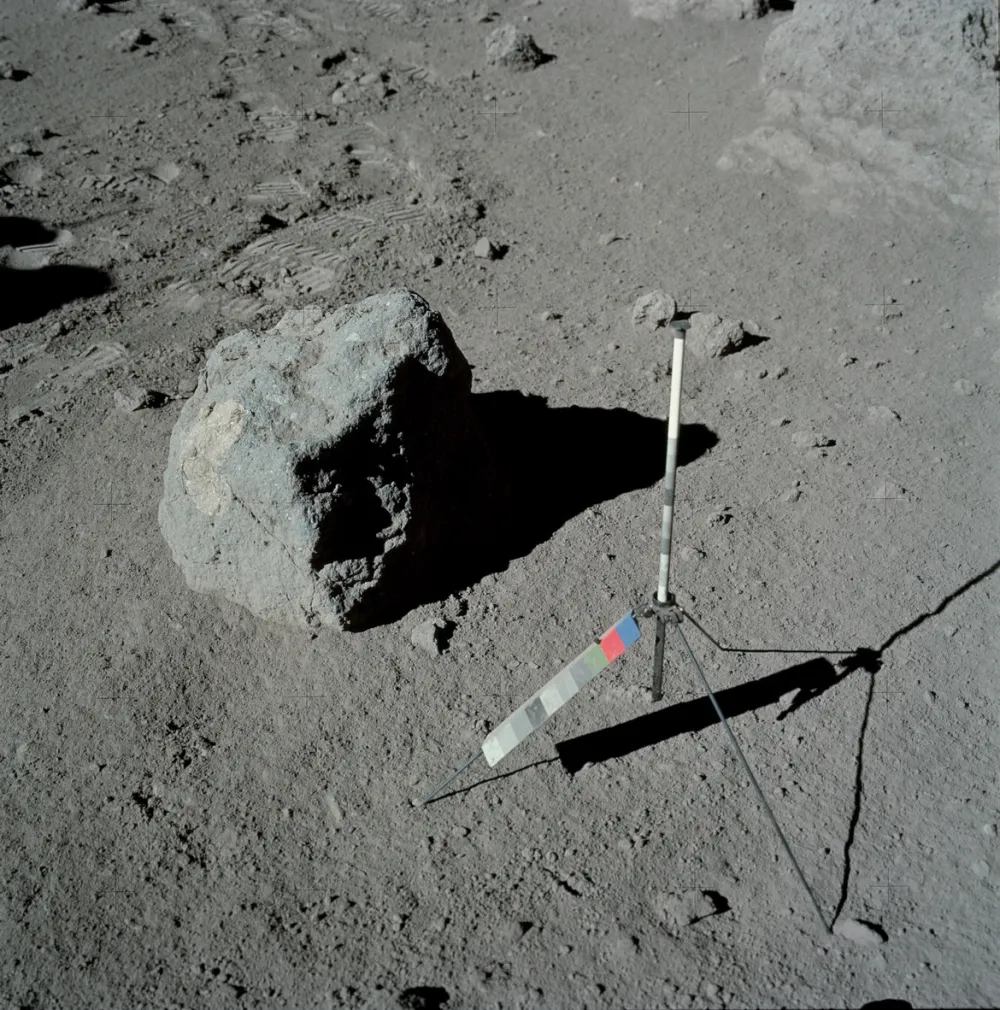

В 1975 году астронавт Харрисон Шмитт, подводя промежуточный итог научной программе «Аполлонов», заявил, что непосредственные исследования помогли ответить на принципиальные вопросы эволюции Луны 19 . Твердо установлено, что она образовалась 4,6 млрд лет назад — в то же самое время, что и вся Солнечная система. Затем тепловая энергия гравитационного сжатия расплавила ее внешнюю оболочку. Постепенно остывая, оболочка расслоилась на кору, богатую алюминием и кальцием, и верхнюю мантию, в которой преобладают минералы с высоким содержанием железа и магния. В период с 4,4 по 4,1 млрд лет назад Луна находилась под непрерывной метеоритной бомбардировкой, в результате чего поверхность покрылась рыхлым «одеялом» толщиной в сотни метров. Около 4 млрд лет назад на Луну одна за другой упали планетезимали, в результате чего образовались круглые «моря» протяженностью в сотни километров. Тогда же завершилось вертикальное расслоение оболочки и сформировалось раскаленное железо-сульфидное ядро радиусом 400 км, генерирующее магнитное поле. Около 3,9 млрд лет назад из переплавленных осколков коры сложились светлые равнины. Еще через 100 млн лет, когда лава заполняла свободные впадины, появились базальтовые «моря». 3 млрд лет назад движение базальтовых потоков прекратилось, а вулканические извержения затихли. С тех пор Луна менялась лишь под ударами редких метеоритов.
Реконструкция Шмитта опровергла ранние гипотезы, но некоторые детали требовали уточнения. Станции ALSEP продолжали работать, поставляя информацию до 30 сентября 1977 года, после чего были переведены в режим ожидания. Анализ данных, переданных ими, заставил ученых усомниться в том, что они имеют правильные представления о строении Луны. Оказалось, что ее кора слоиста, а мантия состоит из блоков планетарного масштаба, разделенных зонами сверхглубоких разломов 20 .
В ходе дискуссий родилась новая теория — рождения Луны в результате столкновения (мегаимпакта) Протоземли с массивным планетоидом. Оно случилось спустя 100 млн лет после начала формирования Солнечной системы. В результате произошло слияние двух тел, а часть их мантийного материала была выброшена на орбиту, образовав рой, из которого позднее и сформировался массивный околоземный спутник 21 .
Теория мегаимпакта популярна, хотя у нее есть противники. Без сомнения, точку в затянувшихся спорах поставят новые экспедиции, но для этого землянам нужно будет вернуться на Луну.
Anton Pervushin
1 Козырев Н. Вулканическая деятельность на Луне // Природа. — 1959. — № 3.
2 Марков М., Суханов А. Масконы впадин лунных морей // Природа. — 1970. — № 3.
3 Болдуин Р. Что мы знаем о Луне? / per. from English. К. Любарского. — М.: Мир, 1967.
4 Шунейко И. Пилотируемые полеты на Луну, конструкция и характеристики Saturn V Apollo. Ракетостроение (Итоги науки и техники). Том 3. — М.: Государственный комитет Совета министров СССР по науке и технике, 1973.
5 Предварительное изучение лунных образцов, доставленных «Аполлоном-11» / пер. from English. Г. Рошкована // Природа. — 1969. — № 12.
6 Куликов К., Гуревич В. Новый облик старой Луны. — М.: Наука, 1974.
7 Lindsay H. ALSEP. Apollo Lunar Surface Experiments Package. Электронная версия:
www.hq.nasa.gov/alsj/HamishALSEP.html
8 Загадок, связанных с Луной, не уменьшилось // Земля и Вселенная. — 1970. — № 3.
9 Поннамперума С. Поиски жизни на Луне / пер. from English. Э. Светайло // Природа. — 1970. — № 8.
10 Предварительное исследование лунных образцов, доставленных «Аполлоном-12» // Природа. — 1970. — № 10.
11 Кропоткин П. «Гудящие полости» на Луне // Знание — сила. — 1970. — № 9.
12 Гольдовский Д. Предварительные научные результаты полета «Аполлона-14» // Земля и Вселенная. — 1971. — № 6.
13 Алёшкина Е. Лазерная локация Луны // Природа. — 2002. — № 9.
14 Гольдовский Д. «Аполлон-15» исследует Луну // Земля и Вселенная. — 1972. — № 4.
15 Лунная пыль и земное оледенение // Земля и Вселенная. — 1976. — № 5.
16 Холмс Д. О чем рассказывает человеку Луна / пер. from English. // Америка. — 1972. — № 11.
17 Ерошенко Е. Магнетизм Луны // Земля и Вселенная. — 1975. — № 10.
18 Шевченко В. Оранжевый грунт // Земля и Вселенная. — 1973. — № 12.
19 Реконструкция эволюции Луны // Природа. — 1976. — № 2.
20 Галкин И. Неоднородная структура недр Луны // Природа. — 1977. — № 12.
21 О происхождении Луны // Природа. — 1977. — № 3.