
Translated material
The idea of glue from the snail

The creation of a composition capable of super -strength and at the same time reversible adhesion is not an easy task. The new adhesive material, developed by researchers from the University of Pennsylvania in the image and likeness of the snail mucus, can be characterized as superclly, which gives the right to error it. With the help of this adhesive material, you can not only firmly glue the details, but also, if such a need suddenly arose, change their position relative to each other, disconnect, without destroying neither details, nor adhesive, and then cross. For the new material, the cycle “Bleing - Bleing” does not lead to a decrease in the strength of the binding of the parts glued to it. This ability of adhesive can be appreciated by many who had to make repairs at home on their own [ 1 ].
Humanity has been using glue for a very long time. It is believed that for the first time, people began to glue the details in the Neolithic (9.5 thousand years BC). The first options for glue were a brew of various raw materials. Nomads and hunters made glue from a decoction of bones and tendons. Primorsky tribes received adhesive substance from the collapsed mass of fish scales. Forest residents widely used both the tar of coniferous trees, as well as the tar, obtained from wood. In the tomb of the pharaoh Tutankhamun, archaeologists found bee wax, which was also used as an adhesive. In 1830, gluing compositions based on rubber were invented, in 1930 a cyanacrylate supergli appeared. Nevertheless, humanity never found a recipe for “ideal glue”.
Currently existing adhesive compositions can provide a very strong connection of glued surfaces on an ongoing basis (supergli). If glue allows repeated use (like an adhesive composition on office-stickers, which can be crossed from place to place), it does not give a high strength of binding. Therefore, the main problem of developing adhesive compositions in our time is the creation of a material that is capable of super -strength and at the same time reversible adhesion to surfaces of various types.
This task, already difficult, becomes more difficult for those who are trying to develop environmentally friendly adhesives based on hydrogels. The main component is made less dangerous to the environment - water, however, the main problem is the main problem - unlike organic resins of natural or synthetic origin, the strength of water binding to most surfaces is not so high. In a new work, a professor of materials science and engineering of Pennsylvania University of Jan Shu and his colleagues were able to receive a hydrogel, which could provide a solid and at the same time reversible gluing surfaces. As often happens, the idea of new material was borrowed from nature.
It was previously shown that mucus released by snails allows them to maintain conformal contact with often uneven surfaces of stones or wood bark [ 2 ]. When dried, the shift module (physical quantity characterizing the ability of the material to resist shift deformation and is one of the main criteria in assessing the quality of adhesion) increases from 100 PO to ∼1 GPa, forming an epiphymer, firmly associated with the surface.
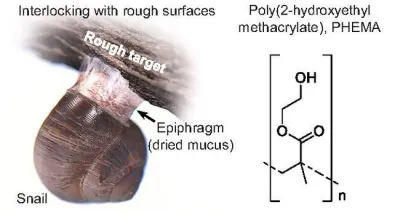
B. The structure of the structural link of the PHEMA polymer. Ill. from [1]
Scientists have found that hydrogel based on the hydrophilic polymer of Poli (2-hydroxyethyl methasrylate) (PHEMA), stitched by ethylene glycolidometsrylate (EGDMA), also undergoes significant and reversible changes in the shift module. For this hydrogel, the value of the shift module in a hydrated state does not exceed 200 kPa, while the hydrogel is elastic. When the hydrogel dries and its transition to a solid state, the shift module can reach 2.3 GPa. Being in an elastic state, the hydrogel is deformed, taking the shape of the surfaces for the gluing of which it is used. With rapid heating to 104 ° C, the hydrogel loses water and due to dehydration goes into a solid state with a high shift module. With a quick loss of water, moving from elastic to a solid state, the molecular mesh of the stitched Phema does not have time to change the shape and reliably glue the surfaces.
If the PHEMA polymer is in a solid dehydrate state, it is re -hydrated, it goes into an elastic state with a low shift module. In this state, glued objects can either be completely stuck or change their position relative to each other, after which heating and dehydration will again ensure a strong binding of surfaces. The reason for such a significant and at the same time reversible change in the hydrogel shift module in a hydrated and dehydrated states lies in hydrogen bonds that can occur either between the macromolecules of the PHEMA (in the dehydrated state), or between the macromolecules of the PHEMA and the water (hydrated state. When the hydrogel is drying, hydrogen bonds combine heavy molecules Polymers of which are difficult to get difficult, and the shift module increases, when the dehydrated gel is used, hydrogen bonds forms water, which, as “molecular lubrication” facilitates the movement of the threads of the PHEMA relative to each other and the greater supplies of the hydrogel in a similar way reduces the amount of hydrogen bonds between the molecules of the cellulose. cotton and linen fabrics-and facilitates their movement relative to each other, which is which it is more convenient and ironed from these fabrics, slightly moistening them with water. Or the introduction of a chemical reagent.
The relative ease of regulating the adhesive properties of the new composition will facilitate the scaling of its production and promises good prospects for practical use - after all, for example, it is much easier to make repairs, knowing that there is an opportunity to change the result of their last action without any problems and costs.
Arkady Kuramshin,
cand. chem. Sciences, Associate Professor of the Chemical Institute of KFU