
Translated material
"There is no rehabilitation of Stalinism"

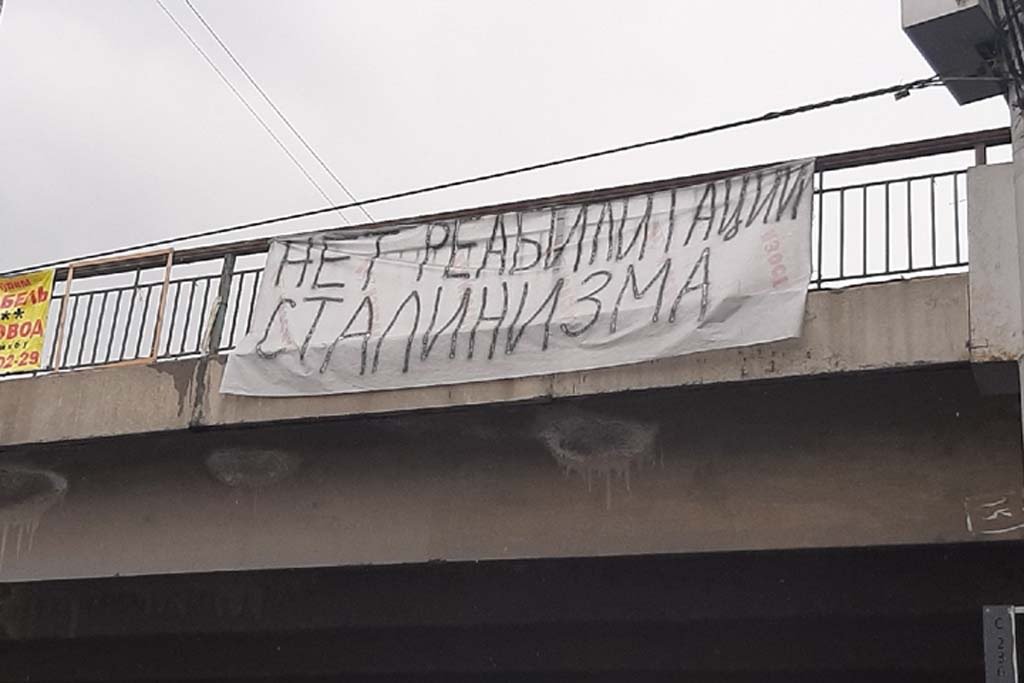
The banner "There is no rehabilitation of Stalinism" , hanged by unknown in the center of Novosibirsk, sagged, write, very few. So much time to become a reason for another news in news feeds. But not so long that many townspeople have time to notice him and that he calls them some kind of reaction.
And what could their reaction be? That all this is old as the world? Such a banner theoretically could have tied some dissidents half a century ago.
The fight against the rehabilitation of Stalinism in the Soviet Union began no later than the first years of Brezhnev's reign. In February 1966 , a “letter of twenty -five” prominent figures of science and art against the rehabilitation of Stalin and Stalinism appeared. "Recently, in some performances and articles in our press there have been trends aimed, in fact, to partial or indirect rehabilitation of Stalin," the authors wrote. At that time, the teninization, begun by the XX Congress, was replaced by restalinization ... And so these two mutually complementing processes continue to this day. Some put the bust of Stalin in the backyard of their organization (as the Novosibirsk Communist Party put a bust of Stalin two months ago), others commit an act of political protest, mastering a banner with a protest against the rehabilitation of Stalinism, and hang it in the middle of the city, and clearly risking immediately to be in the FSB field.
Is it not surprising that even in 2019 such a banner generally occurs to someone to do it and then hang on public display? That is that the words "no rehabilitation of Stalinism" are still an actual protest statement. It would seem, how much you can argue about Stalinism! Isn't it time to discuss the not the past, but the future? Or argue about some real city, regional problems today? Discuss something landed: what is happening on the roads, in medicine, in schools? But no, we continue to argue about the past. What should have ended, continues and continues. It turns out that these disputes are endless. And this is bad news: we cannot get out not just from our own past, but even from endless disputes about it.
When society becomes a space where authoritarianism is asserted, those who are ready to resist this authoritarianism come to the forefront.
At the same time, it is interesting that in the very slogan “there is no rehabilitation of Stalinism”, it would seem, nothing anti -government or even more extremist. Moreover, protests against the rehabilitation of Stalinism seem to not at all contradict the official ideology of the Russian state. Repressions have long been officially convicted. The cult of the personality of Stalin was debunked even earlier. Only the other day in Sergiev Posad Patriarch Kirill personally, de facto, one of the highest government officials, participated in the opening ceremony of the monument dedicated to the priest and philosopher Pavel Florensky, one of the most famous victims of the Stalinist terror. Yes, and Putin himself periodically says the right words about repressions. But why does this slogan "There is no rehabilitation of Stalinism" still read as a protest? Because we all know that the desire for the rehabilitation of Stalinism (non -postalinism) quite exists among the current Russian government and in the current Russian society, that the scandalous Novosibirsk bust of Stalin is only one of many of such the latest monuments in Russia that this is not a Russian state is quite encouraged by the Russian state ... And unknown people are simply reminded of this, “in the forehead”.
This and other recent banners , probably made by those (and) the author (Ami), is the same work of activist art as a political statement. It is effective not only as a political call for the Novosibirsk residents, and quite clear: do not forget that there is rehabilitation of Stalinism and it can be (and necessary) to confront! It is important how it is made: not printed with a clear print in the printing house, not posted on the wall somewhere where the meeting of the political party or public organization takes place. A white sheet with brittle letters, which, as it were, repeat the movement of a trembling from the excitement of the human hand, is flat on the hard concrete parapet-where the eye expects to see an advertisement with a vigorous call to buy something, and not that. That is, the point is not what is said, but how this is said. A homemade poster with letters made by hand, hung in a public place where the placement of political slogans is not accepted, is read precisely as a protest political statement. It is because of their inappropriateness and human fragility that such calls receive the power of influence. Therefore, someone immediately breaks them: if they were inactive, powerless, they would hang, without bothering anyone. And this is the artistic work of critical contemporary art.
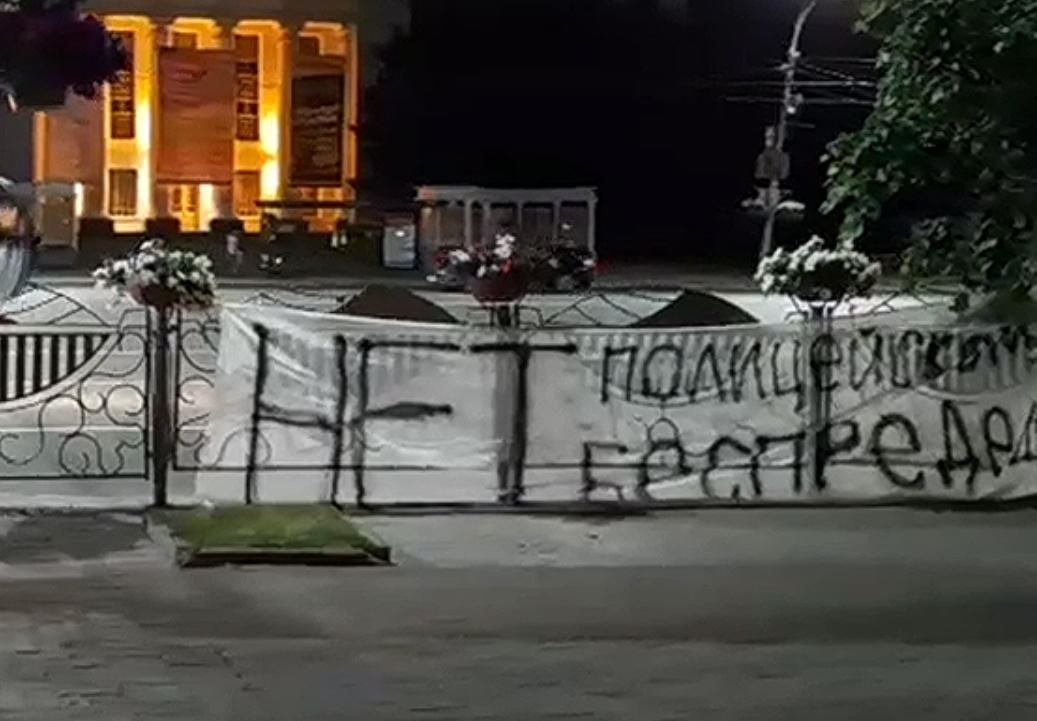
In the end, what do we see? In Novosibirsk, there are some kind of "cultural partisans." They make and place banners with protest slogans in different places of the city, attacking the dominant ideology. And perhaps this is good news.
In Russia, less and less becomes those that can be discussed directly, without hints, clever irony and the like. We all know how to say something, albeit apparent banality, so as to avoid a response, to get ourselves out of a response, because "well, you never know what." And at the same time, the opportunity to talk about what they are not talking about openly, opens in art. But how not to say that "is actually"? .. For this there is art.
Russia is becoming more authoritarian and similar to itself as it usually happens between rare "thaws". And in the oldest times we already know that these are excellent conditions for the emergence of new political art. And these black slogans on the fence of the highway are precisely it is.
When society becomes a space where authoritarianism is asserted, those who are ready to resist this authoritarianism come to the forefront with aesthetic means. Even with such improvised means, reminding him that the rehabilitation of Stalinism still needs to be said “no”.
Mikhail Germans - philosopher
The "Opinion" expressed in the heading of the point of view may not coincide with the position of the editorial office