
Translated material
Requiem given to us in sensations
Romeo Castelcucci staged his first performance at the Opera Art festival in ex-en-production. This is quite strange when you take into account the attention of the festival to smart and inconsistent opera directing. But, probably, it was necessary to wait for the project to form a requiem Mozart to form so that this debut could be so logical and important.
Dick in the genealogy of projects, which are just as radically as this requiem, diverge from ordinary opera practice, is a special pleasure. And it, in general, is not so esoteric. Put a sacred work on the stage, and even such a hit, and even for a rushing public healing in the sun, the solution is at least non -banal. But the festival in the ex-en-provence is still an exquisite tourism, and its management is surprisingly surprised by the strength of the nerves during programming.
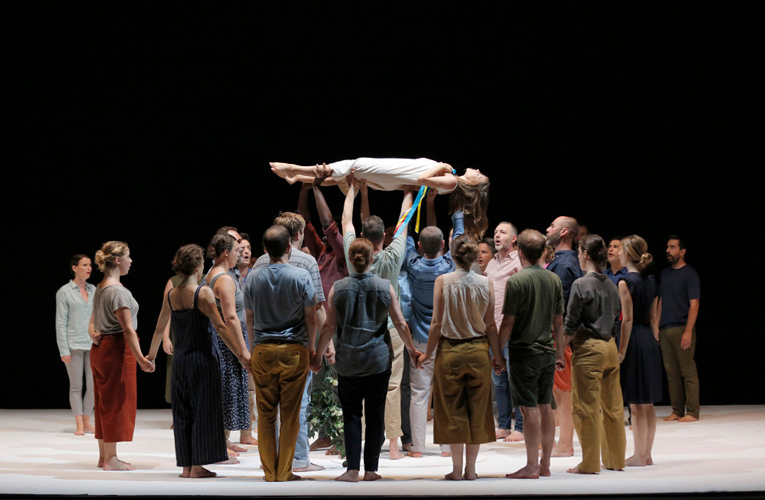
Castelpelli staged a performance about the cycles of life - whether human, natural; About constant dying as a process of rebirth and revival. It begins with a dumb scene when an old woman in her bed passes into another world - both the delicacy and tenderness with which the director comes to this cruel moment remain exemplary. And ends with a lonely half -year -old baby on an empty stage - with the whole spectrum of emotions, from tenderness to horror.
 © Pascal Victor / Artcompress
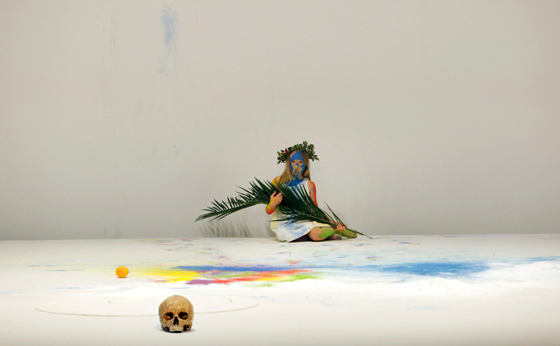
The performance develops as a series of paintings, continuing the license plate of the Mozart score. In it, a visual series is important in it, where the picturesque use of color shakes cyclic transitions between darkness and light. Beauty for Castelpucci is closely connected with death - it becomes beauty precisely because it is finite, and it is at the moment when it dies. And it is the beauty that connects - but does not allow - the tension between the eternal and the infinite, which Castelpucci is engaged in this production.
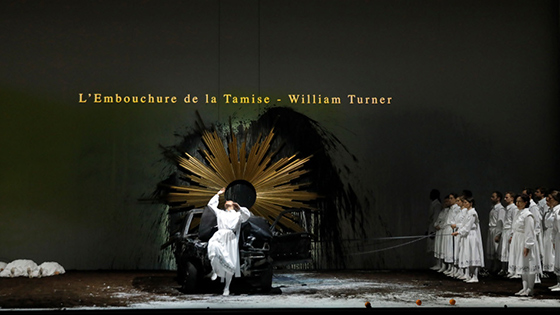
This is a requiem in great losses - in nature, in the animal world, in architecture, in literature, in thought and even ethics. The names of the loss of memorial lines light up on the backdrop, composing at the beginning the “atlas of great losses” - a kind of encyclopedia or an archive, whose deliberate selectivity eliminates ethical dogmatism. These outbreaks of the bygone names structure the performance as a metronome, becoming closer to us in time and more and more abstract in content, catching up and covering the viewer, approaching his life, to his skin. Kastelpellchi, however, is accurate with the words - his atlas does not become a memorial board and, by oblivion. He lists the “ extinction ” , which continue to live in our memory - whether it is Christianity, hunger, even the Alexandrian library. The Atlas breaks off on the date of the performance, leaving the trace of the list of extinction, which will continue the next day with the following losses. And leaving hope for a continuation of life.
 © Pascal Victor / Artcompress
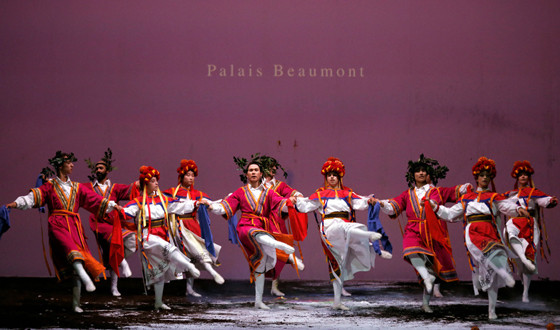
Castelpelli turned the Mass of the Dead into a feast of the Renaissance, where the limb of the existence of man and culture ceases to be a tragedy and becomes the occasion for the holiday. In the visual and conceptual rows, ritual and folklore elements are used, which are set by the cyclic time that overcome the eschatological consciousness that celebrate death. They remain recognizable and abstract at the same time and at the same time - emphasized modern. Costumes, then colored, then colorless, refer to something Balkan; A dance with a rather conditional national binding preserves chaos and risk that provide the charm of any dance; The victim is either Christian, or pagan, and it becomes a scapegoat - in soot, honey, feathers, bright colors, skin and horns.
Allusions can be naive or sentimental - women, children, bright colors, clumsy chorists. But this naivety is not, no, and it turns into a rough power of primitive art, leaving the director dependent on what cannot be controlled. At the play where I ended up, the baby cried in the finale all the time, which is why the final message was rather about something irrevocable and catastrophic.
 © Pascal Victor / Artcompress
The co -author of the Requiem was the artistic director of the ensemble and choir Pygmalion Rafael Pishon, who included several additional musical episodes in the performance. Its installation connected the canonical score of Mozart (completed by Zyusmeer) with ancient Gregorian chorals, warm -up vocalizations and the composer’s incidental music, including recently discovered several tacts. Fulfillment on historical instruments lost its ringing virtuosity, but emphasized the introvert, human dimension of music. It is important to Pishon that the composer's religiosity passed through the Masonic and Enlightenment filter and was enriched with humanistic, fraternal content. The installation strategy here seems more consistent and stronger than earlier in his own “ Trauernacht ” (a play on Bach’s music in directing Katie Mitchell 2014, which touched in Moscow ).
The central participant of the Requiem is the Pygmalion choir: Dancer, in sweat, in the ground and the end completely naked. Its vocal and bodily execution overcomes any ideas about the artistic capabilities of the choir, surprises the accuracy of phrasing and some kind of intuitive synchronism. The super-professionalism of the choir and soloists (Soprano Shivon Stagg, Mezzo-Soprano Sarah Minhardo, tenor Martin Mitterrutzer and Bas Luke Tittoto) is supplemented by solo vocals of the seven-year-old Shadi Lazrek, whose beautiful but not-set voice emphasizes the natural and literal in the performance.
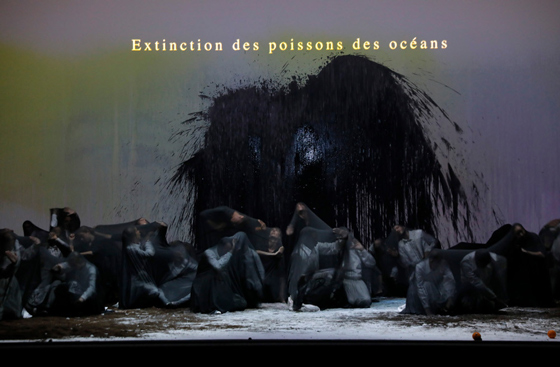 © Pascal Victor / Artcompress
The performance of Castelpelucci and Pishon, of course, does not offer any finished story, usually declared condition sine qua non in the opera. The cyclic time that interests the directors cancels the linear narrative. As well as the figure of an author-story, omnipotent and totalitarian. The authors offer an act of total freedom, in which the viewer can calmly form his own associative series, not worrying that the picture is complete and consistent. At the same time, it is important for them that this experience takes place in a situation of the end of Christianity, the end of the history and the end of the fundamental cycle. The authors find a resonance with the incompleteness of the musical text of the Mozart Requiem - constantly maintaining the tension between the limb and eternity.
The associative series of images and ideas proposed by the authors is not required to understand the performance. But he is accurate from the point of view of the scenic embodiment of the circle of ideas and the experience of perceiving the score of Mozart. In addition, Castelpelli -Pishon’s production leaves a place for literal existence on the stage, which provokes trust in it - as a fact of the own experience of each viewer. And leaves a trace in the mind of intersecting and scattering meanings - like Pollokov’s abstractions formed from the ground, clothes and colors on the floor after the performance and flowing in the final with a vertically raised scene tablet.
Subscribe to the COLTA.RU channel in Yandex.Zen to miss nothing