
Translated material
In the afternoon with fire

Why is it still so difficult to get competent psychological assistance in the regions?
I am 15. I have a nervous breakdown and a disorder of food behavior begins. I do not eat a week and get to the psychologist. He tells me that the connection of my feminine nature with cosmic energy is not strong enough. I do not return to the next reception.
I am 21 years old. My bulimia is six years old. I start a new relationship and first tell a partner about her. He insists that I turn to a psychologist. I am going with strength for two months: I'm scared. I come to a therapist. He says: I am a balm on socionics, I have a moon in a body and I need to do exercises for a female - taking - breathing. I go out into the street, sit in a snowdrift and cry.
A month later, I move to heavy artillery - to an appointment with a psychiatrist. They busily inspect my hands, ask if I take drugs, weigh it. BMI is normal - there is no evidence for treatment.
Now everything is fine with me: after a few months I turned to a good psychiatrist, I received drug treatment. I never found a psychotherapist, I did it on my own with the help of a partner. I managed to get rid of bulimia, but I still live with dysmorphia .
How to trust him
Over the past few years, the conversation about mental disorders and mental health has become more open. To say that depression, disorders of food behavior, neurosis and other deviations are simply laziness and weakness, is already simply inappropriate. At least it may seem if you are in the information space of progressive Internet publications and blogs. And beyond - a huge Russia.
“I live in a small city in the south of Russia. There you go to a psychologist, choosing it according to, for example, a description on the site or in the direction of the center in which it is listed. You go and do not suspect anything. And then this psychologist turns out to be a relative of a friend, familiar to a colleague who was your former. And this destroys all therapy, all trust. ”
“I'm from Kirov. When she studied at school, my close relative had a chance to work with a psychotherapist woman. When she found out in which school I am studying, a stream of information about her customers who studied at my school flew to my relative.
For example, who slept with whom. She said about my classmate that she was worried about why her boyfriend did not have a member at a young age, she said about the guy from the parallel that he was extremely upset by his abundant sweating. How to trust psychotherapists after that? "
In a small city, where each someone is a kum, a matchmaker and brother, the problem of a lack of specialists and distrust of psychology as a sphere begins with a simple fear of publicity. Distrust destroys the very structure of work.
Who is a psychologist
The roles of psychologists and psychiatrists themselves, the questions with which they come to them, and the problems that they solve are incomprehensible. Who is this a psychologist? Adult teacher? Something like an Aychar in the workplace? Entertainment for wealthy people who come up with problems for themselves and "be furious with fat"? After all, "normal, ordinary people do not have neurosis and depression." Well, sometimes difficult. Sometimes sad. But if it is good to sit with friends for beer - will it not solve all the problems?
“Until last year, I thought that a psychologist is such an additional pressure lever on you. There is a mother who wants you to study well, she leads you to a psychologist who also tells you to study well and does not accept drugs. And then the same psychologist at the workplace tells you that you work well and be friends with colleagues. ”
“My parents and I, from all, from friends and even other relatives, hid that I went to a psychologist. Because: "Is she, psycho? Sick?" - Such a reaction. The situation has not yet changed, the words “psychologist” shy in the city. ”
The biased attitude and stereotypes greatly inhibit the development of the sphere. There is no competition without development, without competition - quality growth. Becoming a psychologist in the region is not the most profitable prospect. The demand is low, the standards are not clear, and the market fills self -taught, esotericists, charlatans and gate adherents.
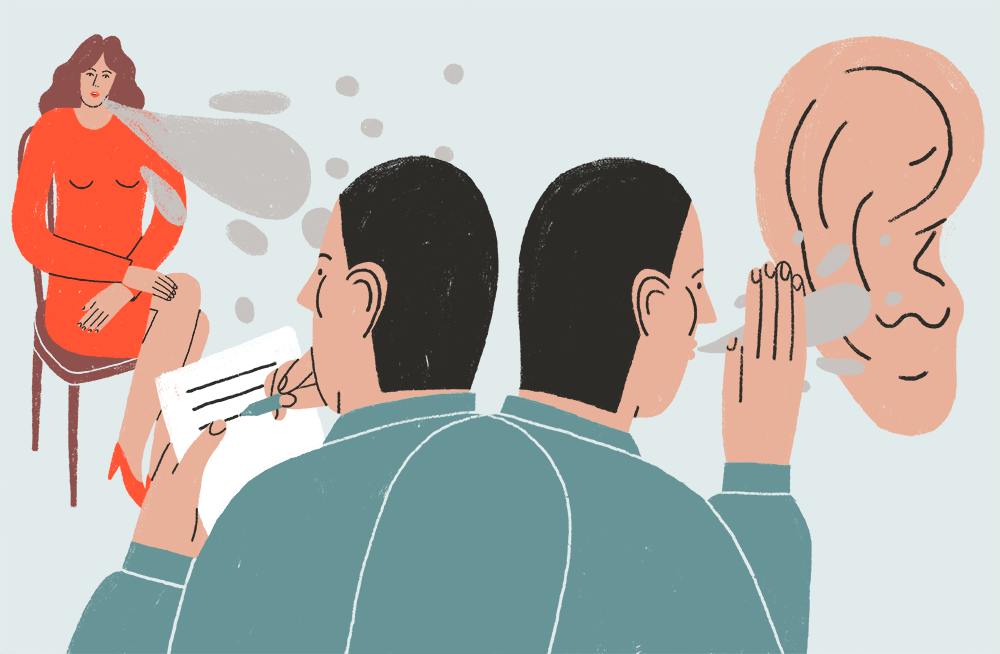 Illustration: Ksenia Stolik for TD
"Lesosibirsk. The first session. She came to a psychologist with dentophobia. I asked a lot of personal questions, such as I have a partner, if I have a complete family. In the second session, he proposed hypnosis and fortune -telling on the runes, I escaped. Then he called me a couple of weeks, called either to sessions or in a cafe. Once I caught at the stop, I threatened him with the police. He lagged behind, but finally quit that I need to clean the energy, otherwise it is packed with the Jews. ”
“I went to three psychotherapists, and two of the three I had to explain what a disorder of food behavior is and what is not, it’s not“ if you don’t weigh 40 kilograms, then you have nothing ”.”
What is psychotherapy
Diana Sakharova, Clinical Psychologist:
“Unfortunately, in Russia, psychologists do not undergo any licensing. Abroad, the concept of “psychotherapist” is very specific: a person has a medical education, has undergone training in the direction of psychotherapy and has the right to conduct psychological practice and prescribe drugs. A psychologist is primarily scientific activity, research.
In Russia, a psychologist is the one who advises. A psychotherapist is one who received a higher medical education and specialized training in psychotherapy. A psychiatrist - treats mainly drugs. The problem begins when a person graduates from the faculty of psychology, receives the right to advise, then specializes, for example, in gestalt therapy and is called a psychotherapist.
Read also Chronicle of one insanity as weight loss destroyed my world
Therapy is about treatment, not about counseling. This is a discrepancy in terms that makes a huge confusion. In fact, anyone can call himself a psychotherapist in Russia.
We need licensing. This will streamline the work and create an institution of control. Because a license, for example, can be withdrawn in case of incompetence. But now in Russia there are actually no methods of pressure on psychologists, they cannot be convicted of incompetence differently than writing a review on the Internet.
Why does such a difficult situation develop in the regions? The difficulty is that the higher psychological education is purely theoretical and with this theory it is impossible to start clinical practice. A long specialization is needed in the framework of separate approaches. And such special training is only in large cities: in Moscow, in St. Petersburg, in Kazan. And it is expensive.
Here the person graduated from a psychiatric facility and plans to specialize, say, in psychoanalysis. In this case, he needs to spend at least 120 thousand rubles in St. Petersburg. In a good way-to slide into courses in Europe. Few people have such opportunities in regional salaries.
A good specialist - really good, who spent time and money on his qualifications - is hard to sit in a small city with an average salary of 17 thousand rubles. "
Who goes to the psychiatrist
In the regions there is an opinion that psychiatrists are for real psychos. Addicts and schizi with hallucinations and a complete set of asocial qualities. They have marks in personal affairs, they are not hired, and if you get into psychiatry, then you will burn.
“I went out after the treatment of severe depression and learned so much new to myself: that I was an alcoholic and my husband forcibly put me in a psychiatric hospital. Relatives at least were aware of the situation, but even my mother said with resentment in her voice: “Why go there, it would be better if she came to us, rested.” And you won’t explain to them that when you can’t get out of the bed, there is no strength even to cry, it will not help you “rest”! ”
“I'm from Tula. From adolescence, periods of mania and depression, diagnosed with bipolar disorder, the doctor in a large paid medical center persuaded to give birth as soon as possible, because this is exactly what will save me and this is the birth of a child - the final goal of therapy. ”
“Yaroslavl. Lucky to lie down in the city hospital. They tie rags to the bed and glorify so that you cannot say. Then, like a vegetable, on tablets, nothing is already needed, you just go along the corridor at the allowed time. Shower once a week. Consent to hospitalization was given to be signed only after 2.5 months in the hospital. There was a healthy woman with me in the ward, whom my husband put in the hospital to sue two children. It's dumb that you can be in such a situation. ”
Daria Marchenko, psychiatrist:
“There is an opinion that regional psychiatry is imprisoned on a narrow spectrum: primarily on narcology, there are not enough diseases from the spectrum of“ large ”psychiatry and doctors of various specializations. So, there are no “sharpeners”, but there is a problem with the bets of psychotherapists, neuropsychologists and clinical psychologists in state institutions, with specialists of other areas in psychiatric and narcological hospitals - the complexity of examination and assistance in stationary treatment is growing from this. And yes - optimization and reduction of beds in the department of neurosis.
The patient’s path most often begins with the fact that someone notices that something is wrong with you. Or you yourself, after an analysis of the situation, understand that you can’t cope with her alone. Next is a search for solution options: it happens in every way, from gatherings with a friend heart to self-medication.
After they go either to psychologists, or to teachers, or to neurologists: there is an interesting analogy: “I have a nerves surrender - and I will go to a neurologist, but I don’t need a psychiatrist, and I don’t need a psychiatrist”, and only when all this does not help us.
If the situation requires immediate treatment (what is called “dangerous for yourself or for others”), then this is a hospital. If it requires treatment, then this is treatment. If it requires an examination to exclude physical pathologies, then this is an examination. Or psychotherapy.
A psychiatrist is not a psychotherapist. Someone can independently conduct psychotherapy sessions, if there is a qualification. Someone directs to a therapist. But then the problem arises: we direct to those whom we trust. But this does not mean that the patient will have 100 percent work with this specialist.
For a psychiatrist, and for any doctor, the first and most valuable is a desire to help. If it is, then the doctor will spend time and raise the literature, and he will turn to colleagues with the uncertainty of the situation, and he will call for repeated reception. There are standards for the provision of medical care, we may not agree with them, but we must fulfill them. I cannot be responsible for the actions of other doctors or say that you need to act according to a certain scenario. But the fact that no standards will help without a desire to help is the main thing. ”
 Illustration: Ksenia Stolik for TD
Invisible people
A separate difficulty in finding psychological assistance in LGBT+ people. LGBT+ adolescents is one of the most vulnerable groups, and it is incredibly difficult to find a specialist ready and, most importantly, capable of working with them. The general low level of competencies is multiplied by homophobia, and we will receive a denial of orientation, the desire to “fix the patient”, and in the worst case, forced auto to parents.
Vyacheslav Slyusarev, civil activist and member of the Russian LGBT network:
“LGBT Pan is difficult to look for a psychologist. Over the past two years, several people have addressed various psychologists/psychotherapists in different state institutions of our city, the result is almost always the same - obvious neglect, manifestation of sexism, homophobia, dubious advice and comments, assessments beyond the acceptable.
There is a fear of output. It is inherent in adolescents, only aware of their sexuality, family LGBT paramas, especially with children, since the danger is added to the usual fear that they will take away children and recognize at work. Probably, something similar is present in LGBT people living with HIV.
Read also The refusal of Hippocrates transgender people who decided to make the transition are very vulnerable. It is especially difficult to hide the inconsistency of gender identity and biological sex at a doctor's appointment
At the moment, based on the cases that LGBT Persons speak of, the main problem is incompetent: from the banal ignorance of the subject ( beams , gender dysphoria and so on) to the use of dubious practices (socionics, horoscopes and the like). For the sake of PR, some psychologists publicly say that they can cure the client from homosexuality, and even talk about successful cases. The most template situation: "You just had a man/girlfriend of normal."
We have long been thinking about compiling a base of friendly experts (including a medical profile), as well as still reflect on the criteria for evaluating the work of such specialists. In fact, there are a lot of specialists, even in Syktyvkar, but a really good specialist raises the price tag. More affordable, working in state institutions, do not always respond to what LGBT client tells them, often in age and have more traditional ideas about psychology.
For decades, a situation has developed in which LGBT people were afraid to treat their psychological problems due to fear of disclosure, punishment, and reprimand. It is not surprising that they come across “therapists” who never worked with LGBT and did not even meet the “living” gay/lesbian and the like.
This situation is already correcting LGBT activists and organizations-conducting, for example, trainings, seminars, lectures for helping specialists, doctors, teachers, trade union workers, journalists and so on. This increases the visibility of LGBT in society. ”
medical care psychology Russia