
Translated material
75th anniversary of the Warsaw Uprising: Stalin did not help the Poles, because the uprising was politically directed against CCCR
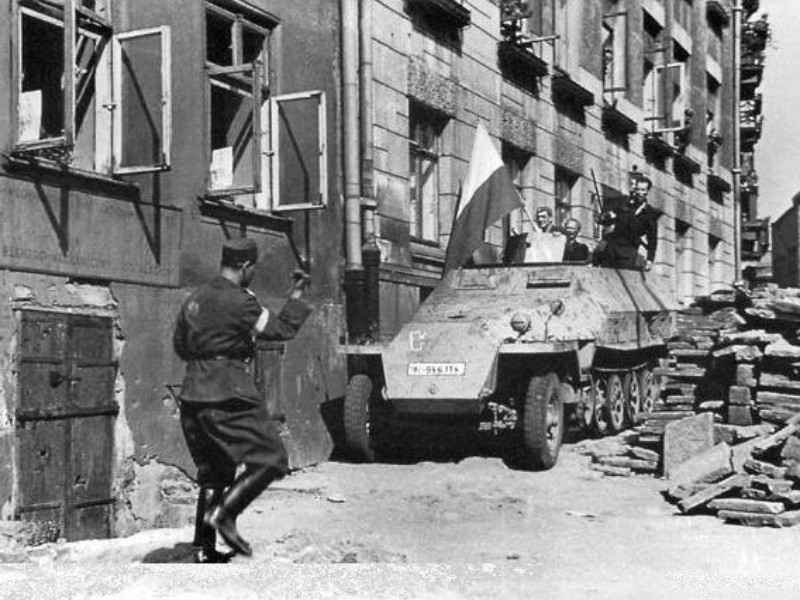
On Thursday, August 1, commemorative events are held in the capital of Poland dedicated to the 75th anniversary of the Warsaw uprising - one of the central events of the Second World War for the Poles. In different areas of the city, worships, concerts, exhibitions, meetings with veterans are organized, TASS reports.
In the morning, the color laying ceremony was held at the memorial plate on the building near the filter street, where an order was signed on the beginning of the uprising. During the day, such shares are held in different places of the city related to the history of those warships.
According to tradition, in order to honor the memory of the dead, at exactly 17:00 local time (18:00 in Moscow) - the so -called hour “in” (W), when the uprising began - in the capital of Poland and other cities of the Mazovets Voivodeship of the republic, a siren will be heard, in the churches they will clog in bells and a minute of silence will reign.
The Warsaw uprising began on August 1, 1944 and was suppressed by the Nazis on October 2. During the fighting, the Nazis completely destroyed the Polish capital and destroyed about 200 thousand inhabitants of the city.
Historians diverge in the assessments of this event in the history of World War II. The uprising in Warsaw from a military -strategic point of view was directed against the "Third Reich", but politically - against the USSR, writes Deutsche Welle .
The Wehrmacht retreated, the Red Army advanced further west. The outcome of the war was a foregone conclusion. It was clear that the Armed Forces of the Soviet Union would receive the entire territory of Poland under their control. The Poles, who did not experience special sympathy for the USSR, decided to take the initiative into their own hands in order to free themselves from German invaders. And at 17 o’clock on August 1, an armed uprising began in Warsaw.
Neither the Soviet side, nor the UK, nor the United States provided significant support to the rebels. The Warsaw uprising ended on October 2, 1944 by the surrender of the Polish side. In the course of actions aimed at suppressing the uprising, the Germans actually equalized the most beautiful city in Europe with the land: about 85 percent of the buildings were destroyed, from 150 to 200 thousand inhabitants of the city were destroyed.
In the historiography of the USSR and the Polish People’s Republic, all responsibility for defeat was assigned to the emigrant government and the command of the Kraiova army, striving to seize power before the arrival of the Red Army. In turn, Western historians accused the Soviet command of intentionally evading helping the Poles, but Soviet historians objected, referring to the fact that due to objective circumstances the provision of assistance was impossible.
According to the Doctor of Historical Sciences, a teacher at the University of Bonn, Ekaterina Mahotina, "the decision on the beginning of the uprising was made very quickly - as soon as the Red Army occupied Prague, one of the districts of Warsaw. The conflict between the Polish government in exile and Moscow was long -standing, and after the mass burials of Polish citizens in the Katyn forests were found in 1943, and the alliance came to an end. The offensive of the Red Army, the creation of the Polish Committee of National Liberation (Lublin Committee), whose members should, in agreement with Moscow, become the basis of the post -war leadership in Poland - all this led to the decision on the beginning of the uprising. "
According to her, "the rebels capitulated not only because they were not assisted. There were many reasons: the incredible cruelty with which the Nazis with the residents of Warsaw, poorly developed communication and insufficient coordination of the actions of the rebels, the lack of combat equipment and shells, were dealt with, and, of course, the non -ordering of assistance from the outside. Stalin forbade American planes occupied by Soviet troops. Only on September 10 The Soviet leadership began to provide assistance and allowed the allies to supply the rebels from the air.
Doctor of Historical Sciences, Chairman of the Management Board of the Ettersberg Foundation, Professor of Joorg Hanzensmun, a professor at the University of Yena, notes that “traditionally there are two versions of those events: the first is especially popular in Poland - according to her, according to her helping the rebels was a conscious political decision of the Soviet leadership, which allowed Stalin to weaken the positions of his political competitors in Poland. The second version was established in the Soviet Union And today, according to it, according to it, the forces and communication of the Red Army, which came close to Warsaw, were too dispersed, and therefore it was not possible to quickly make up for losses in military equipment and in personnel, that is, there were objective military -strategic reasons why the Red Army could not help the rebellious ones.
“Two different versions of those events appeared already in the mid-1940s. And since then nothing has changed. Although, of course, one should not forget that in Poland actually until the mid-1980s or even until the early 1990s it was impossible to talk about the uprising as the heroic page of Polish history,” says Professor Hanzenmunaller.
In turn, Ekaterina Mahotina draws attention to the fact that "the Warsaw uprising has always been used by politicians. In one version - to sacred the nation, in another - to strengthen communist ideology. And so on."
Today, the anti-communist nature of the uprising continues to be the base, on which the national-conservative political establishment is based. And in Russia, the contribution of the Red Army to the liberation of Europe (and, in particular, Poland) is the basic element of the official memory culture, Deutsche Welle notes.