Date
Author
Source

Preserved copy
Translated material
Headquarters on the straps
Documents of pro -government candidates for the Moscow City Duma and their rivals from among the system opposition were prepared by one team of specialists. Investigation of "New"

Studying workshops for the manufacture of fake dissertations, you sometimes encounter a phenomenon such as the "stigma of the Stradivarius." The nameless author, who was beeing the dissertation on order, left a characteristic delusional phrase in all “scientific works” that came out of his pen. This allows you to identify completely different “respected people” as customers of the same factory.
Analyzing the elections of past years, you come across a “stigma of Stradirius” of a different kind: in completely different sections, suddenly the same percentage of the party is suddenly observed in many, with the accuracy of hundredths or thousandths, as it was, for example, in 2016 in the elections to the State Duma. Such numbers can only be drawn, they could not arise by themselves.
Something similar happened during the nomination to the Moscow City Duma with the "hotelines" and some "opposition" candidates. “The Odiedwaners” dubbed those candidates who allegedly nominated themselves, but in reality everyone knows that these are candidates from the United Russia team, often having its party card. It turned out, however, that the “midwives” and their competitors, who were still not associated with “EP”, as well as representatives of the “Communists of Russia”, used the same “factory of candidates”. They were given out numbers and letters.
The financial reports of the candidates have demonstrated coincidences that cannot be explained by nothing but the centralized manufacture of these documents.
Financial reports like evidence
The candidate’s election account is the most important element of the campaign. The manufacture of materials and signature sheets is paid from it, it is calculated from it with signatures and agitators collectors. During the election campaign, candidates twice report on the expenditure of funds, first handing over an intermediate, and then a final report. Since the beginning of July, the Mosgorisbirk publishes the first (intermediate) financial reports of candidates for deputies of the Moscow City Duma, submitted along with a package of registration documents.
As of July 27, S.G. On the website of the Moscow City War Committee, intermediate financial reports of 284 candidates for deputies of the Moscow City Duma were published. 282 of them submitted documents for registration. Since the total documents for registration to the district election commissions submitted 290 candidates, we have financial reports of almost everyone who attempted to register.
In addition to the data on the finances of candidates, these documents contain other interesting information. In particular, by comparing their design, you can find non -obvious connections between candidates.
Power and its candidates
Elections to the Moscow City Duma have been distinguished by increased “handling” for many years - although the forms of this controllability are different. In 2004, for example, in the elections he triumphantly won the Luzhkov List, which was then popular then, which included representatives of different parties, from United Russia to Yabloko. In 2009, the elections were held with mass falsifications - the number of votes thrown out was estimated at about 600 thousand. Before the elections in the Moscow State Duma in 2014, the federal legislation was made a collection of 3% of the signatures of the district voters for self -nominated and candidates from most parties (in Moscow, only parliamentary parties - “United Russia”, the Communist Party, the LDPR and the Fair Russia) are responsible in Moscow. In combination with the new election system (45 single -mandate districts), this made it possible to cut off the majority of candidates independent from the City Hall and hold elections without falsifications, but with a minimum turnout (less than 21%). In these conditions, there were enough votes of the controlled electorate - pensioners and state employees to win the necessary candidates.
However, in the current elected cycle, the same subscription barrier unexpectedly became an obstacle to the authorities. As shown by the Governor's elections last year, to nominate from United Russia (which would free from the collection of signatures) is fraught with defeat, so that the candidates supported by the mayor, both the current deputies of the MGD and beginners, were forced to at least portray the collection of voter signatures.
The approximate list of "Odudnesterns" was published in the media back in March and since then has changed little. It contains 42 candidates - 16 current deputies of the MGD, several heads of Moscow budgetary institutions, businessmen, several journalists and university leaders, as well as two candidates from the System Opposition - Ilya Sviridov, who was running for the Moscow CPS in 2018, and Maxim Shinggarkin, nominated by the Rodina. Each "Odiedwan" is allocated by a separate district. Four districts were reserved for the agreed candidates of the Communist Party - Vadim Kumin, Leonid Zyuganov, Nikolai Gubenko and Nikolai Zubrilin. True, the deputy of the MGD Zubrilin, who in 2014 won his mandate unplannedly, defeating the Yablonnik Andrei Babushkin, laid the “gift” - Evgenia Nifantiev, the General Director of the Capital Pharmacy network, who hardly went to the elections without coordination with the mayor. We will also consider it on a par with the "experts."
No DOC, only PDF
The form of the financial report of candidates for deputies of the MGD was submitted by the Moscow City Electoral Commission as part of the decision of the Moscow City Warrics No. 92/7 of May 23, 2019, published on the MGIK website in the form of a PDF file. The date and number of the solution in the cap of the form were inscribed by hand. The Wordeen version of the report of the MGIK did not distribute. Since the unrecognized (“picture”) PDF format is inconvenient for editing and filling out on the computer, most of the candidates preferred to create a report on the published sample in the edited computer format. A careful consideration of the published reports of the candidates shows, however, that the options for forms used are significantly less than candidates, and many candidates use the same report templates.
Help "New"
"Caps" - visimi
It would seem that the form of the report is clearly defined by law, and there can be many variations in it, especially in the scale of one page. But everyone who attributed to school knows that even by solving the problem in 3-4 lines, the teacher will find out who is written off. In the case of the templates, the following elements of the analysis were distinguished by us:
"Cap". She could be present or absent. All details of the decision of the MGIK could be spelled out in it, but could be completely or partially absent. The “hat” itself could be formatted in the center or on both sides, the number of lines in it could correspond to the original or differ from it. The “hat” could be scored by one kagl less than the main text (so in the sample) or two kagg.
Title "First Financial Report". In the sample, instead of the word “first” - a feature, under it - an adherent explanation in brackets - “first, final, consolidated information”. It is assumed that you need to enter the form of a report. This can be done with different fonts (fatty or low -fat), capital or lowercase letters, completely or partially leaving or losing the line and/or explanation under it. Since not all financial deputies know how to drive outline explanations, many headquarters, reproducing this element of the sample, demolished the explanation to the whole line down. Some even threw an uncomfortable piece (and in fact an unnecessary, who came to the paperwork from the pre -computer era).
Lines "FULL" and account number-in them, too, you can do everything differently. You can write tuning explanations, you can not write. You can enter the data with the usual eighth kegle, can be larger. The account can be written with all the details, or - according to the model (that is, only the number). The lines on which the name and the score are located can, as in the sample, start from the common field, or can - for several characters to the right.
Finally, the table itself. It is very difficult in it, independently stuffing its elements, get the same width of the columns.
The first pages of financial reports of 284 candidates were extracted from the published MGIK PDF reports (most of the report consists of two pages). Then these pages were divided into groups in used forms by computer comparison of images, followed by manual check. As a result, 23 reports of reports covering 231 document were identified, and another 53 reports were left outside the classification. Some of the templates have an explained origin (parties headquarters) and the scope (candidates from the relevant parties), while others demonstrate less obvious connections. The table contains identified templates indicating the area of their use and characteristic features. For convenience, the templates are given the name - by the names of their parties or the names of noticeable candidates.
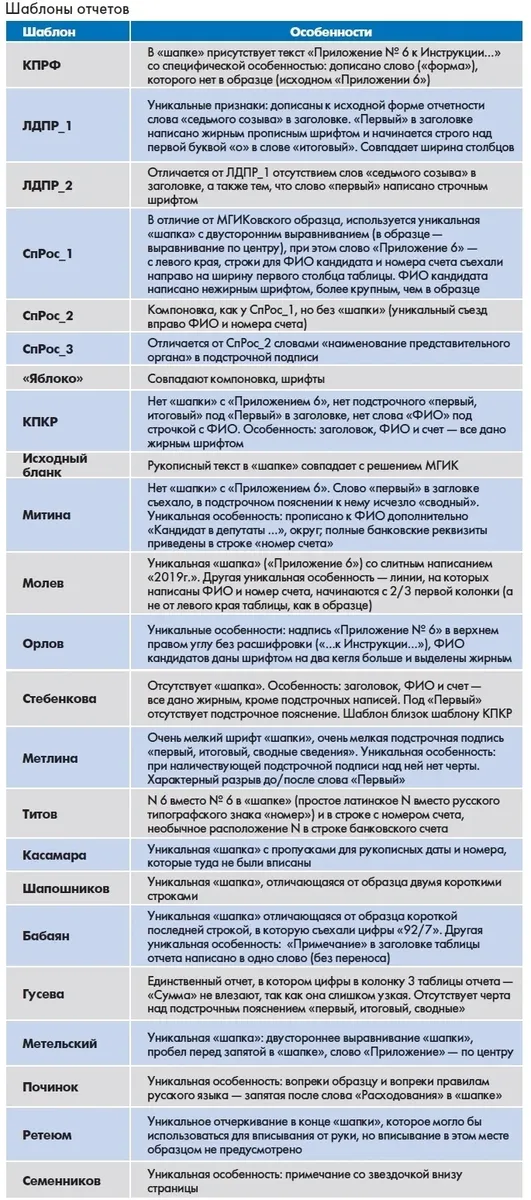
The Communist Party of the Communist Party was used by 37 party members (almost all, except a few eminent party members) - and only they. The LDPR has two templates that differ in small details, with both (especially the second), not only members of the LDPR used, but also several self -nominates and representatives of other parties. Members of Fair Russia used three templates. The Yabloko template was used by five candidates nominated by the party and the “communist of Russia” Olga Zhagina suddenly joined them. The Party of the Communists of Russia (KPKR), which successfully registered by signatures 32 candidates of 34, did not actually have its own template - only two party representatives used a template that did not occur among representatives of other political forces. A few more inconspicuous candidates used the original form from the decision of the MGIK, apparently simply printing it on paper and filling it with hand. We emphasize that the listed use of templates is absolutely normal: the parties provide the campaigns of their candidates.
What is in common with the former journalist Lesya Ryabtseva and head physician Olga Sharapova?
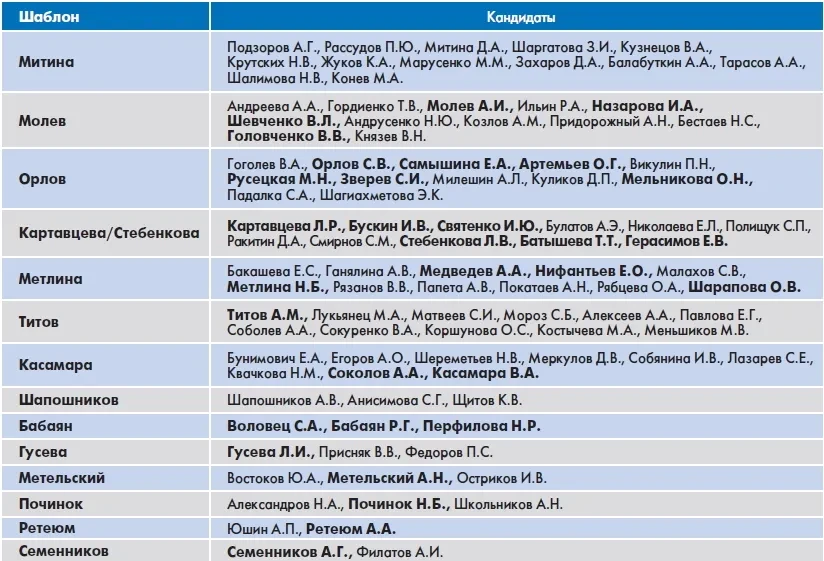
The “horizontal” templates uniting candidates on less obvious signs are more interesting. For example, the Mitina template, in addition to the CPC, Daria Mitina, took advantage of five more representatives of the “Communists of Russia”, as well as seven self-nominates, including the famous politician Zoya Shargatov, self-nominates Marya Marusenko and Mikhail Konev (rival Ilya Yashin in the 45th Electoral District, former assistant Boris Nemtsov, now Enupered from the party Parnassus).
The Moliev template used in only five districts, but as many as 12 times: in addition to the current deputy of the MGD Anton Moliva, it was used in his reports by rivals of Moliev in the 16th District of A.A. Andreeva (self -nominated), etc. Gordienko ("Communists of Russia"). In the 19th district, the current MGD deputy Irina Nazarova and her rival from the “Communists” used the same template, in the 38th and 39th-candidates Alexander Kozlov and Valery Golovchenko and their rivals-candidates from the “Communists of Russia” and one self-nominant, respectively, respectively.
And this is already a pathology. The politician cannot use the services of the election headquarters of his opponent - his lawyers, the financial person, the secretariat.
And in our case, this is exactly what we proved: the degree of uniqueness of the text, layout, formatting of reports is such that an accidental coincidence should be excluded.
The scheme when the same financial report template is used by the candidate from the city hall and his rivals in the district (usually from the “communists of Russia”, but sometimes from other parties or self -nominates), it is extremely widely widespread in these elections. Thus, the Orlov template is used by the current MGD deputy Stepan Orlov and his rival to the 27th district from the “Communists of Russia” Gogolev, the candidate from the city hall to the 30th district of Rusetskaya and its rival from the “Communists” Vikulin, the acting deputy of the MGD Zverev and his opponent in the 31st district from the “Communists” Mileshin, the acting deputy of the MMD Melnikov and Her rivals in the 32nd district from the "Communists" and the Green Party. The Kartavtseva/Stebenkova template is used at once by four candidates in the 25th district-the veteran of the MGD Lyudmila Stebenkova and her three opponents-from the “communists of Russia”, “civilian power” and self-nominee. The Metlina template was used by candidates from the City Hall Andrei Medvedev, Natalia Metlina and Olga Sharapova, as well as their competitors in the districts - Ekaterina Bakasheva and Anna Ganyalina, Sergey Malakhov and Vladimir Ryazanov, Artem Papeta, Sergey Poytaev and Olesya Ryabtseva.
A separate category is formed by “small” templates used only in one district according to the “Candidate from the City Hall Plus, one or two candidate”. These templates were used by the current deputies of MGD Gusev, Metelsky, Semennikov, as well as the rector of the RSSU of the repair.
Kasamara, Bunimovich, Sobyanin?
Funny connections are discovered by the Tsamara template, which looks like a blank of the Mosgorisbirkom form without the date and number of the solution number. It is used by such different people as Evgeny Bunimovich, candidates of the LDPR Egorov, Sheremetyev and Merkulov, self -nominated Irina Sobyanin, Sergey Lazarev and Nadezhda Kvachkova, as well as supported by the mayor Andrei Sokolov (as a result, Valeria Kasamar herself from the elections for low -quality signatures.
It is worth noting separately that independent candidates who conducted noticeable public campaigns to collect signatures, from Besedina and Tsukasov to Gudkov and Yashin, did not use common templates - their financial reports are completely individual. Lists of deputies who have used mass “non -party” templates are given in the table below.
Candidates and money
According to the law, candidates have the right to accept donations from individuals and legal entities to the election account, receive contributions from the electoral association (party), as well as invest their own funds. The maximum total size of the electoral fund in these elections is established by the Moscow City Work Committee at the level of 35 million rubles. Half of this value - 17.5 million - is the maximum amount of donations from one legal entity.
Of the 290 candidates for deputies of the Moscow City Duma who passed the registration documents, 130 were nominated by parliamentary parties and did not collect signatures. All of them submitted “zero” financial reports. Of the remaining 160 candidates from non -parliamentary parties and self -nominates, financial reports were published in 155. The total budget of candidates for the Moscow City Duma, calculated for 155 of 160 “non -equal” financial reports, is 586 million 909 thousand rubles, of which:
54 million 763 thousand rubles - own funds of candidates
19 million 595 thousand rubles - donations of individuals
82 million 249 thousand rubles - the contribution of electoral associations that have nominated candidates
430 million 302 thousand rubles - donations of legal entities
The lion's share of the total budget of the campaign - 459 million 99 thousand rubles, more than 78% - falls on the "willingers". We analyzed 42 financial reports of the "Obloners" in meaning. Reports are grouped according to several signs indicating strange coincidences.
The "Obloners" were very stereotyped in their decisions. So, spending personal money on the campaign, they donated identical amounts from their pocket. Lyudmila Stebenkova, Alexey Shaposhnikov and Igor Diaghilev donated 1,750,000 rubles each. The head physician Olga Sharapova, the victim of Dissernet Sergey Zverev and six more people, without saying a word, donated one million rubles each. Another victim of Dissernet, Yevgeny Gerasimov, educational oligarch Mikhail Balykhin and a couple of people donated 750,000 rubles for themselves. Five candidates donated 400 thousand rubles each, three - 300 thousand rubles each. And this is with all the scatter of their income. But the richest unicorn Metelsky spent only 100,000 rubles from his personal pocket for this campaign. Only Maria Kiseleva invested less than him in the election of personal funds. (Not at all.)
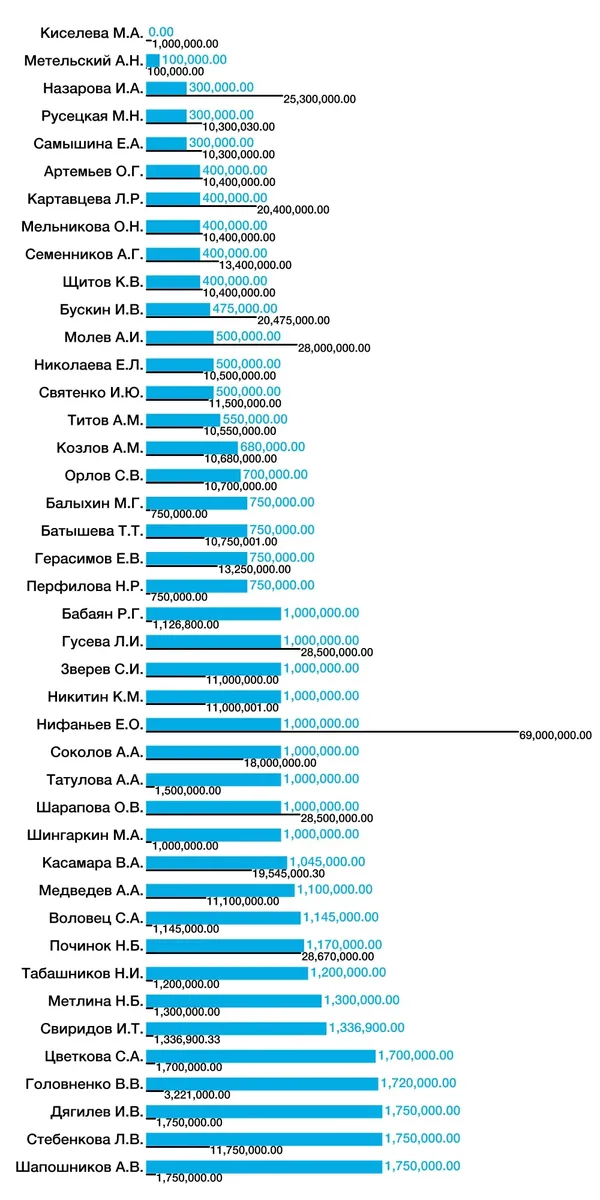
The reports also mysteriously coincide on voluntary donations of legal entities: in 14 reports this amount is exactly ten million rubles, in four - 27,500,000 rubles, in two - 12,500,000 rubles. Surprisingly, for Santa Claus he sent the same donations to the "dratlogs"?
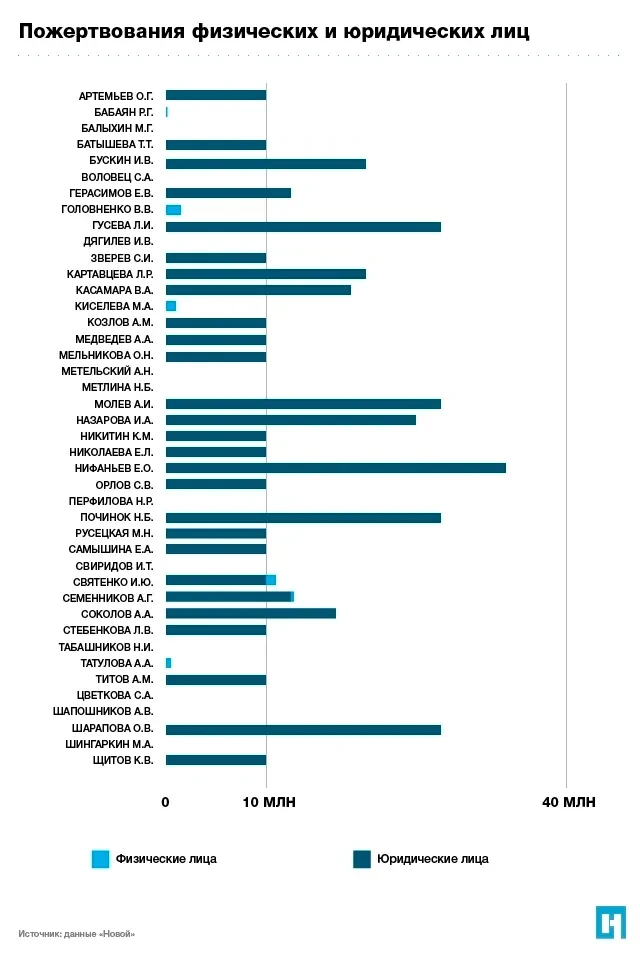
To clarify the information about what kind of legal entities supported the campaigns, we tried to contact the candidates themselves and tried to call all the “midwives”. In more than half the cases, it was not possible to contact, but the answers of those to whom we phoned were pretty pleased.
Rentified signatures
We were also surprised at the reports of waste from election funds. At the moment, all of the felongers listed in this section, except Sokolov, are registered by signatures. Given the standard collection price of one signature of 300 rubles this season, we should talk about the impossibility of collecting signatures by everyone who declared less than 1.2 million rubles of signature fees. 33 out of 42 "Faars" could not collect the signatures that they stated.
Well, okay, the “midwives”, apparently, nourished their collectors with the Holy Spirit - 27 of them generally indicated zero expenses on the collectors of signatures.
At the same time, we see suspiciously coinciding numbers at the Rector of the Russian State Customs Service - the specialist in the scientific forces of Natalia Pochinok (in the dissertation she changed the income for expenses, leaving the numbers unchanged) and Maxim Shinggarkin. Both of these characters spent 84,400 rubles on the entire collection. So, before the penny everything came together with independent candidates. А Олег Артемьев, Ольга Мельникова и Елена Самышина порадовали нас совпадением затрат на сборщиков — по 1 960 000 рублей у каждого.
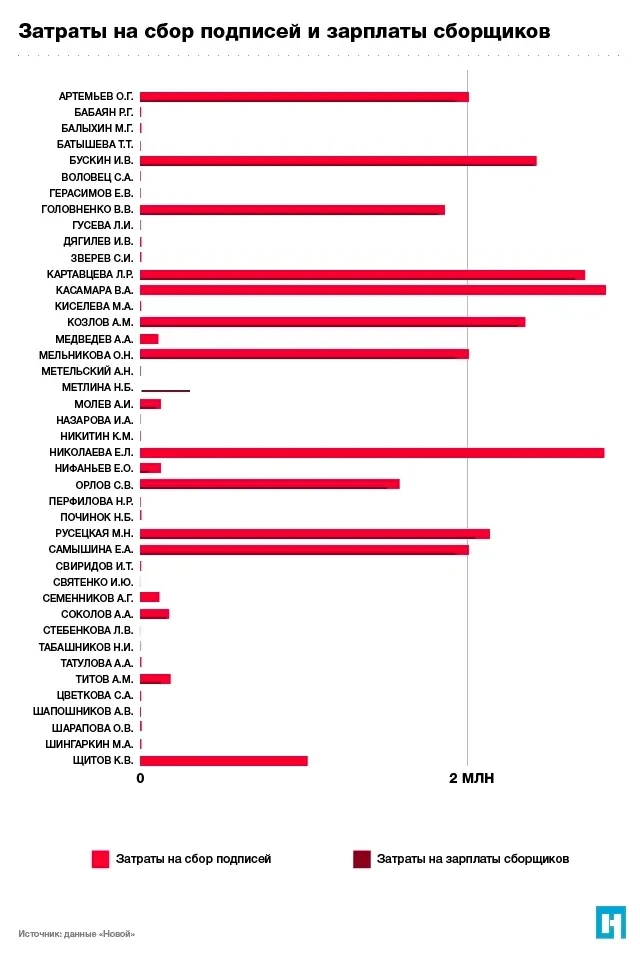
Можно заметить, что кандидаты от власти делятся на две группы: «гуляющие на свои» и «гуляющие на деньги юрлиц». На собственные деньги ведут избирательные кампании в основном новички — журналисты и бизнесмены, хотя в этой группе и три действующих депутата — председатель МГД Шапошников, глава австрийских единороссов Метельский (его избирательный фонд — всего 100 тысяч рублей) и депутат Перфилова. Наоборот, деньги юридических лиц получили в свои избирательные фонды в основном действующие депутаты МГД (хотя и тут есть исключения — например, космонавт Артемьев или ректор Русецкая). Особняком стоит телеведущая Мария Киселева, избирательный фонд которой целиком состоит из одного миллиона рублей пожертвований физических лиц.
Второе место по доле общего избирательного бюджета неожиданно занимает исторически малоизвестная и малоуспешная в Москве (ранее не участвовала ни в одних выборах депутатов МГД, на думских выборах 2016 года получила во всем городе всего 70 тысяч голосов) партия «Коммунисты России», которой на этих выборах удалось зарегистрировать по подписям 32 кандидата из 34 подавших документы.
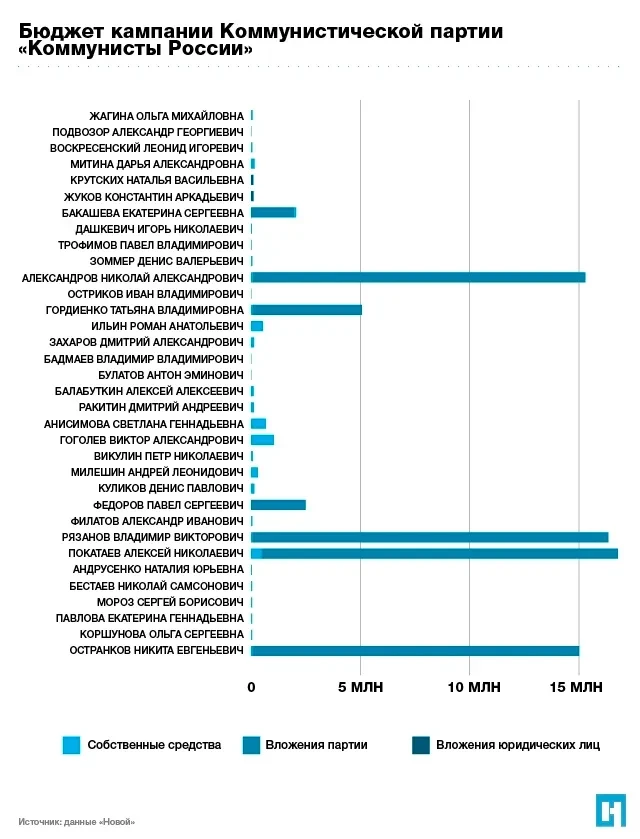
Пожертвования от граждан получили лишь шестеро из 42 «самомедвеженцев», и общая их сумма составляет менее одного процента избирательного бюджета этой группы (а собственные средства кандидатов — менее 8%).
Total
Анализ бланков финансовых отчетов кандидатов позволяет с высокой степенью уверенности утверждать, что в Москве на этих выборах действуют несколько координационных центров («штабов») разного масштаба, одновременно организующих деятельность многих кандидатов от власти и их соперников по избирательным округам. В эту координацию вовлечены в первую очередь выдвиженцы партии «Коммунисты России» (КПКР), которые играют понятную политтехнологическую роль, оттягивая на себя голоса потенциальных соперников от КПРФ. А также широкая сеть самовыдвиженцев и некоторые представители других партий.
Выборы депутатов МГД в целом начинают выглядеть как большая спецоперация по проведению в депутаты нужных кандидатов.
Анализ содержания финансовых отчетов показывает, что, скорее всего, все зарегистрированные избиркомами «самомедвеженцы» (то есть единороссы, которые отказались от партийного бренда) пользуются совершенно непрозрачными схемами финансирования, по всей видимости, финансируются из одного или немногих источников и приводят в большинстве своем невероятные цифры по затратам на сбор подписей.
Ответы кандидатов
Людмила Стебенкова
Депутат Мосгордумы
— Я вас не знаю, комментарии давать не буду. Вся информация будет в отчетах.
Valeria Kasamara
Проректор Высшей школы экономики, кандидат в депутаты Мосгордумы
— Юрлица попросили не разглашать, сохранить «банковскую тайну». Всю публичную инфу смотрите в отчетах. ( Никакой информации о том, кто же был таинственным благодетелем проф. Касамары, в отчетах, как известно, нет — прим. ред. ).
Кирилл Щитов
Депутат Мосгордумы
— До 8 сентября я ничего по выборам не комментирую. ( По его рабочему думскому номеру нам сообщили: «Статус кандидата не предполагает использования служебного положения, ждите отчетов или связывайтесь с комиссией» — прим. ред. )
Инна Святенко
Депутат Мосгордумы
— Мне неинтересно. (*На вопрос о том, кто же ее жертвователь? В ответ: «У них и спрашивайте». Как нам узнать, у кого спрашивать, Инна Юрьевна не пояснила — *прим. ред. )
Evgeny Gerasimov
Народный артист Российской Федерации, депутат Мосгордумы
— Ничего уточнять не собираюсь.
Сотрудники Семенникова Александра Григорьевича просили перезвонить позже, затем дозвониться не удалось.
Бускин Игорь Владимирович предложил говорить с юристом, юрист не перезвонил.
Орлов Степан Владимирович просил перезвонить, затем дозвониться не удалось.
Единственный кандидат, кто ответил на наш вопрос по существу, — Соколов Андрей Алексеевич . Он рассказал, что основная поддержка была оказана со стороны некоего «Фонда защиты потребителя и здравоохранения». Такой организации в ЕГРЮЛ нет.
Андрей Заякин, Сергей Шпилькин, Артем Щенников , data-отдел «Новой»