
Translated material
Promotion July 27. How the authorities violated the rights of protesters
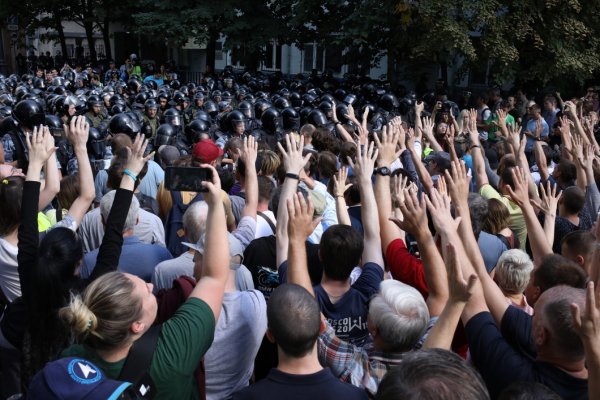
1373 people were detained for shares for the admission of independent candidates held on July 27 in Moscow. The authorities were originally aimed at strict suppression of peaceful protest. After tough detention, the rights of participants in the protest were violated in the police, ships and special receptionists. Violations have become unprecedented in the history of the observation of the OWD-Info. We have collected the main thing that we need to know about the actions of the authorities during and after the action on July 27.
The police and the Russian Guard were originally aimed at force suppression
- For the “law enforcement” during the protest in Moscow, a large amount of police and the Russian Guard was attracted. How much is unknown, but according to unofficial information ), about 400 police officers from other regions were brought to strengthen.
- Employees of law enforcement agencies clamped the participants in the action, did not allow them to go through, and then detained. This happened in Stoleshnikov Lane, where people, in order not to be among the detainees, had to break the cordon.
- Police and Rosgvardists used the force incommensurably the actions of the protesters: they beat them with batons and carried out rigid detention, while the protest was a peaceful nature.
Violations after detention
- The detainees were deliberately kept in stuffy gas stations for several hours. Sometimes they were not released to the toilet.
- At least 12 police departments refused to transfer food and water to the detainees.
- The freedom of people was limited to more than 48 hours after the detention.
- Many detained participants were not allowed to call relatives and lawyers. In this regard, they could not receive qualified assistance in the courts.
- In many cases, territorial jurisdiction was violated. People were detained in one area, and meetings were held in the courts of other areas.
- It is known at least two cases of absentee arrest of participants in the action in the Zelenograd District Court. The court denies the fact of what happened.
- In the Gagarinsky District Court, one of the cases was made in the case before the meeting. At five in the evening, a card appeared on the court website, which says that the participant of the action was guilty of an administrative offense and was arrested for ten days. Whereas, according to the detainee, the meeting itself took place at 21:00.
-On Monday, when people were taken to the courts, some of them did not have the opportunity to call lawyers because their phones were discharged. This situation led to the fact that many of them did not receive legal assistance and will not be able to appeal the court decision.
Violations in specialists and after the promotion
- those who received administrative arrest take away the sentence to other cities: Lukhovitsy, Elektrostal, Chekhov, Sergiev Posad, Istra, Lyubertsy, Mozhaisk. This is done so that their friends and relatives are more difficult to come to the place of departure of the arrest and make a transfer.
- Some detainees were refused the call to the relatives after delivering to the special receiver. Thus, their relatives and friends could not find out where they are.
- Many special -receptions and police units did not take the telephone, in some cases, they informed the deliberately false information about the detainees, threw the phone when they heard the questions of the calling.
- According to the “human rights cards” information , two former prisoners who began to put pressure on them were planted in one of the specialists to the participants. Also, ATD-Info is known about several similar cases.
- On the night of July 31 , the first searches were held as part of a criminal case of "riots." They were carried out by the FSB officers and the ED center, who began to break into the apartments of the participants in the action at about four in the morning. After the search, they were taken for interrogation. According to the law, night searches should be justified, they can only be carried out in exceptional cases. In other cases, searches can be carried out only from 6 a.m. to 22 hours. Considering that the searches were not in the status of the suspects, it is not clear whether these cases have been exceptional.
The authorities are trying to convince everyone that residents of other regions participated in the rally. Do they have the right to protest?
Even before the end of the action, the authorities began to promote the idea that residents of other cities of Russia took part in it. At four in the afternoon, the editor -in -chief of the RT state television channel Margarita Simonyan said that 2000 protesters were not from Moscow and not from the Moscow region. She did not indicate the source of these data.
On July 28, the Ministry of Internal Affairs reported that more than 600 participants in the action are not residents of Moscow. On the same day, the pronounced television channel REN-TVreleased a 25-minute film, which, among other things, stated that “half of the participants in the action” were visitors. The next day, Moscow mayor Sergei Sobyanin said that these were pre -planned “riots”. Here again the thesis about nonresident. According to Sobyanin, people who "had nothing to do with Moscow and the elections to the Moscow City Duma took part in the action." These statements of Sobyanin were broadcast in the Moscow metro.
No law of the Russian Federation prohibits people to participate in political actions. Including in cities in which they do not have permanent registration or registration. At the same time, it is absolutely incomprehensible how the Ministry of Internal Affairs and the city hall believed which of the participants in the action from Moscow, and who came from the region.
The authorities diverge in the official assessments of the number of participants. On the day of the Ministry of Internal Affairs, even before its end, it issued a statement that about 3,500 people took part in it. Whereas the protocol on the detention of journalist Ilya Azar says that about 10 thousand people took part in the action, according to the security forces.