
Translated material
Stories Linor Goralik
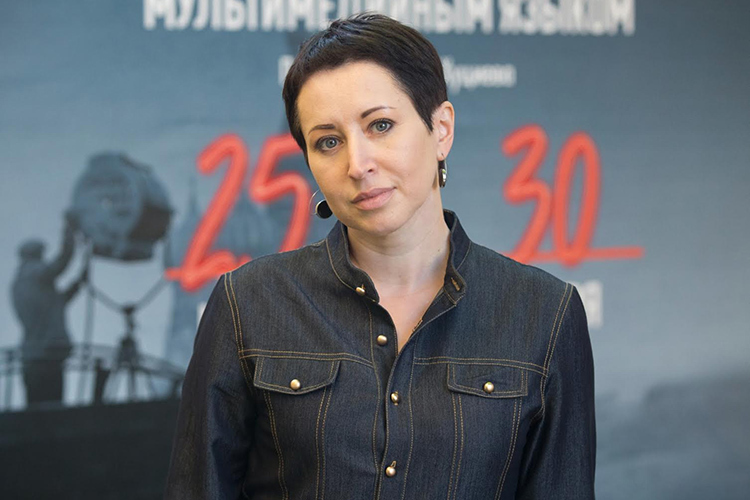
Linor Goralik is a poet, writer, translator, marketer, fashion theorist, creator of the hare of the PC , postpost.media , the project of biographies of modern poets “Private Persons” .
With the kind permission of the Center for Voznesensky , where the meeting of Linor Goralik with readers took place, Colta.ru publishes fragments of her speech.
About the most important topics
I have been telling my students, marketers, I have long been telling that there are five topics that trigger in any case: children, money, sex, death and homeland. I explain that if you can somehow correlate your message with one of these topics, it will be easier to take possession of the person’s attention, and then you can tell the story that it is important for you to tell. I try to teach students to this technique when it is necessary to offer a topic for collecting stories, then to make a publication out of them, this is how Postpost does. Media . Firstly, it seems to me that this is important, because it is important to maintain human stories, and secondly, it gives good results-readability, coverage. And it is especially good to do this with market students who have to promote media. Because for the media the benefits from all sides are obtained: the content is good, and working with social networks is good, very organic. But I always had one condition: you can talk about a lot, but just do not operate the topic of cats. Well, as much as you can. And at some point I read the course in Tbilisi. I always say that it is best to work with a topic that is close to current events. I asked them: what is the main thing in Georgia now? They said - elections, they had elections on their nose. I said: “Excellent, here we have this list-children-money-sec-death-rodin; Let's think what question we can ask people to get into some of these topics. ” Well, it’s clear about the homeland, the elections are already about the homeland, everything is fine here. Children? Well, they say: in childhood, everyone participated in some elections. The election of the elder of the class, someone else ... In general, you can ask people in what elections they participated in childhood, and there will be excellent stories. Well, I say, fine. Money? They say: well, just ask - elections and money. What is your story on this topic? Someone worked in the election and received a salary. They tried to give a bribe to someone, maybe. They tried to bribe someone. There may be very unexpected plots. Great, I say. Sex? They: Well, any elections are sex scandals. You can ask not stories, but opinions and reactions, to make such a selection of opinions: how the sex scandals affect the solution, whom to choose. And one girl is sitting, Marina, she always participated very actively, and then she is silent. I say: “Marina, I have a feeling that you have something to say, but you somehow ...” She says: “I have an idea, but prohibited. She's about cats. " I say: "Let's talk about cats." And she says: “I would ask a question like this: write why your cat would be the best president than all these people.” Marina, I say, from that moment I return the cats to the list of topics admitted. Cats won. Now there are six-children-money-sex-death-rod-kota, and about the homeland I always think that the more local the message will be, the better: people react very well to regional news, because their shirt is closer to the body. When I wrote about this in my blow ( blog Linor Goralik about marketing . - Ed. ), I realized that there was the perfect news: “Omsk children took money from passers -by for the right to watch cat sex in the cemetery.” This is the news on which there would be an endless tail of the traffic, it would never cease to carry traffic. Omsk to change to Kostroma, cats for dogs - and so all the time ...
About private stories
I am interested in these tiny moments of private life. For some reason, I have a feeling that they are most important. More important than large narratives. More important than novels, more important than family sagas. Today I bought a card in the subway, and next to me stood a very sleek, amazingly dressed man, talking on the phone, and I kept the phone quite far from my ear, because the woman sobbed there, was heard. And he said: “Well, you pray that you pray. I understand that you pray, but you understood that it would be a temptation, did you understand that your soul is weak? Why did you go there? She prays. Okay, sit there, do nothing, I’ll pick up one Jewish man right now, we will try to go through the Jewish God to this business. ” And you understand that there is no literature that is better than this, there is no literature that is more important than this, it cannot be written, because ... because literature is a secondary product. The primary product is "the Lord created man." What does a person come in as a result - well, what can, yes? Man as such better.
About "private individuals"
The project “Private Persons” is a separate story: I have been trying for many years to help poets write their autobiography. Because I understand that in 90% of cases a person will not do this. I sit down with the poet, and we talk to the recorder for many hours, I try to help him tell about my life, then I make a raw text, give the poet, and he is free to do anything with this text. There are those who say: "I changed their minds, we do not publish." There are those who change the text beyond recognition, there are those who make a separate book out of this - but one way or another, all these biographies with the amount of 12-13 pieces in one book are published in the project “Private Persons”. Two volumes came out, we are working on the third, right now - with Maxim Amelin over his biography. In the third volume there are already five people, Maxim six, it will be twelve. Usually Tom takes (I counted) for five or six years. There are poets who build, speaking of their life, a great narrative-it is important for them to see the character arch, understand about themselves and tell about themselves some big story, a through plot. And there are those who work with privacy, with tiny stories - but of course, a huge plot is still built of them.
I am all keenly at anxious. And I try when I ask, to go into these little stories. I usually get up for a very long work with each participant in the project: it can last six months and a year with interruptions, it can be three meetings for eight hours and two meetings for an hour - as you like. Slow, patient joint work - but not painful, it brings great pleasure. It happens differently: I came to the first meeting with Sasha Skidan, Sasha sat in front of me and in two hours I set out the finished text. Just because Sasha Skidan fantastically structured thinks. He thinks with narratives, he is so arranged. In other cases, this is different, but the most amazing thing is that when you speak with a person, there are those who tell these tiny invaluable plots, then you give a cheese to a person, and when the finished text comes to you, they disappear. They are seen by the author as unimportant, unnecessary or obscuring meaning. I am terribly sorry for this tiny texture, but I can’t influence here. And there are those who, on the contrary, begin to recall the details and add them-I rejoice, but again I have no right to intervene: the meaning of the project “Private Persons” is not to push out something from the author, but, on the contrary, to give the poet control over biographical statements. Let him do something. Not what they would say about him, but what he wants to tell. And by definition, I have no right to even say: "How sorry that you threw this piece." Because only the word "sorry" can break the course of things. But I feel sorry for, I am terribly sorry, especially since under the terms of the project, I even destroy all the source files. And this, of course, is also terribly painful - but these are our agreements.
I am interested in these tiny moments of private life. For some reason, I have a feeling that they are most important. More important than large narratives. More important than novels, more important than family sagas.
About the conversation about the memory that has become relevant for society
It is difficult for me to judge whether he is relevant, because, of course, I am too passionate about the topic-but I will allow myself to express some versions. Well, first of all, I suspect - as a person who is trying to engage in fashion theory, and as a person who is trying to engage in marketing, that there are trends in any space of human activity. The trend is not a curse, the trend is that which becomes relevant and important for a large number of people at a time. And, of course, there are trends in the space of social thought. How do trends arise? Any person who will say: “Now I will explain to you,” in my opinion, a little charlatan: simply because the trend is, as far as I can judge, the result of a combination of a huge number of factors. There are large factors, but there are a very large number of small factors. To answer the question “How do trends arise?”, We must imagine that a huge ball is lying, all the animals of Africa gathered around and pushing it. Why did he rode to the right - because two elephants are stronger than the rest or because there were a lot of mice on the one hand? These are such complexity mathematical models that we always need to say to ourselves: we can make assumptions, but we cannot say anything. Why are we talking more about memory now, and a little less than two years ago about the injury? Or may it turn out that the conversation about the injury is not finished at all, it smolders and will flare up again? I don't know. I have just the feeling that this trend for talking about memory in the Russian public space began to navigate, that we are observing a decrease. I have no idea what will be the next topic of the conversation - terribly interesting, for example, that we are preparing the following cultural generation, otherwise the generation in the culture that we called the young will have to admit that they are almost thirty. The following people are suitable, they will bring the following topics with them - and they will be unexpected. For example, it seems to me that the next big topic is volatility, instability. Because a more unstable, volatile situation than the one in which this next generation lives, the one that awaits him in the future, we cannot imagine (and they feel and understand it, if I can judge by conversations with my students and younger comrades). The people with whom I work who are studying at my MBA , people involved in HR - I teach a course in the employer’s brand in the Stockholm School of Economics and listen carefully what they say about young specialists who come to them to work, tell me that none of the young people still believe in the word “stability”. The companies stopped saying: "We will give you stability." This word became empty, even when the company is ready to answer for its words. I have a feeling that instability and fear of the future is the next huge topic.
About text and visual perception
I am a dinosaur, a representative of the textual world. The world is much more visual than what I was preparing for and what I was used to. I am a person who is constantly worried that he is watching a little YouTube : it is bad, really bad, a huge layer of modern culture passes past me, but I am used to reading letters in the main thing. It seems to me that it will be as always - in culture the action is not equal to counteraction, but provokes opposition. It seems to me that there will be some rollback to the old formats, to homegrown textoccentrism, in the appearance of warm tube media, and interest in old forms. I do not think it will be a huge trend, but it will take a certain place. It is very important to understand that the point is not, the text world or visual, textual information or visual, but that the text and image are carried and can convey different information. It's not about how we consume information, but what information it is. I have an amazing object, which, perhaps, serves as a magical illustration of the current conversation, is such a thing produced by the Garage Museum. I bought it to hang it at home. It is a double picture that changes when the angle of view changes: it is a dactile of a Russian brutal language, it shows how different letters of the alphabet are performed by gestures. Here the object is simultaneously textual, visual and God knows what else. How to classify it?
About emotional equality
I have a theory that helps me to live a lot, including as a believer. This is the theory of emotional equality. She says a very simple thing: people may have a fantastically different life experience, may not have a common language, not have common cultural codes, one can live in an Australian tribe, the other - sit in this room. But they have absolutely general emotional experience. Fear, love, hatred, jealousy, anxiety - they live the same with a pretty high probability (I know how controversial this statement is from the point of view of the history and philosophy of emotions, but I think that the reader will understand what I'm talking about). Yes, we can talk about how the representative of the Performs Emotion society (expresses emotion. - Ed. ) - how we comprehend it, show, analyze, reflect, present, discuss, and present each other Performative diffurences (differences in expression. - Ed. ); But we experience, I believe me, the same thing. I understand that this is a subtle line: where we end in “experience” and begins “reflected” - God news (reflection is in many ways the fruit of external constructs and discourse), but it seems alive that hurts or has fun in us, seems universal to me. Emotions are the only common currency on Earth, a common code. And exactly from here my admiration for all these tiny stories that people are ready to share with Postpost. Media : They talk about this common code. It's amazing. People can tell some things that may seem completely unacceptable to me in my social circle. Or, for example, a fantastically close person you read and think: how did it happen that we are unfamiliar? You understand that you have a general emotional code. This is unthinkable, this is magic. And this, of course, is what I am collecting stories for. And this is in my understanding there is also a huge key to faith - but there is already a separate conversation.
We create narratives that help us do this: survive every day.
About the failed comedian series
Even when there was such a television that is not a back, Valera Todorovsky turned to me: “Linor, you work with a small form; Let's make a truly high-quality comedic TV series for TV? I dream of doing this, come up with a comedic series and write it, I will shoot it, let's only be a little little one, like fifteen-mines, well, something like you love. ” We sat down with him, I said: “Valera, I have a name for this series - it should be called“ Olivier ”.” And all the stories in it were supposed to spin around Olivier. It can be anything - from the restaurant of molecular cuisine to (this is a real story) of a person who operated on an ulcer of the stomach; Since it was under the New Year, relatives with an Olivier pan made their way to him, because it is impossible without Olivier! In general, it was repeatedly operated on - but it was impossible, it was impossible without Olivier! Valera and I were clear that this was not about eight seasons, but, say, about the ten -part. I wrote the first plot. Valera softly wrote to me that this is very good, only - how to say it - a little sad, but we want a comedic series; Is it possible to do anything with this? I wrote much more fun: two people no longer died there, but only a turtle died. Valera wrote to me: “Listen, Linor, well, well, sacrifice the turtle. But look: you have the main character-an indecisive asshole, his wife is some kind of insane bitch, children-parasites; Who will we love? " I could not write: "Valera, let's love me, for example." It would be a completely different author, we even know which one. I wrote that I would try to change something-and changed so that we loved the turtle: at first I made it so that it was alive, then it died, and we already loved her further. In general, it became clear that the fun series would not work; Valera and I broke up friends, and he allowed me to tell this story.
About why we are captured by other people's stories
I have a suspicion that this is an evolutionary mechanism that makes us be interested in the private life of other people. Because it increases our experience, our safety and our ability to navigate in social situations. I suspect that this is as important as, for example, to gossip (this, if I am not mistaken, is also an evolutionary mechanism). We learn this way, we are better oriented in society, we develop acceptable and unacceptable patterns of behavior in this way. In other words, I think that we are sticking into other people's personal stories, because, as Kaneman writes (Daniel Kaneman, the American psychologist of Israeli origin. - Ed. ), We are so programmed.
About eternal values
Today I heard the phrase, I did not have time to record. Two beautiful hipsters go on electrical scooters, I hear a fragment of the conversation, one says to the other: only buckwheat is important, here it is always some x ∗ fur, and buckwheat-it is buckwheat. It was absolutely great, and you can’t argue.
About oblivion
The mechanism of oblivion is a blessed completely gift of God: I see this both according to the project “Private Persons” and according to the Postpost project. Media - and how amazing it works. Самый яркий пример, который я могу привести: два или три года назад я была шеф-редактором «Букника» — это такой проект, занимающийся современной израильской культурой, — и мы с Марусечкой Вуль, одной из ближайших моих подруг, которая сейчас работает вместе со мной в PostPost , думали, что бы нам сделать к 9 Мая. Ужасно не хотелось делать очередной банальный какой-нибудь материал или интервью, и мы решили пособирать истории. У нас появилась идея: вместо того чтобы задавать вопрос «Чем занималась ваша семья во время войны?», который дал бы нам «пластинки», то есть много раз пересказанные истории, которые человек почти не рефлексирует, а просто повторяет из года в год, — мы задали вопрос: «Что у вас в семье говорилось о войне?» Мы собрали сто с лишним историй, а когда опубликовали этот материал — получили еще сто пятьдесят. Это был единственный раз на моей памяти, когда нам писали истории в комментариях на сайте, — никто не пишет комментарии на сайте! Нам писали письма. В результате эти 250 историй мы сделали бесплатной книгой на Amazon — ее можно скачать, она называется «Лишь бы жить» , она на русском. Я редактировала ее сама и, когда закончила, была реально в слезах, у меня тряслись руки. Это немыслимые совершенно тексты, но там видно, как работает не только память, но и забвение. Не стыкуются даты. Не стыкуются годы жизни людей. Человек пересказывает разговоры, и по хронологии получается, что, когда ему произносил дед этот монолог, ему было два года. Но это не имеет никакого значения. Имеет значение, что у человека есть какая-то конструкция, с которой он может выживать, с которой он может мыслить себя в одном континууме. Если я правильно понимаю (я не специалист, мое ощущение обывательское), мы создаем нарративы, помогающие нам делать именно это: выживать каждый день. У этих нарративов есть двое родителей: память и забвение. И они, конечно, работают вдвоем для того, чтобы нарратив был здоровеньким.
Про собирание историй
У меня вообще чувство, что я всюду делаю одно и то же, включая мою работу маркетолога: тот тип маркетинга, который я предлагаю своим клиентам, — он про то, как живые люди взаимодействуют с живыми людьми. Я всюду занимаюсь этой специфической, узкой темой: как люди общаются друг с другом и при этом остаются в живых. Так или иначе все рассказанные истории, все эти подслушанные разговоры, которые я пытаюсь записывать… Я ведь тоже понимаю, сколько там интерпретаций, сколько там ослышки, сколько там доработки текста, — даже если мне кажется, что я фактически работаю в жанре вербатим. Мне кажется, что я делаю все время одно и то же, что даже в теории моды я выбираю темы про то же самое. Вот сейчас я готовлю статью про патриотические коллекции русских дизайнеров — про дизайнеров, которые, говоря о своих коллекциях, заявляют, что они связаны с патриотической тематикой. И это все про то же самое — про нарративы, помогающие людям найти свое место в реальности. Про то, как человек пытается выстроить свою идентичность в этой стране — тем главным способом, которым он умеет эту идентичность проживать. Так что, короче говоря, чем бы я ни занималась, я всегда занимаюсь одним и тем же.
Subscribe to the COLTA.RU channel in Yandex.Zen to miss nothing