
Translated material
Why does the struggle with Moscow protests destroy the unity of power
Answers Tatyana Stanaya: carnegie.ru
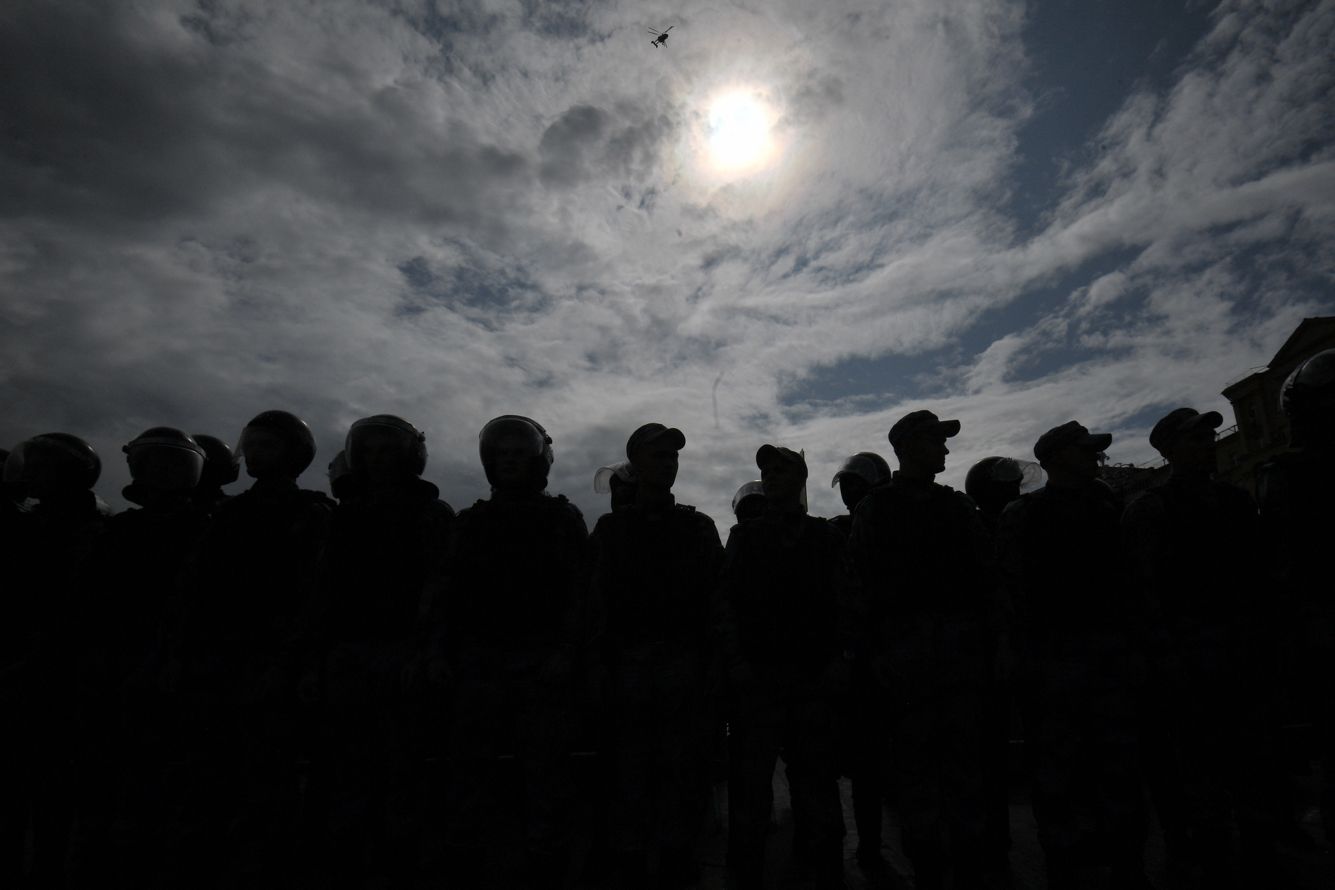
To combat Moscow protests, the country's leadership, obviously, chose power methods. Vladimir Putin by will or captivity forms a request for suppression of discontent, and then different parts of the system begin to compete with each other for who will more convincingly show the president, how effectively they cope with the problem. As a result, everyone is chasing their narrow corporate priorities, far from always useful for the survival of the system as a whole. There is no one to deal directly with the protest itself, try to understand its nature and potential, to probe the possibilities of compromises. This is announced in the article for the Moscow Center of Carnegie by political scientist Tatyana Stanovaya. With the permission of Carnegie.ru "Medusa" publishes the article entirely.
The question of how the authorities are going to cope with growing protests is today the main thing in Russian politics. With the tactical side, it is more or less clear-priority is given to the power scenario, with the exception of cases when the source of concern is not the opposition, but the lower floors of the authorities, as it were, for example, in the case of Golunov.
But with the strategic side, things are much more complicated. It is not clear how the authorities, in principle, are going to build relations with new dissatisfied if it refuses to recognize both the real opposition and the real protest, and considers the protesters a handful of adventurers, bribed by foreign sponsors. The authorities are trying to demonstrate power, but this demonstration is visible to the growing disorientation of its key institutions.
Presidential frame
How are the protests made? Who gives the order to put the opposition? Who coordinates the Foreign Ministry? In which composition does the Kremlin discuss the protesting agenda? How often do meetings go and how involved in all this is President Putin? All these questions today have no unequivocal answers.
So far, the plan of the authorities looks something like this: the dispersal of unauthorized shares, a campaign against external intervention, the arrests of opposition leaders, criminal cases of participants and selective coordinated shares with an sight to split the opposition. However, all this is not a planned campaign, led by a single center, but with a polycentric game of many institutions of power, focusing on their own priorities, and not on the interests of the system as a whole.
The general vector on the power scenario, obviously, comes from the president. Moreover, a direct order does not even need a direct order - Putin’s negative attitude to the protests of the non -systemic opposition and so well known to his environment. Further, the vowel or unspoken position of the head of state sets the frame for the actions of the rest of the system - from the presidential administration and security forces to the city hall.
Putin forms a request for suppression of protests by will or captivity, and then different parts of the system begin to compete with each other for who will more convincingly show the president, how effectively he copes with this problem.
At the same time, Putin himself does not publicly participate in what is happening - it is enough to see his official site where there is anything but protests. The last meeting of the Security Council was devoted mainly to the termination of the contract on medium and lower -range missiles and fires in Siberia. If it was mentioned, the Moscow crisis, then according to the residual principle, as something deeply peripheral.
The country's leadership clearly underestimates this crisis simply due to the fact that it does not fit into the personal picture of the world of Vladimir Putin, where he continues to rely on the broad majority, and the responsible opposition (another cannot, otherwise it is no longer opposition, but criminals) plays according to the rules and does not rock the boat. No one in power is eager to explain to the president that since his triumph in the elections in the spring of 2018, the situation has managed to change a lot - the country has entered a new era, where there are protests and a request for political update.
Everyone is against everyone
Then it turns out that since there is no crisis, then there is no strategy. But there are institutional interests. And each authority is accepted to resist the protest force majeure within the framework of its talents and powers, sometimes to the detriment of the interests of the system as a whole.
The mayor of Moscow wants to get a loyal city Duma, so he pushes the party in power and abuses a signature barrier. The presidential administration prohibits any flirting with the liberal public and civil activists. The security forces irritably observe how civilian mistakes make, and wait for their stellar hour, wanting to fail competitors. At the same time, all participants in the process within the system seems that the problems are not created by the opposition and protesters, but by the inept actions of other institutions of power. As a result, the Moscow crisis is not a challenge in their eyes, but by the consequence of the failure of their colleagues-competitors in power.
The presidential administration holds meetings and organizes “research” in order to inform the president of what is happening, not contradicting his ideas about reality. That is, it is looking for evidence of participation in the protests of nonresident, the involvement of foreign embassies, the use of violence against the police, marginalizes the protesters as an non -presentative part of the Moscow public. But unofficially, the fault for what is happening is assigned to Sobyanin is the best way for AP to take off your responsibility and shift it to a neighbor’s shoulders.
The leadership of the Russian Guard, in turn, diligently proves his legal capacity and need to the president (against the backdrop of doubts about the correctness of the withdrawal of internal troops from the Ministry of Internal Affairs). Unauthorized action? We must crush. Indeed, it is based on how effective this task is that the president will decide on the future fate of the head of the Russian Guard Viktor Zolotov and his entire structure.
The FSB, along with the Investigative Committee, took up the protection of the constitutional system - they started cases of preventing the work of the election commission and the organization of riots. It can be assumed that this initiative does not come from the Kremlin, but from themselves - such a contribution to the common cause and their proposal to the country's leadership.
Finally, you need to do something with Navalny. For many years, the authorities did not dare to put him completely, but the security forces clearly scratched their hands. What is the angry video message of Viktor Zolotov, where he indirectly criticized the civilians for failures in work on Navalny. Whether the power will be decided now is the question, but it is obvious that the rates are growing along with the frequency and duration of the deadlines for Navalny behind bars. And the story with its alleged poisoning looks like a personal and very strict warning.
The Foreign Ministry also joined the situation. Maria Zakharova accuses the United States and Germany, as well as the Western media of interfering in the internal affairs of Russia - they say, they called for participation in unauthorized actions. Let us leave aside the adequacy of this accusation (it is enough to say that it was, for example, about the warning of the US Embassy not to appear in the places of an action made in English and addressed to American citizens). In this case, another thing is important - the Foreign Ministry also connected to the Moscow crisis and is trying to sell Putin his contribution to the defense of the “constitutional system”. Chekists bring to the conspirators, and the Foreign Ministry to their Western sponsors. Each institute uses its strengths in the struggle for the president's attention.
As part of the general power logic, there are Russian television channels that promote a single vision of the opposition as an orange threat and the image of the security forces - reliable defenders of the calm of citizens, victims of cruel protesters, violating all possible laws and acting in the interests of the West. The thesis about good Russian security forces against the backdrop of merciless French has become a common place in the pro -government information space. That is, a narrative is reproduced, who repeatedly repeated Putin with his famous "we do not want in Paris."
Initiative as a form of survival
The position of the head of state, which is too busy with geopolitics, leaves a lot of space for free interpretations on the lower floors and ultimately leads to abuses. Throw in a hurry “restore order” can be interpreted as a sanction on the most stringent and decisive actions. If earlier, in order to bring the state car to act, the president’s direct participation was required, now everything that is not prohibited by Putin is allowed, and inaction is becoming more dangerous than determination.
Each institution of power, be it the FSB, the Russian Guard, the Foreign Ministry or RT, felt not only the need to prove himself, but also the danger of missing the moment, losing to the initiative to others. In conditions of political uncertainty, when everyone is in a hurry to demonstrate their reliability and responsibility to Putin, to stay away means to be suspicious and the risk of being on the sidelines.
Institutes have to prove their own need, fight for the victory of their interpretation of what is happening and zealous in satisfaction of imaginary Putin desires. Because of this, there is no one to deal directly with the protest itself within the authorities, try to understand its nature and potential, and probe the possibilities of compromises.
This, in turn, leads to erosion of the regime, which loses the ability to identify problems and select adequate solutions for them. The authorities, although it acts within the framework of general power logic, but acts disunity. Everyone is chasing their narrow corporate priorities, far from always useful for the survival of the system as a whole.
The regime loses the ability to think strategically in matters of the internal political structure, to build not a corporation with a tough hierarchy, but to create conditions for a multi -subject political space, dialogue and compromises. Therefore, the Kremlin began to lose the initiative in the internal agenda and lose the elections. The political situation in the country will now be much more determined not by decisions at Kremlin meetings, but by the ability of the population to mobilize, the effectiveness of new opposition leaders and the number of errors made by the authorities.
Read also on Carnegie.ru:
- Teachings for the revolution. How Moscow protests will end
- Mosgordum and Transit. How Moscow protests will change the Russian power
- The townspeople are angry again. Why the authorities provoked a crisis around the elections to the Moscow City Duma
Tatyana is becoming