
Translated material
A thousand demonstrations
How this happens in Brussels in fact, and not in the heads of Russian senators
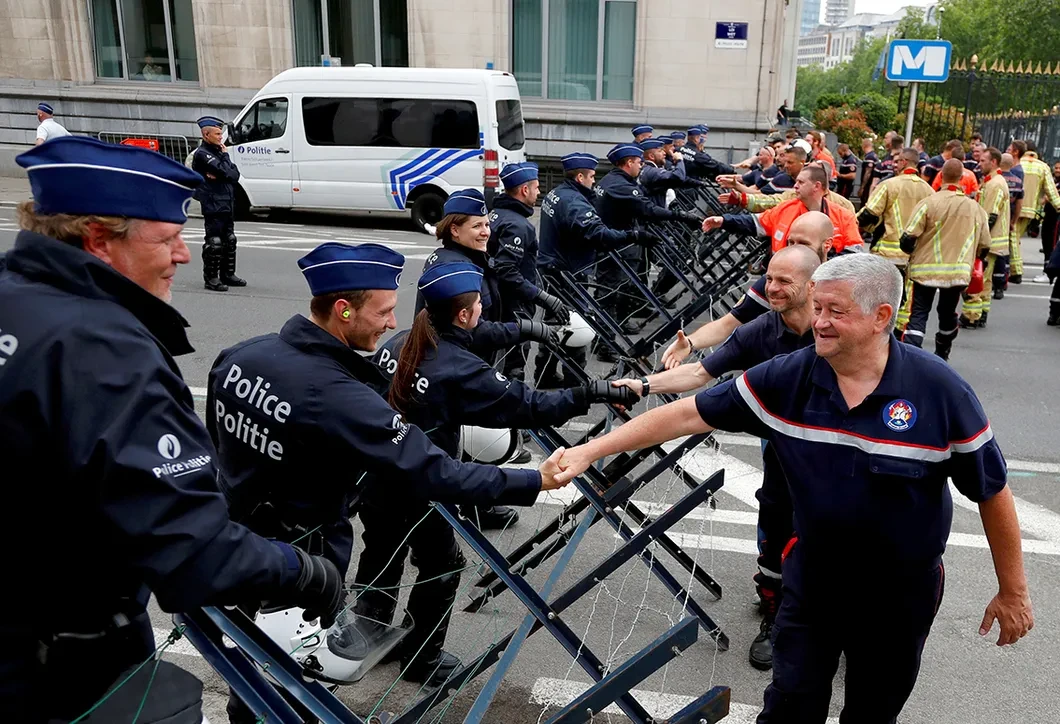
The summer vacation season in Brussels is more than a month to rest from political life. Including from protest demonstrations. The rest of the time, rallies and demonstrations are the organic part of the life of the millionaire city. Only in its central part, the zone of responsibility of the Brussels-Xel police, last year there were 995 “revison shares”, as stated in official police jargon, are events whose purpose is to demand something or to protest against something. On average - three per day.
In addition to the fact that Brussels is the capital of Belgium, whose citizens have his own claims to the authorities, he is also the capital of the European Union and NATO. Here they require an increase in salaries and improving social conditions, subsidies to the EU farmers and the respect of human rights in Zimbabwe. They protest against increasing gasoline prices and illegal migration, arbitrariness of police and abortions, against the carelessness of governments and business to the problem of climate change. Militant "yellow vests", peaceful students-ecologists, disciplined firefighters-rescuers ...
The day does not pass without any demonstrations on Schuman Square in the middle of the "European" quarter,
which is surrounded by the buildings of the European Commission and the European Council. The usual place of crowded stocks is the area of the Luxembourg station in front of the complex of buildings of the European Parliament. Farmers defiantly pour milk, which cannot sell with profit. Syrian refugees protest against the Assad regime.
The most banal route of processions is Lua Street (“Law”), at one end of which is the Parliament and the Belgian government, on the other - the EU leading institutions. This is natural. The proposal to hold a rally or march in the sleeping areas of Voanuvo or Yukl will cause only doubt in their right mind proposing.
In a civilized democratic European country, which Belgium considers himself, everything obeys the law. Any "revisely action" requires the permission of the authorities. Not political, not federal government, God forbid, but the administration of the local police, in extreme cases, the burgomaster of the commune.
The law prescribes the police to assist citizens who exercise their right to vote and express opinions. That is, to ensure that the requested action took place, and not invent how to prohibit it. Laughter reasons such as “interference for walking other citizens”, and the sudden holding of competitions on the run of cowards are not considered. Applications are discussed at a special council with the participation of intelligence representatives for the likelihood of re -exposure of shares into riots.
Then, on the radio and television, a warning of approximately the following content is transmitted: “Due to possible actions on Saturday, December 15, 2018, traffic problems may arise in Brussels in the morning. They can arise in the European quarter, as well as on a small ring of boulevards or in the city center. If you have to be there, the police will ask you to strictly follow its instructions. In case of closing tunnels, you must follow the temporary road signs. Avoid the center of Brussels by car and public transport, as far as possible. ”
Bans of the declared mass shares can be no more than three or four per year (against the background of almost a thousand permitted). That's why
The Belgians are unfamiliar to the phrase so close to the Moscow ear “Unauthorized action”.
The procedure is practically declarative and is needed in order for the police to provide appropriate measures.
Last year, some rallies and processions were prohibited. The burgomaster prohibited the rally by the ultra -right of the Nationalist Party “Flambs Belang” against the signing by Belgium of the World Migration Pact in Marakesh. The very fact of signing the document Prime Minister Michel led to the collapse of the Belgian ruling coalition.
At the same time, a rally was also banned, which they wanted to hold the left as opposed to the nationalists. The burgomaster said that, according to intelligence, the collision of two groups is likely: brown and red. And he asked the organizers to plan them for other days. But the Supreme Administrative Court canceled the ban, considering that it contradicts the constitution. The police had to rake the consequences.
In Belgium, there is only one absolute rule of the ban that the police strictly performed. This ban goes back to 1890. Then the "neutral zone" was installed. Initially, it included the Royal Palace, the federal parliament and several ministries, such as the Ministry of Internal Affairs, Finance and the Chancellery of the Prime Minister.
The principle that led to the creation of such zones is to prevent any interference with the constitutional powers of state bodies. On Lua Street “Neutral Zone” begins a hundred meters from the building of the federal government, in the “European Quarter” - on the steps of Building Lex - one of the buildings of the European Commission.
Whatever the demonstration - permitted or prohibited, peaceful or aggressive - steel barriers are arranged around the “neutral zone”, behind which the police are in full equipment.
Most of the clashes with the use of special equipment and “Windol” occurs when the most active demonstrators are trying to storm barriers.
In the last political season, the most numerous demonstrations (up to 65 thousand) were connected with the demand to protect the environment and it is better to confront climate change, and the most serious riots - with the movement of “yellow vests”, which was thrown into Belgium from France.
The “vests” demanded the resignation of the government and said that the increase in gas prices and diesel fuel, as well as other requisitions, put them on the brink of poverty. In November and December, they gathered in every weekend. In some of them I found myself in the thick of events ...
First, a crowd with posters, heated by screamers, moves in the direction of the prime minister’s office or the European Commission. In parallel on both sidewalks, police officers follow the goose. Both those and others are talking, joke. On the approaches to the "neutral zone" the police line blocks the path. The organizers enter into negotiations with the police chiefs. Then they declare to everyone that it is allowed to continue the procession along such and such streets, provided that it will be peaceful. Finally, the column approaches the last line designated by steel fences, behind which the police in the "spacesuits" and threatening watermark vehicles. Someone is not content with chants and tries to overcome the forbidden line. The “daredevils” are supported from the crowd, they are becoming more and more, empty bottles, stones, urns, and temporary road signs “on iron legs” are used. The police respond with streams of water, tear gas, light-shum grenades. Passions are growing, parked cars, shop windows and cafes become victims. The police begin to hold the pogrom, connecting their hands with white plastic stripes and seating in rows on the sidewalk. Some resist and get on the back with batons ...
These final scenes are shown on Russian television.
Brussels