
Translated material
The executed culture
Sixty -seven years ago, on August 12, 1952, according to the secret sentence of the Military Collegium of the Supreme Court of the USSR, thirteen defendants in the case of the Jewish anti -fascist committee were executed
The material was first published in No. The New Times on August 12, 2012
Sixty -seven years ago, on August 12, 1952, according to the secret sentence of the Military Collegium of the Supreme Court of the USSR, thirteen defendants in the case of the Jewish anti -fascist committee were executed
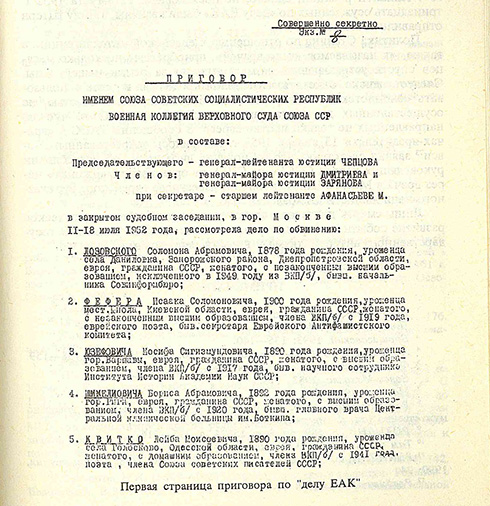
All sentenced to death was guilty of the guide of the Jewish Anti -Fascist Committee (EAC) of nationalist and espionage activities. The truth about the process, which became an important link in the policy of state anti-Semitism in the post-war years, was published only in the late 1980s. Many details of this process are still a secret.
The trial of EAC figures was one of the last political processes carried out at the direction of Stalin shortly before his death. The process took place secretly, in the newspapers there was not a word either about the court or the death sentence over its participants. Among the defendants are famous writers, state and public figures, journalists, scientists, doctors. All before the arrest were active participants in public life. But their names completely disappeared from the press, from literary articles, from encyclopedias, and the essays were hidden in secret storages or destroyed - as if these people never lived.
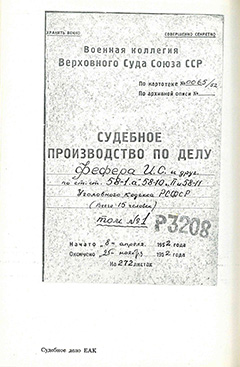
In the history of this terrible process there is a lot of unknown. It lasted more than two months. The court was suddenly interrupted, then a week later or two were resumed. It was supposed to expand the composition of the accused, to attract all persons who appeared in the interrogation of the EAAC. There were many famous names in this expanded list: Ilya Ehrenburg, Vasily Grossman, Samuel Marshak, Mikhail Blanter, Boris Slutsky, more than 200 people. A whole series of processes was supposed, “Jewish nationalists, spies and saboteurs” should have appeared before the court. The investigation tried to prove the existence of an extensive Jewish bourgeois-nationalist organization in the Soviet Union and aimed to get from under investigation about the contacts of the heads of the EAA with famous statesmen, including with close associates of Stalin Lazar Kaganovich and Vyacheslav Molotov*. (* Jewish Anti-Fascist Committee in the USSR. 1941-1948. Documented history. M.: International Relations, 1996.)
Initially, the closed trial, held by the military collegium of the Supreme Court, was decided to conduct without the participation of representatives of the prosecution and protection and without the call of witnesses. However, in the second half of the process they were forced to invite and hear witnesses. The whole charge relied on the “recognition” of the defendants, who were knocked out by torture, imprisonment, threats and mockery. During the judicial investigation, the defendants found the strength to abandon the “confessions”. As a result, the chairman of the military collegium was supposed to contact the highest authorities, indicating that the prosecution was not based on facts, but only “grateful” testimonies. Finally, on July 18, the verdict of the Military Collegium was sentenced, but its introduction was detained for almost a month.
Already after the death of Stalin, the conducted verification of the “case of the Jewish Anti -Fascist Committee” showed the complete absurdity of the accusations, it turned out to be a gross falsification carried out by state security authorities. It turned out that a few months before the start of the court, in early April 1952, the sentence was approved at the Politburo, and actually Stalin.
The country's top leadership had undoubted evidence of the complete innocence of all executed in this “case”. In 1955, the Supreme Court of the USSR decided to rehabilitate all convicts in the EAC case. However, this decision turned out to be secret. His publication in the open press was not allowed. Censorship strictly made sure that the information about the tragic fate of the executed does not become the public. Few knew that the good name of innocently killed was restored. Their books began to be reduced by little, returned to the regiments of libraries, and the names ceased to be served only with swear epithets. Nevertheless, only a quarter of a century after the execution, in 1988 it was openly and explicitly said about the innocence of the victims of the EAAC process. And in 1994, the Presidential Commission on the rehabilitation of victims of political repressions issued a transcript of trial over EAC members*. (* Unrighteous court. The last Stalinist execution. The transcript of the trial of the Jewish Anti -Fascist Committee. Ed. V.L. Naumov. M.: Science. 1994.)
To recall by name who were those people who today, on the anniversary of the tragedy, should be remembered? We call them by name (names are presented in the same sequence as in the sentence).
Solomon Lozovsky (1878-1952)-During the Great Patriotic War, the deputy commissar of foreign affairs of the USSR, the head of the SOVINGORMABURO, before the arrest in November 1949 he headed the department in the highest party school. Isaac Fefer (1900-1952)-poet. David Bergelson (1882-1952)-writer. Joseph Yuzefovich (1890-1952)-Professor Professor, Researcher at the Institute of History of the Academy of Sciences of the USSR. Boris Shimeliovich (1892-1952)-before the arrest in January 1949 for eighteen years, the chief physician of the clinical hospital named after Botkin. Peretz Markish (1895-1952)-poet; Veniamin Zuskin (1899-1952)-actor and director, People's Artist of the RSFSR and the Uzbek SSR, after the death of Solomon Mikhoels in 1948-artistic director of the State Jewish Theater. Leo Kvitko (1890-1952)-poet. David Gofstein (1889-1952)-poet. Emilia Teumin (1905-1952)-journalist, employee of the SOVENformBuro, Deputy Chief editor of the diplomatic dictionary. Ilya Vatenberg (1887-1952)-journalist, senior editor of the State District of Literature in foreign languages. Leon Talmi (1893-1952)-journalist, translator, employee of the SOVENformBuro; The Seagull Vatenberg-Ostrovskaya (1901-1952) is a translator in the EAC and the State Property of Literature in Foreign Languages. Lina Stern (1878-1968)-Director of the Institute of Physiology of the Academy of Sciences of the USSR, a full member of the USSR Academy of Sciences and the USSR Academy of Medical Sciences. Solomon Bregman (1895-1953)-party and statesman, deputy minister of state control of the USSR. Due to the fact that Bregman was in an unconscious state and could not be present at the hearing, the consideration of the criminal case against him was suspended "until his recovery." In January 1953, he died in a prison hospital.
All the above participants in the process, with the exception of Bregman and Stern, were sentenced to execution. Academician Lina Stern was sentenced to imprisonment in forced labor camps for a period of three years and six months. There is no documentary explanation for such a soft sentence against the rest of the rest. The “mercy” of the tyrant, according to one version, can be explained by the fact that the research work of Stern, who was engaged in the institute led by the Herontology and extension of the life of older people, interested Stalin, and this saved her life herself.
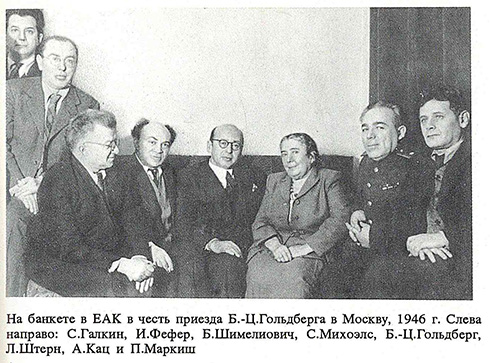
The history of solidarity of the Jewish Anti -Fascist Committee was created on the tragic days of the Great Patriotic War along with other anti -fascist committees - Slavic, scientists, youth and women. He acted at the Sovincorm Bureau, the Soviet propaganda organization. Committees were created in order to form world public opinion in favor of the USSR. In August 1941, when the Nazi troops occupied a significant part of the country and rushed to Moscow, the Stalinist regime turned to the Jews of the world. On radio impressions, prominent figures of Jewish culture called on “Jewish brothers around the world” to help the USSR.
Almost at the same time, the two leaders of the Polish Bund* (* “Universal Jewish Worker Union”, the Social Democratic Organization, created in 1897 in Vilna, united Jewish workers and artisans of the Western regions of the Russian Empire.) Fleas from the occupied Poland to the Soviet Union-Henry Erlich and Victor Alter proposed to create an anti-Hitler committee, consisting of Jews of various countries. Their project was essentially accepted, but ... without their participation. And they themselves were arrested by the NKVD. The first was executed, the second committed suicide. Stalin decided that the Jewish Anti -Fascist Committee should be created, but exclusively from Soviet citizens. The Jewish public was supposed to inform the Jewish public, primarily the United States, Great Britain and other countries of the anti -Hitler coalition on the struggle of the Soviet people against fascism, through the Jewish organizations of these countries to achieve material assistance and the speedy discovery of the second front against fascist Germany.
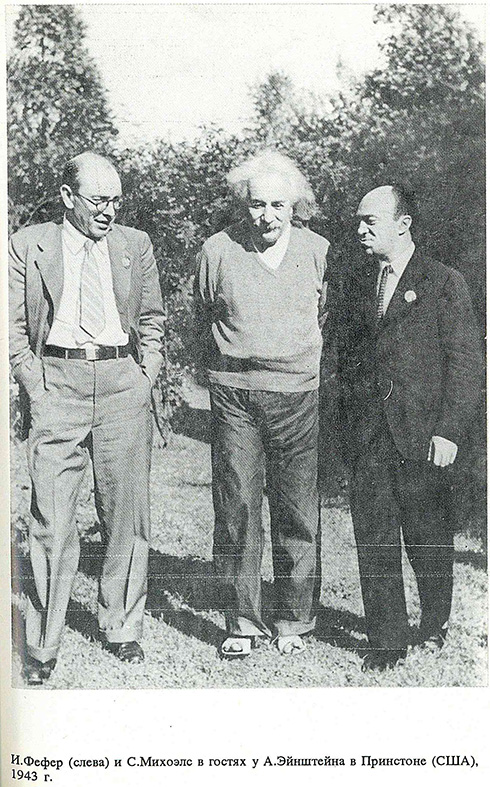
The chairman of the EAC was appointed an outstanding actor Solomon Mikhoels. The EAC began to issue a newspaper for Yiddish "Ainicait" ("Unity"). The publication spread mainly abroad and wrote about Nazi atrocities in the occupied Soviet territories and heroism of the Jewish fighters of the Red Army. At the initiative of the Committee, funds were raised to get the Soviet Birobidzhan tank column. At the end of 1943, Solomon Mikhoels and Isaac Fefer went on a propaganda tour in the United States, visited Mexico and England. As a result of their speeches at thousands of rallies in the USSR Assistance Fund, tens of millions of dollars were raised.
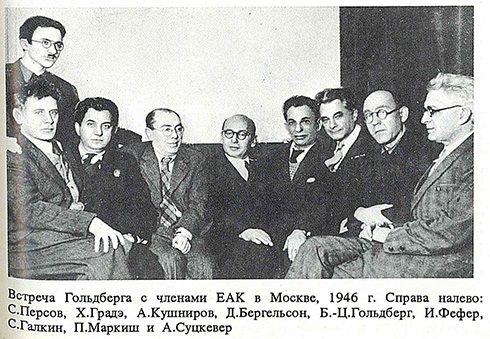
Exiting the flags
At meetings with the leaders of Jewish organizations, the United States was talking about the fate of Soviet Jews during and after the war. EAC activities were focused purely on foreign policy propaganda activity. Nevertheless, a significant part of the Jews in the situation of war, the Nazi genocide and the strengthening of anti -Semitic sentiments in the USSR perceived the EAC as its representative. In the last period of the war, the leadership of the committee received many letters that were told about cases of anti -Semitism, that it was impossible to return after the liberation of the Western territories to the previous places of residence, get a job, etc. EAK turned to the highest leadership, in particular, in the mid -1944 he turned to the Molotov deputy chairman with a proposal to create assistance to assistance at the Committee. Jews affected by the war. These appeals usually caused a negative reaction at the top or remained unanswered. In the hope of the best structure of life after the war, after the victims incurred, the EAAC leadership, clearly overestimating the role that he was assigned, discussed the idea of creating in the European part of the country, possibly in Crimea, Jewish autonomy. In February 1944, this idea was discussed with Molotov. As a result of that conversation, the EAC leaders sent a note to Stalin with a proposal to create a Jewish Soviet Socialist Republic in the territory of Crimea and appoint a government commission to develop this issue.
Stalin undoubtedly got acquainted with this letter. But he left him unanswered. A few years later, that note was useful for the factory on the Lubyanka of the Zionist Conspiracy. In Stalin, the “Crimean project” approved by Stalin was interpreted in this way: “Acting by direct conspiracy with representatives of American reactionary circles, the accused ... harassed from the Soviet government the provision of the territory of the Crimea to create a Jewish republic there, which the Americans hoped to use as a bridgehead against the USSR.”
Soon after the war, an anti -Semitic campaign was deployed in the country. EAC in the quality in which he acted during the war, the authorities were no longer needed. He was already intended for a completely different role: from now on, he should have appeared in the image of the Center for Jewish Nationalism and Spying, performing the tasks of American imperialists. In October 1946, the MGB presented a note "On nationalist manifestations ... in the EAC." However, the situation in the Middle East obviously delayed the decision to “develop” the EAC. Stalin used the struggle of the Jews in Palestine against Britain, turning the future Jewish state into a guide of Soviet influence.
Meanwhile, the MGB continued to fabricate the “EAK case”. The first wave of arrests among the Jewish intelligentsia passed. According to the MGB scenario, the EAC leaders on the instructions of American intelligence mined information about the life of Stalin and his relatives. After the murder in January 1948, Solomon Mikholes, Lozovsky, appeared as the main conspirator. In March 1948, the Minister of State Security Abakumov reported to Stalin that “as a result of Chekist events” it was established, supposedly the leaders of the EAA (among them were primarily named Lozovsky), conduct anti-Soviet nationalist work ...
The defeat of the EAA was postponed due to the Middle East situation. In May 1948, the Soviet Union was the first in the world to recognize the state of Israel and announced his readiness to establish diplomatic relations with it. However, the unwillingness of Israel to become a guide for the influence of the USSR and the enthusiastic reaction of part of the Soviet Jews to the proclamation of the independence of Israel* (* Soviet-Israeli relations. Collection of documents. T. I, book 1. M: International Relations, 2000.) finally dotted all points over I. In November 1948, the Politburo decides on the immediate dissolution of the EAC.
Tragic finale
The arrests began in the fall of 1948. In total, from 1948 to 1950, more than a hundred writers, scientists, journalists, party and statesmen who were accused of “criminal ties with the EAK” were in conclusion.
The arrested were mercilessly tortured. Yuzefovich testified in court: “At the very beginning of the investigation, I ... told investigators that I did not feel any crime after me. After that, I was called by the Minister of State Security of Abakumov and said that if I do not give conference ... they will beat me. And before that I had been “crumpled” for several days. I answered Abakumov with a refusal, then I ... began to beat me with a rubber stick and stomp with my feet when I fell ... I decided to sign any testimony, just to wait for the trial day. "
The brutally beaten Shimeliovich, whom Abakumov ordered the required testimony to “beat the death battle”. The arrested non -stop was beaten with rubber sticks, they brought on interrogations from the camera on a stretcher and continued to beat. In his statement at the MGB Shimeliovich, he showed: “The protocol of my interrogation was signed by me ... with an unclear consciousness. This condition was the result of my methodological beating within a month daily. Cocking and bullying and mockery took place day and night. ”
Suskin, after the murder of Mikhoels and relentless surveillance, was in a state of deep depression, was arrested during the treatment procedure in the clinic for the neuromeds. He also did not escape torture.
Stern said in court: “For three years, interrogations were going on ... After you stay at the interrogation for the whole night and come to the camera in the morning, but you are not allowed not only to sleep, but also to sit ... I felt that I could go crazy.”
A real conveyor of interrogations was arranged. The pepper of Markisha first months after the arrest was interrogated daily two to three times a day, a total of 12 hours a day. The management of the MGB reported to Stalin about the successful progress of the investigation.
What other “crimes” were incriminated with active EAC figures and related (or specially involved in the case) other accused?
This is a “criminal connection with Jewish nationalists in the USA” (the fact of the trip of Mikhoels and Fefer on the instructions of the Soviet authorities to America was used), “sending information about the USSR economy” (materials from Soviet open press), “propaganda of nationalism”, “Jewish nationalist speeches”, “sings of Jewish antiquity”, “town traditions”, and an exaggeration Jews in world culture (consisting in the fact that Jewish writers and poets wrote in their native language, spoke at anti -fascist rallies and wrote about the history and culture of their people), as well as the fact that “on the assignment of American intelligence” raised the question of “the settlement of the Jews of Crimea and the creation of the Jewish republic there” ... (Crimean project). It turned out that some of the accused "hostilely met the Great October Socialist Revolution and fled abroad." Others, on the contrary, arrived in the USSR not in order to build socialism, but to lead "under the flag of the EAA of hostile nationalist activities."
Not only EAC members, but also the vast majority of Jewish writers, artists, artists, musicians, many representatives of cultural, technical, and production intelligentsia were subjected to repression. At the same time, it begins to gain momentum of the “Doctors' Case”, which opened the way for a new wave of mass repressions in the country.
Bun on culture
On April 4, 1952, the Minister of State Security Ignatiev sent the text of the indictment to Stalin: “I present to you ... an indictment in the case of Jewish nationalists, American spies of Lozovsky, Fefer and others ... with a proposal to condemn Lozovsky, Fefer and all their accomplices, with the exception of Stern, to execution.” On April 5, Stalin approved the indictment. The trial turned out to be nothing more than a farce. 12 августа заранее вынесенный приговор был приведен в исполнение.
На Донском кладбище в Москве усилиями Международного культурного центра имени Михоэлса в 2004 году был открыт мемориал. Памятник, выполненный скульптором Марком Шубом, представляет собой гранитную стелу, на которой высечены имена казненных и изображен еврейский национально-религиозный символ — семисвечник-менора. Памятник установлен на месте предполагаемого захоронения членов ЕАК — общей могилы для расстрелянных в те годы. Имеется скромный мемориал и в Иерусалиме.
Шестьдесят лет назад в СССР был казнен цвет еврейской культуры — выдающиеся поэты, писатели, ученые, журналисты. Еврейский язык и еврейская культура на долгие годы были поставлены вне закона: еврейские театры ликвидированы, издание литературы и преподавание на еврейском языке прекращено. Лишь в конце 1950-х годов советские власти под нажимом либеральных и коммунистических кругов Запада вынуждены были предпринять крайне робкие и осторожные шаги по восстановлению еврейской культуры.
Однако Холокост и сталинские репрессии сделали свое дело. Еврейская культура в Советском Союзе так никогда и не сумела оправиться от этого тяжелого удара. Язык, на котором творили расстрелянные писатели и поэты, стал неким экзотическим украшением, литература на идиш стала фактически недоступной. Литературный идиш фактически превратился в мертвый язык. На одну из неповторимых красок в палитре мировой цивилизации стало меньше.