
Translated material
Light boards. Memory of Mikhail Abramov
My friend and I stood in the church of the ancient (very ancient) Russian city. The church is the end of the 17th century, the painting is a solid such beginning of the XVIII. An interesting time - the tradition has already rested on Europe, but has not yet completely broken. The faces are registered in the Fryazh manner, but figures and colors are from ancient Rus'.
A good church woman let us into the closed temple for a donation, but this is a trifle in every sense. She started to explain the plot to us. But there the plot is understandable: the entire lower belt is the acquisition of the life -giving cross. The pious Queen Elena, the mother of the holy emperor Constantine, goes to the city of Jerusalem with a letter from son to Patriarch. The queen sits in a gold cart - so our master, clearly from the locals, the school is identified at a time, imagined a chariot. And this is touching, and yet-there is a background, sugar white cities and blindly-blue sky.
The iconostasis was broken, some icons were settled in local museums, some left for Moscow, and some disappeared without a trace. The fate is ordinary. They make a new one - it is impossible without an iconostasis, plastic plus a bright varnished vulgarity from the famous Sofrinsky factory.
The church woman tried to get enthusiasm for us and about Sofrin's products, did not achieve, was upset, thought: she thought:
- Are you restorers or what?
- No, we just look, we are looking at.
- I see, restorers. Anna Nikiforovna, go, look, then the restorers arrived!
So we became restorers - honestly, not through our fault. They stood and looked at the frescoes, and two nonsense ladies - at us. We, however, did not restore anything, thanked, left.
The fate of the icon
It is not easy to find the right words here. “The Russian icon was not particularly lucky, neither in tsarist Russia, nor even in the Soviet Union,” I want to say something, but it comes out somehow too lightweight. In Russia, not without violence, the European elite ate Europe and appreciated its taste, but she learned everything to be considered uninteresting and wild. A real, scientific interest in icon painting appeared closer to the end of the 19th century. And at the beginning of the 20th, the tradition of ancient Russian painting was discovered, admired, and rushed to study. Muratov and Grabar found a language for description, experts began to deal with schools, artists - and nervous modernists, and uncompromising avant -gardens - were inspired by the laconicism and courage of the work of old masters.
It suddenly turned out that these are not just dark boards in old churches and family kivots. There, under the Olipho, blackened over the centuries, is a whole world. It is only necessary to clear it carefully, remove numerous ponies, return to the world what was hidden from the world. In our past, there is a real beauty universe, which educated Russia simply forgot how to see. Sometimes - bright and colorful, and sometimes - a strict and ascetic Russian Middle Ages, a little protracted, but left behind an almost endless stream of masterpieces.
Then there was a revolution. Some connoisseurs escaped, killed other experts, but-here an amazing paradox-it was the new power that destroyed the church, helped Russia to recognize its ancient art for real. Previously, the church is quite reluctant (and this is still very mildly said) allowed restorers to work, now the church has lost influence. It is almost impossible to believe in this, but before the October Revolution, no one knew how the Rublevo “Trinity” looked like on itself. This ice light did not burn his soul to anyone. For us, it is a symbol, given, that which has always been and without which there is neither Russian history nor Russian culture. But until 1904 and she was a "dark board." Then she was barbarously restored, or rather, recorded. And only in 1919, restorers, led by Count Yuri Olsufiev, returned the Trinity to people. Olsufiev was killed in 1938, lies at the Butovo training ground.
History seemed to play with an icon in the twentieth century in a terrible game. The main Russian catastrophe, devouring both people and churches, made it possible to discover ancient Russian art. In the historical museum, in Grabar workshops, restorers earned in the Tretyakov Gallery. The commission created by the Bolsheviks to preserve the monuments of ancient Russian painting, in which outstanding experts worked, not only saved that it was possible to save from the churches ruined by commissars, but also found old masterpieces in sheds, on the bells, under layers of blue droppings. It was the employee of this commission, the hereditary icon painter and the great restorer Grigory Chirikov, who found in the wood of the Assumption Cathedral in Zvenigorod and saved three icons of the “Zvenigorod rank”, which attributed Rublev for a long time. Now it is proven, it seems that this is another Moscow artist of the beginning of the 15th century, whose name we do not know. But this does not make them worse, and saved from the “rank” - a masterpiece is completely unconditional, it could envy Italian masters.
Chirikov in the 1930s for “participating in a counter-revolutionary organization and wrecking” served, went out and died in 1936. The Chekists were already interested in them, he managed, one might say, to die. Otherwise, they would certainly be killed.
Thousands of icons died like people, but thousands were chosen from under the age-old soot in order to tell the survivors something new about them. About our past and about our place in the world.
When money was needed for industrialization, the councils began to actively trade museum values. They would have sold out - there is no doubt - and the main masterpieces of icon painting, but the icons were first saved by great depression, and then the Gulag.
In the early 1930s, a grandiose exhibition of Russian icons in the West was organized, which was triumphant in Germany, England and the States. It was an advertising trick - Europe and America showed a new product. And now the whole world has learned about the incredible wealth of our past. But the economic crisis struck, and there were simply no rich buyers for a new product. Therefore, the "Trinity" - with us, and not in one of the overseas museums of elegant arts.
The Hermitage, as you know, was less fortunate: US Minister of Finance Andrew Mellon found $ 7 million to buy dozens of masterpieces; There was a thing with the icons. Well, how it did. Many of them were sold through the Torgsin and Antiques organizations, including first -class ones. About this there is an excellent book by Elena Osokina’s historian “Heavenly Blue of Angel Clothes”, exposing at the same time the sensational stories of Vladimir Tetereyatnikov about the “Stalinist factory for the production of fake icons”. Alas, the union was not at all fakes.
And then, at full power, the gold mining enterprises of Dallaga earned, and the state became uninteresting to trade in works of art. Small, income is not the same, slave labor was more profitable, contrary to the omnipotent teachings of Marx.
Yes, by the way, although what kind of "by the way." One of the organizers of the exhibition that showed the world the Russian icon was the historian and restorer Alexander Anisimov. He was killed in 1937. Lies in the tract of Sandarmokh.
And the fate of man
Then there were new-already Khrushchev-persecution, and the semi-underground fashion for ancient Rus', and the clumsy, but at least somehow told the Soviet people about their invisible wealth of the book of Vladimir Soloukhin “Letters from the Russian Museum” and “Black Boards”. And the Church, which was driven into a corner, and expositions in museums, and unwillingness, inability to tell you about what we actually own.
There is no this desire now, in the new Russia. The church, gaining strength, does not rush to be friends with intellectuals, intellectuals do not want anything but savagery, to notice within the church. And it’s difficult in a different way, when the lady of the ex-prosecutor broadcast on behalf of the church, then some dangerous madmen, exposing the intrigues of the Jews and calling for a nuclear war on our heads, and the highest hierarchs feel quite comfortably in the role of the leaders of the informal Ministry of Agitation and Propaganda.
For the church, the icon is primarily-something like a liturgical instrument, and only then and not for everyone-the masterpieces of painting. That is why church old women rejoice - from naivety, from misunderstanding, not from evil - lacquered squalor of the new veins, not particularly paying attention to the old boards. For most secular people, they are in museums - something incomprehensible and strange, which you need to run by for order and forget. From boring museum halls and churches smelling with damp - into the air, where animators and the ability to make a beautiful selfie.
Again, the pit, again, the gap, where for centuries the copied beauty could become a bridge between the warring sides for some reason and disturb something in the indifferent. Look into the deep, dark eyes of the saints from restored, open boards. They are both the few that the Mongols experienced, and those who painted at the end of the 17th century icon painters who realized their greatness of the Moscow kingdom, inspired by engravings from the Dutch Bible of the squeak, - we say one thing: we are Europe. We are part of the Christian civilization. Special, of course, and who is not special? All are different, but our road is definitely common.
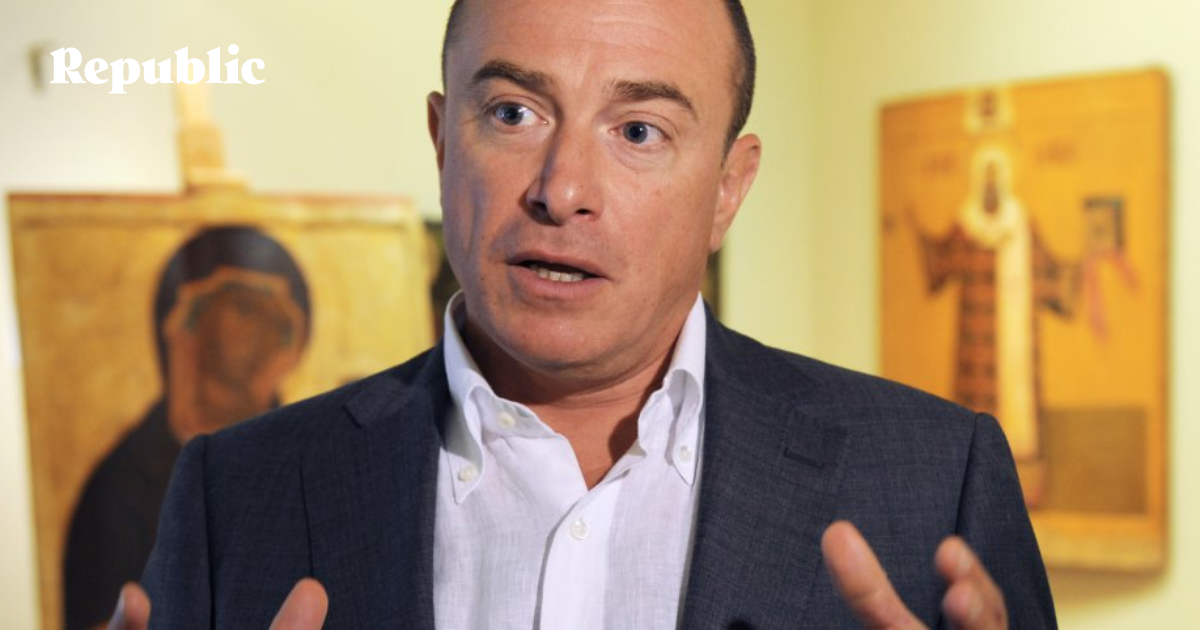
We have abundant beauty in abundance, but after all, people who can open it are needed. Show this very way to human community through your own, through what has grown here. Businessman Mikhail Abramov, who died on August 20 in a plane crash in Greece, was just such.
A successful entrepreneur, biographical information - in the public domain, probably not sinless, like everyone else. This is not important now, he now has another judge. And we have what he managed to do. He himself really could not explain why, how was carried away by collecting icons. But he became interested in - relatively recently, at the beginning of the zero. However, there are many collectors, and Abramov created his own museum. Big, real, conducting magnificent exhibitions. Ryazan, Pskov, Yaroslavl, Rostov icons, among other things - real masterpieces. Art historians worked in the museum, the museum published books, and - this is a trifle, of course, but also important - there was a free entrance to the museum.
He was looking for icons in Russia, bought at Western auctions-the very ones that left us in the terrible 30s-spending very impressive amounts on the replenishment of the collection and the maintenance of the museum. He gave something to provincial museums. And he had everything in Taganka somehow humanly, or something. Special air, a special sense of intimacy both to history-general, and to the incredible beauty that everyone feels in their own way.
Where love is real, it always turns out humanly. And yes, by the way, why was it “was”? There is a museum and, I want to believe, it will remain. Moscow, Goncharaya Street, house 3. The son, they say, shares his father’s hobby. But hobby is one, passion is another. Both sad and scary for the museum. Go, suddenly there will be no chance after.
Now it’s too late, and if nothing, probably, but I still want to say thanks to Mikhail Abramov. For the museum, for time in it, for the opportunity to show it to friends - as a miracle. Here, we have such a place in Moscow, and there was such a person. Bright memory. Anyone who saves beauty works for freedom, we will not forget about it.
In 1929, Maximilian Voloshin wrote the poem "Vladimir Mother of God":
But the blind people in an year of anger
He gave the keys of his strongholds himself,
And the printer-girl left
From their scolded shrines.
And when kumashny plates
They raised a scream in front of the churches -
From under the RIZ and a devout corn
You showed your genuine face:
Bright face of wisdom-sophia,
Troused in the Skaul Moscow,
And in the future - the face of Russia itself -
Contrary to the seducts and rumor.
Beautiful and terrible, it is dedicated to Alexander Anisimov, to the very one who organized the first Soviet icon exhibition and which was then killed in Karelia. Dedication is:
Faithful guard and zealous guardian
Mother Vladimir - you -
Two keys: gold - in her monastery,
Rusty - to our woeful fate.
Probably, these words are now about Mikhail Abramov too.
PS
The time is bad again now, and you can’t do without a postscript. History loves cruel rhymes. The doctor of strange sciences Vladimir Medinsky is fussing: “Abramov created a museum all his life, this was his main brainchild. He was baptized at a conscious age, for a long time went to this. I don’t think he wanted the museum to leave his family. ” Hinting, that is, that the state will not spend money on the museum. Medinsky is fussing, and people from his Russian military-historical society ruin the executed graves in Sandarmokh to put their executioners. Maybe Anisimov’s grave has already been defiled.