
Translated material
"Marriage History" Noah Baumbaka: a quiet drama about a divorce
Cast - Adam Driver and Scarlett Johansson
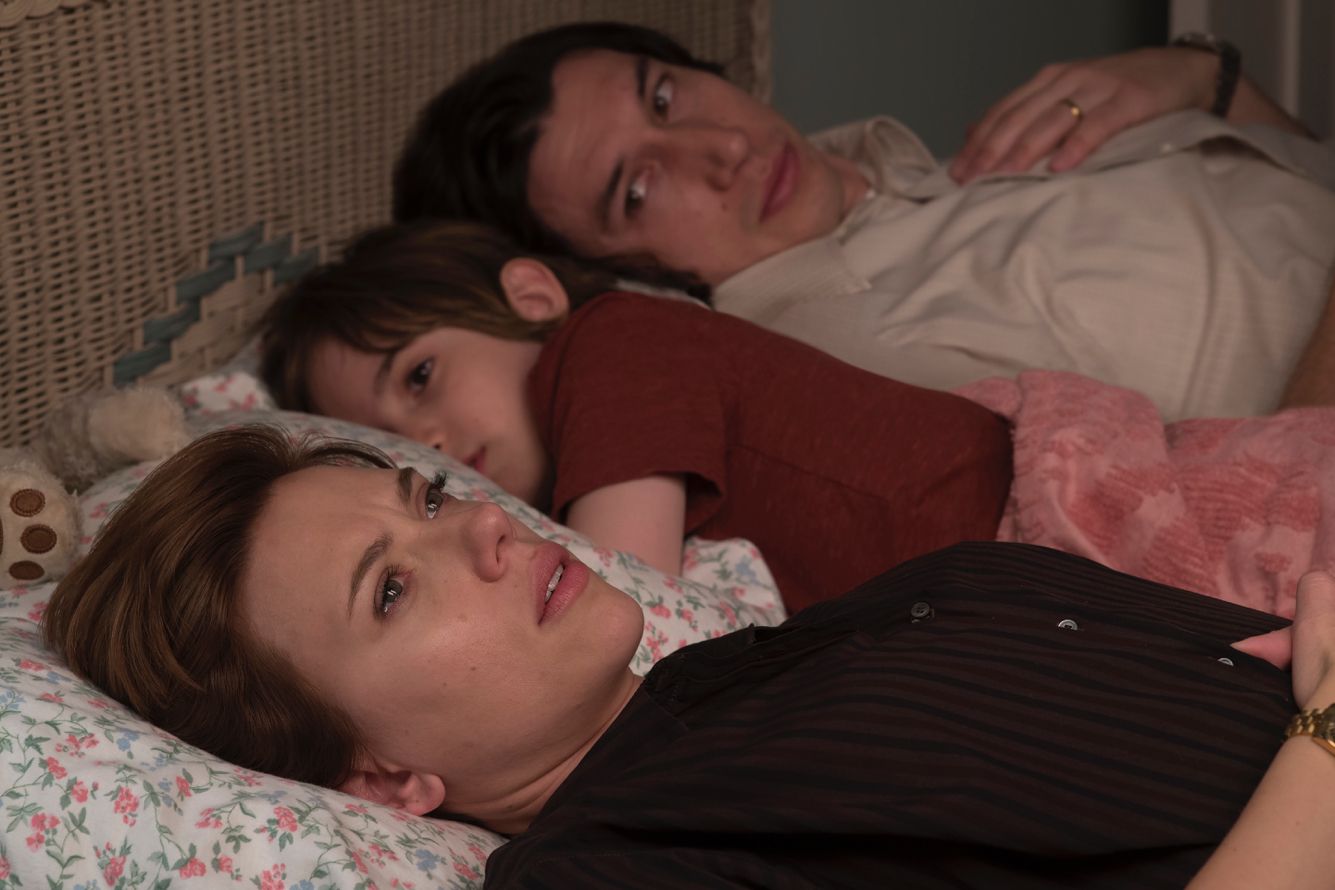
Netflix entered the “marriage story” - the drama of the American director Noah Baumbak. The main characters are the New York director Charlie (Adam Driver) and the actress from Los Angeles Nicole (Scarlett Johansson) are worried and try to determine in court with whom their eight-year-old son will remain. The film critic of Medusa Anton Dolin tells why the destruction of the family is increasingly appearing on the movie screens, and as this time the director gave the voice to both sides.
This material was first published on August 29, immediately after the premiere of the "marriage history" at the Venice Film Festival.
The number of plots is limited, theorists say; There are no more than fingers on their hands. The twentieth century added at least one new to the list - divorce. Previously, men parted with women as they wanted, the same could perhaps die or go to the monastery. The situation in which women suddenly received equal rights with men (at least in theory) gave rise to the plot of voluntary parting. Like all important stories, this one contains duality: divorce is always pain, but also liberation. Of the millions of liters of tears spilled by the survivors of the divorce in pairs, several crystal masterpieces were scandalized. Only in the cinema: “Scenes from marital life” and “Kramer v. Kramer”, “Do not part with your loved ones” and “Husband and wife”, “Divorce of Nadera and Simin” and “Dislike”. From now on, this list included “Marriage History”-apparently the best film by American Noah Baumbak.
Charlie (Adam Driver) and Nicole (Scarlett Johansson) - a harmonious couple. He is a theater director in New York, whose new production is about to start on Broadway; She is an actress from Los Angeles, who found herself on stage and became his muse. He is scattered, generous, inventive, generous, he is an ideal father for their eight -year -old son. She is a wonderful mother, and also beautiful, smart, independent, attentive. Both are not only loving people, but also excellent comrades. We will learn this in the first ten minutes, listening to Nicole's monologue about Charlie and the monologue Charlie about Nicole. They wrote them at the request of a family psychologist, and now they refuse to read them aloud to each other. The session develops into swearing and ends, not really starting.
Nicole is about to leave where she grew up in Los Angeles: there she was offered a pilot of a promising fantastic series, her mother and sister live there. Charlie cannot follow her - he has a person in front of Broadway rehearsals. Maybe the reason for their separation in this. Or that Charlie slept with a girl from the troupe. Or that he slept with her due to the fact that Charlie’s sexual life and Nicole stopped. Or in some ways: data and not fulfilled promises that have accumulated irritation, contrary to each other's ambitions. The West is the West, the East is the East, and they can’t converge together: these words could be written about New York with Los Angeles. Among other things, “marriage story” is a film about America, its paradoxes and internal conflicts. But to a greater extent - about feelings and mind, more precisely, about the victory of the first over the second.
Baumbak earned fame and love as the voice of the hipster generation - urban neurotics, narcissistic and uncertain in themselves, miserable and touching at the same time. Such were the heroes of Kalmara and Keith, Greenberg, Cute Francis, who could not grow up, no matter how many years they were in passport. Where the director was sometimes filled with tenderness, another viewer shrugged perplexedly. But something, but the spirit of time Baumbak conveyed more precisely to many. It is believed that time does not stand still: it makes you grow up. Or not? The previous film, “The Stories of the Meyrovits Family”, showed that even the death of a loved one would not pierce the psychological armor of the Baumbakov’s eternal teenagers. And suddenly a miracle happened: it was the divorce that turned out to be a fundamental test of maturity, which Baumbak withstood. The result was an amazingly smart, thin, delicate picture.
It can be argued that the “marriage story” is more like a television film, as evidenced by the puppet-widened music of Randy Newman, and the Irish Robbi Ryan, the Irish Ryan, emphasized the operator work of the Irish; No wonder Netflix produced the picture. But Bergman proved that the theme of divorce requires intimacy and asceticism. The level of artistic ambition should be reduced to a minimum, so that the human, understandable to everyone, will speak in actors and characters - and touch the viewer, otherwise nothing will come of it. With the story of parting, any of us can be identified, but only if it avoids falsehood. In the “scenes from marital life” (Baumbak could not resist and quoted them directly) there is only a brilliant script, two magnificent artists and a camera directed at them. More or less on the same principle, a “marriage story” is built.
The actors, taking advantage of the opportunity, jump significantly above their heads - in other scenes it seems a miracle. The ironic driver of the driver and the compressed energy of Johansson here enter into such a chemical reaction that it begins to spark. It is impossible to break away from them. The second fighters are the second fights in the deadly duel of the ambitions-Laura Dern connects the infernicity with the bitchiness of her heroine from “Big Little Lie”, and from the cold gaze of Ray Lyutta goosebumps on the linch films: it seems that now he will kill someone. These two play lawyers in the divorce proceedings.
As was said, the story about divorce is a relatively recent one. And yet not new. A resident of the 21st century Baumbak turns it into a study of subjective realities, the mismatch of which becomes obvious in critical moments of life. Charlie and Nicole have different pictures of not only the world, but also their own relationships, let them consist of the same, deliberately banal, set of facts. The human rights doctrines of modernity are built on the concept of a “other voice” that we must learn to hear; It is this difficult science through pain and loss that Nicole and Charlie learn. And with them the audience. Viewing the “marriage story” can work both as therapy and as preparation for traumatic experience (for which, honestly the film is recognized, it is still impossible to prepare).
A touching fact: no matter how the author tries to observe the parity - and, in fact, manages not to show any of the heroes more guilty than the other - there is no doubt that he sees himself in Charlie, and sympathizes with him more acutely. You won’t run away from yourself: Baumbak himself is a director from New York, who survived a divorce from the actress. But, at least, he does everything possible in order to understand the one with him, and not to repeat the mistakes made once. The attempt is counted.
Anton Dolin