
Translated material
How to store money abroad and do not break anything. The instructions The Bell
UPD. dated January 7, 2020. This article was published in August 2019. Since then, important changes have occurred in the currency legislation: since 2020, any currency operations can be made on accounts opened in the EURSECS countries or in countries that are exchanged in financial information with Russia automatically (the relevant law was adopted on December 27, 2019). In the list of these countries (its last version, the Ministry of Justice registered on December 24, 2019) is Cyprus, Malta, the British Virgin Islands and other offshore jurisdictions popular among Russians, but there is no UK. In the previous version of the innovations, it was assumed that without restrictions from the beginning of 2020, it would be possible to conduct operations on accounts in the OECR or FATF countries that exchange information with Russia.
In early August, Vladimir Putin signed a law on the liberalization of foreign exchange operations. According to it, since 2020, the owners of foreign accounts have been waiting for a lot. The main change is from operations on accounts in the most transparent, from the point of view of tax authorities, countries will remove almost all restrictions. It will be possible to enroll any funds from non -residents and some from residents without fear of fines. But there are bad news: from the New Year, not only banking, but even all accounts, including brokerage and insurance, will fall under the law on foreign exchange control. This means that they will need to report to the Russian tax. And the funds can only be enlisted on them only in cases that still have to be set by the Central Bank.
The Bell compiled instructions on how to use foreign accounts, taking into account all the innovations, and do not violate anything.
.card [Data-Color = " #FD371D"]: BeFore {BACKGROUND-COLOR: #FD371D; } .card [Data-Color = " #FD371D"]: After {Background-Color: #B22715; }
Who is it for
Citizens of Russia and those who have a Russian residence permit - their law calls residents, but only if they spend more than 183 days in Russia during the calendar year.
- If you spend more than 183 days a year abroad (in total, and not in a row), you do not need to report to the Federal Tax Service regarding the foreign account. You can perform any operations on it. For you, this instruction is not relevant.
- By the end of 2019, everyone else should be reported only on bank accounts. ❗️ And since 2020 - and on other accounts in "other financial market organizations".
- What to consider such accounts and organizations is incomprehensible, but it is almost certainly about brokerage accounts, lawyers surveyed by The Bell say. In addition to them, insurance organizations or NPFs can fall under currency regulation in theory, but lawyers do not have confidence in this. And the press service of the Federal Tax Service of this and other questions The Bell did not answer.
? What is the catch: the current reporting forms for the Federal Tax Service on the movement of funds are not technically adapted for reporting on any other accounts except banking. It is not clear whether it will be necessary to report on the receipt of funds to the account or on the arrival of papers, to show their monetary assessment, and if so, how to determine it, the director of the group for the provision of legal services to banks and financial institutions of the PWC Legal Ksenia Grickepanova warns.
.card [Data-Color = " #F8b831"]: Before {Background-Color: #F8B831; } .card [Data-Color = " #F8B831"]: After {Background-Color: #AE8123; }
What to report about
According to the law, the owners of foreign accounts need to report to the Federal Tax Service on the opening, closing of the account, the change in its details, as well as the movement of funds in the account.
- While reporting on the movement of funds must be reported.
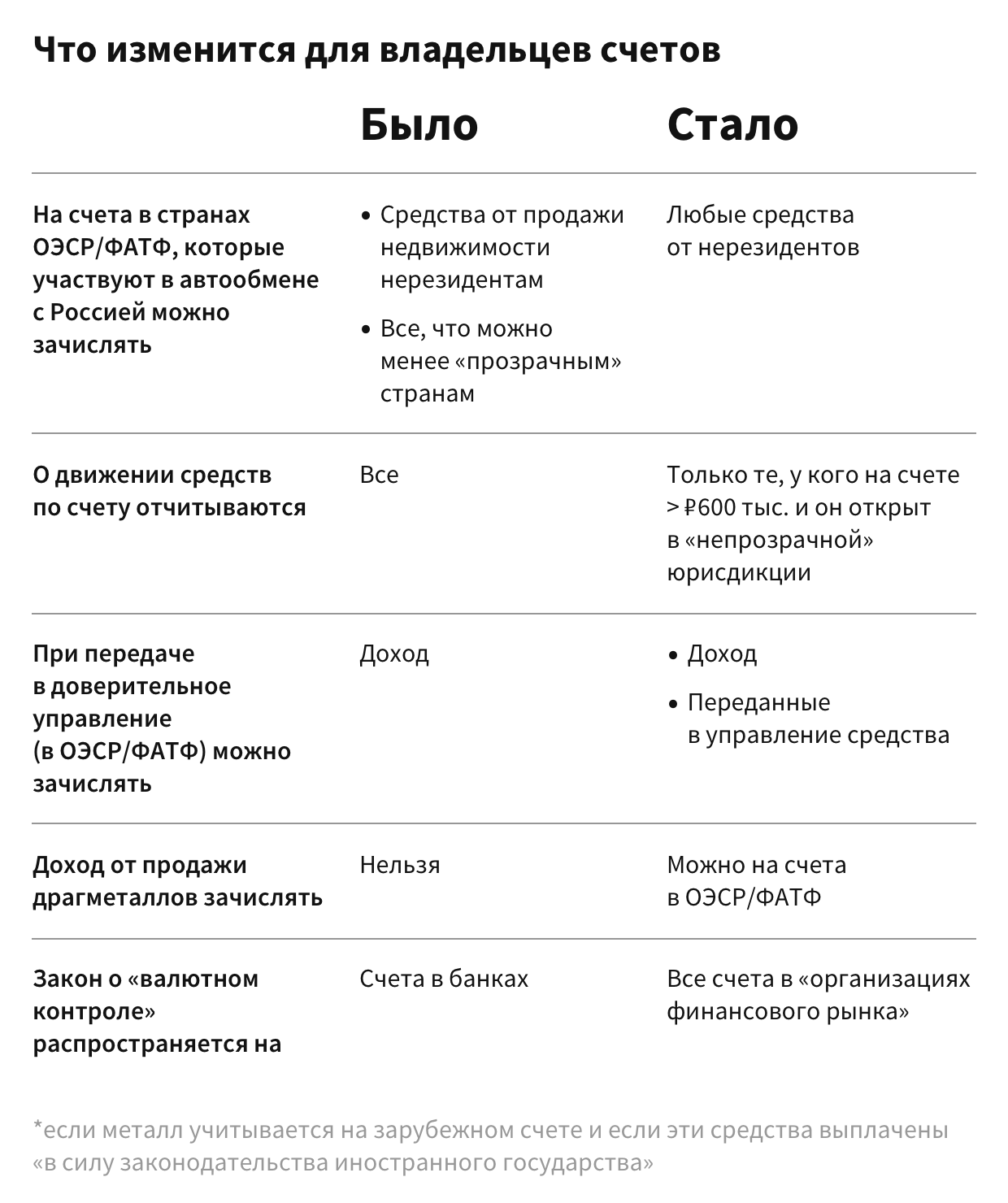
- ❗️ From 2020, it will be necessary to report if the amount of funds (credited, decommissioned or located on the balance) exceeds 600 thousand rubles. It is also necessary to report if the account is not opened in the country of the Fatf and the OECD , which carries out auto exchange with Russia.
- If the amount is less than 600 thousand and the account is open in one of these countries, then it is not necessary to report on the movement of funds.
? What are the catch: according to the current rules, everyone who concerns the “currency” law should report on the movement of funds. This must be done until June 1 of the year, which follows the reporting (that is, in 2019, you must report until June 1, 2020). But from 2020, the rules will change. Those who kept less than 600 thousand rubles on the account will not be necessary to report, provided that the account is open in one of the “transparent” jurisdictions. But let's say that according to the results of 2019, a person fell under these criteria (the funds in the account were less than 600 thousand, he was opened in “correct” jurisdiction). Then, according to the “new” rules, at the time of the report (summer of 2020) he no longer needs to submit a report, but, according to the “old” - at the time of operations, it is necessary. What to do?
- The law does not directly allow not to submit a report for 2019, which means the new rules will concern only the operations performed from the beginning of 2020, explains Andrei Lokis, special adviser on tax issues of the PEN & Paper Bar Assitus. In this regard, he still advises to submit a report.
.card [Data-Color = " #F8b831"]: Before {Background-Color: #F8B831; } .card [Data-Color = " #F8B831"]: After {Background-Color: #AE8123; }
How to report
When. About the opening, closing, changing the details of the account - no later than a month after the event itself. The report on the movement of funds must be submitted until June 1 of the next year (that is, for 2019, it is necessary to report until June 1, 2020).
How. Personally or through a representative, by registered letter or through the personal account of the taxpayer. Here is a form of notification about the opening and closing of a foreign account, but here is a change in details.
Where. Individuals - in the tax at the place of residence or stay. If there is neither one nor the other, then in the place where the property belonging to this person is located. If there is not him, then in any tax.
? What is the catch: it is not clear from what moment and how the tax counts 183 days. Here is an example: let's say you left for a year in Cyprus. You had a house in Limasol, and you decided to sell it immediately after moving. According to the law, such an operation can be painlessly performed only by those who spend more than 183 days in the calendar year abroad, otherwise it is a gross violation (because Cyprus is not part of the FATF or OECR). You know for sure that you will spend more time abroad, but have not yet had time, because the year has just begun. How to be?
- If a person knows that according to the results of the year he will spend more than 183 days abroad, he, in theory, can perform any operations without restrictions on his foreign account, says Lokis from the Pen & Paper lawyers college. There is a chance to earn a fine in this case, but then it can be challenged, the partner of Paragon Advice Group argues. True, so far this is only a theory: it is not known about real such cases. There is no way to notify the tax in advance that you have left for a year, it is not provided, he adds.
- However, there is a life hack: you can withdraw from registration at a constant place of residence in the local department of the Ministry of Internal Affairs to leave abroad for permanent residence, says Zakharov. The department must notify the IFTS within three days, and the applicant will be removed from the tax accounting for personal income tax. This should also remove the issues related to currency control, he concludes.
- So far, practices, in order to understand how the Federal Tax Service will act in such cases, is not enough, says Grickanova from PwC Legal. But in case of violations of tax legislation, the approach is this: if there is reason to attract a person, it is necessary to attract, and the court will figure it out.
.card [Data-Color = " #F8b831"]: Before {Background-Color: #F8B831; } .card [Data-Color = " #F8B831"]: After {Background-Color: #AE8123; }
What can be credited to a foreign account
Currency legislation is arranged on the principle of "everything that is not allowed is prohibited." In this case, the number of permitted operations depends on where the bank is located. The more “more transparent” the country, the wider the list of operations, the funds from which can be painted painlessly.
? What is the catch: since 2020, the law will regulate not only bank accounts, but also brokerage (or the very “accounts in the organizations of the financial market”, which we have already written above). They can be credited with funds in cases that the Central Bank will set. What kind of cases are these are not known. “So far, there are no cases of these cases in public access, and whether it will be ready by January 2020, it is not obvious,” says Grickepanova from PwC Legal. At the same time, the practice is inclined to the fact that there is no list yet, there are no permitted operations, it warns. The Central Bank is working to determine these cases taking into account the fact that the changes come into force on January 1, 2020, the Bell said in the regulator’s press service.
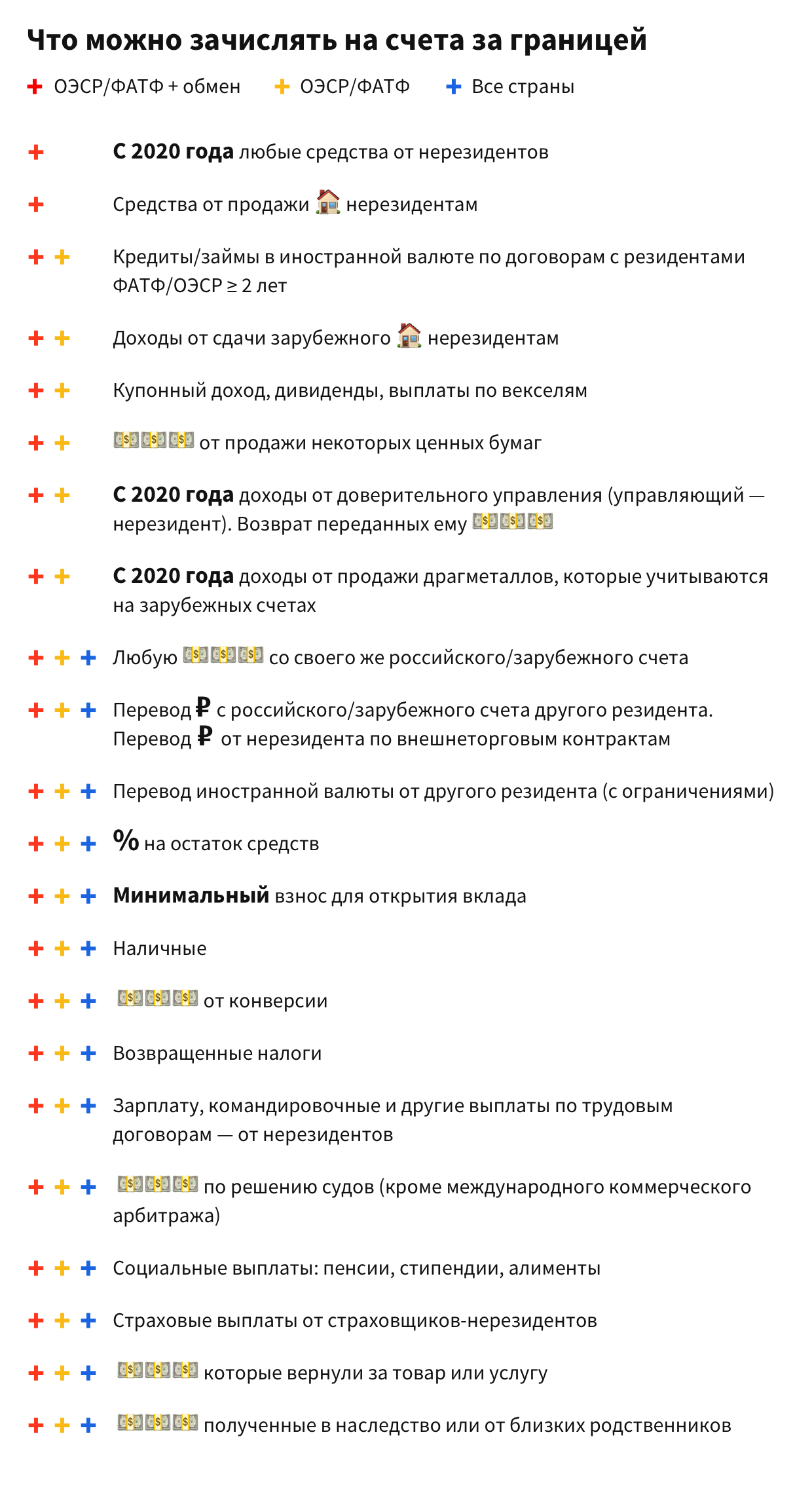
The law is allowed by different operations - depending on where your bank is located. In detail about what can be done and what is impossible - we will tell in the next three cards. And here is a short memo:
.card [Data-Color = " #F8b831"]: Before {Background-Color: #F8B831; } .card [Data-Color = " #F8B831"]: After {Background-Color: #AE8123; }
What is allowed in the most “reliable jurisdictions” Color =
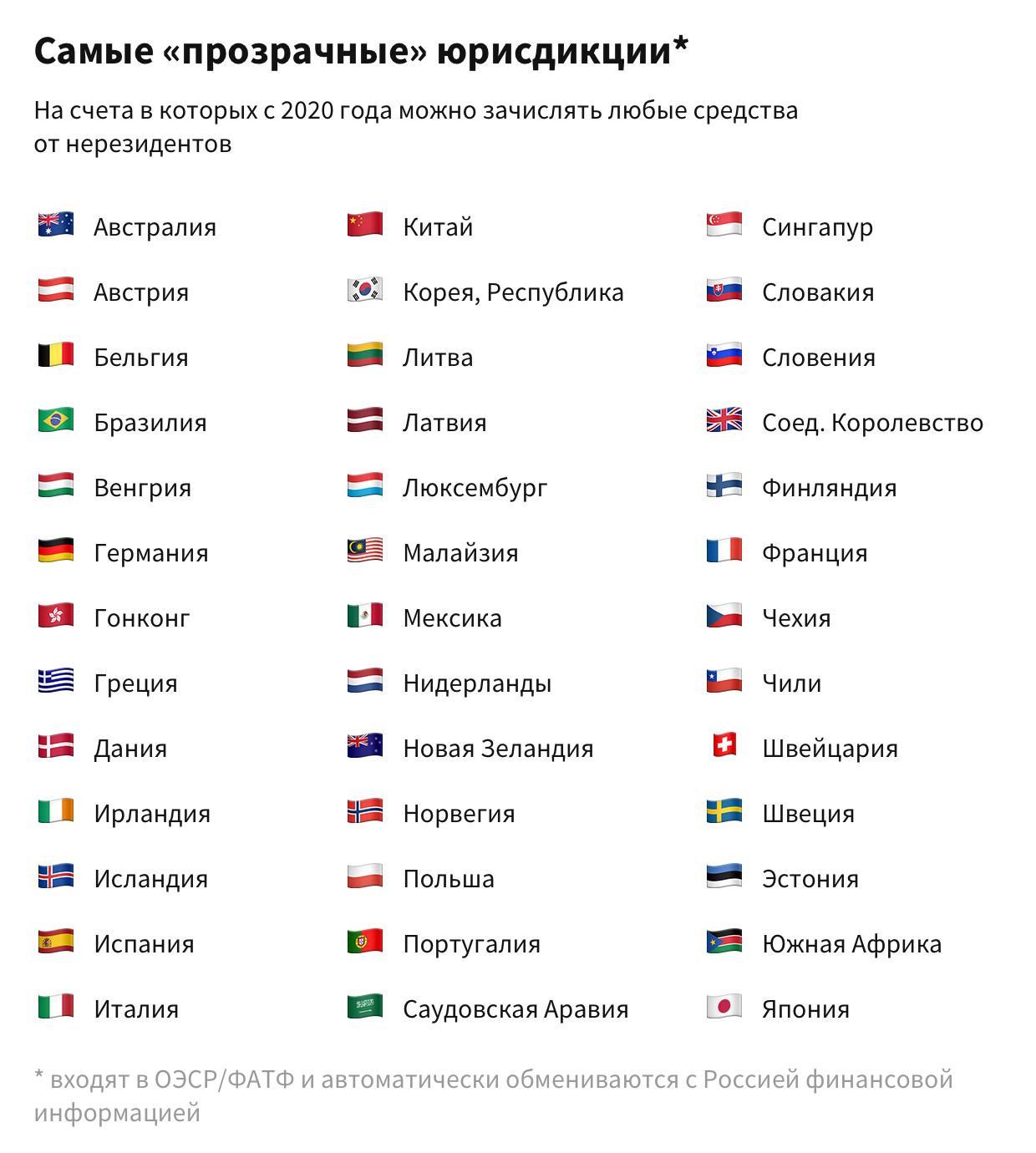
If your bank is located in the country of the OECD or FATF, which is exchanging with Russia financial information, then:
- ❗️ Since 2020, any funds from non -residents can be credited to accounts in such banks.
- Until that time, funds from the sale of real estate are non -residents (if it itself is in one of these countries).
- As well as funds from all operations that are allowed less “transparent” jurisdictions - we will list these operations lower.
? What is the catch: the OECR and FATF do not include many directions popular among Russians, in particular Cyprus. Therefore, for example, it is possible to enroll money from the sale of an apartment in Cyprus only to the Russian account.
A separate issue with Great Britain: it is included in the FATF, but excluded Russia from the list of countries with which it will exchange tax information in 2019. It turns out that it is impossible to sell a house in London and enroll money to a British account. Get a transfer to your account abroad from the account of a British friend at a local bank-too. So far, the Federal Tax Service has not removed the UK from the list of countries with which the exchange of tax information is underway, says Grickepanova from PWC Legal. But it is possible that this will happen in the near future due to the fact that the UK stated the refusal to exchange with Russia.
? Help: Here is a complete list of "most reliable" jurisdictions. But the picture that can be downloaded and used if necessary.
.card [Data-Color = " #1b64e1"]: Before {Background-Color: #1b64e1; } .card [Data-Color = " #1b64e1"]: After {Background-Color: #13469e; }
What is allowed in "less reliable" jurisdictions
If your bank is located in the country of the OECD or FATF, but Russia does not have auto exchange of tax information with this country, then:
- At the account in such a bank, you can enroll loans and loans in foreign currency under contracts with residents of the FATF / OECD for a period of two years.
- Revenues from the delivery of foreign housing for rent to non -residents.
- Cupid income, dividends, bonds and bills.
- Funds from the sale of securities that were listed on a Russian or foreign exchange from the list of permitted.
- Revenues from papers or funds in trust management, if the manager is a non -resident (❗️ and since 2020, also a return to the money transferred to the management of the non -resident).
- ❗️ Revenues from the sale of precious metals, which are taken into account in foreign accounts, are also since 2020, and only if these funds were paid "by virtue of the legislation of a foreign state." This reservation raises questions: this requirement may well not be spelled out in the law, but to be the norm of banking practice, says Grickepanova from PwC Legal.
- Funds from the sale of a vehicle non -resident.
.card [Data-Color = " #FD371D"]: BeFore {BACKGROUND-COLOR: #FD371D; } .card [Data-Color = " #FD371D"]: After {Background-Color: #B22715; }
You can enroll on any accounts abroad
- Any currency from your own Russian or foreign account.
- Transfer of rubles from a Russian or foreign account of another resident. ❗️ Since 2020 - transfer of rubles from non -resident on foreign trade contracts.
- Transfer of foreign currency from another resident from a Russian bank. If this is a close relative, then without restrictions. If you are abroad for more than 183 days and conduct entrepreneurial activities without the formation of a legal entity - too. For everyone else, there is a restriction: $ 5 thousand through one bank during the day.
- Interest on the rest of the funds.
- Minimum contribution for opening a contribution.
- Cash.
- Funds for conversion operations at the expense of the credit funds.
- Returned taxes.
- Salary, business trips and other payments under labor contracts - from non -residents. And from residents, if the contract provides for work abroad.
- Funds paid by decision of courts (except for international commercial arbitration).
- Social payments: pensions, scholarships, alimony and so on.
- Insurance payments from non-resident insurers.
- The money that the non -resident gave you for the returned goods or the service provided.
- Inherited or donated (close relative or spouse) currency values.
.card [Data-Color = " #FD371D"]: BeFore {BACKGROUND-COLOR: #FD371D; } .card [Data-Color = " #FD371D"]: After {Background-Color: #B22715; }
What threatens for violations
- The penalty for prohibited operations is 75–100% of the amount of the illegal operation (Code of Administrative Offenses of Article 15.25.1).
- The penalty for the fact that the owner of the account did not report on the opening or closing - up to 5 thousand rubles. If you reported incorrectly - up to 1.5 thousand rubles. If you delayed the report on the movement of funds for more than 30 days - up to 3 thousand rubles. For legal entities, all these fines are higher.
Just in case, in one picture we remind you that it will change since 2020:
.card [Data-Color = " #F8b831"]: Before {Background-Color: #F8B831; } .card [Data-Color = " #F8B831"]: After {Background-Color: #AE8123; }
What else is required from the owners of accounts abroad
- They are required to pay taxes if there are more than 183 days a year in Russia.
- The majority of operations that are performed on foreign accounts are taxed. Exceptions are obvious - receipt of scholarships, pensions and other social payments (the Tax Code of the Russian Federation Article 217).
- ❗️ An important point: when selling foreign securities, not only actual income is taxed with tax, but also a course difference, because the tax base is considered in rubles. Here is an example: the paper cost $ 100, for a year its price in dollars increased by $ 1, and the dollar exchange rate was from 50 to 60 rubles./$. The tax will need to be paid from 1060 rubles (60 rubles - the growth of quotations, the rest is a exchange rate difference). Moreover, the tax will need to be paid even if the quotes have fallen: when the quotes fall by $ 15, the cost of paper in ruble terms has increased. This is applicable to foreign and Russian accounts.
.card [Data-Color = " #1b64e1"]: Before {Background-Color: #1b64e1; } .card [Data-Color = " #1b64e1"]: After {Background-Color: #13469e; }
What will happen if you do not pay taxes
- In case of small violations, the fine will be 20–40% of the amount of unpaid taxes. The unpaid taxes themselves will also have to be paid.
- With large violations (from 900 thousand rubles over three years), the fine increases to 100-300 thousand rubles, and with especially large ones (from 4.5 million rubles in three years) - 200-500 thousand rubles.
- In addition to the fine, it will also be necessary to pay all taxes for three years.
- In the worst case, tax failure can turn into criminal punishment : up to a year of imprisonment for small violations, up to three years - with large ones.
.card [Data-Color = " #F8b831"]: Before {Background-Color: #F8B831; } .card [Data-Color = " #F8B831"]: After {Background-Color: #AE8123; }
What's next
The main consequence of the innovations may be a sharp reduction in controlled foreign companies (KIK) in Cyprus and other such jurisdictions, Filinov from PWC believes. This is also evidenced by Zakharov from Paragon Advice Group. In recent years, they have been actively created for the trading of securities. There were two reasons:
- Firstly, it was inconvenient to use a foreign account for the trading of securities, and sometimes it is impossible at all due to restrictions in the law on foreign currency control;
- Secondly, this made it possible to optimize the tax base: since the KIK tax base is considered without taking into account changes in the ruble exchange rate.
Ways to work in a foreign securities market were found quickly. “Abroad, for example in Cyprus, a controlled company is established. She opens an account with a foreign bank and trades through it with papers. Its owner pays income tax on profit without waiting for the payment of dividends, ”explains the scheme of Filin. Another popular scheme is to buy papers to the insurance account, since payments from the insurer-non-resident can be credited, says Finconsultant Natalya Smirnova.
Previously, due to restrictions on foreign currency control, Kiki was created by Russians whose fortune exceeded $ 1-2 million. Now now such companies will be created less often due to “concessions” in the new currency legislation. However, owners of medium and large conditions - $ 5-10 million - will continue to work on this principle, said Filinov.