
Translated material
"Only five points!"
How is the struggle for schoolchildren of the self -proclaimed republics of Donbass
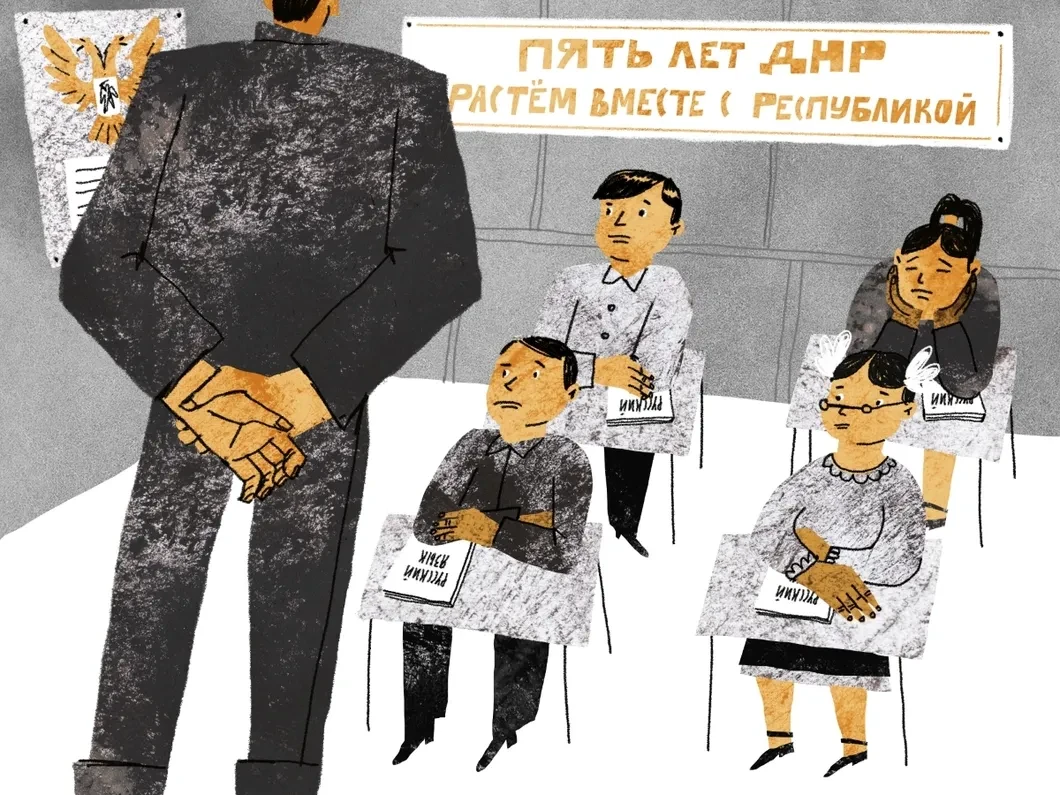
In the self -proclaimed and unrecognized republics of Donbass this year, about two hundred thousand children went to schools and the first lesson in all classes will be one - about patriotism. In Donetsk, for example, it will be a lesson: “Five years of the DPR - we grow together with the republic!” In Lugansk, on September 2, in all educational institutions, a single lesson will be held “The feat of the people to live for centuries!”.
My Donetsk comrade, who in 2014, had only 3 years to my daughter, recently told me a story about the effectiveness of the local patriotic education in schools.
“My daughter, I remember, finished the first class and somehow came up to me and asks: dad, but there were historical times when Donetsk was not the capital?!”
In the capitals and other cities of two unrecognized republics, over the years, a system built according to Russian standards and with Russian textbooks has been created, a system of education-without Ukrainian classes and schools, with a five-point system instead of Ukrainian twelve-balular additives in the form of citizenship lessons of Donbass, the initial military training and allomage history of the Fatherland.
As a result, the best graduates of local schools have the opportunity to travel to Rostov-on-Don to pass the USE along with Russian applicants and subsequent admission to universities in Russia as part of special quotas for Donbass.
In order to enter Ukrainian universities, local children have to make special efforts - to study in parallel with LDNR schools remotely in Ukrainian, pull up Ukrainian language and Ukrainian history with tutors, to go through checkpoints to Ukraine controlled by Ukraine ( external independent assessment - Ukr. ) And still with entrance benefits, but still with entrance. exams, enter "in Ukraine."
How it was
In the constitutions of the self -proclaimed republics, the Ukrainian language is called the second state language, but it does not exist on it, and all Ukrainian schools and classes have been translated into Russian for the years. The transition period stretched from 2014 to 2016.
“At the end of 2014, our programs were still and in 2015 continued with all textbooks and programs,” Tatyana Pavlovna, now a former younger school teacher of one of the schools of Donetsk with the Ukrainian language of teaching, tells us. - The only thing that “nature” and “I and Ukraine” was removed from the subjects, they said to replace (in topics) Ukraine with Donbass in magazines. It turned out Beliberda complete! The textbooks are the same, but the plans and magazines did not have the word "Ukraine". This concerned the subjects “Natural Science”, “History of Ukraine”, “Geography of Ukraine” and “I and Ukraine”.
We were told that if it is impossible to replace Donetsk, Donbass some topic about Ukraine, then you need to change it any other about your native land.
Since September 2015, Russian textbooks began to be imported, it was already after me. ”
NOTE
Tatyana Pavlovna taught her class to release and quit from her school, left home, but regularly happens in her native Donetsk and urgently asked the “spectrum” to change the name and voice in an interview. All the current teachers interviewed by the “spectrum” in Donetsk also urged to not indicate their names and installation data for security reasons.
In September 2015, as a spectra correspondent, a source in the Ministry of Education of an Unrecognized DPR told at the same time, 1,500 tons of Russian textbooks were brought in two white humanitarian convoys to Donetsk. Another training mode has begun. In the academic year 2015-16, Ukrainian classes and schools were still preserved in the self -proclaimed republic, but in the summer of 2016, the Minister of Education of the DPR Elena Polyakova announced that there were no more people left to study the Ukrainian language in the republic, and all such classes were closed.
The transition period was completed, and study began according to Russian training standards with some local features.
For example, the Ukrainian language remained in the program - once a week. In elementary school, for example, this lesson is divided in half - the first twenty minutes are devoted directly to the language, while the second part of the lesson is “Ukrainian literary reading”.
One of the teachers of the Leninsky district of the city of Donetsk admitted to the “spectrum” that now everything reminds her of 1984, when she came to work in her school - in the middle classes the same amount of Russian as under the Soviet Union - 6-7 hours of language and literature per week.
Teachers of the Ukrainian language and literature were partially reduced by age pensions, but most of the young teachers underwent a annual retraining at the Donetsk Republican Institute of Additional Pedagogical Education. “They invited everyone to retire into Russian - both physicists and lyrics,” said the “spectrum”.
The Russian teacher, a philologist from one of the schools of the Kyiv district, Donetsk, said that the current situation is inconvenient for teachers of the Russian language.
“You see, many young people have retrained into Russian, old teachers who have a second specialty in Soviet diplomas after“ Ukrainian ”,“ Russian language ”also has the situation and the situation was obtained when there are not enough educational hours for everyone, and we don’t even have a chance to go to Ukraine - there is no chance on the other side of the Russian language hours!” - said Elena Petrovna.
Elena Petrovna is not quite right - as the “spectrum” found out, 60 kilometers from Donetsk in the Volnovakha schools, in the territory controlled by Ukraine, the Russian language is taught, although it is not enough - 1 hour in elementary grades, and 2 per week - in senior. Russian literature is taught in the framework of the course “foreign literature”, Pushkin’s poems, as well as Kipling, can be taught in Ukrainian translated, you can also choose from the “original language”. A certain number of Russian philologists also retrained.

What does training look like now?
“2015 was the most turning point, I finished conducting the fourth grade, and my parents already took information who would move into Russian, we had the task of interviewing everyone so that everyone would go to Russian,” says Elena Vladimirovna, a junior school teacher of one of the Donetsk areas. - 2015 we finished in Ukrainian, and then there was simply no choice, they simply said: “Everyone is studying in Russian!” And in the same year Russian textbooks came, and we are now working under the program "School of Russia". The only thing that was adjusted was where the nature of Russia is going on, we now have the nature of Donbass. Our language is now once a week, and the Russian language every day is five times a week. ”
“As the obligatory introduced a lesson, which is now called“ a lesson in the citizenship and spirituality of Donbass, ”it goes once a week and is mainly aimed at patriotism.
He is not just the most important, but the most serious attention to him, he was taken from us at all and now the director reads him, ”Elena Vladimirovna explains teaching the basics of patriotic education in the DPR. - There is no talk that “we are Russia, and Putin is our president” on it, mainly the emphasis on the Donetsk Republic and on its capital - Donetsk. And the anthem of the DPR told us that all of it from the first class should know by heart and in each class there is a poster - the coat of arms, anthem and the DPR flag. Well, outside the lessons, each student knows how to properly cover his head with his hands in case of shelling, where to hide, how and where to go - it is also. ”
On social networks, you can sometimes find the tablets of their children - successful students from the DPR posted there with proud parents. They look quite exotic for the inhabitants of the part of the Donbass and immigrants controlled by Ukraine. Firstly, there are unusual “five”, and secondly, these estimates are for knowledge, including in subjects such as “Initial military and medical preparation”, “Lessons of citizenship of the Donbass”, and the Ukrainian language is combined into one subject with literature. But the fact that the inhabitants of Donetsk lay out these tablets, not assuming aggression by former neighbors with pro -Ukrainian views, indicates how much they already got rid of the surrounding reality.
We talked with the mother of a high school student of one of the schools of the Proletarsky district of Donetsk. “There are extracurricular loads, of course,” Julia shared with the “spectrum”. - We have a class teacher, for example, threatened to reduce the assessment of his son for a non -civic defense lesson, I had to go to school in our dad for a conversation. He studies well with us, protects the honor of the school and does not move, for example, from visiting rallies. By the way, you can not go to rallies if parents write a statement about their disagreement - and we wanted to write, still any clusters of people during the war are pose potential danger. But ours himself went, showed solidarity with the class. "
Mass events, holidays, concerts of visiting Russian pop stars and ubiquitous symbols and political advertising of the republic in Donetsk at every step. Most commercial advertising are very few and most of the advertising sites are occupied by a long -not removed patriotic campaign - congratulations on Victory Day can be adjacent to the already faded quotes signed by the head of the republic, Alexander Zakharchenko, separate ministries are leading their agitation campaigns and now everyone is scored by portraits of five -year -old children who were “born together with the DPR”.
In schools, the detachments of the "young people" did not create, Zakharchenko himself rejected these ideas during his lifetime. And two years ago, at the Ilovaysk school on the school board “Monitoring participation in school events” we saw such the name of the elementary class units as “shaken”, “knowledge”, “sun” and only “young patriots”.
Now, in August 2019, the main public movement registered here - the Donetsk Republic - was held by the “Young Guard” rally for its young reserve. In the absence of summer news, the rally caused a large information scandal - one of the teams rented an inventory from sex shop (they are in the republic) and presented a scene with girls dressed mainly in leather armor and guys with large inscriptions of the “slave” on their chests. At the same time, the advanced youth of the DPR immediately posted photos on the social network, causing a cheerful storm in the Ukrainian media.
Meanwhile, the rally in Zuevka was indicative. The declared half -thousand young participants lived in tents, and
The rite of initiation included the game with the delivery of the letter “Stalin”, which was interfered with “Beria”, the messengers were threatened with tortures and interrogations, and the newcomers at the end were waiting for “execution” with water.
But the teams of cities were called completely apolitically - “pirates”, “Amazons”, “hooligans” ... And only Dokuchaevsk put the Pioneers team relatively suitable under the brand of the “Young Guard”. At a rally called “Young Guard” there were elections of the local leader and his position, by the way, was called not “Commissar” or “People's Commissar”, but in the American manner - “Mr.”.
The own ideology of the republics has not yet been built.
Choose your school
“Choose yourself a school from the list, register, you need to come only once a year for exams!” - The radio receiver of my car catches near Volnovakha Ukrainian social advertising video "For schoolchildren from occupied territories."
The video is short and as simple as possible - any student of the schools of Donetsk or Lugansk can choose a school for distance learning on the website of the Ministry of Education of Ukraine to taste, only one of the parents need to be credited to absenteeism, and you need to come to “your” school only once a year - for exams.

The current advertising campaign is the continuation of one large, stretched over the years of struggle - for the children of Donbass. This struggle has its exacerbations - now there is a recruitment of children in schools, both in the LDNR and for distance learning in the territory controlled by Ukraine. In May, almost special operations were held here - children from high school with their parents were traveling from Donetsk and Lugansk to take Ukrainian state tests under the SNO program, and sometimes they were detained and not allowed further on the roadblocks of the DPR.
For example, on May 23, the then Deputy Head of the Donetsk Regional Military Civil Administration, Igor Stokoz, complained that 678 people were to take the Ukrainian language exam in the Ukrainian language, and children did not miss the children in the DPR and Gnutovo. Allegedly, the DPR special services were able to get a list of graduates of their schools, who registered in the Russian Federation, and prevented the entry of future students of Ukrainian universities on the key to admission.
According to Stokoz, then 430 people registered in mathematics, and 834 people gathered in total for the surrender of the SNS controlled by the Ukrainian authorities only in the Donetsk region. About 900 people in the Donetsk region were remotely studied in the 2018-19 academic year. Luhanskaya Vitsa and other authorized regions of Ukraine were carried out by the ZNO exams.
According to the Ministry of Education of the DPR, in 2019, 8120 students of 11 classes were released from schools of the self -proclaimed republic.
Ukraine is waiting for about two thousand applicants from Crimea and Donbass to its universities. The specially created educational centers of Crimea-Ukraine and Donbass-Ukraine will work until September 27. Through these centers, residents of uncontrolled territories can act according to a special preferential program - without a SNO, Ukrainian passport and certificate.
This is a preferential program for preferential children and a special list of “preferential” universities - the basis of which is the displaced higher educational institutions from Donetsk, Lugansk, working in Kyiv of Tavriysk National University. The years of the Russian school in Donetsk and Lugansk led to the natural process - not all graduates of Donetsk are ready for serious exams in Ukrainian. For admission to the status humanitarian universities of Ukraine, they have to engage in separately.
“Look, today the percentage of children who go to Ukraine after grade 11 has decreased in our city,” Oksana tells me from one of the small mining cities on an unprecedented part of the Luhansk region, the mother of the University of Kiev-Mogilyansk Academy, which was already received. -Of the two graduation classes of our school-and this is 40 people-one or two travels. But in schools where traditionally parents are richer and more intelligentsia, this figure grows up to 5-6 people. You can now enter a solid university if parents pay tutors for two years. <...> In addition, it must be taken into account that in order to go to study in Ukraine you need to go through checkpoints at the age of 14 and receive a Ukrainian passport, now this is not available to everyone. ”

The nomination of schoolchildren towards Ukraine has its own history. In the hot months of 2014, they were in all directions - Russia, Ukraine, Belarus - very many families, in the Central Donetsk schools in relatively prosperous areas in classes there could be 12 children, and in the graduation class on the last call in 2015 could be on the line of 1-2 students. Over time, the situation has straightened out - now in Donetsk it is allowed to open the class only if there are 15 children, the norm established by the Ministry of Education is no more than 26.
Most of those who had such an opportunity have already left. Now, not thousands of people go from the self -proclaimed republics, but dozens of full families, they are going - they don’t run, the current departures have been suffered, prepared and thought out with the sight for the future - their own and their children.
Author: Dmitry Durnev.
According to Spektr.press. With the support of the media network.