
Translated material
"Project": Oppositionists were not allowed to elections to the Moscow City Duma after the terrified authorities
The conflict between the authorities and the opposition on the basis of elections to the Moscow City Duma began after spring surveys, according to which it turned out that pro -government candidates lose oppositions in many districts, including central ones. This was written by the independent publication "Project" with reference to three interlocutors close to the Moscow City Hall and the Kremlin.
According to the results of election polls, it turned out that pro -government candidates did not have sufficient support at least nine out of 45 Moscow election districts, including the entire city center. According to the "project", even the starting ratings of the head of the Krasnoselsky municipal district of Ilya Yashin and the lawyer of the Corruption Fund (FBK) Lyubov Sobol, who wanted to be elected to the Moscow City Duma from the Central Administrative District, allowed them to count on victory with a successful election campaign. This also concerned those districts where the "stars" of the opposition, like Yashin and Gudkov, did not resist the pro -government candidates. In this situation, even the proposals of the authorities did not help to support candidates in addition to members of the United Russia party.
The 43rd district (Arbat, Khamovniki, Presnensky) turned out to be problematic for the authorities, from which Sobol, the 44th (Zamoskvorechye, Tagansky, Tverskaya, Yakimanka), the 45th (Basmann, Krasnoselsky, Meshokanniki), where the pro-government candidate of Valery Kasamare was supposed to confront Yashin; 5th district (Filevsky Park, Khoroshevo-Mnevniki, part of Schukino), from which Dmitry Gudkov was running; 6th district (Golovinsky, Levoberezhnaya, Khovrino, part of Western Degunino), 8th (airport, Sokol, Voikovsky), an unregistered opposition candidate-director of the FBC Ivan Zhdanov; 9th (Begovoy, Savelovsky, Timiryazevsky, Khoroshevsky, part of Beskudnikovsky), Julia Galyamin; 23rd (Kuzminki, part of Lublin, part of Ryazan); 37th (academic, Gagarinsky, Lomonosovsky, part of Vernadsky Avenue), Elena Rusakova.
According to the “project”, it was the data of the quarters that laid on the table to the mayor of Moscow Sergei Sobyanin and the leadership of the presidential administration, who finally assured the authorities that the non -systemic opposition could not be allowed to the elections. For several years since the participation of Alexei Navalny in the elections of the Moscow Mayor, the city hall’s ideas about opposition candidates changed. If earlier it was believed that, voting for them, society simply “releases steam”, now the authorities began to fear that, having gone to the Moscow City Duma, they could become serious politicians and will claim places in the State Duma.
Nobody thought about the fact that the disabilities of the opposition will result in mass protests. According to one of the sources of the publication, initially the authorities did not want to refuse to register at once all the opposition candidates, making an exception for the least "dangerous" representatives like Sergei Mitrokhin , and having agreed with some opposition to cooperation.
It was planned, for example, that Yashin would be convinced to voluntarily refuse to participate in the elections, but the officials could not figure out what to offer him. And when checking the signatures, it turned out that the quality of Sable and Yashin’s signature sheets is much better than those whom the city hall was ready to allow, including Mitrokhin. After that, it was decided not to register any of the independent candidates, and “dead souls” were suddenly discovered among their signatures.
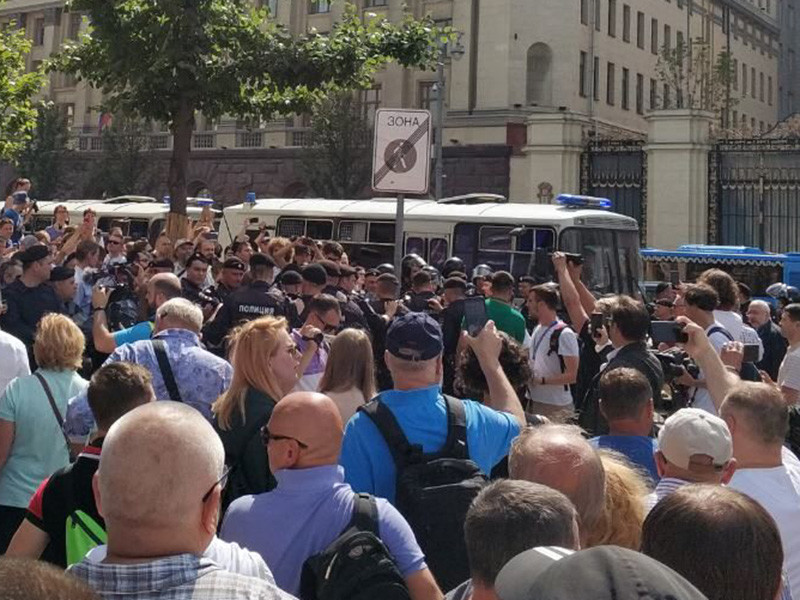
After the frank “liquidation” of opposition candidates caused indignation in Moscow and resulted in, in particular, into the action on July 27, Kremlin employees began to call the State Duma deputies, inviting them to make statements that should frighten the participants in street protests. However, many deputies did not go to this. It is attempts to intimidate the participants in mass protests that explains the initiative to increase fines for unauthorized rallies and detaining protests by 72 hours.
The arrests were much more effective for intimidation: the list of those who should be arrested was compiled after watching the live broadcast of the Rain television channel and the filming of the operatives, and changed depending on the political situation. After the scandal with directorDmitry Vasiliev , who ended up in the cell without the insulin diabetics he needed, the officials asked the security forces to stop his persecution. And after the rallies became less massive, and as the day of the vote approached the four defendants in the case of the "riots" released , and two more, including the student of the Higher School of Economics, Yegor Zhukov, was transferred under house arrest. At the same time, two defendants in the case of Ivan Podkopaev and Danil the fugitive were convicted of real terms , the same Zhukov was a new accusation of calls for extremism via the Internet. Many protest leaders, including Navalny, Yashin and Gudkov, left for a long administrative arrest.
At the peak of protesters in the city hall, they thought to organize a “patriotic rally”, Sobyanin was offered to speak on it, but, according to the source of the “project”, he categorically refused to do this, as well as photographed with candidates in the Moscow City Duma. Despite the elimination of all prominent oppositionists from the elections, the city hall is still not sure that the candidates supported by her will win. Closed polls show that pro -government candidates can lose to little -known people who, as part of the Smart Voting project, supports Navalny's team. So, few opposition representatives admitted to the elections can win in the 6th district (Children's Ombudsman Evgeny Bunimovich), the 8th, where the “project” calls Vadim Kumin from the Communist Party of the Communist Party, and the opposition is Daria Besedina; 37th and 43rd districts.